Massacre of Hazaras

Re: Massacre of Hazaras

^Sunnis are protesting against these monsters, and not just Sunnis, ahmadis/christians have protested along with Shia brothers in recent sit-ins... LEJ/SSP has not killed shias but they have killed sunnis/ahmadis and christians as well... hence, its high time every Pakistani should unite against these savages, as its not about shias, this is about humanity, future of Pakistan is at stake due to likes of Malik Ishaq and others.

govt is not incapable, they lack the will, as there are certain sections in political parties and security agencies who are in sympathy with these killers for their own gains.

Personally, I feel peaceful protests/sit-in should continue until the culprits are punished, just saying we have arrested bunch of suspects is not good enough...

Re: Massacre of Hazaras

It’s not just about Hazaras or Shias. All Pakistanis, irrespective of their personal beliefs and backgrounds, should stand united with Hazara brothers and sisters and demand an end to the growing intolerace and bigotry in the country.
**

“With every Hazara you kill, you are killing a piece of me too”](Blogs & Commentary | The Express Tribune)

It’s easy to be disheartened by the general state of affairs in Pakistan at present. We seem to have lost the capacity to choose dialogue over violence, to stand for what is right over joining the latest political circus (Tahirul Qadri et al), and to be a nation, if ever we were one.**

And now we’ve taken to something not-so-new, driving out all elements that are deemed non-Pakistani, or non-Muslim perhaps — there is little distinction between those terms of late.

The latest 80 plus Hazaras massacred, depicts what is swiftly becoming nothing short of genocide. To what end, I ask?

What kind of a Pakistan are we heading towards?

**A nation isn’t defined by the land that it inhabits; it is defined by its people. Their identities are forged by every citizen.
**
**I am a Pakistani, and while the perpetual identity crisis is a given, there are some things that are absolutely certain.

I am Punjabi, Sindhi, Balochi and Pathan.

I am Sunni, Shia, Christian, Ahmedi, Parsi, Hindu, and a myriad of other sects and religions.

I can’t be Pakistani without the diversity that each faction of society brings. And when any one of these elements is mercilessly attacked, every incident, quite literally, brings us closer to ripping this identity apart.
**
This isn’t just about saving the persecuted; this is about preserving who we are, because it’s them today and it could very well be you tomorrow, in what seems to be an endless quest towards a mono-religious, mono-sectarian, gender-skewed ideology.

The point, however, is how we might rebuild the strong socio-moral fabric we seem to have lost. The way I see it, this isn’t about economic disparity; it’s not about corrupt political leaders. This is about showing that we, as a nation, as one community, will not allow for our identities to be tarnished.

Yes, we can have a long march for a cause that supersedes any political agenda, or peaceful protests that might force the government to give the wound some temporary relief; we may even condone the use of force to protect citizens who are wrongfully targeted, but our efforts have to go much deeper than window washing if we are to salvage the mess, so to speak.

I don’t have an exact framework or model for how this might be accomplished. It’s an arduous task at the very least, but as a Communications major, I’d like to suggest that we start with dialogue and understanding.

**The western world has inter-faith councils, and it may serve us well to emulate them for our own benefit. We need places where we can acknowledge that Pakistan is a country that is religiously diverse, and can begin to appreciate the complexity that brings; places where minorities and other religions aren’t portrayed as second class citizens; places where we can sit next to each other and disagree without aiming for the throat; places where we say, it’s important for each one of us to be at this table, for Pakistan would not be the same without any of us.
**
Whether these conversations happen in the media, on the streets, in homes, community gatherings, academic institutions or at the highest echelons in a multi-stakeholder setting, we must find a way to bring disagreements from bloodshed to words; the fate and future of our identities hangs in the balance.

While the simplicity of this idea might seem foolish, and the power of conversations negligible, remember that religions began with words and conversations, nations were born from words and conversations, and perhaps, the deepest of atrocities can be conquered with the same.

With every Hazara you kill, you are killing a piece of me too – The Express Tribune Blog

Re: Massacre of Hazaras

These sick religious extremists are not even 1% in total population, puri population mil ke ek ek thapad bhi maren tou ye wese hi mar jaen ge!! We just need be unite more against this shetani fitna parst.

Re: Massacre of Hazaras

I was actually commenting abut the protest at Bilawal house. Neither zardari/govt did the massacre nor they have capability of stopping it.
"Protesters" very well know who did it or who is supposed to provide security, so why not protest in front of their headquarters. And i dont believe that govt has will issue, its just that they are not the right authority who is in control. They should in fact demand for change instead of protest in front of the govt. there is a huge difference between protest and demand. Govt always goes with the public demand to justify their actions, they need people behind them. So demand for the change and back the person who promises it.

Re: Massacre of Hazaras

Buried, I hope this is the last catastrophe to affect the Hazaras.

All Quetta victims buried | Pakistan | DAWN.COM

Re: Massacre of Hazaras

if the govt had any shame left, they wouldve stepped down, they have no right to be in govt, when they cant protect their own citizens. however, obviously, we know it this wont happen, especially when elections are just weeks away. and I agree with the part they should protests in front of the headquarters, and CM house in Punjab.

Hazara community clearly said they were not taken into confidence when the annoucement for calling off protests was made, they clearly said they wanted to continue with the protest until their demands are met ....they know govt is just making empty promises, no serious measures will be taken..its a pretty known fact that where these extremists are coming from, but nobody in the govt has the guts to say it aloud, due to their petty political gains...

can someone ask Punjab Govt what they have done in regards to this? Did someone ask SS what was he thinking when he align with LEJ just to secure his place in few regions in Punjab? or these people are above the law??

Re: Massacre of Hazaras

heart wrenching scenes during the mass burial.. women were screaming, laying in the graves, saying bury us alive first, we wont bury our loved ones… zulm ki inteha…

Re: Massacre of Hazaras

The dead can make things happen – The Express Tribune

The dead can make things happen

The writer is a journalist and works for Express News

Do not underestimate the power of the few to overwhelm the many; nor the ability of the weak to shake the strong. This is the clear message that comes out of the protests the Hazara community has made with tremendous effect. By keeping their dead out of the graves and on public display for days, the second episode of the Hazaras’ outpouring of anger has created a model of articulating demands that is likely to change the face of public protests in Pakistan for years to come. While extremely troubling and deeply distressing, the sight of dozens of coffins lined up under rain and surrounded by the mourning families, with infants and children of all ages, is an arrangement that the other weak of this country can take up as their most potent weapon against a repressive and unresponsive system.

By any estimate, this is not the first time dead bodies have been used as a way to highlight grievances. In a span of a week or 10 days, you do get to read a couple of news items of families carrying the remains of their loved ones onto roads, blocking traffic, demanding justice. Around the same time as the Quetta protests were taking place, relatives of two brothers, killed in what looked like an overzealous and off-target raid against al Qaeda sympathisers in Rawalpindi, resorted to this time-tested method to draw attention towards their plight. Two days ago, a young person got killed at the hands of land-grabbers in Islamabad and his dead body, too, was placed in the middle of a busy road for hours. Earlier, victims of a particular operation in the Fata region had done the same thing in Peshawar.

However, the Hazara community’s move has been supremely methodic and infused with a spirit of total defiance. More than that, the large number of the dead provoked the families to come out in totality, leaving no breathing soul behind in the comfort of their homes. The chants and the slogans around the coffins and the meticulous organisation in the mourning crowd (the hardest to handle because of extreme emotional stress and deep trauma) has created a model of protest that is most spectacular, even if macabre and soul-destroying to view. This community has finally created the key for ordinary people to get an audience with the state of Pakistan — by making the dead their emissaries.

And they have been very successful in making this key work. Two protests of this nature have already made a dysfunctional government go out of power and forced the sleeping giant, the country’s security establishment, to wake up to the need to take real action against those who kill in the name of sects. This is no mean achievement. For years, the killing of this community remained a non-issue for the federal government. While the missing persons’ case got maximum publicity, the killing of Hazaras and, of course, those of the settlers in Balochistan, could never fetch any attention. Former chief minister, Nawab Aslam Raisani, in fact, used to crack strange jokes about the extreme vulnerability that this community felt in his area of jurisdiction. The media remained quiet. The army and the intelligence agencies went about their work as if nothing of supreme urgency was happening under their nose. This continued even when the killings bore undeniable marks of racial and sectarian motives and took the form of an open declaration that all those who looked like Hazaras and acted in faith like Shias would be wiped out of Balochistan.

From that abominable apathy to the present-day alacrity in which the chief of army staff was seen huddled with the president and prime minister, vowing to carry out a “targeted operation against terrorists”, there has been a sea-change in the reaction that the Hazara community’s demands have got from the same set of political and military elite that ignored them for years. Clearly, the potency of the protest has been because of its nation-wide nature. Not just Quetta, but practically all big cities of the country had been shut down on account of coordinated strikes by different Shia organisations. This protest got great strength because of thousands of others who came out to express their anger, not because of ideological affinity with the Hazaras, but because of the sense that a grave tragedy had fallen upon a hapless section of the population. Obviously, not every other group would be able to paralyse the country like these protests have. Not every wronged section would have enough courage to delay the religiously-mandated and medically-recommended burial for days. But there will be copy-cat protests for sure, especially since the weak and the vulnerable across the country are being consistently put in the grinding machine of terror, injustice and hopelessness. The Hazaras, through their protests, have proven to the millions in Pakistan that here, in this land of the pure, the living do not matter but the dead can be deft negotiators. They can make things happen.

Published in The Express Tribune, February 21st, 2013.

Re: Massacre of Hazaras

^ how many innocent lives couldve been saved had they taken this grave issue seriously, had they not ignored Hazara community pleas, these tragedies couldve been prevented. Pakistan has come to this that now families of victims have to sit under open sky, in chilly weather, with their loved ones dead bodies for days and ask for justice!!

Re: Massacre of Hazaras

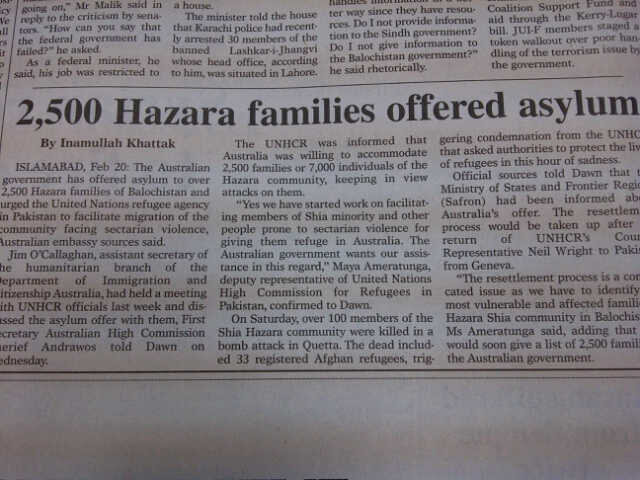
Australia offers asylum to 2500 hazara families. If implemented at least 2500 families would be safe.

http://t.co/8UFDNf2dL9

Re: Massacre of Hazaras

^^ Jinnah would be crying in his grave. In a country created for the safety of muslims, muslims are migrating to a "christian" country for safety.

What the turn of events, who would have thought this in 47.

Re: Massacre of Hazaras

^If Jinnah sahab still reads the newspaper then the previous episode would have hurt him a lot more, one where Hindu families from Sindh applied for Asylum in India.

Re: Massacre of Hazaras

Hazaras are the most educated among people in Balouchistan, I am sure they have a good future in a "Kafir" country!

Re: Massacre of Hazaras

Educated and pro Pakistan. There are very few pro Pakistani people in Balochistan, its a pity we cannot protect them.

Re: Massacre of Hazaras

Hazara killers

In the aftermath of the Quetta massacre, the arrests of a few Lashkar-e-Jhangvi (LeJ) militants have been looked upon warily as nothing more than a ploy to placate an angry nation.

If there was sincerity and strategic considerations behind this move, however, the headquarters of the Sunni extremist group in Punjab would have been dismantled much earlier.

But with elections approaching, a full-fledged and whole-hearted operation against such militant groups seems highly unlikely, especially in the Punjab, the breeding ground of sectarian militants. This has much to do with the fact that in Punjab, extremist and militant groups have a strong electoral presence.

“I doubt that there will be a real crackdown,” says author and journalist, Zahid Hussain, talking to Dawn.com: “The Punjab government has been looking the other way for too long and pursues the policy of appeasement.” He added that it had even made a covert deal for the release of LeJ leader Malik Ishaq.

Seconding Hussain, defence analyst Hasan Askari Rizvi added: “The Punjab Government is known for patronising the LeJ and (its predecessor) Sipah-e-Sahaba Pakistan (SSP).”

But it’s not only the Punjab government complicit in the inaction against extremist sectarian outfits. The centre hasn’t appeared earnest about the issue either.

Hussain has serious reservations about Pakistan’s National Counter Terrorism Authority, for example. The authority was created in 2009 under an executive order. “It remains dormant and a toothless body because the bill has yet to be passed in the National Assembly. There is also the unresolved matter of whether it should fall under the umbrella of the interior ministry when in the original charter, it was to be under the prime minister,” he explains.

And so the scourge of extremism will continue, as was seen last week when terror revisited the Shia Hazaras on Kirani Road in the south-western Pakistani city Quetta. The attack was also a grim reminder that without a national consensus in Pakistan on how to deal with domestic terrorism, the next attack is not far behind.

The bomb that killed over 90 people and injured more than 160, many of them critically, was the second major attack on Pakistan’s minority Shia Hazaras this year. A twin-suicide attack at a snooker club on January 10 had killed 92 and wounded 121. With the Hazara community living huddled together in certain localities, they have become an even easier prey and large numbers can be annihilated in minutes.

Hazara Democratic Party (HDP) Chairperson Abdul Khaliq Hazara told Dawn.com that the terror and fear had reached such a crescendo that the Hazaras had stopped venturing out of their locales. “There is no place left in Quetta that remains safe for Hazaras, be it an educational institution, school, bus stops, government offices or a marketplace. Public space is increasingly shrinking for us,” he said.

Where the LeJ derives power from

The LeJ, which claimed responsibility for these attacks, is born out of SSP. It also has ties with the Tehrik-i-Taliban Pakistan (TTP). In fact, some of the top TTP leaders, like the current spokesperson, Ehsanullah Ehsan, were all members of LeJ in Punjab, before they became part of the TTP.

“These groups morph and gel and even support each other,” says Rizvi, who fears that “unless the government adopts a tough position and keeps up the pressure over an extended period of time” these attacks will continue.

Equally, if the government decides to pull the rug from under them, and has some successes to show to the people, it will gain legitimacy. “Nothing succeeds like success, and we saw that in Swat once the government decided to go all out; their efforts were lauded not criticized,” he points out.

The HDP chairperson agreed that “The state is more powerful than the militants. We believe the state knows who the culprits are and if it wants it can round up the militants, cleanse the city off them, even kill them, in just three days.” But, he adds, “They don’t want to.”

According to Rizvi, “Organisations like the LeJ, the SSP and the Ahle Sunnat Wal Jammat (ASWJ) are politically convenient, especially for all the Punjab-based political parties and even the present Punjab government – and they will not go beyond a certain point to enrage them.”

“So while they will condemn acts of sectarian attacks and militancy, they will never muster the courage to condemn a particular group,” he explains.

In addition, says Rizvi, these groups have embedded themselves in society by setting up schools, hospitals, mosques and other welfare organisations and created a strong support base, including those in the lower ranks of the police and the intelligence agencies.”

“There is no place left in Quetta that remains safe for Hazaras, be it an educational institution, school, bus stops, government offices or a marketplace. Public space is increasingly shrinking for us.”

It is very easy for the LeJ, a predominantly Punjabi group to thrive in Balochistan, he further explains. “With a non-existent provincial government and the support of the Taliban, the place became a safe haven.”

The LeJ made inroads in Balochistan and had steadily spread its wings (since 2004-05), where the ethnic Hazara community has been their main target. Talking to Dawn.com, senior journalist Rahimullah Yusufzai said: “Call it infiltration, or what you will, but the LeJ has succeeded in recruiting many Baloch, once considered quite secular.”

According to Hussain, the Baloch have “been indoctrinated into hating the Hazara community.”

Khaliq points out that the whereabouts of the militant camps was common knowledge. According to reliable sources, the training camps are run in Mastung and Khuzdar, from where earlier attacks on Shia pilgrims going to Iran have taken place. Those who are apprehended, meanwhile, are released for want of enough evidence – and if the evidence is there, it’s not produced in the courts.

The desire to eliminate Shias altogether is also constantly fed from the outside. “A proxy war between Iran and Saudi Arabia is being waged in Balochistan.” says Khaliq. It is widely held that these anti-Shia militants receive funding from the Sunni-Wahabi sheikhdoms of the Arab world. The Shias, on the other hand are perceived to be supporting Iran.

Hussain, meanwhile, expresses surprise over the mushrooming of madressas in Balochistan, which lacks “even the most basic facilities for locals”. The senior journalist adds that it’s common knowledge such ‘nurseries’ of extremism were being financed by Sunni-Wahabi leaning Middle Eastern countries.

So where do the agencies come in?

Some experts are also of the view that these assaults are carried out to deflect international attention from the ongoing separatist movement in Balochistan.

The HDP spokesperson insists that such acts of terrorism are carried out in collusion with the security and intelligence agencies.

Yusufzai, however, does not believe in this commonly held viewpoint. “These agencies would never allow their own country to get destabilised and they would never want to eliminate the Shia community. After all there are many Shias within these organisations too,” he points out.

According to Yusufzai, the intelligence agencies’ ‘incompetence’ can be attributed to “overwork”.

“Their hands are full with the ongoing separatist movement in one province, and the attacks by the TTP in others – and then these other militants fanning sectarianism. And if that were not all; these agencies are also being used for political purposes!” says Yusufzai.

Hussain plays down the involvement of the agencies, but adds, “They have the knowledge of who the culprits are but they are not focused on fighting these groups. So while they may not be in direct collusion; by their inaction they are helping these extremists gets stronger.”
Re: Massacre of Hazaras

1500 Hazaras killed in 13 years, not a single challan filed?

Quetta hearing: Malik asked to relay information to security agencies – The Express Tribune

Re: Massacre of Hazaras

PathanBhai,

            The United States has designated Lashkar e jhangvi as a terrorist organization almost a decade ago. This designation consequently freezes any U.S. assets the group might have, makes it illegal for anyone under U.S. jurisdiction to donate, or provide, material support for the group, and it also denies U.S. visas to its representatives. If fail to understand what “relations” you are referring to. With all due respect to Sheikh Waqas Akram, since we have not heard what exactly “he has said on T.V, we cannot address his statements directly”.  If you can give us specifics of what he has accused the United States of, maybe we can answer better. If the allegations are that we have some ulterior motives in Pakistan, or that there are “relations between LeJ and the U.S. embassy, then we would like to inform anyone who believes such conspiracy theories, that it is a complete lie and a baseless accusation. Blaming every ill under the sun on the United States is not going to help anyone and least of all it will not help in eradicating militants and terrorists that are killing innocent civilians on the basis of sectarian differences.  We continue to help and support that Pakistani nation in tackling the issue of terrorist groups on its soil.

Ali Khan
DET – U.S. Central Command
www.centcom.mil/ur

Re: Massacre of Hazaras

Capital talk (18th February 2013) - YouTube

Any plans on designating the family of Saud -the biggest sponsors of terrorism on earth- on your list?

Re: Massacre of Hazaras

Mubashir Luqman did a detailed program on Saudi Funding in exporting terrorism in Pakistan, he shares cables and few recent articles stating that how Saudi is playing proxy war in Balochistan.

Re: Massacre of Hazaras

Punjab govt may not act against LeJ PML-N has seat adjustments with defunct SSP - thenews.com.pk

Punjab govt may not act against LeJ PML-N has seat adjustments with defunct SSP - thenews.com.pk

ISLAMABAD: While the federal government wants the Punjab government to launch a massive crackdown on the Lashkar-e-Jhangvi (LJ) and defunct Sipah-e-Sahaba Pakistan (SSP), Chief Minister Shahbaz Sharif is unlikely to oblige. The main reason is a seat-to-seat adjustment deal between the PML-N and Ahle Sunnat Wal Jamaat (ASWJ) for the upcoming elections.

Well-informed circles in the ASWJ (previously the SSP) confirmed that following extensive discussions, the two parties had agreed to have seat adjustments in the general election on at least 15 seats of the National Assembly from South Punjab where they would not field candidates against each other.

Two former key leaders of SSP, Maulana Mohammad Ahmed Ludhianvi and Malik Mohammad Ishaq, who are currently the president and vice president of the ASWJ respectively, are all set to run for two National Assembly seats from the South Punjab in the coming polls, with the support of the PML-N.

After being banned by the Musharraf regime as a terrorist group in 2002, the SSP was renamed as the ASWJ and it will be using the same platform to contest the election. Malik Ishaq, who has been commanding the Lashkar-e-Jhangvi since his July 14, 2011 release from a Lahore jail, was made vice president of the ASWJ on September 18, 2012 by Maulana Ludhianvi.

He was formally inducted into the ASWJ hardly a few days after Interior Minister Rehman Malik had written a letter to the chief secretary Punjab, asking him to arrest Ishaq for allegedly sponsoring sectarian terrorism. The letter was never responded to.

On the other hand, in September 2012 Ludhianvi said: “I deserve praise for making Ishaq throw away his weapons. Now the Interior Ministry should talk to a deweaponized Ishaq”. However, the federal government believes sectarian terrorism has multiplied, especially in Quetta against the Shia Hazaras, following the release of Ishaq.

Rehman Malik has only recently blamed the Punjab government for harbouring the Lashkar and Sipah, adding that it must take stern action against them to nip the evil of terrorism in the bud.

Giving a speech in the Senate on February 20, he said if the Punjab government won’t take action against these groups, he would himself raid their hideouts. “The central headquarters of these groups are in the Punjab, while their sub-headquarters are in Karachi”.

About the February 16 suicide hit in Quetta, he said, “Liquid explosives were used for the first time with the composition of diesel and potassium chloride. The tanker bomb was assembled in Lahore by Lashkar-e-Jhangvi and transported to Quetta”.

But informed circles in the ASWJ believe the PML-N government in the Punjab would not risk jeopardising its recently concluded pact on seat adjustments by acting against the ASWJ leaders in a big way.

The ASWJ is an active component of Difa-e-Pakistan Council (DPC), which is packed with the establishment’s favourites who dabble in extremist rhetoric. These circles added that the PML-N’s latest strategy of confronting the PPP in South Punjab is hinged on its understanding with the ASWJ. They conceded that the PML-N and ASWJ had reached a consensus on seat adjustments in the Punjab and National Assembly for the upcoming elections.

The understanding was reached after hectic parleys between Maulana Ludhianvi and the Punjab Law Minister Rana Sanaullah Khan. The ASWJ has a strong Sunni Deobandi vote bank in many constituencies of South Punjab and the PML-N obviously wants to take advantage of that in the coming general election.

According to the ASWJ insiders, the PML-N has agreed to support their candidates on four National Assembly seats from South Punjab. In return, the ASWJ will not field its candidates against the PML-N in 12 constituencies.

The five Punjab districts where the two parties will support each other’s candidates include Jhang, Faisalabad, Bahawalnagar, Rahim Yar Khan and Layyah. The ASWJ sources did not rule out the possibility of Malik Ishaq and Maulana Ludhianvi contesting the next general elections on two of the four National Assembly seats from South Punjab where the PML-N will support them.

To a question, the ASWJ sources said if Malik Ishaq was not allowed to contest the polls due to the pending cases against him, his son Malik Mohammad Usman will be their most likely candidate from NA-177 Muzaffargarh.

Ludhianvi is most likely to contest from NA-89 Jhang, which was previously won by Sheikh Waqas Akram of the PML-Q, who is all set to join the PPP to run for the same seat. To recall, the PML-N and ASWJ had jointly contested a by-election on a Punjab Assembly seat for Jhang in March 2010.

Punjab Law Minister Rana Sanaullah chose to campaign for the PML-N candidate in PP-82 [on February 20, 2010] along with Ludhianvi, which was bitterly criticised by the then Governor Punjab Salman Taseer. The election was eventually won by Azam Chaila of PML-N with SSP’s crucial support.

Approached for comments, central secretary general of ASWJ Khadim Hussain Dhiloon said his party was open to talks with all the political and religious parties in connection with the upcoming polls.

Even during the 2008 elections, he said, almost all the major political parties including the PPP, PML-N, ANP, PML-Q and the JUI had sought the ASWJ’s support in the four provinces of the country and subsequently won their seats.

Dhiloon said Maulana Ludhianvi was already on record having produced to the media [in 2012] a list of 25 PPP leaders who won their seats in the 2008 polls because of the ASWJ’s support. Therefore, he said, the PPP had no moral justification to criticise the other parties if they want an election understanding with the ASWJ”.

Approached for comments, Siddiqueul Farooque, a central executive committee member of the PML-N, expressed ignorance about a seat adjustment agreement between his party and ASWJ. However, he claimed that many key leaders of the PPP had won the 2008 general elections with the support of the SSP, including Shah Mahmood Qureshi, Syed Khurshid Shah, Qamaruz Zaman Kaira, Jamshed Dasti and several others.

“It is totally moral and principled for the PPP to seek the support of these groups when they need their votes. But if any other party even thinks of getting their electoral support, it is lambasted by the PPP and declared pro-fascists”.

He then raised a few queries about the status of the “so-called” banned organisations, saying: “I want to know if allegations against these groups have already been established in any court; have these groups already been declared terrorist outfits by any court; has the Election Commission of Pakistan barred the leaders of these groups from casting their votes in the coming elections; have these leaders not been set free from jails?” The PML-N leader concluded: “If the government still believes all these groups are involved in terrorism and anti-state activities, it should approach the Supreme Court to get them banned”.