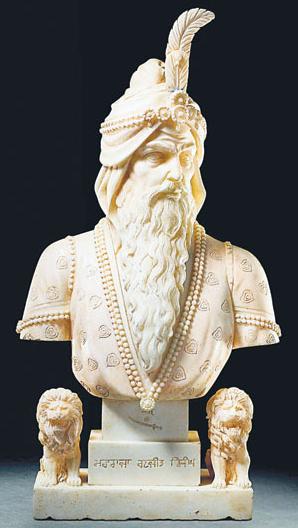
Great topic choice Mr Anwer Pasha. Indeed Ranjeet Singh was a very lucky figure in Indain History. He was a great war leader and shrewd Politician I was intending to open a thread about the Anglo Sikh Wars and about the Sikh Empire under Ranjeet Singh and how it fell apart.
My Ancestors were engaged in brutal Wars against the Sikh Empires expansion but in the end the Sikhs were still much better than the British and the History of the Empire is very tragic indeed, in it’s short period the Sikh Empire was perhaps among the bloodiest in Indian History but Ranjeet Singh was the real power that kept it together… and after his passing the end was inevitable.
Yes, You are right . It was actually beginning of ‘Takht e Lahore’.اسی قیدی تخت لاہور دے
But I came in this forumا to avoid political discussion.
I was reading history from child hood but Pakistani historian avoid this topic.
You are welcome here to take part .
Good question and really it’s own to the OP to answer it…
But I guess aside to the Political and Religious aspects one can also learn and discuss about the actuall life lessons from this period of History in the Sub-Continent. Ranjeet Singh was among the most shrewd and cunning fellows of that time and he did well to carve out his Empire however in the end I guess this topic has many points.
The Sikh Empire is not merely a high time for Sikhs in the Sub-Continent it is also a high water-mark for the British East India Company… and was a crucial turning point in Modern Subcontinental History, many of the issues that affected people in Ranjeet Singhs time still lie unadressed in todays period.
Ranjit Singh belonged to a Sikh clan of Northern India. He was born in Gujranwala, now in modern Pakistan, according to some historians, into a Jatt Sikh family and others believe that he was born intoa Sansi Sikh family who were Sukerchakia Misldars. As a child he suffered from smallpox which resulted in the loss of one eye. At the time, much of Punjab was ruled by the Sikhs under a Confederate Sarbat Khalsa system, who had divided the territory among factions known as Misls. Ranjit Singh’s father Maha Singh was the Commander of the Sukerchakia Misl and controlled a territory in the west Punjab based around his headquarters at Gujranwala. After his father’s death he was raised under the protection of Sada Kaur of the Kanheya Misl. Ranjit Singh succeeded his father at the age of 18. After several campaigns, he conquered the other Misls and created the Sikh Empire.
The Maharaja
Ranjit Singh was crowned on 12 April 1801 (to coincide with Baisakhi). Sahib Singh Bedi, a descendant of Guru Nanak Dev, conducted the coronation. Gujranwala served as his capital from 1799. In 1802 he shifted his capital to Lahore. Ranjit Singh rose to power in a very short period, from a leader of a single Sikh misl to finally becoming the Maharaja (Emperor) of Punjab.
He then spent the following years fighting the Afghans, driving them out of the Punjab. He also captured Pashtun territory including Peshawar (now referred to as North West Frontier Province and the Tribal Areas). This was the first time that Peshawari Pashtuns were ruled by Punjabis. He captured the province of Multan which encompassed the southern parts of Punjab, Peshawar (1818), Jammu and Kashmir (1819). Thus Ranjit Singh put an end to more than a thousand years of Muslim rule. He also conquered the hill states north of Anandpur Sahib, the largest of which was Kangra.
When the Foreign Minister of the Ranjit Singh’s court , Fakir Azizuddin, met the British Governor-General of India, Lord Auckland, in Simla, Lord Auckland asked Fakir Azizuddin which of the Maharaja’s eyes was missing, Azizuddin replied: “The Maharaja is like the sun and sun has only one eye. The splendour and luminosity of his single eye is so much that I have never dared to look at his other eye.” The Governor General was so pleased with this reply that he gave his gold watch to Azizuddin.
There was strong collaboration in defense against foreign incursions such as those initiated by Ahmed Shah Abdali and Nadir Shah. The city of Amritsar was attacked numerous times. Yet the time is remembered by Sikh historians as the “Heroic Century”. This is mainly to describe the rise of Sikhs to political power against large odds. The circumstances were the hostile religious environment against Sikhs with a tiny Sikh population compared to other religious and political groups.
Ranjit Singh’s Empire was secular, none of the subjects were discriminated against on account of their religions.The Maharaja never forced Sikhism on his subjects.
Secular Rule
The Kingdom of the Sikhs was most exceptional in that it allowed men from religions other than their own to rise to commanding positions of authority. Besides the Singh (Sikh), the Khan (Muslim) and the Misr (Hindu Brahmin) feature as prominent administrators. The Christians formed a part of the militia of the Sikhs. In 1831, Ranjit Singh deputed his mission to Simla to confer with the British Governor General, Lord William Bentinck. Sardar Hari Singh Nalwa, Fakir Aziz-ud-din and Diwan Moti Ram ― a Sikh, a Muslim and a Hindu representative ― were nominated at its head.
Externally, everyone in the Sikh kingdom looked alike; they supported a beard and covered their head, predominantly with a turban. This left visitors to the Punjab quite confused. Most foreigners arrived there after a passage through Hindustan, where religious and caste distinctions were very carefully observed. It was difficult for them to believe that though everyone in the Sarkar Khalsaji looked similar, they were not all Sikhs. The Sikhs were generally not known to force either those in their employ or the inhabitants of the country they ruled to convert to Sikhism. In fact, men of piety from all religions were equally respected by the Sikhs and their ruler. Hindu sadhus, yogis, saints and bairagis; Muslim faqirs and pirs; and Christian priests were all the recipients of Sikh largess. There was only one exception – the Sikhs viewed the Muslim clergy with suspicion.
The Generals of Maharaja Ranjit Singh
Ranjit Singh encircled himself with an array of strong generals and soldiers. They were men from different clans, castes and regions
These included:
Hari Singh Nalwa
Dewan Mokham Chand
Jassa Singh Ahluwalia and his son Fateh Singh Ahluwalia
Veer Singh Dillon later Jallaha of Gurdaspore
Sawan Mal
Sirdar Gulab Singh Pahuwindia
Sham Singh Attariwala
Sardar Sangat Singh Saini
Sher Singh
Shaikh Elahi Bakhsh
General Ghause Khan (Mian Ghausa)
Sultan Mahmud Khan (Son of Ghause Khan)
Zorawar Singh
Chattar Singh Attariwalla
Balbhadra Kunwar – Gorkhali General who served for Ranjit Singh after the Anglo-Gorkha war (1814–1816).
Mahan Singh Mirpuri
Misr Diwan Chand
Among his European Mercenary Generals were:
Jean-François Allard
Jean-Baptiste Ventura – Italian (Modena)
Paolo Di Avitabile – Italian (Naples)
Claude August Court – French
Americans of note:
Josiah Harlan – American general and later governor of Gujrat
Alexander Gardner – American (Scotch – Irish)
Geography of the Sikh Empire
The Sikh Empire was also known as Punjab, the Sikh Raj, and Sarkar Khalsaji, was a region straddling the border into modern-day People’s Republic of China and Islamic Republic of Afghanistan then popularly referred to as the Kingdom of Cabul. The name of the region “Punjab” or “Panjab”, comprises two words “Punj/Panj” and “Ab”, translating to “five” and “water” in Persian. When put together this gives a name meaning “the land of the five rivers”, coined due to the five rivers that run through the Punjab. Those “Five Rivers” are Beas, Ravi, Sutlej, Chenab and Jhelum, all tributaries of the river Indus, home to the Indus Valley Civilization that perished 3000 years ago. Punjab has a long history and rich cultural heritage. The people of the Punjab are called Punjabis and they speak a language called Punjabi.
The following modern day political divisions made up the historical Sikh Empire:
Punjab region till Multan in south.
Punjab, India
Punjab, Pakistan
Haryana, India. Including Chandigarh.
Himachal Pradesh, India
Kashmir, conquered in 1818, India/Pakistan/China
Jammu, India
Gilgit, Northern Areas, Pakistan (Occupied from 1842–1846)
Khyber Pass, Afghanistan/Pakistan
Peshawar, Pakistan (taken in 1818, retaken in 1834)
North-West Frontier Province and FATA, Pakistan (documented from Hazara (taken in 1818–22)to Bannu)
Parts of Western Tibet (1841), China
Legacy
Maharaja Ranjit Singh died in 1839, after a reign of nearly forty years, leaving seven sons by different queens.
Maharaja Ranjit Singh is remembered for uniting the Punjab as a strong nation and his possession of the Koh-i-noor diamond. Ranjit Singh willed the Koh-i-noor to Jagannath Temple in Puri, Orissa while on his deathbed in 1839. His most lasting legacy was the golden beautification of the Harmandir Sahib, most revered Gurudwara of the Sikhs, with marble and gold, from which the popular name of the “Golden Temple” is derived.
He was also known as “Sher-e-Punjab” which means the “Lion of Punjab” and is considered one of the three lions of modern India, the most famous and revered heroes in Indian subcontinent’s history. The other lions are Rana Pratap Singh of Mewar and Chhatrapati Shivaji, the greatMaratha ruler. The title of “Sher-e-Punjab” is still widely used as a term of respect for a powerful man.
Captain William Murray’s memoirs on Maharaja Ranjit Singh’s character:
Ranjit Singh has been likened to Mehmet Ali and to Napoleon. There are some points in which he resembles both; but estimating his character with reference to his circumstances and positions, he is perhaps a more remarkable man than either. There was no ferocity in his disposition and he never punished a criminal with death even under circumstances of aggravated offence. Humanity indeed, or rather tenderness for life, was a trait in the character of Ranjit Singh. There is no instance of his having wantonly infused his hand in blood."
Many famous folk stories about Maharaja portray a leader and the inspiration Maharaja Ranjit Singh was. In one famous incident, when Maharaja was about to cross the badly flooded river near Attock (now in Pakistan and called Kabul River). One of Maharaja’s generals reported this fact to Maharaja, saying that the river cannot be crossed and it is now an Atak (an obstacle in Hindi) for us. Maharaja retorted “eh Attock uhna lai atak hai, jehna de dillan wich atak hai” or “This river Attock is an obstacle for those, who have obstacles in their hearts”, then crossed the river successfully. The army and other generals followed his lead.
Another famous folk story about the Maharaja is that he was accidentally hit by a stone thrown by a 5 year old boy, who actually wanted to hit a fruit tree to knock down some of its fruit. When he was brought before the Maharaja, Ranjit Singh gave him a gold coin. He said, “How can I punish him for hitting me with a stone, when this tree will give him fruit for the same?”
This is mostly a Wikipedia dump but there’s a lot of good info about MRS.
Not neccasarily avoid the Topic… more correctly theres a great confussion of this period in History and in some regards it’s very controversial and highly sensitive so wisely most Historians dont like to say things that could be counterproductive.
While certainly it’s dificuilt to avoid the facts of History sometimes History is brushed under the carpet when the powers that be do not or can not abide what the past has to tell us. In some respects Ranjeet Singhs wins and losses continue to haunt people to this day and the shadow of the Sikh Empire is stained with much blood.
Truth be told while there was a cultural breathing space, Historically speaking Ranjit Singhs time as ruler was merely a breakwater between events that were gradually tearing the Subcontinent apart.
I’m pretty sure things would have been very different had his subordinates and offspring inherited the same skill as Ranjit Singh. He was a very potent force while he was alive.
Yes to some extent I agree, however knowing the British and the other big powers at the time Ranjit Singh was always in a bit of a Rock and Hard place. His great Wisdom is often touted to Prophetic levels one example of his great powers was as follows.
In the year 1829 two British exploring officers visited the Durbar at Lahore and bought with them the latest Maps of the Regions from as far East as the SumnDabans in Bengal to the Westerly points of Ali Masjid in the Afghan/Indian Frontier and from the Nepal in the North to the Mysore in the South…
As Ranjit Singh scanned the Maps with his one good eye he asked the Officers what the large areas in Red represented, to which the Officers politely replied that the Red regions were all the possesions of the East India Company.
Ranjit Singh looked more closely and then commented with a mournfull tone to his fellows…
“Ik din Sab Lal Hojaye gah!” (One day the whole Map will be Red!)
Since that day Ranjit Singh made every effort to strengthen his own Army and improve the quality of the Khalsa troops and other irregular forces. Yet he crucially made several errors and chief among them was that he never selected an hier or even named anyone to the position…
One did not need to be a Prophet to see that things were moving fast and the end was in sight however despite that Ranjit Singh seems to have made no contingency plans and that I think was his big failing… though to be fair he did do a lot for his people and was a great administrator he too realised the game was up…
“Fransisee, Rusee, German ya Angraiz sub namak Haram ain” (French or Russian, German or English they were all traitors!) Where the Mahrajahs comments when he came to know of the double dealings and espionage played by his clique of European Officers which also included Italians and Portugese, Dutch and Spaniards even Colonel Gardner and Conora who were Americans.
Aye, his biggest failing was to nominate an official heir. But then it is speculated he knew none of his offspring or subordinates had the necessary grit for such a task. And the legacy he left behind suffered as most great ones do. Lost to infighting and corruption and greed. Oh well C’est la vie! And the East India Company profited from the Empire failing.
Well actually research shows that even during the reign of Ranjit Singh the British East India Company were doing thier best to undermine and even subvert Ranjit Singh… the Officers Ranjit hired were also double agents. Men like Van Cordtland and Colonel Ventura earned huge profits from both the Sikhs and British and Ranjit Singh could do very little to stop these transgressions.
In fact some of the official East India Company documents which I have had the luck to read are quite shocking and the general gist of the times was highly Political and Imperialistic. My fellow researchers both in London and New Delhi unearthed several policies by the British which at first supported Ranjit Singh and later used and abused the Sikhs before finally annexing the Independant State of Punjab all together.
The sad fact is that by the year 1839 the British had allready made plans that would help them not only quell the 1857 War of Azadee (Indian Mutiny) and the brutal massacres that led to the Partition but even the Kashmir conflict and the current attitudes to Islamic extremism were all predictable repurcussions that go right back to the Pre Emperial British Colonial administration.
The Sikh empire was in itself betrayed not so much by foriegn double agents such as those aforementioned but also by high ranking nobles who squandered the Empire between them…
I reccomend Kushwants Singhs “How the Sikhs lost thier Kingdom” to anyone who wishes to Study this period in History. Kushwant Singh is in my opinion the foremost scholar on the Subject of Punjabi and particulalry Sikh history and his work makes interesting reading.
I personally hold that the mark of a great leader isn’t their conquests and their other deeds, but rather their ability to create lasting, stable, powerful state that can endure for over 100 years against all challenges.
By that measure, Ranjeet Singh clearly failed - he wasn’t able to set in place a stable succession.
Similarly, Queen Victoria failed as Empress of India - her British India was based on such inequality as to drive its subjects to seek to overthrow the system that ruled them.
^ Yes by your rather accurate measures you are indeed correct.
However not all quick shoot and scoot Empires have short term legacies, many Empires and Kingdoms literally spring forth for a short while and then disintegrate but some still make a lasting impact not only on the landscape but on the people they ruled.
An obvious negative example would be the Huni Empire also reffered to as the Hun Empire which primarily sprung up thanks to the Mafia Don style leadership of Attila, likewise one could argue to some extent the Mongols as well could fit this category though I think they lasted in one form or another for some centuries.
But History also has positive examples too for instance the short and prolific Dynasty of Muslim kings in Mysore such as Tipu Sultan and Hyder Ali or even the very short riegn China’s first Chin Dynasty which while it was only around for a short spell shaped the nation pretty much forever be it for the better or worse.
So while as a general theory you would be right to say that we can draw some patterns and generalisations each case is unique though and should be treated that way despite the obvious parralels.
I still think your measure for both Ranjit Singh and Victoria is on the whole very accurate. :k:
Indeed you would have since your city was the centre of power for the Sikh Kingdom.
I think many of the places dear to people in Ranjit Singhs time are still present today. Lahore Fort for instance is pretty much as it was back then, Shalimar bagh is somewhat runcated but still there as are the various other sites significant to that period.
Lahore actually is full of the History not just of one Kingdom but scores of others who passed through that way.
I disagree. Making an impact simply makes you disruptive, not great. The truely great have creations that stand the test of time.
The Roman Empire is one case. The Ummayad, Abbasid, and Ottoman caliphates are another. Even the endurance of the United States for over 200 years marks George Washington as being amongst the ranks of the great. There have been nations created since then that haven’t lasted; for example, the union of Syria and Egypt to create the United Arab Republic.

 Indeed Ranjeet Singh was a very lucky figure in Indain History. He was a great war leader and shrewd Politician I was intending to open a thread about the Anglo Sikh Wars and about the Sikh Empire under Ranjeet Singh and how it fell apart.