**Life in the Perspective of Quranic Revelations—A Brief Introductory Chapter
THE HOLY QURAN** makes a wide range of observations covering the entire span of creative processes pertaining to both the evolution of life and the preparatory stages preceding it. Some of the observations have set landmarks of unique character and it is to them that we propose to draw the attention of the reader.
However, it should be kept in mind that the brief introductory passages which follow, comprise discussions which are fully elaborated in the relevant chapters.
Of prime importance to note are the guiding principles mentioned in the following verse:
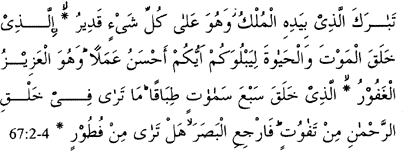
Blessed is He in Whose hand is the kingdom, and He has power over all things;
It is He Who has created death and life that He might try you—which of you is best in deeds; and He is the Mighty, the Most Forgiving,
**The Same Who has created seven heavens in stages (Tibaqan). No incongruity can you see in the creation of the Gracious God. Then look again: Do you see any flaw? **1
This is the principal verse which speaks of the plan of things covering the entire universe. The two fundamentals highlighted in this verse are as follows: a total absence of contradiction in the entire universe created by God and a stage by stage development of all that has been created. The latter is further elaborated in an attribute of God which is extensively used in the Holy Quran in relation to all creative processes. The word () (Rabb—a in this word is pronounced like u in but) invariably means someone who continues to evolve something from a lower to a higher stage. When a foal, for instance, is raised to the state of a fully grown horse—with special care taken to improve its potential qualities—the Arabs use the expression () (Rabb-al-Fuluwwa) meaning that someone has brought up and trained the foal excellently. Similarly, the same attribute () Al-Rabb is often translated as ‘The Provident’. This indicates that God the Creator also provides for all the subsequent stages of development of His creation. This leaves no doubt whatsoever as to the fact that the Quran speaks of creation only in step by step progressive stages which are well provided for, categorically rejecting the concept of spontaneous generation. Spontaneous generation is further rejected by the Quran because it violates the dignity of God. Thus the following verses enquire from man remonstratively:

What is the matter with you that you expect not wisdom and staidness from Allah? While He has created you in different forms and ever varying states? 2
The following verse from Surah Al-Inshiqaq addressing humans, promises them that theirs is a continuous journey of moving on from stage to stage:

That you shall assuredly pass on from one stage to another.3
This is the all-embracing plan of Creation. At different stages of evolution, the processes that governed and shaped life were different but their direction remained the same—always pointing at man.
This is an important topic which has been the subject of much debate amongst various scientists and religious scholars who seek to unravel the mysteries of the origin of life. Various scenarios have been proposed and experiments carried out which attempt to simulate the conditions resulting in the creation of organisms billions of years ago from an entirely lifeless earth. To that we shall return later. Presently we propose to confine ourselves to a brief account of the Quranic concept of how life originated and evolved on earth. Some observations relevant to this subject have been gathered from various verses of the Holy Quran. This serves the double purpose of illustrating the role of the Quran in transferring parts of the ‘unknown’ to the realm of the known and to assist the specialists in this field of knowledge to benefit from Quranic guidance.
We shall begin by noting that many a time when the Quran speaks of some earlier forms of creation, it refers to them as the creation of man while whatever was created at that time had no semblance to him. In fact, all the landmarks of creation have been likewise referred to as human creations because right from the beginning it was man alone who was the ultimate object and purpose of the entire exercise of creation.
By way of example, we may consider the construction of an aeroplane for which many thousands of stages and processes are required. The designer while planning its production treats every component nuts, bolts, wings, seats and all—as the building of the aeroplane itself, which is the real object of this exercise. Nuts and bolts also have an independent purpose to serve other than just being the components of the plane. As such all the earlier stages are treated as merely preparatory to the consummation of the ultimate purpose. This aspect is highly essential to note because it is here that the Quran parts company with the biologists who believe in a haphazard evolution without a pre-set design. To these biologists the origin and evolution of life appear to have neither purpose nor design, nor a well-calculated plan of execution.
These various stages as mentioned in the Holy Quran shall now be introduced only briefly point by point but a fuller discussion will follow in the relevant chapters.
The Creation of Ancient Organisms
We begin with the most ancient creative phenomenon which existed prior to the biotic evolution as mentioned in the Quran. It is with reference to this age that it employs a specific term, the jinn. But in this context it is certainly not applicable to the word genie to which ordinarily the readers relate it.
Their concept of jinn (genie) as a ghostlike creature is largely superstitious. Such superstitions would have us believe that the jinn possess a mixture of part human and part hobgoblin characteristics, which can adopt as many shapes and forms as they please. They are particularly prone to haunt and possess women and the weak. They can be mastered by the so-called divines who enjoy the knowledge of such verses from various scriptures as press the jinn into their service. Once subjugated, the jinn can perform fantastic tasks at their command such as materializing anything they like out of thin air. Through the jinn they can gain control over their loved ones or acquire power to annihilate their enemies. The Quran most certainly does not speak of this superstitious human fantasy when it speaks of the pre-biotic age with reference to the jinn. Of that the reader will be given a full account in the chapter The Jinn.
The Role of Clay
In the Quran, dry dust or wet clay are also repeatedly mentioned as stages through which life passed in ancient times. In Surah Al-'Imran, it states:
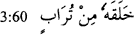
… He created him (Adam) out of dust (turab)… 4
On the same subject we read the following:
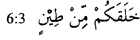
… He created you from clay (humid or moist earth)… 5
Clay is also mentioned in Surah Al-Rahman, but this time it is not wet clay which is referred to for it is clearly stated:

He created man from dry ringing clay like pieces of pottery. 6
Here its quality is described as having a plate-like appearance dry enough to create ringing sounds, like broken pieces of pottery. Again in Surah Al-Hijr, clay is mentioned three times with the added qualification that man is created from dry ringing clay, formed out of dark fermenting mud.*
The overall scenario as presented by the Holy Quran envisions life as having been advanced step by step from dust, from water, from clay and also from fermenting blackish mud which subsequently turned into dry, ringing clay. These last two stages attract particular attention. No man of the era when the Quran was revealed could even remotely relate the creation of man to dry ringing clay made out of stagnant mud.*
- The Holy Quran 15:27,29,34
Later on we shall present a brief account of what scientists say in relation to this subject. The reader is at liberty to draw his own conclusions regarding the compatibility of Quranic statements with the outcome of contemporary research. One is the scenario presented by the Quran based entirely on Divine revelation; the other is the scenario composed of various theories, claims and assertions made by many scientists who have devoted their lives to the study of the origin of life entirely on the basis of scientific investigation. Everytime the conclusions of scientists are found to be well-established, the reader will also find them to be in perfect agreement with Quranic statements. This will be so despite the fact that, at the time of the Quranic revelation, science had not yet advanced enough to investigate the mysteries of life and its origin. The purpose of such verses is to particularly address man of a later scientific age, so that his belief in the existence of an All-Knowing Supreme Creator is aided by the knowledge he has gained.
Survival by Accident or Design?
On the issue of survival the Quranic view is diametrically opposed to that of the naturalist’s. According to the Quran accidents play no major role in the survival of species or individuals. Not only species but also individuals are well protected from a host of impending dangers, constantly surrounding them, threatening extinction at every moment of their lives. Hence their survival is in no way accidental. Instead it is a well-chalked out, well-preserved and well-implemented protective design which is in operation throughout the history of life. Among many relevant Quranic verses we choose the following to illustrate the case in point:
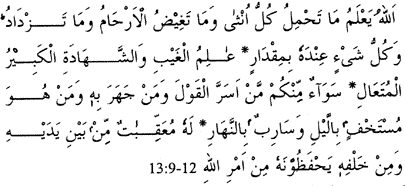
Allah knows what each female womb bears and whatever they secrete and reject therefrom and whatever they fostered to grow. And with Him everything has a proper measure.
He is the Knower of the unseen and the seen, the Incomparably Great, the Most High.
Equal are in His sight those of you who speak secretly and those who speak up aloud. Also those who move about under the cover of night and those who walk openly during the day.
For each of them there are sentinels in front of him and behind him, to protect him by the command of Allah … 7
Sidedness or Chirality in Nature
Among all the scriptures, the Quran is unique in highlighting the issue of sidedness in relation to socio-religious behaviour. One is surprised to read any significance attached to the right or the left. The same is observed in the conduct and instructions of the Holy Prophetsa, where the right and left are each portrayed as playing a specialized role in a Muslim’s conduct. For instance, the right hand is selected for all good things and clean acts; one should eat with the right hand, one should start serving from the right side, one should not touch any filthy object with the right hand etc. The opposite applies to the left hand. Incidentally, when one shakes hands with a Muslim, he should be confident that he is shaking a hand which is clean. In the comparative fuller discussions of sidedness and chirality, the reader will come across amazing disclosures regarding the phenomenon of sidedness as observed in nature. The reader should bear in mind that this is strongly suggestive of the sameness of the Author of the Quran and the Creator of the universe.
The expression ‘partiality’ is generally used to indicate that a choice is made without specific reasons leading to that choice. However, in application to God, one’s lack of knowledge as to why God is partial to sidedness does not necessarily mean that there is no hidden reason for His selective behaviour.
As science continues to delve deeper and deeper into the understanding of the chain of cause and effect, many hitherto inexplicable patterns of natural behaviour are being understood.
Natural Selection and Survival of the Fittest
Without ambiguity the Quran repeatedly declares that at every step of creation choices had to be made and each time the selector was not the blind operator of natural selection, but the hand of God, the All-Seeing, the All-Knowing. Again it is specifically and categorically declared:

And thy Lord creates whatever He pleases and chooses whomsoever He pleases. It is not for them to choose. Glorified be Allah, and far is He above all that they associate with Him. 8
The same assertion runs through the following verses:
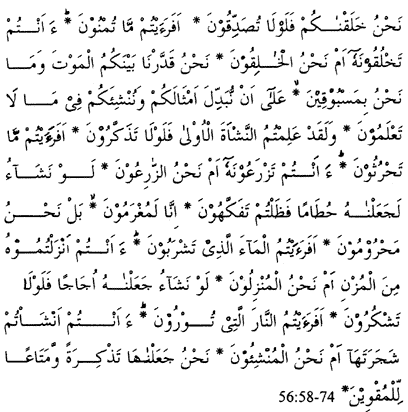
We have created you. Why, then, do you not accept the truth?
What think you of the sperm-drop that you emit?
Is it you who created it or are We the Creator?
We have ordained death for all of you; and We cannot be prevented.
From bringing in your place others like you, and from developing you into a form which at present you know not.
And you have certainly known the first creation. Why then, do you not reflect?
Do you see what you sow?
Is it you who grow it or are We the Grower?
If We so pleased, We could reduce it all to broken pieces, then you would keep lamenting:
'We are ruined!
‘Nay, we are deprived of everything.’
Do you see the water which you drink?
Is it you who send it down from the clouds, or are We the Sender?
If We so pleased, We could make it bitter. Why, then, are you not grateful?
Do you see the fire which you kindle?
Is it you who produce the tree for it, or are We the Producer?
We have made it a reminder and a benefit for the wayfarers. 9
These verses draw the attention of man repeatedly and emphatically to the fact that it is God Who is the Creator, and it is He alone Who makes choices. The decision making is not left to chance, nor to the things which are themselves being created. At every such moment it is God Who makes the choice and operates as the Supreme Selector.
There is no blind haphazard selection of characters as life evolves. It is God who through the trials between life and death makes it possible for life to evolve in its character, design, style and mode of survival. In this grand scheme of things there is no flaw whatsoever because it is He who governs from the seat of His majesty with absolute wisdom. Nowhere in His creation can one find any flaw or contradiction. The import of these verses is manifestly clear.
In the Darwinian hypothesis of The Survival of the Fittest as we shall discuss later, there is no guarantee for a flawless operation which must always result in the survival of the fittest. On the contrary, some of those animals which may survive in the struggle may be fit only to survive that particular challenge. As far as the more evolved qualities of life are concerned however, the mere survival of an animal in a given situation certainly does not offer a guarantee that with it these qualities will also be preserved. This is so because there is no room for a Conscious Selector in that scheme, capable of invariably choosing better characters emerging during the struggle between life and death. The Quranic vision of creation speaks of a universally flawless operative system, controlled to its finest detail so there is not the least chance of flaws and defects stealing their way into this scheme of things:
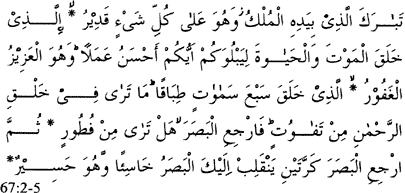
Blessed is He in Whose hand is the kingdom, and He has power over all things;
It is He Who has created death and life that He might try you—which of you is best in deeds; and He is the Mighty, the Most Forgiving,
The Same Who has created seven heavens in stages. No incongruity can you see in the creation of the Gracious God. Then look again: Do you see any flaw?
Aye, look again, and yet again, your sight will only return to you tired and fatigued. 10
A Game of Chess or a Game of Chance!
Some of the verses mentioned above, deal with the same subject creating the scenario of a guiding hand of a planner who plans and executes with absolute adroitness and dexterity. Each creature on the vast chequer-board of creation is moved square after square to a predetermined destination. This vision of creation leaves no room for an ungoverned and unguided course of evolution. In fact the entire scheme of things, both biotic and pre-biotic, is sketched by the Holy Quran as a coherent plan of order completely devoid of chaos.
Building the same theme of universal order, the Quran rejects the possibility of there being another God who would certainly have clashed with his adversary turning the order we observe into disorder.
**SO FAR **the discussion has been introductory, now we are ready for a detailed examination of the same subjects, chapter by chapter and category by category.
REFERENCES
1 - Translation of 67:2–4 by the author.
2 - Translation of 71:14–15 by the author.
3 - Translation of 84:20 by Maulawi Sher Ali.
4 - Translation of 3:60 by the author.
5 - Translation of 6:3 by the author.
6 - Translation of 55:15 by the author.
7 - Translation of 13:9–12 by the author.
8 - Translation of 28:69 by Maulawi Sher Ali.
9 - Translation of 56:58–74 by Maulawi Sher Ali.
10-Translation of 67:2–5 by the author.
Revelation, Rationality, Knowledge & Truth
Mirza Tahir Ahmad