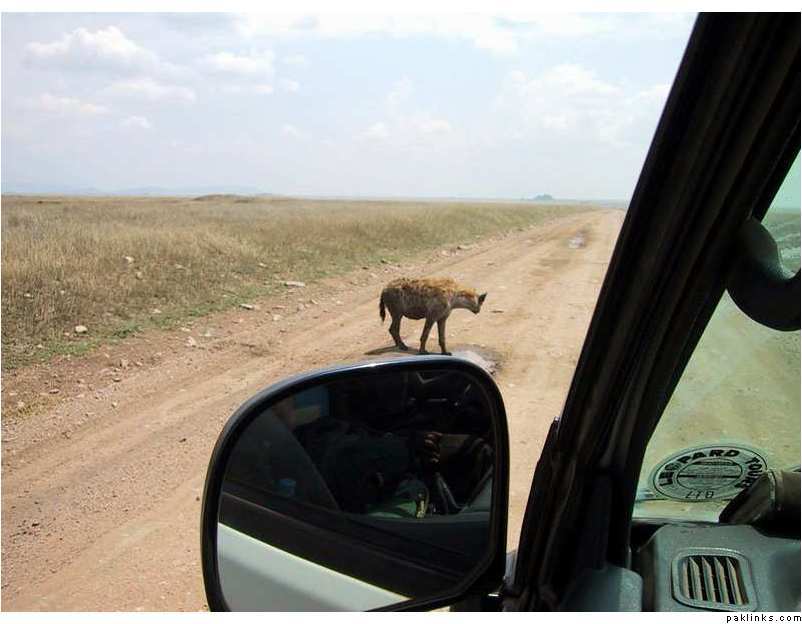
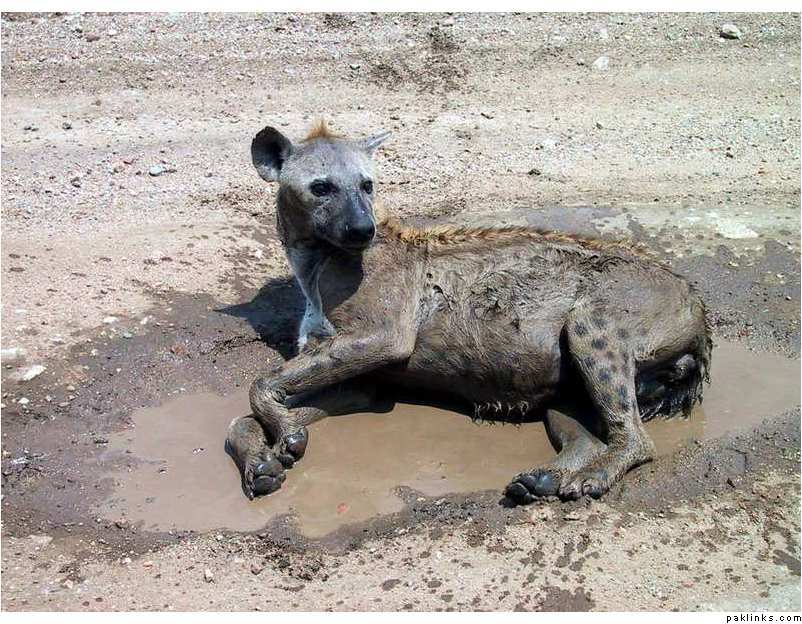
I would love to see a Hyaena. Sadly they are rare in Pakistan now. Its hard to believe but some people would consider Hyaenas Halal before and maybe even now in Pakistan.
Footloose, NOS, The News International
Legend of the elusive hyena
Following the trail of pugmarks, enthusiastic wildlife lovers may have to wait for another winter to hear more about this pack of hyenas that they lost in a village in Rahim Yar Khan…
By Dr Raheal Ahmad Siddiqui
Abbi, my father, introduced me to the world of animals at a fairly early age. In mid-1960s, huddled in bed, usually on weekends, Abbi would read out stories by Jim Corbet. On Sundays, he would take us to Bahawalpur Zoo to show us the animals mentioned by Corbet.
Then, my animal kingdom consisted of tigers and panthers, all man-eaters, chased and gunned down by this great hunter. Occasionally, Corbet would mention langurs, peacocks or Sambhar calling to inform the movement of a predator in the jungle.
My animal world enlarged in the 1970s with Tarzan comics. Swinging from one tree to another, the half-naked Tarzan would wage endless wars against black savages and evil white men. But Abbi introduced me to the ferocious predator called hyena through Ernest Hemingway’s short story 'The Snows of Kilimanjaro’. He had watched the motion picture, which starred Gregory Peck and, at bedtime once, he narrated the tale – “the hero’s camp was visited at night by a laughing hyena…” I was told that hyena is a scavenger that can crush bones with its powerful jaws.
It was by the end of the 70s, when I saw a National Geographic film in which a pack stole away fresh kill from a solitary lioness, that I learnt that hyena is more than a scavenger; it’s a ferocious predator, especially when hunting in packs.
According to T.J. Roberts, an authority on mammals of Pakistan, hyena is a large, dog-like carnivore with a conspicuous crest of long hair extending like a mane from the crown of the head to the pelvis. The head is large with a dog-like snout, whereas the ears are upright and triangular. The tail is short, thick and bushy. The general body colour is tawny-yellow with indistinct broad vertical black stripes along the flanks and horizontal black stripes around fore and hind legs. The hyenas lack the fifth toe; the fore-feet are much larger than the hind-feet hinting that they have comparatively weak hindquarters. The difference between the hind and fore legs gives it a distinctive dragging gait and hence the locals call it 'lagar-bagar’.
According to T.J. Roberts, the striped hyena in Pakistan is primarily an inhabitant of rough, hilly country with broken ravines and rocky escarpments.
In the year 2000, I was posted as a political agent ¶ in the tribal area of DG Khan, which provided me an opportunity to monitor the activities of this elusive animal in its natural habitat.
During night halts and campfire conversation with locals featured around folk tales, tribal feuds or stories of encounter with animals and supernatural, my interest in the vanishing fauna of this region would be charged with fresh knowledge. Most of the Border Military Police (BMP) posts are Victorian age forts built to outlast the siege of wild rebellions tribes. One night at BMP post Mubarki, while I was wriggling to get in my sleeping bag, I heard a faint unusual sound coming from the deep chasm in the west. Suddenly, the mares started neighing and kicking wildly. Jamadar Yaqoob Shah growled a few invectives in Balochi from his bed and the BMP sowars rushed to calm down the horses.
" Sahab all well ……….. only Aftaar". His commanding English conveyed the whole story and this time it was I who jumped out of the sleeping bag. Now Aftaar is a Balochi word for hyena. Though the sound was not repeated, the horses remained restless for another hour.
Since it was not possible to start a hot pursuit in this pitch-dark night, that too on a difficult mountainous terrain, I confined myself to Yaqoob Shah’s narratives. As a young BMP recruit in 1968, Yaqoob Shah was sent one night along with three other sowars to investigate a murder in Khosa tuman in Baghal Choor area. They left BMP post on foot to reach the spot before dawn; because if they failed, this simple murder could escalate into a bloody tribal feud. In a dark, chilly night, they had hardly covered two miles along the bed of a dry sandy stream, when a pack of hungry hyaenas surrounded them. The hyaenas, numbering about eight to ten, repeatedly attacked them with clattering jaws and laughing growls. The four men fended the attacks by using their Lee Enfield rifles as clubs and throwing stones, abundantly found in the dried bed. They were afraid to fire their guns, because in a tense tribal atmosphere, a single shot could trigger a mini tribal war.
Hyaenas usually don’t attack humans. Extreme hunger could have driven them for this desperate act or may be the BMP posse had come dangerously close to their den. According to Yaqoob Shah’s account, he never came so close to this animal again.
Last winter, he phoned to inform me that hyaenas had eaten five sheep within a month near his hamlet in Baghal Choor area of BMP Post Mubarki. The news was heartening that at least a few solitary animals had survived in this last undisturbed wilderness.
Unlike Shah’s experience, my closest encounter with a hyena was tragically comic. On August 11, 2000, as I walked down from the PA’s residency in Fort Munro to inspect the market, adjacent to the famous Jirga Hall, I noticed a crowd of over hundred, gathered around the elevated veranda of this hall.
Now Fort Munro, at this time, was buzzing with excitement, as the tribesmen from the neighbouring of districts of Balochistan and D.G.Khan division had started gathering at this summer hill resort of Southern Punjab, in anticipation of a three day Jashan Fort Munro Mela which was to commence from August 12. This mela, a colonial legacy, was revived after five decades and contained all traditional Balochi sports like horse racing, tent pegging and rifle shooting. On inquiry, the Dafedar of BMP informed me that one of the tribesmen had killed a wild animal that he intends to present to the Political Agent.
Haq Nawaz, the hereditary caretaker of the residency (whose father had served three British PA’s before Partition), is a guidebook of local traditions. As I approached the Jirga Hall, the crowd melted sideways to give us honourable space to reach the veranda. There it was; a head of a dog-like animal, proudly displayed on the floor. As the crowd hushed, I asked a few questions and I was told that, as per tradition, the PA is supposed to give cash prize in return for this daring act of destroying a dangerous animal.
By that time, the conservationist within me had started to agitate and I asked as to who had killed the animal. Haq Nawaz translated the question in Balochi for the benefit of the crowd. Over thirty hands were raised, closely followed by a shouting match amongst them.
I ordered the arrest of all those involved in this heinous killing “under the Wildlife Act”. The crowd took to its heels, chased by a half dozen BMP Sowars. Within seconds the ground was clear but not a single arrest could be made immediately.
The Buzdar tribe, which roughly inhabits middle reaches of Suleman Range, between Fort Munro and the tribal belt of D.I.Khan, has a legend closely associated with a hyena-like creature. This mythological animal is called 'Gull-Aftaar’ (Super-Hyena), which is more or less of the same size as hyena and has a similar lane gait, but differs from an ordinary hyena [Aftaar] in being far more aggressive. As per the legend, an attractive woman, who at times is either semi-nude or dressed in all white, always accompanies it. Tales of its encounters have a familiar pattern. On a dark night, a lonely traveller is enticed towards a desolate place by a lady in white and then the creature moves in to finish him off.
It is strange that this myth of 'Super-Hyena’ is totally absent amongst other tribes like Legharis, Mazaris, Khosas and Qaisranis who occupy the low altitude mountains of this range. The higher you go in the Buzdar mountains, the more stories you hear about this creature, though the narration is always in third person and no credible fresh sightings are obtained. The encounter is always a few years old and it is difficult to give a clear physical description of this animal, which varies from person to person.
My repeated inquires convinced me that apart from the addition of a lewd woman in these tales, we were actually dealing with an elusive animal, which has never been identified because of the remoteness of this area and the lack of interest of Wild Life Department in the fauna of Pakistan.
In December 2002, two Mirkhani Baloch travelled for three days to D.G.Khan to break the news of their close encounter with 'Gul Aftaar’. Moving up on a pony trail in Jhandi mountain [5500ft] soon after dusk, they heard an animal coming down the same path. The shadow leapt into the thicket on the left and started growling ferociously, making them freeze in their path. The standoff continued for 20-25 minutes, after which the animal moved away.
Now Jhandi lies on the foothills of mighty Beeho Mountain [8200ft] that spreads into Musa Khel District of Balochistan. During summer, some clans of Mirkhanis Buzdar migrate along with their herds to the virgin pastures of the Beeho top. It is here that the legend of Super-Hyena is more popular. With thick vegetation cover and a thin migratory human population, these pastures are teeming with game. I interviewed my two Balochi guests for many hours, showing them photos of various animals but could not get the exact description of this Super-Hyena, which could fit into some credible form. Pitch darkness was the worst impediment towards positive identification. The only clue was that this animal definitely had a short tail. In general appearance the lynx is notable for its relatively short back, thick powerfully developed legs and a very short tail. It is a resourceful hunter and is capable to kill variety of animals from young Markhor, sheep, small rodents and birds like hill Pigeons.
From this day on, I have classified this animal that the Buzdars always refer in their legends as 'Gul Aftaar’ [Super-Hyaena], as a subspecies of a felis lynx. The dwindling population of Suleman lynx urgently needs more research to establish its identity, before this specie fades into oblivion.
During my posting as Assistant Commissioner/SDM Larkana, my driver Sikander Bhutto always insisted that I should visit the Irrigation Bungalow located on Nai Gaj in Johi Taluka. This picturesque rest house was built 70 years ago on the side of a deep gorge at the base of Kirthar Range in Dadu District. A concrete wall dams the flash-floods coming from the hills, thereby reducing its devastating impact on the plains. In the winter of 1970-71, Sikander had spent many chilly nights on the roof of this bungalow along with SDO Public Works, as the surroundings were routinely taken over by ten to fifteen 10-15 hungry hyenas. Their weird howls and physical brawls would give them sleeplessness nights.
Hyenas spend the day sheltering in underground burrows or natural caves. At night they are capable of travelling great distances in quest for food. K.R Eates (1968) had report of many instances in Sindh where hyenas had killed donkeys. Jerry Wood Anderson, a naturalist friend of T.J. Robert, once found a hyena at Sehwan inside a railway wagon that was filled with bones for shipment to a glue factory. “A male hyaena killed near Malir in 1966 was found to have nothing in its stomach except the remains of an old leather shoe.”
On January 3, 2009, I read a news item in an Urdu Daily that 18 sheep had been killed a night before by wild animals at Bahodi Pur Machian near Rahim Yar Khan. After office hours, I rushed to the scene of crime along with District Wildlife Officer (DWO). During the half an hour that we drove together, the DWO tried to convince me that since no predatory wild animals are found in this area, this must be a work of some sinister opponent extracting crude revenge. The village was fairly large with over 100 households and is located on road leading to Jamal Din Wali Sugar Mill from the main highway.
The news that the District Coordination Officer was visiting the scene of crime had spread like wild fire attracting scores of people to site. Carcasses, almost two days old, had been removed from the sheep pen. With hundreds of people visiting the place, no pugmarks could be preserved. The owner, who slept in the mud cottage within the open compound, woke at dawn to find most of his sheep killed and some partially eaten. Many people started narrating different stories at the same time, making me difficult to comprehend the truth. By this time I was fully convinced of DWO’s tales of crude revenge. The police were equally clueless.
As I was getting in my car, Muhammad Nawaz Indhar, a local shikari, whispered in my ear that last night, a farmer had noticed a strange animal while watering his fields not far from this village. With the mob still following us, we reached the small hamlet and were taken to the place where the villager had seen a large animal with strange ears. Following the moist bed of a nallah along sugarcane fields, we at last found pugmarks. The District Wildlife Officer dismissed it as that of a 'Jungli Billa’, a vague term for caracal. Nawaz Indhar insisted that the pointed claws of this size meant something big and different. It is known fact that all cats, big or small, had retractable and not fixed claws. Even lions and tigers don’t leave the impression of claws while walking on soft ground. The most amazing thing about this pugmark was that the fifth toe was missing. The only animal that can kill sheep and had fixed claws with four toes is none other than a hyena. After positive identification of the culprit, we walked back to Bhodipur Machian village where an excited crowd once again mobbed me. Many mouths, many voices. Some were asking for official compensation, others were thanking me for my efforts, still a majority wanted to organise a big hunt for the destruction of this 'dangerous pest.’ Instead I announced a substantial cash award for all those who would assist the Wildlife Department in capturing it alive for Bahawalpur Zoo. I also directed the Wildlife Officer to immediately get one or two sheep to be used as bait, set-up a trap and get the tranquilliser gun from the Zoo for handy use. Telephone numbers were exchanged with a few locals who promised to give me prompt information about the movement of the hyena. I left the village fully satisfied that at last Bahawalpur Zoo would soon be getting a new guest. Never did I realise at that point that the concerned department had serious inherent defects, which would turn this high drama into an anticlimax.
Two days later, I received an early morning call from Nawaz Indhar that the pack had struck again and all the remaining sheep in the same pen had been killed. While the officials of concerned department were enjoying sound sleep, I was at the site before office hours. The owner, disturbed by unusual movement in the small hours, decided to have a closer look. His approach disturbed the feast and the animals scattered in all directions, some took the aerial route, jumping over a five feet tall mud wall, and the rest disappearing through an open compound. A closer examination of the pugmarks revealed that it was the work of a pack consisting of at least five animals, two of which were definitely cubs. We picked the trail of pugmarks, which having crossed various fields and irrigation channels had finally disappeared in a sugarcane field. This 20-acre sugarcane field was roughly six to seven kilometres from the scene of the crime.