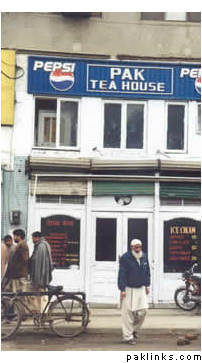
*If someone says, 90% Giants Of Urdu Literature and Poetry were from Pak Tea House of Lahore is understandable.Even cities like Dehli,Lucknow,Hyderabad Deccan ,Karachi etc famous for its Urdu culture,history and background are not parallel to this city and most important place for them was Pak Tea House.Following are those who by any mean attach to this place in thier lives.Look at these people and thier ‘Height’ in Urdu Literature.
*
Sadat Hassan Manto
Ali Jawad Zaidi
Prof. Zoe Ansari
Dr M. D. Taseer
Faiz Ahmed Faiz
Vijaydan Detha
Sajjad Zaheer
Khagendra Thakur
Bhisham Sahni
Prof Ahmed Ali
Dr Nusrat Jehan
Rashid Jahan
Ahmed Nadeem Qasmi
Ahmed Faraz
Kaifi Azmi
Krishan Chander
Ismat Chughtai
Rajinder Singh Bedi
Ali Sardar Jafri
Josh Malihabadi
Makhdoom Mohiuddin
Munshi Premchand
Amrita Pritam
Majaz Lucknawi
Sahir Ludhianvi
Chiragh Hassan Hasrat
Ustaad Amanat Ali Khan
Intezaar Hussain
Mira Jee
Nasir Kazmi
Qateel Shifai
Muneer Niazi
Habib Jalib
etc etc…
Lahore needs another Tea House
Shafqat Tanvir Mirza
Dawn
28 January,2009.
HERE to get together and W stage a protest march against the Israel’s attack on Gaza? That was the question before some old writers and intellectuals of Lahore who were among those who had staged successful protest marches from Pak Tea House to Punjab Assembly building during Ayub’s period and later on. The same question was raised in the presence of Masud Ash’ar and some other writers at a farewell tea gathering at the office of Idara Saqafat-i-Islamia in the room of its director Dr. Rasheed Ahmad Jullundhri. The reason for the proposed protest march was that the great poet and writer the late Ahmad Nadeem Qasmi’s services as the head of the neighboring Majlis-i-Taraqqi-i-Adab were terminated and that was supposedly the latest day of Qasmi Sahib at the Narsingh Das Gardens.
The late Qasmi Sahib was humiliated at least two times; one, when there was a mushaira at the Open Air Theatre in which Kaifi Azami, Majrooh Sultanpuri from India were also participating. Qasmi Sahib was accused of participating in the All Pakistan Writers Conference under the auspices of the newly founded Pakistan Academy of Letters. The younger lot of the writers who had suffered under Zia’s regime got hysteric and raised slogans against Qasmi who quietly slipped from the function before Kaifi and Majrooh could express their disliking on younger’s rage. Incidentally, Qasmi was surrounded by some of the hardcore supporters of Ziaul Haq and who were awarded Pride of Performance medal … perhaps out of turn on which many senior writers like Qateel Shifai had protested publicly.
This was the second time when Qasmi Sahib was not only asked to leave office disgracefully but his opponents had spread rumours that there was some financial bungling in Majlis’ financial affairs. But the background was quite different. The people of Nazria-i-Pakistan were desperate to occupy more land at the Narsingh Das Gardens which was the property of two trusts – **Majlis-i-Taraqqi-iAdab **and Idara Saqafat-i-Islamia. The information department of the Pervaiz Elahi government had asked Qasmi Sahib to sign a document which was supposed to give a large chunk of the trust’s land to the Nazria people. But Qasmi Shaib refused to sign it. Consequently not his services were terminated he was insulted by the low grade employees of the Nazria section and now the question was how to protest against the highhandedness of the govern ment and land grabbers?
The Pak Tea House was no more there which had remained an important meeting place of the writers and intellectuals of all shades for the last 50 years. Many of the successful protest marches in the first Ayub’s period were conceived at the house in which** Qasmi, Hanif Ramey, Habib Jalib and Javed Shaheen** had actively participated. Now there was no Pak Tea House and there were no more workers like Saleem Shahid, Raja Rasalu, Kanwal Mushtaq and Mushtaq Butt. The protest march in favour of Qasmi Sahib could not be organised.
Governor Khalid Maqbool could not come forward to help the writers. He was known as the friend of writers but could not prove his credential on this great opportunity. Then it were the friends of Qasmi Sahib who arranged a protest meeting at the Shezan in Dayal Singh Mansions. It was Ataul Haq Qasmi who invited the writers to this protest gathering and the result was positive. Qasmi was again in the saddle. This Shezan was burnt and closed down for ever. It was no substitute to Pak Tea House in respect of expressing and demonstrating the anger of the writers.
There were three major places associated with writers and intellectuals. The oldest was Arab Hotel close to Islamia College, Railway Road,Lahore the Nagina Bakery and close to that were Coffee House and Pak Tea House, and the last one was the favourite meeting point of writers associated with **Halq-i-Arbab-i-Zauq Progressive Writers, Association and Punjabi Adabi Sangat **which was the last to emerge on the literary horizon of Lahore.
The Progressive Writers became the victim of the pro-America government and was banned. Many of the members and sympathisers joined the Halqa and Tea House became a sort of thinking tank. It were the Tea House people like **Nasir Kazmi, Intizar Husain **and their young friends who reminded the nation the sacrifices of the freedom-fighters of 1857 (who were to great extent ignored by the government and pro-government groups of writers). This Pak Tea House group brought out a thick publication titled Khayal about the 1857 war. The next were the progressive papers (The Pakistan Times, Imroze and weekly Lail-o-Nihar) which observed the centenary of 1857 in a befitting manner. In India the centenary was observed by the government at a greater level which prompted the government and official literary organ Mah-i-Nau also brought out its special issue on 1857.
It was at the Tea House that writers did their best to support the cause of Palestine and then the heroic fight of the Algerian people under Ben Bella. The hub of the literary activities in support of Algeria was Pak Tea House.
It was the **1965 war against India on Kashmir **which involved the Tea House writers and it were here that writers from all schools got together to condemn the Tashkent Declaration. Now Tea House became the center of those writes who wanted to project their point of view on national and international issues like Vietnam. A ProVietnam Society was formed at the Tea House with Masud Ullah Khan as its secretary which not only published literature on Vietnam but also arranged a big procession in support of Vietnam fighters. This procession attracted political leaders like **Mumtaz Daultana **too.This was Nawab of Kalabagh’s period in West Pakistan. In spite of him the protest march form Pak Tea House peacefully ended on Punjab Assembly. It was a great success and the protest march was covered by the international press.This encouraged the writers and they arranged a photograph exhibition on Hiroshima Nagasaki bombing which was arranged by the Tea House people at **Mairaj Khalid’s **office at the **Lakshmi Building **which attracted a big crowd. Now the movement against dictator Ayub Khan was getting momentum and another big procession of the writers was arranged by the Tea House people which marched on the Mall. For the Tea House writers now the deposed foreign minister Z.A. Bhutto became a great rebel rouser.The late Saleem Shahid, Altaf Qureshi, Husain Naqvi, Masud Ullah and Abbas Athar were in the forefront in Bhutto’s support and they published pamphlets in Urdu and English in which they suggested how the new part (PPP) should be.
Bhutto himself visited the Tea House. ***
That was the Pak Tea House of the bygone days***. There is no Tea House form where writes of Lahore get together and arrange protest march on Gaza, judiciary, drone attack on the innocent people of Fata. Another Tea House is badly needed in Lahore.