Re: Krishna, Radha, Hanuman re-installed in Lahore
Also Farid Mian, alot of mosques during your democratically elected Nawaz Sharifs regime (even though ure a peepliya but in desperation you try to act like a supporter of democracy) were demolished in Rawalpindi, I can name atleast a dozen that I know of, on the direct orders of Mian Choti Tind. What do you have to say about that?
Re: Krishna, Radha, Hanuman re-installed in Lahore
Yeah rite, because the hindus in India torn down Babri mosque, lets do the same to temples in Pakistan. I cannot justify this thing. In Islam there is allowance for non muslims to participate in whatever religion they want to. How/why do you blame the hindus living in Pakistan for Babri mosque?
Nice shayr but it’s neither law nor sharia. You make it sound like Pakistan belongs only to muslims. Sorry friend I don’t agree, it belongs to our non muslim citizens as well.
Re: Krishna, Radha, Hanuman re-installed in Lahore
What Mushi is doing is good news but what my friend has written ^ is not entirly the truth, as we say movies are mirrors of the society this interesting article by** Javed Akhtar **will certainly throw light in few interesting facts.
**Secularism in Hindi cinema has primarily been a Hindu’s responsibility: Javed Akhtar
**about entertainment, but there’s a fine difference between art and circus,” began Javed Akhtar at the fifth Subhas Ghosal Foundation lecture held in Mumbai. The well known lyricist, writer, and social activist had been allotted the topic, ‘The Role of Secularism in Hindi Cinema’. Akhtar said that cinema, although exaggerated, is relevant to the common man, and one can actually learn a lot about real society from Hindi movies. “Dreams don’t offer realism either; but they are relevant nonetheless as they are often a reflection of our thoughts,” Akhtar said. “In a way, cinema is like a relevant dream as well…on decoding it one can unearth the collective psyche of the society.”
Having established the relevance of Hindi movies in society, Akhtar went on to outline the importance of characters in films, and how these are a mirror image of real life. He said that if one makes a list of Hindi film villains over the last few decades, he can actually learn everything there is to know about society’s evolution in India. In the 1940s, we had the Zamindars as villains, which was a reflection of the actual state of affairs. In the 50s, this villain lot was replaced by the factory owner bully. In the 60s, however, the underworld don of big cities ruled the small screen as the bad guy. “In the 70s, this underworld don became a hero,” quipped Akhtar. In the 1980s, the villain in a Hindi film was invariably a policeman or a politician – yet again a reflection of societal affairs. “In the 90s, Pakistan became the villain,” said a candid Akhtar, to everyone’s amusement. “In the new millennium, we don’t have any villains; such characters in today’s movies frighteningly resemble us!”
http://www.agencyfaqs.com/news/news_story_grfx/16668_1.jpg Javed Akhtar
On a more somber note, Akhtar spoke of a time which shook the nation: the year 1947. “India went through a trauma back then, but Hindi cinema couldn’t handle that and pretended it didn’t happen,” Akhtar said. “For a very long time, Hindi cinema did not touch upon this topic.” Further, he insightfully declared that for several years after partition, no film with a Muslim protagonist was made. Finally, in 1960, ‘Chaudhvin Ka Chand’ came along which broke this trend, followed by ‘Mere Mehboob’, both of which has Muslim characters as heroes. “These films, to my mind, were dangerous, because they created ‘Super Muslims’ or unreal Muslims,” Akhtar stated. For instance, such films showed Muslims to be understandably pathans or nawabs living in large ‘havelis’, who talked only in poetic lingo, wore sherwanis all day long, indulged in Mujras/brothels, and sported beautiful women at their arms. “This created a world that never existed!” exclaimed Akhtar.
So then, one saw the era of two categories of Muslims. “The first was who we saw on cinema. The second was my neighbour – an owner of a cycle shop,” smiled Akhtar. This real life Muslim then started believing that his ancestors may have really led the kind of life shown on screen. “As one can see, both these Muslims were far away from reality,” Akhtar said. But the story doesn’t end here. The Muslim social circle reciprocated this stereotype depiction. One then saw the birth of a ‘token Hindu’ or a ‘good Hindu’ in movies; a man who would sacrifice his life for his Muslim friend. For instance, ‘Mughal-E-Azam’ had a Hindu character that dies for the Muslim hero, Salim.
While the rapt audience was still digesting that one, Akhtar hit another jackpot with his next point: that secularism and religious tolerance in Hindi cinema is exclusively a Hindu’s responsibility. On secularism, Akhtar said that while we can have a ‘Vijay’ getting saved by a ‘786 billa’ (metal arm band that Amitabh Bachchan wears in ‘Coolie’), one is yet to hear of a Muslim character being saved by a Ganesh idol. “I haven’t seen a Muslim character play Holi in any film, although millions of them do so in real life,” Akhtar added. Further, while a goon can hide gold behind a Hindu deity, one can’t show a similar situation in a mosque, as filmmakers are afraid of hurting the sentiments of a minority. This is getting reflected in society too. “We find that few got arrested for the Gujarat genocide,” Akhtar said.
On religious tolerance too, Hindus seem to shoulder the burden. “There are films on untouchables and child marriage, but rarely one on a social malpractice by a minority,” said Akhtar. The closest a film came to doing that was ‘Nikaah’ (on the disadvantages of the Muslim divorce system), but that too was a personal story, rather than a community one. It all boiled down to one point: filmmakers know exactly what society can take, and what it won’t accept.
As the Hindu-Muslim debate was getting heated, Akhtar decided to step away for a moment. “Hindi films haven’t treated Christians very well,” he said. A Christian has always been depicted as a good hearted drunkard, or the ‘Mona Darling’ type (the vamps in Hindi cinema took on the form of Rita/Mona/Julie, who dressed and talked in a particular way). “But then, heroines started wearing those kind of clothes, so the differences with the vamps sort of vanished,” joked Akhtar, evoking a roar of laughter from those present at the event.
Akhtar concluded on a promise of a better tomorrow. He placed faith in today’s young generation, as they possess a less tainted view of society, and are healthier than their parent generation, in that sense. “This too, is reflecting in Indian cinema,” observed Akhtar. Secular movies such as ‘Rang De Basanti’, ‘Sarfarosh’ and ‘Iqbal’ are finding their places in the hearts of Indians – three films which wouldn’t have been accepted in the 50s despite the roar of secularism that had erupted then, Akhtar signed off.
Re: Krishna, Radha, Hanuman re-installed in Lahore
Let's hope the Pakistani governement and intelligence agencies will provide enough security to this temple to avoid any attack by fanatics....also I am afraid the temple may become a target to express anti-India sentiments..so I think a tight security is very important.
Re: Krishna, Radha, Hanuman re-installed in Lahore
There are more than 2.5 million Hindu’s in Pakistan (most in Sindh), and they are held in high respect.
Singing praises
By Zulfiqar Ali Kalhoro
THE Charans belong to an ancient tribe of Sindh. There was a time when they were known for describing heroic deeds of the Rajputs in verse. They were also known for writing great poetry and using it to inspire their warriors to fight against their enemy. It is said that the Charans were descendents of Siva and Parvati. Because of their ability to compose poetry, they occupied the second rank in the hierarchal order in those days, above their Rajput patrons. Without someone showering praise on them, it was impossible for the Rajputs to assert their position in society at the time. Whenever the question concerning ancestral rights, privileges, inheritances, lands, or forming new alliances arose, the Rajputs would depend on the Charans’ knowledge, which would be transferred through different ways. The Charans would also be used as sureties whenever a legal guarantee was required. Pacts, engagements, transfers, recovery of debts, collection of land revenue and even the signing of treaties wouldn’t be complete without them. Moreover, they were arbitrators of conflicts between the various Rajput clans or factions. In the time of war, their villages would become neutral zones and places of refuge.
The Charan tribe is divided into different castes or lineages. Prominent amongst these are the Detha, the Kaachhela, the Gadhvi, and the Maru. The Charans who inhabit Tharparkar adhere to Hindu religion. Those living outside Tharparkar are all Muslims. There are a number of Charans who are held in high esteem as far as the history of Sindh goes. Among them, Junfah Charan, Sumang Charan and Juman Charan are the most famous ones. Junfah Charan was a court poet and adviser to the Sodha Rajputs. It was he who prepared the ground for invasion of Umerkot. When the Sodhas snatched Umerkot from the Soomra Rajputs, they showered him with gifts and gave him land at Khariryo Charan where his descendants still live. Sumang Charan lived during the Soomra rule and popularised the seven valiant men and 10 Datars (munificent and bountiful) belonging to Jareja and Samma Rajputs. The names of those generous (Datars) Samma Rajputs were Sakhi Supar Jam Chotai, Rai Daich, Odho Jakhrai, Lakho Phulani, Jam Karan, Jakhro Odai, Jam Harand, Jasudhan, Vikyo Datar Jarejo, and Sakhi Sahar Jam followed by seven valiant men Jam Unar, Abro Arbang, Ponyro, Banko, Kararo Kondhar, Hothi Waryam and Lakho Phulani.
Sumang Charan roamed about in every village and town of lower Sindh and Tharparkar and sang songs of generosity, valour and heroism praising Samma and Jareja Rajputs. The poetry that Sumang Charan composed is still popular among the Hindu Charans of Tharparkar. Juman Charan lived during the rule of Mian Noor Mohammad Kalhoro (1719-1753). He and Jalal Khati engaged in a discourse regarding the battle that was fought between Mian Noor Muhammad Kalhoro and Abdullah Khan, who died in that battle. Juman Charan eulogised him in his poetry. However, Jalal Khati praised the valour of Mian Noor Muhammad Kalhoro and the Sindhian army. In contemporary times, Kesoji Charan of Nagarparkar and Devi Dan Charan of Umerkot are well-known poets. Kesoji Charan lives in Densi village which is located 15 kilometres from Nagarparkar. Densi is the village of the Charans who’re famous for reciting and narrating verses, couplets and stories of Soomra and Sodha periods. Kesoji Charan has a gift of telling the stories of Soomra and Sodha rulers. He also entertains his community and other people by narrating the story of Rai Daich who was a generous king of Kathiawar, India. The Charans of Kharerio Charan are equally famous for telling stories and reciting verses about heroic acts of the Rajputs. Kharerio Charan is located some six kilometres from Umerkot. Devi Dan is a recognised Charan and has composed poetry on heroic deeds of Makwana, Sodha, and Rathor Rajputs. Apart from that, he has also churned out poetic pieces on the parchas (miracles) of Deval goddess.
Re: Krishna, Radha, Hanuman re-installed in Lahore
Hindus greeted on Holi festival
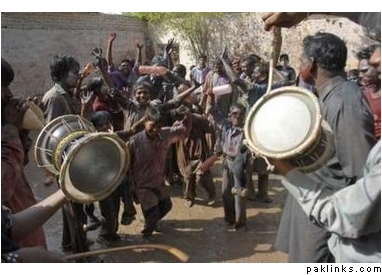
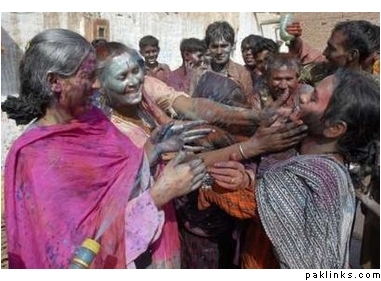
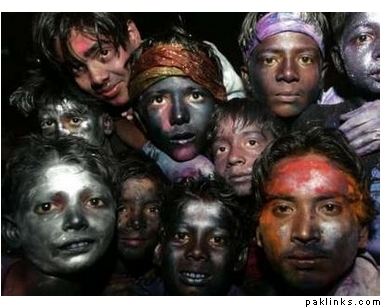
The Hindu festival of ‘Holi’ is being celebrated with great zeal by the Hindu community in Lahore as elsewhere in Pakistan. On the occasion, Punjab Minister for Minority Affairs Joyce Rufin Julius in a message issued here Saturday offered felicitations to the Hindu community and said that such religious celebrations are a time of joy and sharing, and that people of all faiths wish them a happy festival. She observed that religious minorites must also strive for national uplift and play their role in the country’s development. On the occassion of Holi, participants celebrate spring by throwing colour at each other, while prayers are offered by devotees, said Hindu leader Dr Manore Chand. He said Holi is a festival to unite those who have been separated, and represents love and peace. He said special prayers are also offered for national progress and prosperity.
Re: Krishna, Radha, Hanuman re-installed in Lahore
Yes.. i am proud of my Pakistan..intead of riots in 2002 gujrat killing brutaly 2000 + muslims...and joint ballat kar of hundreds of innocent girls and womens on streets of Naroda , Baroda.aAhmedabad etc ... in front of all people ...there was not a single such act taken in pakistan or sindh where hindus are quite large...and i am more proud to say that during thel ast 10 days of december 2006 and 10 days of january....virtually the most powerful man of pakistan was a hindu...justice bhagvan das...the acting chief justice of pakistan..a post which can negate even the orders of 5 star general !!!!!! so this is the real enlightened moderation of pakistani great people that even a very little minority of hindus...they are **generally **not suppressed or tortured......
Re: Krishna, Radha, Hanuman re-installed in Lahore
Members of the minority Hindu community in Pakistan celebrate THE Holi festival on March 4, 2007. The tradition of Holi, also known as Festival of Colours, heralds the beginning of Spring.