Re: Kallar Me Blue
Interesting 
But the link might die soon.
I have visited both places and specially the katas raj temples is very historic site. with archaeological and religious reverence for specially for hindus. And it has a very interesting story behind it (told in article bellow) . Mostly 1000 years old and oldest might be 1500 years old. and good thing is that both place very easily accessable if you commute on Isb-Lahore-motorway.
Kallar me blue
The Kallar Kahar Lake and the Katas Raj temples offer a gratifying stopover – from the motorway and the usual daily grind
By Aziz Omar
Travelling on the motorway while heading towards Rawalpindi, it is quite easy to miss the shimmering expanse of Kallar Kahar Lake. However, for those in the know, slowing down and exiting the M-2 highway at the local interchange lands them right at the banks of this historically tinged body of water. The very founder of the Mughal Dynasty, Zahir-ud-Din Mohammad or more famously known as Babur, passed through this region en-route to India to capture the throne of the Delhi Sultanate. Babur was so touched by the beauty of this area that he ordered his men to lay a garden that was named Bagh-e-Safa and which still exists today. According to his memoirs, he used to languish in the beauty of its orchids while perched atop his stone throne or Takht-e-Babri, from which he also used to address his army while it was encamped here.
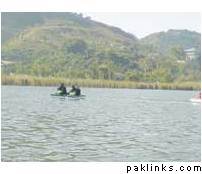
Since the opening of the motorway in 1997, Kallar Kahar is frequently visited by hordes of students while on their daylong field trips. They usually throng the gangway that extends into the lake, waiting for their turn to paddle around in the paddle boats moored there. Powering these fibre glass bobbing crafts with pure muscle power is quite an effort yet really gives one an incredible cardio workout while melting away those extra pounds that one packs in one’s otherwise sedentary lifestyle. It makes one wish that such a breathtaking (pun intended) exercise environment was located close to home so that one could access it every now and then.
This boating facility has been made possible courtesy of the PTDC (Pakistan Tourism Development Corporation) resort that is right partway up the hill that faces the lake. The lodgings here are quite comfortable with the recent additions of two VIP rooms, and even a small in-house eatery that serves a variety of Chinese and continental cuisine. However, considering the proximity to a major thoroughfare and year round stream of tourists, it is quite surprising that there is no availability of piped natural gas or cable TV services. Hence electric heaters and geysers are a costly but essential alternative.
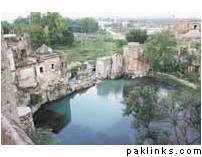
If you are truly interested in immersing yourself in ancient history, you can take the meandering road leading towards Choa Saidan Shah which passes right through the Hindu temple complex of Katas Raj some 24km away. Although most of these temples were built during the 10th and 11th centuries A.D., the earliest of these date back to the 6th century A.D. This complex is regular pilgrimage spot for Hindu devotees who come from across the border every spring. These temples had been in a state of neglect and disrepair for quite a long time until 2006 when they were transferred from the federal government to the Punjab Archaeology Department (PAD). They were also awarded a grant of around Rs.108 million to perform conservation and development work over a period of three years. Though the ruins may hold a lot of fascination for history buffs as well as for Hindu pilgrims, the highlight of the temples is the pool that is formed from the water of a mountain stream that flows in to their midst. Remarkably, the water of this pool is naturally blue and offers an attractive background for taking photographs. Nonetheless, it holds of a lot of religious significance for Hindus as it is believed to wash away all the sins of the ones who bathe in its waters. Furthermore, according to the Hindus holy book of ‘Mahabharata’, the deity Shiva wept so profusely over the death of his wife Satti that his tears formed two pools, one at Pushkara in Ajmer and the other at Ketaksha or Katak Shell. It is from the latter Sanskrit word, meaning chain of tears, that the Katas has been derived. However, a visitor might be have to shed their own tears due to usage that some others might have for water of the source stream, of which washing clothes is just one ordinary kind.
Another claim to historical fame of this place is the stay and work undertaken by the renowned Muslim scientists/philosopher extraordinaire Al-Beruni. On his way to India in the 11th century A.D. to gather material for his later work Kitab-ul-hind, Al-Beruni stayed at Katas for some time where he learned Sanskrit and also attempted to calculate the circumference of the Earth. His measurements that were a result of his solving a complex equation were so right on the money, that his figure was only off by 100km or so from the modern value.
The Kallar Kahar Lake and the Katas Raj temples offer a uniquely gratifying stopover for all those who frequently shuttle to and fro from Lahore to Islamabad. These two places on either side of the motorway as it passes through Chakwal district are ideal for one wishing to take a break from the usual daily grind (read professional bondage) that is typical of the hectic life of these two mega cities.