ISRO to build orbiter for NASA

**SRIHARIKOTA: The National Aeronautics and Space Administration (NASA) has asked the Indian Space Research Organisation (ISRO) to build an orbiter that will provide the communication between the soil samples collected from the far side of the moon and the earth, according to ISRO Chairman K. Radhakrishnan.

This joint venture between the ISRO and the Jet Propulsion Laboratory in Pasadena, California, would be part of the Moonrise missions planned by the NASA.

“This project is in the planning phase, alongside India’s lunar mission programme centred on Chandrayaan-2,” he said.

The ISRO would provide an orbiting communicator to the NASA for this mission, scheduled for 2016.

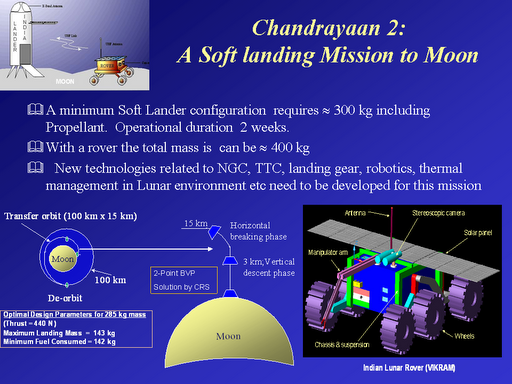
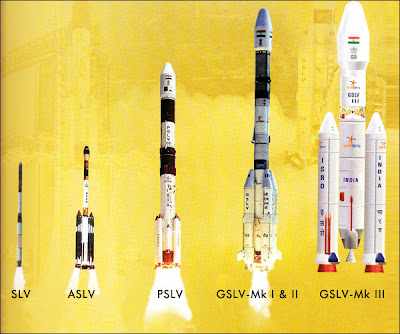
Chandrayaan-2 would be put in an orbit around the moon by a Geo-synchronous Satellite Launch Vehicle (GSLV) in 2013 and the project would cost Rs.462 crore, Mr. Radhakrishnan said. It would be a joint mission with Russia: while the spacecraft and the rover would be built by India, the lander would be from Russia.

The two-member committee the Centre had appointed to go into the allocation of the S-band spectrum to private company Devas by ISRO’s commercial arm Antrix Corporation had submitted its report. The government would give it to the ISRO, which would act on it, he said.**

source

Re: ISRO to build orbiter for NASA

India launches three satellites on single rocket

BANGALORE - India launched a rocket carrying three satellites into orbit on Wednesday in its latest effort to gain a share of the global commercial space market.
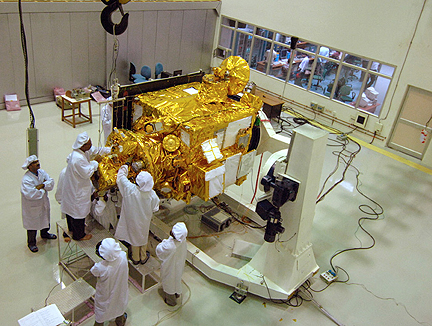
The main satellite in the launch from the Sriharikota space centre in Andhra Pradesh was the remote-sensing Resourcesat-2, which will study the effect of human life on the Earth’s natural resources.
The rocket also carried an Indo-Russian satellite for stellar and atmospheric studies and an imaging orbiter built by the Singapore-based Nanyang Technological University.
“The Resourcesat-2 mission is successful,” Indian Space Research Organisation (ISRO) chairman K. Radhakrishnan announced after all three satellites were released by the rocket 822 kilometres (510 miles) above Earth.
The successful mission was a relief for India’s space project, which suffered a major setback in December when a satellite launch vehicle blew up and fell into the Bay of Bengal live on television after it veered from its intended flight path.
Prime Minister Manmohan Singh said that Wednesday’s launch, which was greeted with cheers from scientists, “demonstrated yet again the advanced capabilities” of the nation’s space programme.
India, which aims to send its first manned flight into space in 2016, first staked a claim for a share of the lucrative commercial satellite-launch market by sending up an Italian orbiter in 2007.
The country sees its space exploration programme as an achievement that underlines its emergence as a major world economy, and many Indians take patriotic pride in its development.

http://www.isro.org/pslv-c16/Imagegallery/launchvehicle_images/pslvc16-lp3.gif

http://www.thehindu.com/multimedia/dynamic/00545/10TH-RESOURCESAT_2_545445e.jpg

better then testing some nuclear weapons,which are never going to used anyway :smiley:

Re: ISRO to build orbiter for NASA

wow...amazing! i wish them ALL the success :) it's indeed a step in the right direction. :)

Re: ISRO to build orbiter for NASA

ok another site i saw brief role about this orbiter,will copy paste :D

Re: ISRO to build orbiter for NASA

Moon Rover

The lander

unlike on the Chandrayaan-1, none of these seven instruments are international: they’re all ISRO, even on the Russian-built rover

**QUESTION: “A significant aspect of Chandrayaan-2 is that the orbiter, unlike in Chandrayaan-1, does not have any foreign payloads even though NASA and the European Space Agency showed interest. Is there any reason why foreign payloads have been removed?"

ANSWER: “As per the present plan we do not have any weight in the orbiter for foreign payloads. We were keen on giving an opportunity to our scientists.”- “‘We’re Launching Chandrayaan-2 for a Total Coverage of the Moon”**

Re: ISRO to build orbiter for NASA

Orbiter

1. Large Area Soft X-ray Spectrometer and Solar X-ray monitor (XSM).

•Similar to a payload on the first Chandrayaan, these will map major elements on the lunar surface—namely magnesium, aluminium, silicon, calcium and iron.

2. L and S band Synthetic Aperture Radar (SAR).

“…for probing the first few tens of metres of the lunar surface for the presence of different constituents, including water ice. SAR is expected to provide further evidence confirming the presence of water ice below the shadowed regions of the moon…” – “Payloads for Chandrayaan-2 finalised, to carry 7 instruments”, The Times of India

•Icing on the lunar water cake…and, of course, potentially valuable ($$$) info on what deposits there are and where.

3. Imaging IR Spectrometer (IIRS).

“…for mapping of lunar surface over a wide wavelength range for the study of minerals, water molecules and hydroxyl present…”- The Times of India
•This will confirm the levels of water that is collected in the soil and minerals, as opposed to the water ice (as payload 2 above will investigate). This should be a comparatively tiny amount of water, but any in situ amount is both helpful and potentially valuable.

4. Neutral Mass Spectrometer (ChACE-2)

“…to carry out a detailed study of the lunar exosphere.” -The Times Of India

•The lunar exosphere is what little ‘atmosphere’ the moon has, and pertains to the interactions of ions and the solar wind. Japan’s Kaguya was the first craft to detect the Moon originating ions outside of the solar wind, so this is an area really just beginning to be dug into.

5. Terrain Mapping Camera-2 (TMC-2)

“…for preparing a three-dimensaional map essential for studying the lunar mineralogy and geology.” -The Times of India

•Lunar orbiters love their Terrain Cameras, and after seeing the amazing images that the LRO’s been churning out in spades, to have a potentially next-gen set of imagery in 2013 could make for a spectacular view.

Rover

1. Laser induced Breakdown Spectroscope (LIBS).

•As the U.S. Army puts it, a LIBS is “simple, straightforward, and powerful”! It ‘atomizes and excites particles‘, and “in principle, LIBS can analyse any matter regardless of its physical state, be it solid, liquid or gas“…which sounds really convenient for detecting helium-3, it being a gas that collects in the lunar soil and that can be released (and therefore collected for use) by heat.

2. Alpha Particle Induced X-ray Spectroscope (APIXS).

•Also for determining chemical composition, this instrument (at least, on a Mars rover equivalent) is geared more towards geologic study: formation of rock, crust, etc.

source:chandrayaan-2
Re: ISRO to build orbiter for NASA

http://luna-ci.com/wp-content/uploads/2009/05/newsweek-pdf-miner.jpg

Re: ISRO to build orbiter for NASA

Re: ISRO to build orbiter for NASA

SOFT LANDING SCHEME

http://1.bp.blogspot.com/_GqeW76-fC2I/S-fsyUhq_EI/AAAAAAAAAq0/JCMALc6Gtks/s1600/Soft+Landing+Scheme.jpg

Re: ISRO to build orbiter for NASA

If I remember right even the NASA Mars landing mission was led by an Indian American - the landing sub-system