salam,
my question regarding calligraphy,that wht’s the scholars view about calligraphy.
coz Quran is not for decoration or just o set on the walls.
whts ur view abt it?
salam,
my question regarding calligraphy,that wht’s the scholars view about calligraphy.
coz Quran is not for decoration or just o set on the walls.
whts ur view abt it?
Re: is calligraphy allowed in islam?
Who said that you cannot decorate Quran? Don't make religion hard on yourselves by your own assumptions.
Re: is calligraphy allowed in islam?
salam,
my question regarding calligraphy,that wht's the scholars view about calligraphy. coz Quran is not for decoration or just o set on the walls.
whts ur view abt it?
what do you think are the prevailing views of scholars as you see kaaba and masajid, new and old?
hmmmmmmmm
but you may be right..
I suppose then we have to take the cover off from kaaba and take down all the calligraphy on all the masajid. :(
Re: is calligraphy allowed in islam?
Calligraphy is, on the other hand, encouraged and liked in the views of Scholars.
Re: is calligraphy allowed in islam?

Re: is calligraphy allowed in islam?
yep, even rule out people with good handwriting…
Quran is not for decoration, the one has the worst handwriting shud write down all the Quran…

Re: is calligraphy allowed in islam?
 …armughal bhai aap buhat sarcastic hain.
Re: is calligraphy allowed in islam?
the form of art allowed in islam is calligraphy , but on the walls ,
there would be limitations
Re: is calligraphy allowed in islam?
if ppl do calligraphy, it has many styles some styles are not easily understandable by a lay man.so wht do u want to preach if ppl unable to even read it.
so u just simply use ayahs to decorate walls and paintings.
and who says Quran is for decoration, our Holy Prophet(PBUH) never ever used any ayat or dua for decorating purpose. He (PBUH)
only preached to obey and follow Its rules.
Re: is calligraphy allowed in islam?
Guess whats written on this tile.
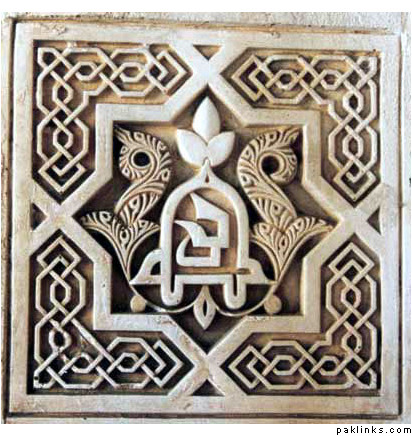
Did Prophet Muhammad(SAW) ever say that the use of ayahs for decoration is not allowed?
I think Uthman(ra) for the first time used Quranic ayahs for the wall of a mosque, like Umer(ra) added “Asalaatu Khairu minan naum” in the salaatal fajar.
If Sahaba(ra) has used the ayahs for decoration then why can’t we?
Re: is calligraphy allowed in islam?
so how else u wana decorate ur walls wid…abstract nude figurez or ny other garbage. 
(HAVE QURAN IN HEART, but it will be great IF PAAK-AYAT are always in front of ur eyez :))
(sorry mam i m XTEREMLY TOUCHY ABOUT ART n ESPECIALLY CALLIGRAPHY. ppl like me use art to express their relationship with ALLAH SWT. n also reveal it to the non-muslimz dat look we are not all about SOO CALLED BARBARIC STORIES. we are fill wid colorz, emotion. each turn describes r new mode, a new of us.)
putting them on walls also gives the feeling as him those walls are meant to made for this purpose. (oo wat n idea…inshaALLAH i will sculpt or paint walls of my house wid Quranic verses…AMEEN)
u know many ppl turn to Islam cuz of calligraphy. 
Re: is calligraphy allowed in islam?
I don’t see why not but I find it a bit disrespectful when they make animate objects out of it like making peacock shapes with curly writing when writing the name of Allaah :swt: or a lion when writing the name of 'Ali  (he is indeed the Lion of God, but no need to break laws).
Quranic calligraphy is a beautiful part of our culture but if you’re going to put it up then respect it, don’t take drugs (smoke etc.), swear/curse or watch/listen to unIslamic things on the TV if it’s in the room. Also don’t just hang it there, make it practicle and use it as a reminder to read the Verses and Prayers so Allaah will bless your home.
I wouldn’t think mere hanging up verses on it’s own will have much blessing though so use them for reading off.
It’s no religious requirement to hang them up though, I personally like the idea that there is no iconography in Islaam, we don’t have any symbols for worship like the Christians have the Cross, the Hindus have all them statues/idols, us Muslims don’t have any such thing (the Crescent-Star has nothing to do with Islam), we are devoted to and worship the True Lord who is so Great that He is beyond our imagination/comprehension so icons/symbols are useless. It remninds me of something I once heard “the non-Muslims wear their coat with the fur on the outside but us Muslims wear it on the inside” (our religion gives inner satisfaction/serentiy/peace whereas other religions resort to superficial rituals and show.
Re: is calligraphy allowed in islam?
i do not think that is included in calligraphy . and yes it is disrespectful
nicely explained
Re: is calligraphy allowed in islam?
Question:
When visiting muslims, I noticed that many of them put verses of the Qur'an on the walls or pictures with the names Allah and Mohammed. I know a lot of muslims think that it is good to do so because it will protect them and their house. Personally, I consider it a form of shirk or superstition. Is there any ruling on that subject?
Answer:
Praise be to Allaah.Hanging plaques and cloths containing aayaat of the Qur'aan in homes, schools, social clubs and places of business, involves a number of reservations and prohibitions according to Islam, such as the following;
(1) In most cases, hanging such things on the wall is done for purposes of decoration and adornment, as the aayaat etc. are written in calligraphy and colourful brocade. This is an inappropriate use of the Qur'aan, as it was revealed to guide people and to be read regularly. The Qur'aan was not revealed to decorate walls, but to guide mankind.
(2) Some people hang up such things for "blessing" - which is a form of bid'ah. The blessing as described in Islam comes from reading or reciting the Qur'aan, not from hanging it up or placing it on shelves or turning it into artwork and three-dimensional images.
(3) This is contrary to the practice of the Prophet (peace and blessings of Allaah be upon him) and the Rightly-Guided Khaleefahs (al-Khulafaa' al-Raashidoon), may Allaah be pleased with them, who never did such a thing. The best way is to follow them, not to introduce bid'ah. History tells us that in places such as Andalusia, Turkey, etc., the adornment of houses and mosques with ornate carvings of aayaat only happened at times when the Muslims were weak and humiliated.
(4) Hanging up such pictures or plaques could lead to shirk, because some people think that these things are amulets that will protect the house and its people from evil and disease. This is shirk and is haraam, because the One Who really offers protection is Allaah, may He be glorified, and one of the means of gaining His protection is sincere recitation of the Qur'an and du'aa's taught in the Qur'aan and Sunnah.
(5) There is the risk that the Qur'aan may be used, in such cases, as a means of promoting one's business or increasing one's earnings. The Qur'aan should be protected from being used for such purposes. It is well-known that the production and sale of these pictures and plaques involves a great deal of extravagance and wasting money.
(6) Many of these plaques are painted with real gold, which makes using them and hanging them up even more haraam.
(7) Many of these plaques involve a kind of carelessness, because the letters are twisted into complex designs that are of no benefit to anyone because they are barely legible. Sometimes words are fashioned into the shape of a bird or a man prostrating, and similarly forbidden pictures of animate beings.
(8) Ayaat and soorahs of the Qur'aan are exposed to misuse and abuse by this practice. For example, when moving house, they are piled up with the rest of the furniture and belongings, and other objects may be placed on top of them. This also happens when they are taken down so that the wall may be painted or cleaned.
(9) Some Muslims whose observance of Islam is lacking put these plaques and pictures up so that they can feel that they are doing something religious, in order to reduce their feelings of guilt – in spite of the fact that this practice does not help them in any way.
All in all, we must close the doors of evil and follow the leaders of guidance of the early centuries of Islam, whose people the Prophet(peace be upon him) testified were the best of the Muslims in faith and practice. If someone were to say, "We are not going to abuse it or make it a decoration or exaggerate about it, we only want to remind people (about their religion) in our gatherings", our response would be: if we look at real life, will we find that this is what actually happens? Do people really remember Allah? Do they even read these aayaat when they raise their heads?
What really happens is the opposite: people go against the words hanging over their heads, they still tell lies, engage in gossip, make fun of others and do and say evil things. Even if we assume that there are some who do benefit from these plaques etc., the fact is that they are very few, and this does not change the hukm (Islamic ruling) on the matter.
The Muslims must turn to the Book of Allaah, read it and recite it, and act in accordance with it. We ask Allaah to make the Qur'aan a light of guidance for us, and a means of removing our grief and anxiety. May Allaah bless our Prophet Muhammad.