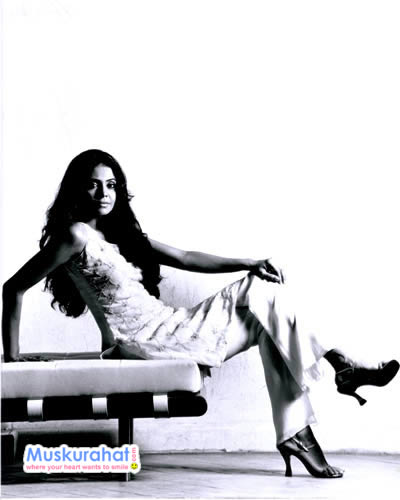
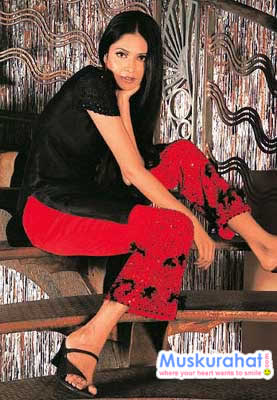
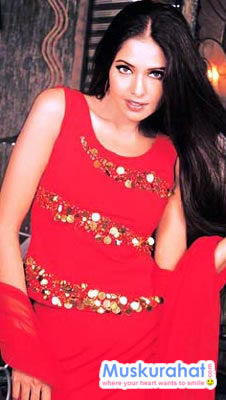
She is one of my favorite model (Sunita Marshall being the finest in my opinion, then Iraj…) She is definately the most professional model…I found this article…
-feel free to share pictures…
source: www.dawn.com
Irresistibly Iraj
At 32 mega-model Iraj Manzoor, like most unmarried women in Pakistan, still lives at home. This cozy abode is a fifth floor apartment near the old Sabzi Mandi in which the Manzoor family has lived in for what seems like a sentimentally long time.
There is none of the garishness associated with newbie ‘celebrities’ nor the je ne sais quoi ambience of the love shack of a languorous and independent model. It is a tasteful family home, with stunning prints made by both Iraj and her younger art school-going sister hung on the walls of the sitting room, with a welcoming adjoining kitchen. Iraj’s mother, veteran TV actress Zinat Yasmin, even peeks in and offers tea and biscuits.
Iraj also finally looks at ease in her own skin and is voluble; bubbling with effervescent energy and candour. Her gamine crop (which she’s bored of talking about and no, her mane was not what ultimately epitomized her) has grown out, and she has allowed it to follow its own natural wavy route, adding a dash of burnt sienna on a centre straggle of hair. She is without make-up, save for a little kohl on her under-lids, barefoot and dressed simply in a skater’s long T-shirt and snug, slim jeans.
Iraj has always been heralded as an ‘amazon’ and a ‘chameleon,’ both for her 5’10” frame, once long wavy hair and dusky complexion; as well as for her ability to seduce the camera and become a mood-swinging photographic changeling. Her most distinctive quality however has always been her authenticity. At any given time in her 14-year career one could inversely ply that chameleon-like soft mocha skin of hers and find the same being on the other side. It is one trait that she is also most proud of.
‘Fashion has become crafty rather than arty and I think the time of the supermodel is gone. Now it’s very Stardust and Bollywood inspired. Publications have become catalogues, and designers have become shadi ka jora mills, not aiming to produce ethereal pieces anymore,’ says Iraj
“I don’t think I fall into the circle of ‘icon,’ she says evenly when asked about her status in the fashion world. “I think a model has to go beyond modelling, into acting for example to be considered an icon. Few people cater to the perception of a model reaching such heights.” She mulls and sprightly states that she feels, however, that she has reached icon-hood, and she says this not with a self-righteous hauteur but just as a matter of fact. “I think I’ve given a lot and set standards. I’ve been outspoken. I’ve sat out of shoots that weren’t creatively interesting.”
In response to a question whether there was the possibility of a model receiving a ‘lifetime achievement award’ at the upcoming Lux Style Awards, Iraj says that it would probably never happen as models weren’t taken that seriously, but hopes otherwise. “I think what sets me apart is that my purpose for modelling has not been like that of the other girls. I think my stint as a model has been as important as the work done by a person sitting in a corporation or the travails of a social worker. It has not been my purpose for everything in life, but there has been pain involved. I think I have gone beyond and challenged the stereotypical, physical and sociological impressions of models. It hasn’t just been about looking good and feeling good. The validation of my sanwali complexion was also a challenge to the gori chitti-obsessed fashion industry.”
Feeling good about herself has not always been an easy undertaking for the now seemingly self-assured mannequin. In a profile about four years ago, Iraj had discussed her “uncomfortable relationship with food.” She had said she had been almost anorexic and at fashion shows, while skinny Vinny dove into a heap of biryani, Iraj would find dinnertime excruciating.
Iraj unabashedly says that since she quit smoking three years ago she has become much more conscious about her eating habits. “I was a chain-smoker for 12 years. Peoples’ general perception of a model is ‘No food, lots of cigarettes; drinking; loose morals; and unfortunately loose bowels as many models also use laxatives’. And a lot of young models buy into that stereotype. One is so pressurized to remain skinny that one becomes disoriented. A lot of the new girls don’t eat and start smoking in their belief that this will keep them thin. It is my responsibility and the industry’s to re-educate the new crop of girls and tell them there is an alternative, and that is to be healthy,” says the model who still claims that she loves a woman’s clavicles showing not as a sign of malnourishment, but of power.
Iraj says she now maintains her base weight of 116 pounds with aerobics, running and using weights. “I eat food to stay healthy and to remain healthy when I am old. It’s been about a life change and sticking to a healthy lifestyle.”
Speaking about the industry in which she has reigned, along with Vaneeza Ahmed, for nearly a decade-and-a-half (“Vinny came much after me, about four years later”), Iraj becomes animated but stays to the point. “Fashion has become crafty rather than arty,” she says, throwing me the ironic smirk that has delighted fashionistas for aeons.
“I think the time of the ‘supermodel,’ of Vinny, Bibi, Zoella and (Amna) Zaidi, etc, is gone. Now it’s all about mass production done in bulk. There is no pain involved in shoots anymore. I loved the outdoor shoots we used to do with Arif (Mahmood) and Arshad (Tareen). Now it’s very Stardust and Bollywood inspired. The personal touch is missing. Publications have just become catalogues, and designers have become shadi ka jora mills, not aiming to produce ethereal pieces anymore.”
She says that she does suffer professionally because she avoids shoots that a lot of the other girls end up doing. “I just can’t stand and do the typical spiel in front of a tree,” Iraj says, adding that she also can’t sit with other models either. “They don’t talk. They b… out. I find being alone more constructive and less obscene. I need positive energy around me and to remain rooted, otherwise I’m miserable.
“I find this whole clannishness and grouping associated with this field very bothersome. Since Lahore has come into the fashion frame in a big way, not necessarily in terms of quality but at least in quantity, the exigencies related to clannishness have increased.” Iraj says that Lahore girls should get along with Karachi girls as there is a lot of talent in both cities in terms of photographers and stylists and enough work for both of the cities’ models. “But the thing is,” Iraj explains, “it’s not up to the models in most of the cases. It’s this entire system of Svengalis who don’t allow “their” models to circulate around other clans.”
http://www.dawn.com/weekly/images/images/images1c.jpg She also sees a class bias inherent in the modelling business. “I come from a very Urdu-speaking background. I’ve been lucky as I’ve been very bad with my PR. But God has been kind although it has taken me a long time to reach my pinnacle. However, I feel newer modelling agencies would discriminate and only encourage girls from a particular social milieu. I see the same happening on FM radio channels with their overabundance of English being spoken. If I befriend a fledgling model from a background similar to mine, I could help her, but her agency might not encourage her as much as she deserves.”
What about the absence of and a need for a cohesive fashion council? “This is not a personal attack,” Iraj warns smiling. “But when ‘big people’ get together their egos begin to collide. That sense of segregation and ‘me, myself and I’ has to go and the whole industry has to move beyond and view the larger picture.” Iraj concedes that this type of detachment is difficult in human nature but fashion people need to get the basics and the foundation right. “Most people in the fashion field aren’t rooted. They don’t know why they’re there,” Iraj states without irony.
How did she feel when the LSA handed out a ‘Best Model’ award to both her and Vinny in 2002? “It didn’t feel good,” she says. “They played it safe. I think they should have given out ‘Best Model’ awards in two different categories. I was justified for ramp modelling and Vinny for print.”
Iraj is also vocal about the latest campaign for a soap brand, perhaps feeling a tad bit pinched that neither she nor her cohort Vinny was used in it. “Besides being known as the ‘soap for film stars,’ they should look beyond the film world and use new faces that may make it in the industry. I feel though that Sonya Jahan was a good choice.”
The cultural predilection for the gori and the chitti brings us to Iraj’s early music video appearances and the controversies surrounding her most recent cameo in Schaz’s Jalan. “I’ve done five music videos in my career,” Iraj explains. “My personal favourite is the Vital Signs’ Sanwali Saloni which I took favourably as an allusion and compliment to my own complexion,” says Iraj.
A video Iraj did just for the concept (“Primarily, the concept of a video is very important in my decision to commit to a project, as is the money, otherwise one is used and abused”) was Saqib Malik’s risque video for Rushk’s Behti Naar which was so provocative that its screening on TV was ultimately banned. “At that time in my life I could relate to the dominatrix role and I loved the fact that I was dominating Tariq Amin,” she says.
But the character she plays in Jalan seems to be Iraj at her most authentic self, although there is also a hint of the alter ego and apparitional character played by Brad Pitt in Fight Club. “That is the real me,” Iraj says in an almost celebrative manner. “I am very loud. However, I’m not that adventurous. I might have to think about things. Among my friends and colleagues I’m the most weird and experimental and no one is as much as a shocker or is not as balsy as me. The director of Jalan, Wajahat Rauf, came up with this character and knew he had to cast me. Finally I got a character I could relate to.”
Iraj says that her days of dreaming about a romantic ideal have been numbered. “I believe the best ideal is yourself,” she says stoically. “I’m busy discovering that first. The perfect person inside of me. When that happens I’ll observe the seemingly perfect block and look for something missing in me and find someone to fill that void.”
This is the conundrum surrounding this seemingly straightforward of models. “Perfection is boring,” she says only half facetiously. “I suppose I’m a negative person. But quixotically the negativity within me brings out the positive energy that is so important to my survival and sustenance. That’s why the negativity surrounding fashion helps me to channel an optimistic outlook.”
And what does the future hold for this fashion maverick? Is it time to hang up the catwalk stilettos? “Yes,” she guffaws. “I’m still viable monetarily. I will never ever use botox and collagen implants. I have survived because of my honesty; my integrity in my work; always making an extra effort and slogging; my individuality; and my authenticity. People who have common sense and an aesthetic eye will always see my value. The basic criteria for a model are her physical attributes. But I would like to suggest to the fashion world to think about character building. I want to do a lot of things, but self-control is an issue with me.
“I don’t do TV because that’s a personal choice. The dramas of my mother’s heyday were far superior. I would never do a soap opera especially where the role is built around the fact the actress was a model. I love Sania Saeed. She is my favourite actress because she is so simple but brilliant. I’m very anti-filmi. Look at the recent spate of TV commercials. They are all ‘item’ based. Our culture is not like that. The fuzzy line between Indian and Pakistani TV has become more obscure,” she says.
A graduate of Karachi’s Indus Valley School of Art and Architecture’s Fine Arts programme and a very talented artist whose thesis project was an incisive rendition of the stringent demands imposed on models’ bodies, Iraj says that she is miserable that she is not painting these days. However, she would have to think really hard about participating in a exhibition. She would love to perform more mime theatre after her fashion tableau performance with the Lahore-based mime troupe Oops! in a Nabila/Zain Mustafa production.
“My friends, especially Schaz, who can really sing well live, tell me I have a great voice. But I’m a perfectionist and so I use that as an excuse to become lazy about most things.” Lazy perhaps, but also enduring.