Iqbal Poetry Contest====Now Closed

:salam:

As you all know gupshup is paying tribute to our National poet Alama iqbal on his death anniversary.Being a Poetry lover its also our duty to pay a little tribute by cherishing his poetry. in honor of his work we’ll be having a poetry contest. I hope you can all participate by presenting his work in your own way. for more details you can check the link below.

http://www.paklinks.com/gs/showthread.php?t=282883

<font size"5">Rules:
More than one ghzal are allowed
NO Audio/Video is allowed
Images can be used
No Entry should be exceed more than one post.

=================
Submissions start: 18th April
Closing Time:28th April
Results: date to be announced

Points Scale & Judges Panel

Judges Panel: Alyish, Chacha Ghalib and TLK

Points Scale:
Introduction (2 points)
Presentation (3 points)
Piece of poetry (5 points)

Re: A Gupshup Tribute to Shaire-e-masriq Alama Iqbal (Poetry Contest)

http://www.koolpoetry.com/bismillah.gif

http://img36.picoodle.com/img/img36/4/4/18/f_k3372m_d2256df.gif

Introduction:

Hakeem-ul-Ummat Shaair-e-Mashriq Dr. Sir Allama Muhammad Iqbal was born in Sialkot on November the 9th,1877. He got his school and collegee ducation from Sialkot. He got his B.A. and M.A. from Government College Lahore. He got Gold Medal in M.A. Philosophy from University of the Punjab. Iqbal Stayed in Europe from 1903 to 1907 for higher studies. He studied at Cambridge (England) and Munich (Germany). Finally, he got his Ph.D. degree from the Munich University.
Dr. Iqbal died in Lahore on April the 21st, 1938. He is buried near the footsteps of the Badshahi Mosque Lahore.

Presentation:

Life Sketch:

Allama Iqbal is the son of Shaikh Nur Muhammad, was a tailor whose handiwork was quite well known in Sialkot. But it was his devotion to Islam, especially its mystical aspects, that gained him respect among his Sufi peers and other associates. His wife, Imam Bibi, was also a devout Muslim. The couple instilled a deep religious consciousness in all their five children.

Allama Iqbal As Poet:

Allama Muhammad Iqbal is generally known as a poet and philosopher, but he was also a jurist, a politician, a social reformer, and a great Islamic scholar. People even bestowed on him the title of “Shaere-Mashriq” (Poet of the East!). It may sound strange that Iqbal never considered himself a poet as is evidenced by his correspondence with Syed Sulaiman Nadvi [1885-1953].

“I have never considered myself a poet. Therefore, I am not a rival of anyone, and I do not consider anybody my rival. I have no interest in poetic artistry. But, yes, I have a special goal in mind for whose expression I use the medium of poetry considering the condition and the customs of this country.”
(translated from the original in Urdu; Maktoobat, Volume I, page195)

Allam Iqbal As A Muslim:

Iqbal’s contribution to the Muslim world as one of the greatest thinkers of Islam remains unparalleledThe central theme and main source of his message was the Qur’an.
Iqbal considered the Qur’an not only as a book of religion (in the traditional sense) but also a source of foundational principles upon which the infrastructure of an organization must be built as a coherent system of life.
Thus, in Iqbal’s opinion, Islam is not a religion in which individuals strive for a private subjective relationship with God in the hope of personal salvation as it is done in secular systems. Iqbal firmly opposed theocracy and dictatorship and considered them against the free spirit of Islam.

Allama Iqbal Presidential Speech:

In his 1930 Presidential speech delivered to the annual session of Muslim League at Allahabad, Allama Iqbal stated:
“I, therefore, demand the formation of a consolidated Muslim state in the best interests of India and Islam. For India, it means security and peace resulting from an internal balance of power; for Islam, an opportunity to rid itself of the stamp that Arabian imperialism was forced to give it, to mobilize its laws, its education, its culture, and to bring them into closer contact with its own original spirit and with the spirit of modern times.”

Allama Iqbal Deedawar:

Iqbal’s “Deeda-war” (visionary), is like Iqbal himself. He could foresee what others could not. Whereas others only have a short term view of things, a visionary sees the problems in a long term perspective and develops some sort of cosmic sense. A nation is indeed fortunate if it produces a few such individuals in centuries. Such individuals, although very rare, change the course of history forever, as indeed Iqbal did. Pakistan owes its existence to Allama Iqbal. Thus, the people of Pakistan owe a great deal of gratitude to this extraordinary visionary.
Allama Iqbal’s contributions are numerous and it is not possible to give even a glimpse of his work here.

http://img37.picoodle.com/img/img37/4/4/18/f_Visonarym_1db05bf.jpg

I also want to share a ghazal of the same behar which I have found on paklinks during searching Iqbal’s work which was shared long back.I loved to read following ghazal hope you people also like it.

“Deedawar Ki Talaash”

Iqbal nay bhee kiyaa khwaab dekha thaa
Kay Muslim main ho Cheetay ka jiger paida

Nazar Uqaab kee, parvaaz Baaz jaisee
Ho na sakaa par chaman main deedawar paida

Najaanay aaey kitnay hee iss kay baad
Nigah-e-kargas liyeh, huvay dil-e-buuz paida

Baat tau kartay hain loug apnay aslaaf kee
Par nahin hotay kahin bhee Ibn-e-Qasim paida

Sunna hay kay har khuaab kee hotii hay taa’beer, Anwaar
Shayad kay ho hee jaaey kaheen Iqbal kaa bhee Shaheen paida

My Thoughts And Outline Of The Following Selected Poetry:

He gives an account of the Prophet (PBUH) and his high qualities. Not only here alone, but throughout his poetical works we can see an unceasing stream of his love for the Prophet (PBUH) gushing out wave after wave.
I read in a book about Allama Iqbal that He Say Filbadi Poems and Ghazals and whenever a poem that contained the Prophet’s (PBUH) sacred name was recited in Iqbal’s presence spontaneously tears flowed from his eyes.So thats why I selected one of his Persian Ghazal which is related to our Holy Prophet (PBUH) to give tribute to him.May ALLAH bless him with all HIS blessings and Janat-ul-Firdous Amin.

Tomb Of Allama Iqbal:

http://content.answers.com/main/content/wp/en/thumb/9/97/250px-Inside_allama_iqbals_tomb.JPG

My Selected Peice Of Poetry:

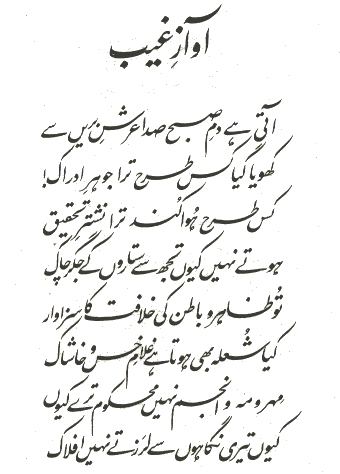
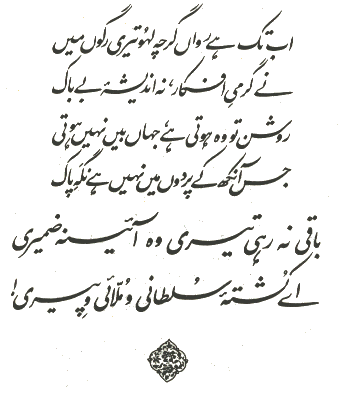
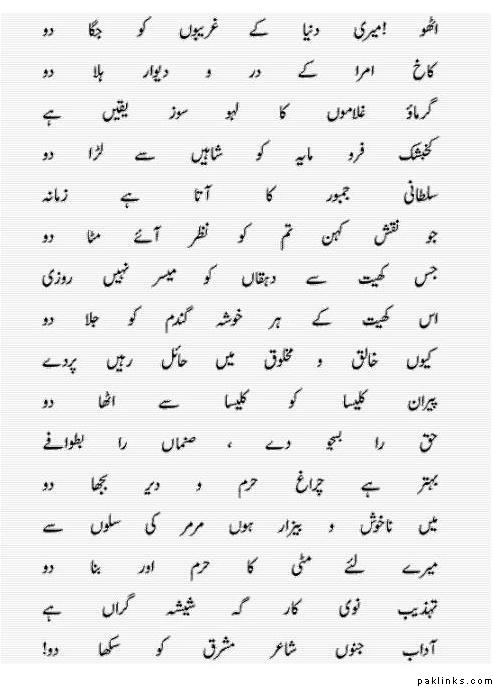
http://img37.picoodle.com/img/img37/4/4/18/f_iqbal092927m_4c87056.gif

English Translation:

The beloved is hidden in Thy heart.
If thou art gifted with eyes, come, I will show thee his face.,
His lovers are lovelier than all the beloved of the world,
More beautiful, more elegant and more loveable.
Through his love the heart gains strength,
And the earth attains the exalted status of the Pleiades.
The land of N«id was made vigilant ingenious through his grace,
In a state of ecstasy it flew higher than the heavens.
The heart of the Muslim in the seat of al-Mustafa.
Whatever respect we command is due to his name.
Mount Sinai is nothing but dust that arose from his House,
His parlour is sacred even for the Ka’bah.
The mat is grateful to him that he prefers to sleep on it,
The Taq-e Kisra is trampled under the feet of his Ummah.
He retired to the privacy of the Cave of Hira’,
And brought forth a nation, a constitution and a government,
Night after nigh t passed by his bedside finding him awake,
So that his people could rest on the throne of Khusrow.

**

http://img37.picoodle.com/img/img37/4/4/18/f_AlamaIqbalm_494c04c.jpg

**

Re: Iqbal Poetry Contest

http://www.paklinks.com/gs/../gsmedia/thumbs/14734/Allama_Iqbal.jpg

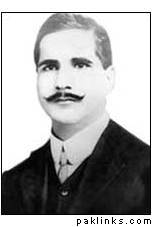
Hakeem-ul-Ummat, Muffakkir-e-Pakistan, Shaair-e-Mashriq, Dr. Sir Allama Muhammad Iqbal:rahm: - a person considered to be the GREATEST and the BIGGEST poet of 20th century by a majority of Critics needs no introduction on his name for he is commonly well known to everyone who is related to Pakistan in someway or other and to muslims especially Arabs who have read his translated work…

The following information about him is taken from Wikipedia and is accurate as per my own knowledge about him.

Sir Muhammad Iqbal (Urdu:** محمد اقبال**) born (November 9, 1877 – April 21, 1938) was a Muslim poet, philosopher and politician born in Sialkot, British India (now in Pakistan), whose poetry in Urdu and Persian is among the greatest of the modern era, and whose vision of an independent state for the Muslims of British India was to inspire the creation of Pakistan. He is commonly referred to as Allama Iqbal (علامہ اقبال‎, Allama lit. Scholar.)

After studying in England and Germany, Iqbal established a law practice, but concentrated primarily on writing scholarly works on politics, economics, history, philosophy and religion. He is best known for his poetic works, including Asrar-e-Khudi—which brought a knighthood— Rumuz-e-Bekhudi, and the Bang-e-Dara, with its enduring patriotic song Tarana-e-Hind. In Afghanistan and Iran, where he is known as Iqbāl-e Lāhorī (اقبال لاهوری‎ Iqbal of Lahore), he is highly regarded for his Persian works.

Iqbal was a strong proponent of the political and spiritual revival of Islamic civilisation across the world, but specifically in India; a series of famous lectures he delivered to this effect were published as The Reconstruction of Religious Thought in Islam. One of the most prominent leaders of the All India Muslim League, Iqbal encouraged the creation of a “state in northwestern India for Indian Muslims” in his 1930 presidential address. Iqbal encouraged and worked closely with Muhammad Ali Jinnah, and he is known as Muffakir-e-Pakistan (“The Thinker of Pakistan”), Shair-e-Mashriq (“The Poet of the East”), and Hakeem-ul-Ummat (“The Sage of Ummah”). He is officially recognised as the “national poet” in Pakistan. The anniversary of his birth (یوم ولادت محمد اقبال‎ - Yōm-e Welādat-e Muhammad Iqbāl) on November 9 is a holiday in Pakistan.

Iqbal Died on April 21st, 1938 in Lahore.

His works in urdu includes the following books in his name:

  • Baang-e-Dara (1924)

  • Baal-e-Jibreel (1935)

  • Zarb-e-Kaleem (1936)

  • Armaghan-e-Hijaaz (1938)
    His works in Persian includes the following books in his name:

  • Asrar-e-Khudi (1915)

  • Rumuz-e-Bekhudi (1918)

  • Payaam-e-Mashriq (1923)

  • Zaboor-e-A’jam (1927)

  • Javaidnaama (1932)

  • Pas Chah Bayaad Kard (1936)

  • Armaghan-e-Hijaaz (1938) - also in the list of urdu poetry

lab pe aatii hai duaa banake tamannaa merii zindagii shammaa kii surat ho Khudaayaa merii

duur duniyaa kaa mere dam a.Ndheraa no jaaye
har jagah mere chamakane se ujaalaa ho jaaye

ho mere dam se yuu.N hii mere watan kii ziinat
jis tarah phuul se hotii hai chaman kii ziinat

zindagii ho merii parawaane kii surat yaa rab
ilm kii shammaa se ho mujhako mohabbat yaa rab

ho meraa kaam Gariibo.n kii himaayat karanaa
dard-ma.ndo.n se zaiifo.n se mohabbat karanaa

mere Allaah buraaii se bachaanaa mujhako
nek jo raah ho us raah pe chalaanaa mujhako

kahiye kesi rehi presntation and poetry…:slight_smile:

Re: Iqbal Poetry Contest

:bism:

INTRODUCTION


Name: Mohammed Iqbal

Other names (Alaises): Poet of the East, The Poet Thinker, The Poet who dreamt Pakistan, The poet who awakened the Muslims of India. Spiritual father of Pakistan.

Birth: November, 1876 at Sialkot

Education**:**M.A. Government College Lahore,Barrister at law England,Doctorate in Philosophy Germany (1905-1908)

Profession: Taught Philosophy and Law. Barrister at Law. Member Punjab Legislative Council 1926-1930. President of Muslim League 1930 Knighted by the British in 1992 for poetry.

Hobbies and Passion, and claim to fame: Poetry in Urdu and Persian.


PRESENTATION

Dr. Allama Muhammad Iqbal, A Philosopher Poet, A Genius Linguist, A Man of Foresight, A Man of Strong Faith in All Mighty God, A Man of Peace and Unity, A Man of Justice and Equality, A Man of Love and Humility, A Man of Wisdom and above all, The Artist of First Ever Islamic Republic, which got freedom in name of Islam.

Allama Iqbal & Pakistan


**KHANJAR HILAL KA HAI QAUMI NISHAAN HAMARAH **

. ” The Muslims wish to lead a life of freedom and honour. They want to live as a nation and this can be achieved if they have a separate Islamic state”. (Two nation theory, 1930)

” Cant you see that a Muslim, when he was converted more than a thousand years ago, bulk of them, then according to your hindureligion and philosophy, he becomes an outcast and he becomes aMalecha (an untouchable) and the Hindus ceased to have anythingto do with him socially , religiously , culturaly or in any otherway? He, therefore belongs to a different order not merely religiousbut social and he has lived in that distinctly separate and antagonostic social order, religiously, socially and culturally…can you posibally compare this with that nonsensical talk thatmere change of faith is no ground for a demand for Pakistan? Cant you see the fundamantle difference ?"

**2 march 1941, Pres. address to Punjab Muslim Students Fed.

Dr. Muhammad Iqbal, A Man who devoted his life for his people. The dynamic leader of slave Muslims of India, who dared to preach Self-Respect to subjugated and exploited Muslims of India. Who had been the first drop of rain, who taught the lesson of Dignity, Prestige and Grace to his people, who had been socially destroyed and physically trampled by the British Rulers.

Dr. Muhammad Iqbal, A Man who loved his people, who was not like ordinary leaders, who was not power or fame hungry, found out the right person for administration and management for Independent Muslim State Resolution and handed over all authorities of All India Muslim League to him. This dynamic and bright leader of Indian Muslims was the famous Barrister Mr. Muhammad Ali Jinnah.
Dr. Muhammad Iqbal kept on playing his role after handing over affairs to Mr. Jinnah. Dr. Muhammad Iqbal kept on reminding the principles and keys of success to Mr. Jinnah:

Nigah buland,sukhan dil’nawaz,jaan pur’soz
Yehi hai rakht-e-safar meer-e-karwan k liye


Dr. Muhammad Iqbal, The Originator of Two Nation Theory on the basis of which, a free Independent Muslim State Pakistan was created on August 14th, 1947, passed away before Pakistan’s emergence on the globe and never had an opportunity to watching his dream coming true. But Pakistan, which is 60 years old now by the grace of Allah Almighty, stood up in August 1947 as per dreams and desires of it’s great architect:

Who shamma bujh gaee magar us k farogh se
Qandeel-e-arzoo hai farozaan usi terha

Lahore is that City of Pakistan, which is given this honour of being the final residence of the great Philosopher Poet Dr. Muhammad Iqbal .
In March 1938, Allama Iqbal fell ill very seriously. Despite the best medical help and the most careful nursing, the poet-philosopher of Islam died in the early hours of 21st April, 1938.

Aasma teri lahed per shabnum afshaani karey
Sabza-e-norasta iss ghar ki nigehbani karey

Quaid-i-Azam Mohammad Ali Jinnah issued the following statement on the death of Allama Mohammad Iqbal:

*"I am extremely sorry to hear the sad news of the death of Sir Muhammad Iqbal. He was a remarkable poet of worldwide fame and his work will live for ever. His services to his country and the Muslims are so numerous that his record can be compared with that of the greatest Indian that ever lived. He was an ex-President of the All-India Muslim League and a president of the Provincial Muslim League of the Punjab till very recent time when his unforeseen illness compelled him to resign. But he was the staunchest and the most loyal champion of the policy and programme of the All-India Muslim League……..*My sincerest and deepest sympathy go out to his family at this moment in their bereavement in losing him, and it is a terrible loss to India and the Muslims particularly at this juncture."

Allama Iqbal & islam

He had started as a nationalist poet, since the major portion of poetry concerns the Muslims and Islam.

Allama Iqbal represents that moderation which is enjoined by Islam. Almost all of his basic ideas are derived form Islam but he has presented them not only for the Muslims but for the entire world. He maintains that the best solutions of the world problems lie in the Islamic way of life.

Emphasizing the supreme importance of MAZHAB (faith) for unity and strength of Muslims Iqbal pointed out:

Unki Jami’at Ka Hai Mulk-o-Nasb Per Inhesaar
Quwat-e-Mazhab Se Hai Mustehkam Jami’at Teri

His poetry was so popular especially among the youth that nearly every student had memorized some of his verses. As a matter of fact Allama Iqbal inspired Muslim youth and students of colleges who played an important role in Pakistan movement.

PIECE OF POETRY

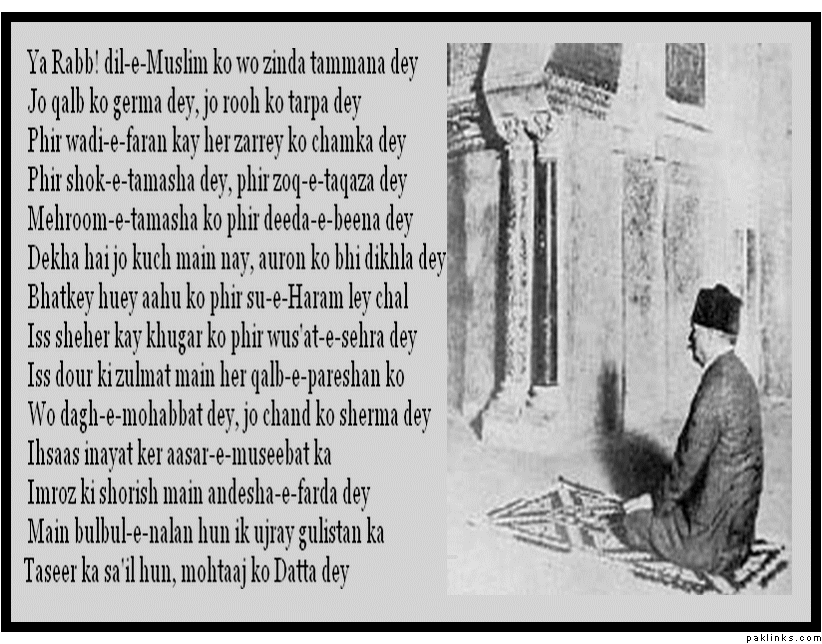
Prayers for improvement in conditions of Muslims and Encouragement of Muslim Youth in light of history

(Meanings: *Zinda Tammanna = *Motivation; *Qalb = *Heart;*wadi-e-faran = *Islamic nation; *shok-e-tamasha = *Determination; *Zoq-e-taqaza = *zeal; *Mehroom-e-tamasha = *Ignored; *deeda-e-beena = *awareness; *bhatkey huey aahu = *referring to Muslim nation who has gone astray; *su-e-Haram = *awareness of Islam; *Khugar = *Thoughts; *wus’at-e-sehra = *Broad horizon; *zulmat = *darkness/depression; *qalb-e-pareshan = *depressed; *dagh-e-mohabbat = *relaxation (referring to Islam) ; *asar-e-museebat = *expected hurdles; *imroz ki shorish = *commitments of present; *andesha-e-farda = *Foresight; *bulbul-e-nalan = *complaining; *ujray gulistan = *referring to downtrodden Muslim nation; *Taseer = *Blessing; *Sa’il = *begger; *Mohtaj = *begger; *Datta = *Allah)

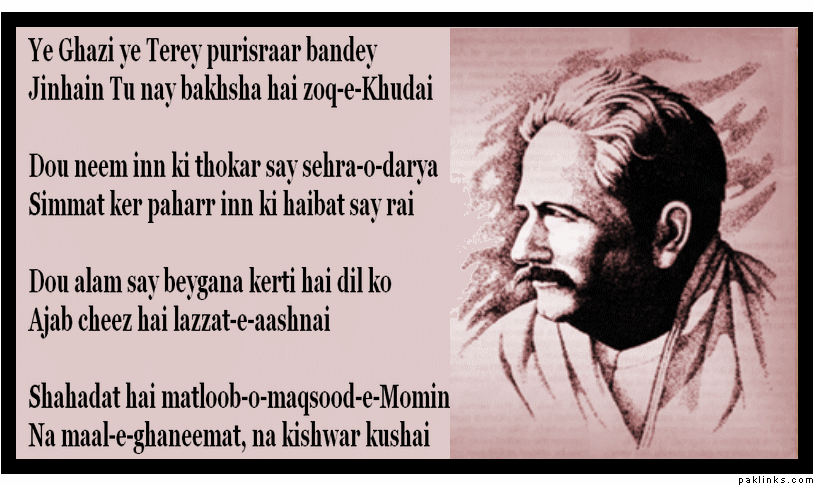
(Meanings: *Ghazi = *Brave warriors; *Terey = *Referring to Allah; *Purisrar Bandey = *Devoted slaves; *bakhsha = *blessed with; *zoq-e-Khudai = *Love for God; *Dou neem = *minor stuff;*sehra-o-darya = *deserts and rivers; *simat = *to contract; *paharr = *mountains; *haibat = *grace; *rai = *giving way to; *dou alam = *universe; *baygana = *indifferent; *cheez = *devotion; *lazzat-e-aashnai = *Strong faith; *Shahadat = *Martyrdom; *Matloob = *Required; *Maqsood = *Goal; *Momin = *Muslim; *Maal-e-ghanimat = *booty of war; *Kishwar kushai = *appraisal)

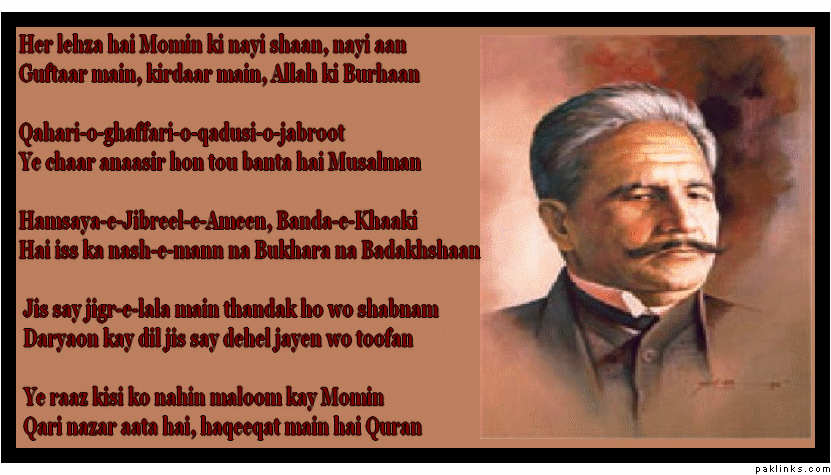
(Meanings: *lehza = *moment; *shaan = *grace; *aan = *dignity; *guftaar = *speech; *kirdaar = *character; *burhan = *reflection; *Qahari = *Strict; *Anasir = *factors; *Hamsaya-e-Jibreel-e-Amin banda-e-khaki = *Referring to a true Muslim who is given simile to as worthy as angel Gabriel; *Nash-e-mann = *premanent residence; *jigr-e-lala = *flower; *shabnam = *dew drops; *dehel = *to tremble; *tufan = *thunder; *raaz = *secret; *qari = *one who recites)

**"After me they will read my poetry, grasp it and say, A self-conscious man has revolutionised the world.” **

Re: Iqbal Poetry Contest

We all start out in Life as Children…and those who infuence us during our childhood stay in our hearts for ever…one such person whoes poetry had affect on my outlook on lifes problems…Allama Iqbal (Rehmat Ullah Elah)


The peom is HAMDARDI


**

http://www.urdutaleem.com/images/smilies/dil.gif

Assalam-o-Alaikum!

http://www.urdutaleem.com/images/smilies/dil.gif

**

http://www.urdutaleem.com//attachment.php?attachmentid=6174&d=1188187700

The lesson… no doubt… from it is:


Hain Loge wohee jehan main achay


Aatay hain jo kaam douseroun kay!

Re: Iqbal Poetry Contest

http://nazariapak.info/iqbal/images/iqbalmain.jpg

Allama Iqbal

The Poet of East

http://nazariapak.info/iqbal/img-islam-inspiration/S5.gif

**RESUME OF MOHAMMED IQBAL

To awaken the Muslims of India so that they could regain their lost glory
and greatness. To wake up the Muslims and be more practical.To show the
Muslim youth of India the path of truth and progress **

Islamic Inspirations of Iqbal

Supercharged with emotion, highly potent and productive are the couplets of Iqbal containing his Islamic inspirations, and these have assumed special significance, importance and value today when there is an upsurge of feeling of fraternity and good will through-out the world of Islam

http://nazariapak.info/iqbal/img-islam-inspiration/S8.gif

The Holy Haram’s only One,
And God except Allah there’s none:
Our Quran’s One that we recite –
Could not then Muslims all unite?

http://nazariapak.info/iqbal/img-islam-inspiration/S7.gif

The Nations through their Faith do live;
Without it nowhere Thou wouldst be:

Introduction
This work, published a few months after the poet’s death, is a fairly small volume containing verses in both Persian and Urdu. It is incomplete, although this is not readily apparent to the reader; for Iqbal left some gaps in the book which he intended to fill when he made the pilgrimage to Mecca. The title means “Gift from the Hijaz.” He had long wished to undertake the journey to the Arabian Peninsula to perform the Hajj and to visit the tomb of the Prophet, but was prevented from doing so by continuous illness during the last years of his life. Iqbal began composing the Armaghan as a gift to take to the Hijaz, intending to publish it on his return to India as a “Gift from the Hijaz” to his countrymen.

Re: Iqbal Poetry Contest

:salam:

http://www.paklinks.com/gsmedia/files/11778/unbelievablerebel.jpg

http://www.paklinks.com/gsmedia/files/11778/AllamaIqbal.jpg

Allama Iqbal, a great poet-philosopherand an active political leader was born in 1873, in Sialkot in the Punjab. Hedescended from a family of Kashmiri Brahmins, who had embraced Islam about three hundred years earlier. Iqbal’‘s first education was in the traditional Mukatab. Later he joined theSialkot Mission School, from where he passed his matriculation examination. In 1897, he obtained Bachelor of Arts Degree from the Government College, Lahore. Two years later, he secured his Master’'s Degree and was appointed in the Oriental College, Lahore, as a lecturer in History, Philosophy and English. Later he proceeded to Europe for higher studies. Having obtained a degree at Cambridge, he later secured his doctorate at Munich and finally he was able to qualify as a barrister. In 1908, on returning to India, besides teaching and practicing Law, Iqbal continued to write poetry. He resigned from the Government service in 1911 and took to the propagation of his individual thinking to the Muslims through his poetry. By 1928, his reputation as a great Muslim philosopher was solidly established and he was invited to deliver lectures at Hyderabad, Aligarh and Madras. These series of lectures were later on published as a book - The Reconstruction of Religious Thought in Islam. In 1930, Iqbal was invited to preside over the open session of the Muslim League at Allahabad. In his historic Allahabad Address Iqbal visualized an independent and sovereign state for the Muslims of North-Western India. In 1932, Iqbal came to England as a Muslim delegate to the Third Roundtable Conference. In latter years, when the Quaid had left India and was residing in England, Allama Iqbal wrote to him informing his personal views on political problems and state of affairs of the Indian Muslims and also persuading him to come back. These letters are dated from June 1936 to November 1937 and they now form important historic documents concerning our struggle for freedom.

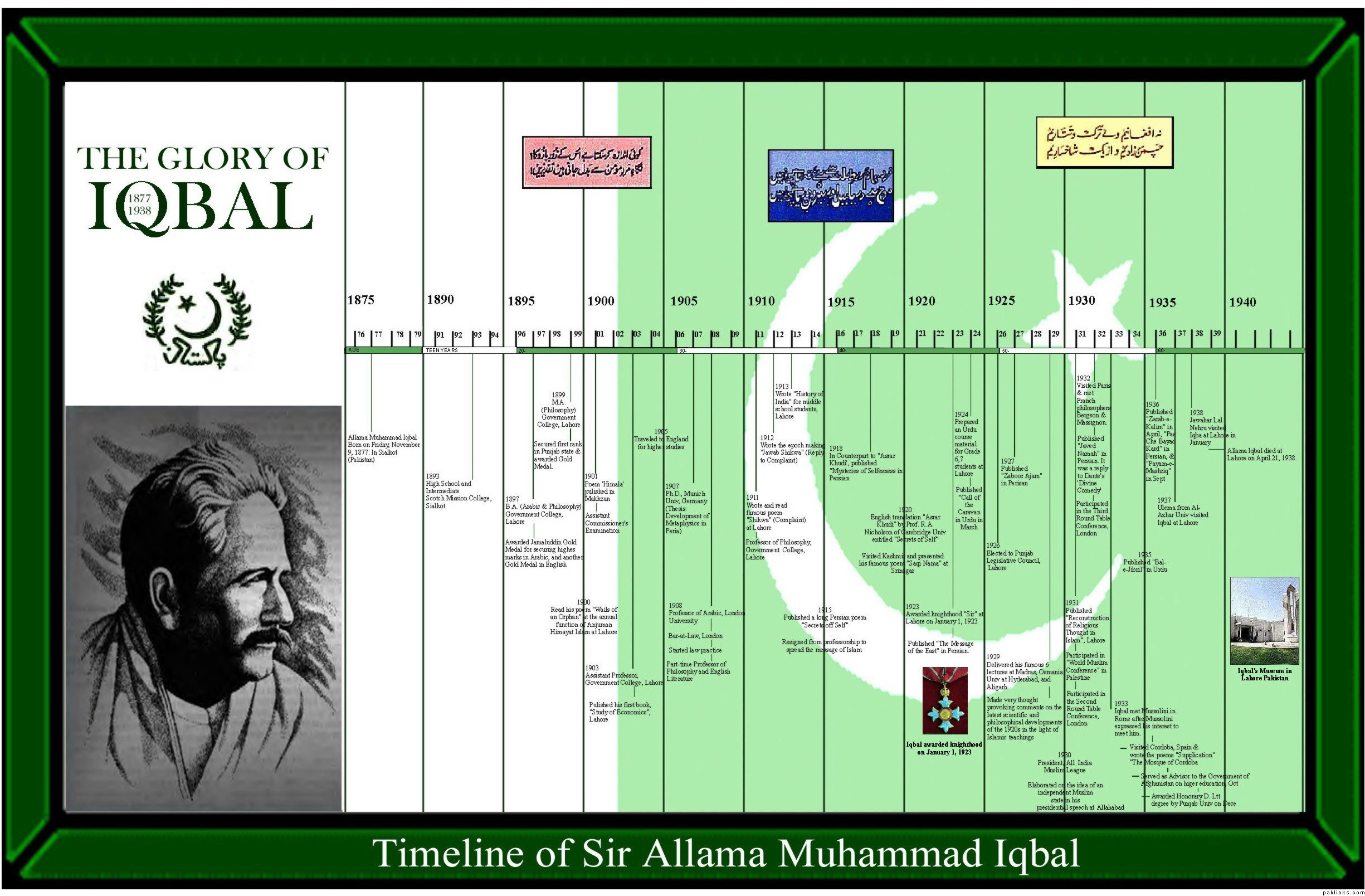
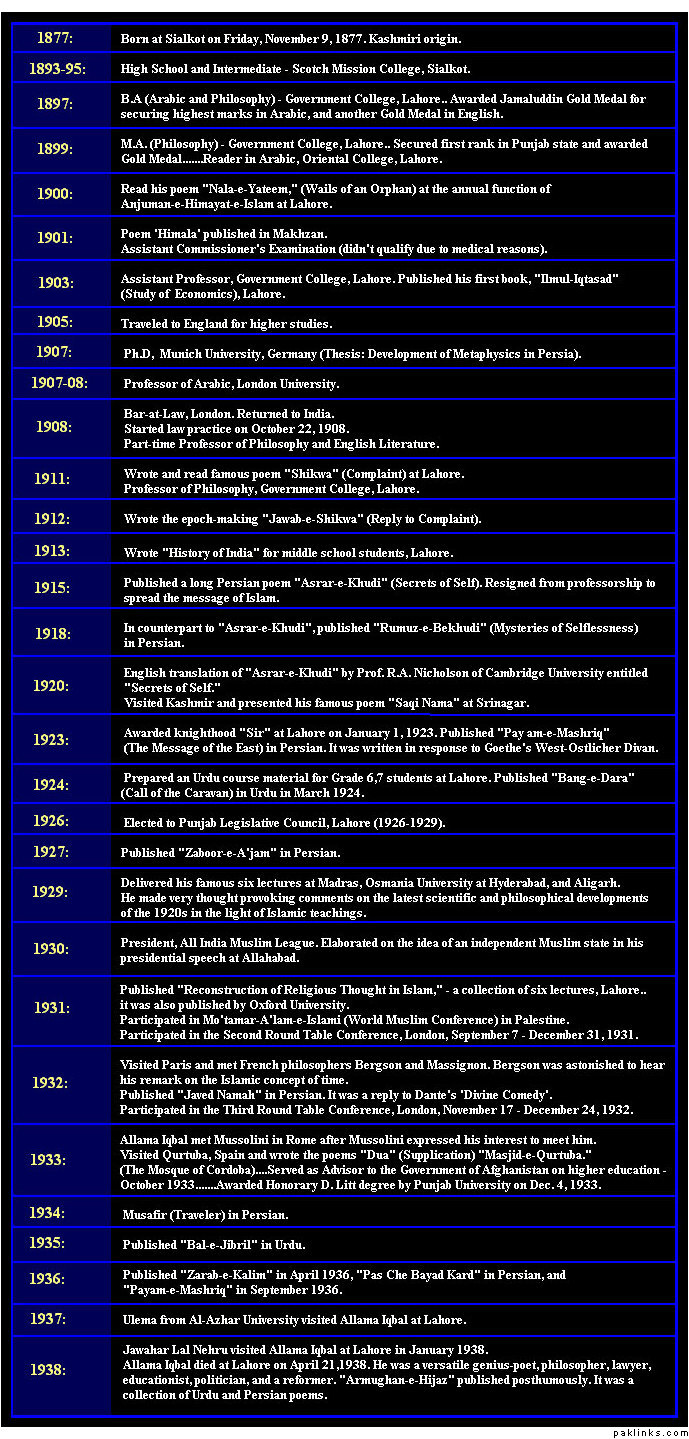
TIMELINE OF Sir Allama Mohammad Iqbal

In English

In Urdu

http://www.paklinks.com/gsmedia/files/11778/iqbalzind.jpg


It was on April 21, 1938, that this great Muslim poet-philosopher and champion of the Muslim cause passed away and lies buried next to the Badshahi Mosque in Lahore.

http://www.paklinks.com/gsmedia/files/11778/TombIqbal.jpg

Re: Iqbal Poetry Contest

:bism:

Iqbal was born at Sialkot, India (now in Pakistan), on 9th November, 1877 of a pious family of small merchants and was educated at Government College, Lahore. In Europe from 1905 to 1908, he earned his degree in philosophy from the University of Cambridge, qualified as a barrister in London, and received a doctorate from the University of Munich. His thesis, The Development of Metaphysics in Persia, revealed some aspects of Islamic mysticism formerly unknown in Europe.
**Iqbal was an heir to a very rich literary, mystic, philosophical and religious tradition. He imbibed and assimilated all that was best in the past and present Islamic and Oriental thought and culture. His range of interests covered Religion, Philosophy, Art, Politics, Economics, the revival of Muslim life and universal brotherhood of man. His prose, not only in his national language but also in English, was powerful. His two books in English demonstrate his mastery of English. But poetry was his medium par excellence of expression. Everything he thought and felt, almost involuntarily shaped itself into verse. **

**Iqbal The Visionary **
**Iqbal joined the London branch of the All India Muslim League while he was studying Law and Philosophy in England. It was in London when he had a mystical experience. The ghazal containing those divinations is the only one whose year and month of composition is expressly mentioned. It is March 1907. No other ghazal, before or after it has been given such importance. Some verses of that ghazal are: **
**At last the silent tongue of Hijaz has announced to the ardent ear the tiding t****hat the covenant which had been given to the desert-dwelles is going to be renewed vigorously: **

The lion who had emerged from the desert and
had toppled the Roman Empire is
As I am told by the angels, about to get up
**again (from his slumbers.) **
You the dwelles of the West, should know that
the world of God is not a shop (of yours).
Your imagined pure gold is about to lose it
**standard value (as fixed by you). **
Your civilization will commit suicide with its
own daggers.
A nest built on a frail bough cannot be
**durable. **
The caravan of feeble ants will take the rose
petal for a boat
And inspite of all blasts of waves, it shall cross
**the river. **
I will take out may worn-out caravan in the
pitch darkness of night.
My sighs will emit sparks and my breath will
produce flames.

**There are some critics of Allama Iqbal who assume that after delivering the Allahbad Address he had slept over the idea of a Muslim State. Nothing is farther from the truth. The idea remained always alive in his mind. It had naturally to mature and hence, had to take time. He was sure that the Muslims of sub-continent were going to achieve an independent homeland for themselves. On 21st March, 1932, Allama Iqbal delivered the Presidential address at Lahore at the annual session of the All-India Muslim Conference. In that address too he stressed his view regarding nationalism in India and commented on the plight of the Muslims under the circumstances prevailing in the sub-continent. Having attended the Second Round Table Conference in September, 1931 in London, he was keenly aware of the deep-seated Hindu and Sikh prejudice and unaccommodating attitude. He had observed the mind of the British Government. Hence he reiterated his apprehensions and suggested safeguards in respect of the Indian Muslims: **

*In so far then as the fundamentals of our policy are concerned, I have got nothing fresh to offer. Regarding these I have already expressed my views in my address to the All India Muslim League. In the present address I propose, among other things, to help you, in the first place, in arriving at a correct view of the situation as it emerged from a rather hesitating behavior of our delegation the final stages of the Round-Table Conference. In the second place, I shall try, according to my lights to show how far it is desirable to construct a fresh policy now that the Premier’s announcement at the last London Conference has again necessitated a careful survey of the whole situation. *

Iqbal’s grave in Lahore
After a long period of ill health, Iqbal died in April 1938 and was buried in front of the great Badshahi Mosque in Lahore. Two years later, the Muslim League voted for the idea of Pakistan. That the poet had influenced the making of that decision, which became a reality in 1947, is undisputed. He has been acclaimed as the father of Pakistan, and every year Iqbal Day is celebrated by Pakistanis.

PIECE OF POETRY
**Aik Arzoo **
(Allama Iqbal)
Duniya ki mehfilon se uktaa gya hoon ya Rabb
Kya lutf anjuman ka, jab dil hi bujh gya ho?
Shorish say bhaagta hoon, dil DhoonDta hai mera
Aisa sakoot jis par taqdeer bhi fidaa ho
Marta hoon khamoshi par, yeh aarzoo hai meri
daaman mein koh ke, ik choTaa saa jhonpRa ho
Azaad fikr se hoon, uzlat mein din guzaaroon
dunya ke gham ka dil se kaanTa nikal gya ho
lazzat sarod ki ho chiRiyon ke chehchehon mein
chashme ki shorish mein baaja saa baj raha ho
gul ki kali chiTak kar paighaam day kissi ka
saaghar zara saa goya, mujhko jahaan-numa ho
ho haath ka sarhana, sabza ka ho bachoona!
sharmaaye jis se jalwat, khlawat mein woh ada ho
maanoos is qadr ho soorat se meri bulbul
nannhay se dil mein us kay khaTka na kuchh m’ra ho
Saf baandhay donoN jaanib booTay haray haray hoN
nadi ka saaf paani tasveer lay raha ho
ho dilfareb aisa kohisaar ka nazaara
paani bhi mawj ban kar uTh uTh kay dekhta ho
Aaghosh mein zameen ki soya huwa ho sabza
phir phir kay jhaRiyon mein paani chamak raha ho
paani ko choo rehi ho jhuk jhuk ke gul ki Tehni
jaisay haseen koi aa’ina dekhta ho
mehndi lagaaye sooraj jab shaam ki dulhan ko
surkhi liye sunehri har phool ki qabaa ho
raaton ko jalne waalay reh jaain thak kay jis dum
Umeed unki mera TooTa huwa diya ho
bijlee chamak kay unko kaTiya m’ri dikhaa de
jab aasmaan pe har soo baadal ghara huwa ho
pichle pehr ki koy’al, woh subaH ki muazzin
main uska hum-navaa hoon, woh meri hum-nava ho
kaanoN pe ho na mere dair o haram ka ihsaan!
rozan hi jhoNpRee ka, mujhko sehr-numa ho
phooloN ko aaye jis dam shabnam wuzu karne
rona mera wuzu ho, naala meri dua ho!
Is kham’shi mein jaain itne buland naalay
taaron kay qaafilay ko meri sadaa dara ho
Har dardmand dil ko rona mera rulaa day
bayhosh jo paRay hain shaayad inhein jagaa day

Re: Iqbal Poetry Contest

:bism:
INTRODUCTION
Sheikh Muhammad Iqbal was born in Sialkot, Punjab, British India ; the eldest of five siblings in a Kashmiri family. It is believed that Iqbal’s family were originallyHinduBrahmins, but became Muslim following his ancestor Sahaj Ram Sapru](http://en.wikipedia.org/wiki/Sahaj_Ram_Sapru)'s conversion to Islam, although this version is disputed by some scholars. Iqbal’s father Shaikh Nur Muhammad was a prosperous tailor, well-known for his devotion to Islam, and the family raised their children with deep religious grounding

Higher Education
Passing on to the Government College of Lahore, Iqbal did his graduation with English Literature, Philosophy and Arabic as his subjects. At the college he met Prof. Arnold and Sir Abdul Qadir. Iqbal’s poem, Chand (moon) and other early poems appeared in the journal (which belonged to Sir Abdul Qadir) in 1901 and were acclaimed by critics as cutting a new path in Urdu poetry.
It did not take him long to win recognition as a rising star on the firmament of Urdu literature.
In the mean time he had done his MA in Philosophy and was appointed as a Lecturer in History, Philosophy and Political science at Oriental College, Lahore. He then moved to Government College to teach Philosophy and English Literature.
Wherever Iqbal worked or thought his versatility and scholarship made a deep impression on those around him.

Politics
In 1927 the poet was elected to the Punjab Legislative assembly. In 1930, he was elected to preside over at the annual session of Muslim League. In his presidential address at Allahabad, Iqbal for the first time introduced the idea of Pakistan. In 1930-31, he attended the Round Table conference, which met in London to frame a constitution for India
In Spain
**

**While in England, Iqbal accepted the hospitality of Spain. He also went to Cordoba and had the distinction of being the first Muslim to offer prayers at its historical mosque after the exile of Moors. Memories of the past glory of Arabs and their 800-year rule over Spain were revived in his mind and his emotions were aroused by what he saw

Meeting with Mussolini
In Italy Iqbal was received by Mussolini who had read some of his works and was aquatinted with his philosophy. They had long meetings and talked freely to each other.
The Universities of Cambridge, Rome and Madrid and the Roman Royal society organized meetings in his honor. On his way back he also went to Jerusalem to attend the International Conference of Motamar-i-Isalami.
In Afghanistan
At the invitation of King Nadir Shah, Iqbal visited Afghanistan in 1932. The king received the poet with great honor and met hi privately, as well during which he laid bare his heart. The two talked and wept.
Iqbal’s Death
The last phase of Iqbal’s life was embittered with constant illness. But as regards his creative activities this product was most productive. He kept in touch with every question of the day and continued composing beautiful verses.
A few minutes before his death he recited these touching lines:
The departed melody may return or not!
The zephyr from Hijaz may blow again or not!
The days of this Faqir has come to an end,
Another seer may come or not!

Although Iqbal’s was long and protracted the end was sudden and verypeaceful. He breathed his last in the early hours of April 21, 1938, in the arms of his old and devoted servant, leaving behind a host of mourners all over the Islamic world. There was a faint smile playing on his lips, which irresistibly reminded one of the last criterions, which he laid down for a truthful Muslim.

SELECTED POETRY
Manf-e-at Eik Hai Is Qaum Ki Nuqsaan Bhi Eik
Eik Hi Sub Ka Nabi, Deen Bhi, Imaan Bhi Eik
Haram-e-Paak Bhi, Allah Bhi, Quran Bhi Eik
Kuch Bari Baat Thi Hote Jo Musalmaan Bhi Eik


THE DEADENED HEART
Dil-e-Murda Dil Nahin Hai Isse Zinda Kar Dobara
Ke Yehi Hai Ummatoon Ke Marg-e-Kuhaan Ka Chara


THE EMOTION AS A IDOL
Zabaan Se Gar Kiya Tawhid Ka Da’wa To Kya Hasil
Banaya Hai But-e-Pindaar Ko Apna Khuda Tu Ne


Re: Iqbal Poetry Contest

http://i223.photobucket.com/albums/dd137/Myalbum00/bis.gif

http://i223.photobucket.com/albums/dd137/Myalbum00/banner.gif

!!-May mercy of Allah be upon him..Ameen-!!

21st April is regarded as Youm-e-Iqbal. It was the day in 1938 when the Great Muslim Poet Sir Mohd Iqbal died and left for abode in the heaven. Let’s explore the history on this occasion..

Diyaa Iqbal ne hindi Musalmanon ko Soz Apnaa…
Yeh ik mard-e-tan asaan tha, tan asanon k kaam aaya!

..::..Introduction..::..

Allama Iqbal was not only a great poet but also a great thinker,Philosopher, and political leader. Iqbal is said to be the first man who gave the idea of Pakistan.He was well-vershed in philosphy, both Eastern and Western. His poems too expressed this idea in a very forceful way. He put a new life into the youth of his nation and looked forward to new era of freedom and achievements.

Na samjho ge tou mitt jaao ge aey Hindustan waalon (Muslims)
Tumhari daastaan tak bhi naa hogii daastaanon mein

**Allama Iqbal’s contributions are numerous and it is not possible to give even a glimpse of his work here. A brief outline of Allama Iqbal’s life and achievements is presented below: **

..::..THE GREAT PHILOSOPHER-POET OF NATION..::..

Allama Iqbal was a great Philosopher-Poet of Asia. As a matter of fact he deserves this title.He is one of most outstanding poets, writers, intellectuals and thinkers of modem times.When he began to write poetry, Islam was passing through a critical phase. In india the Muslims were being rapidly dominated by Hindus. He placed before people his philosophy of self-realization. His poetry is full of force and enthusiasm.

..::..THE EDUCATIONIST..::..

He was connected with the Punjab Educational Department for number of years.For years he was Dean of Faculty of Oriental Studies and Chairman of the Department Philosophical Studies. He was closely connected with the Islamia College, Lahore, for years. In 1933 he was invited by the Afghan Government to visit Kabul and advise them educational reforms in Afghanistan in general and the administration of Kabul University in particular. He took great interest in the Jamia-Millia of Delhi and was always ready to help its promoters in every possible way.

**..::..THE POLITICIAN..::.. **

The important role that Iqbal played in the political life of the subcontinent, especially as architect of Pakistan, will be appreciated from the following message Quaid-i-Aazam Muhammad Ali Jinnah sent to his son:

“To me he was a friend, guide and philosopher, and during the darkest moments through which the Muslim League had to go he stood like a rock, and never flinched one single moment.”

He was elected Member of the Punjab Legislative Assembly.In 1930 Iqbal was elected President of the Muslim League session held at Allahabad.In 1931 he attended the Round Table Conference which met in London to frame a constitution for India and took active Part in its various committees.He was the first to give a concrete shape to the Muslim aspirations in India for a separate homeland.

**..::..Life, as Iqbal sees It..::.. **

Bar-tarr azz andeshaa-e-sod-o-zayann haii Zindagi..
hai kabhi jaan aur kabhi tasleem-e-jaan hai Zindagi
Apni duniya aap paida karr agar zindon mein haii
ser-e-Adam haii zameer-e-kun fakaan haii Zindagii
Bandagi mein gatth k reh jaati hai ik ju-e-kam aa’b
aurr Azaadii mein behrr-e-be-karaan haii Zindagii..
Aashkaraa haii yehh apnii quwwatt-e-taskheer say…
garchah ikk matti k paykarr mein nihaan haii Zindagi
Qulzum-e-hassti say tuu ubhraa haii manind-e-habaab
Iss zayaan khanay mein taira imtihaan haii Zindagii!!

..::..Views about iqbal..::..

http://i223.photobucket.com/albums/dd137/Myalbum00/opinion.gif

**..::..Iqbal’s Message to Muslims..::.. **

http://i223.photobucket.com/albums/dd137/Myalbum00/message.gif

http://i223.photobucket.com/albums/dd137/Myalbum00/aaaa.gif

..::..THE LAST PHASE..::..

Iqbal developed kidney trouble in 1924. For its treatment he intended to visit Vienna, but some friends advised him to consult the well-known Indian physician Hakim ‘Abdul-Wahab An known as Hakim Nabina, ‘the blind physician’, and his treatment cured Iqbal of the kidney trouble. After this he kept in fairly good health till the beginning of 1934, when as a result of exposure he got a throat affection which resulted in loss of voice.Every possible treatment was tried in Lahore, Delhi and Bhopal, and at times there were hopes of complete recovery, but these were not realized. In 1937 Iqbal developed cataract in his eyes. In spite of periods of comparative good health the last phase was embittered by constant ill-health in the physical sense. But as regards his creative activities this period was the most productive. Till the last Iqbal kept in touch with every question of the day and took great interest in the controversies going on.His illness took a serious turn on 25 March 1938, and in spite of the best medical aid and careful nursing of his friends, he breathed his last in the early hours of the 21st of April.

When dying, Keats said: ‘I feel the flowers growing over me.’ Byron passed on with the gentle words: ‘I must sleep now.’ Goethe called for ‘more light’. Most moving death phrase of all was that of the deaf composer Beethoven, who said: ‘I shall hear In Heaven.’

On his death-bed this great poet-prophet presented a picture of peace and composure. It seemed as if he was just resting after finishing his life’s work. There was a faint smile playing on his lips and one was irresistibly reminded of his well-known verse:

I tell you the sign of a ‘Momin’
When death comes there is a smile on his lips.

‘Momin is Iqbal’s term for a superman, and there is no doubt that Iqbal was a superman. He died with a smile on his lips.

http://i223.photobucket.com/albums/dd137/Myalbum00/tomb.jpg

Woh shamma bujh gayii magarr uss ke farogh se
Qandeel-e-Aarzoo hai ferozaan usssi tarrahh!!

Re: Iqbal Poetry Contest

Iqbal or Ishq o Muhubat
**Taaruf: **
**Hamary Qaomo shair, Mufakir or Mashhory zamana philosopher Alama Muhhamad Iqbal 9 November 1877 ko Punjab ky aik gaon Sialkot main pyda hoy.**walida ka nam Imam bibi or Walid Shaikh Noor Muhammad. I guess ky Iqbal ka koi bhai nahi tha aik behan thin Kareem Bibi jin ka zikar “Allama Iqbal-Ek Mehbooba, teen beewiaN, chaar shadiaN” main Dr. Khalid Sohail ny likha hy.(khasi rwaiti qisam ki nand sabit hoin.) **
iqbal or Sardar Begam ky darmiyan ghalt fehmian pyda ker ky Iqbal ki shadi Mukhtar Begam sy krwany ka sehara Kareem Bibi ky sir hy, Iqbal ky bary farzand Aftaab ki bivi Rasheeda Begam ny inkishaf kiya hy. Mandarja bala kitab ki ro sy.

Iqbal ki passandeeda begam Sardar Begam thin jin ky bary main nazm hy Mera khiyal hy Bang-e-dra main, “…ki gaod main billi dykh ker…”
Tujh ko duzdeeda nigahi yeh sikha di kiss ny
Ramz Aghazy Muhubat ki seekha di kiss ny
Iqbal ky baity Aftab, Jawaid or byti Muneera thin. Jin ky byty Yusuf Salhudin hain
Aatia Faizi ki nakam muhubat bhi is kamyab insan ki zindagi ka aik bab hy.Iqbal ny 21 April 1938 ko Lahor emain wafat pai. Inna lilahy wa inna ilahy rajyoon.

Paishkash o Shairi ky Namoony:
Allama Muhammad Iqbal ki ziada tar shairi pind o nasah or falsafiana afkar(Philosophical thought) per mabni hy.Socha jaay tu aik sadi purani bat hy or shari perhu tu lagta hy aj kal ky daor per bhi sadiq atti hy or ju daor shaid abhi aya nahi agli sadi ky bachon ko bhi lagy ga ky yeh os zamany ky shair ky khiyalat hain ju aj bhi taro taza hain or aj ky masail per behas ker rahy hain.
Jysa ky "Jawaid Ky Nam " main hy,
Muhubat mujhy on jwanon sy hy
Sitaron py ju dalty hain kamand
Iqbal ki sharii shairi ki aam rawaish sy baghwat nazar ati hy. Woh “azad Nazm” wali baghwat nahi magar jysa ky os daor main shyr 0 shairi ko bas ishq o muhubat or mehboob ki twareef sy tabeer kiya jata tha Iqbal ki shairi os sy sarasar bar aks hy. Ishq or Muhubat ka tasawr kam as kam Iqbal ki shairi main aik alag hi tasweer kheenchta hy.

**Iqbal ki ibtadai daor ki shairi main os zamany ka aam andaz hy yeh nazm mulahyza farmaiy. **Iqbal day per Muqblay bait bazi main jab college main main ny yeh shyr prha ky ,
Bhari bazm main apny ashi qko tara
Teri ankh masti main hushyar kiya thi
Aik shor mach giya ky yeh Iqbal ka shyr nahi hy or Muqabla sirf Iqbal ky ashar ka tha. Is per Bnagy-e-dara( Ya ju kitab bhi thi) khol ker yeh shyr dikhaya(GN) ny Iqbal ky bhi tharki shyr yad ker rakhy thy:wink:
Ab yaqeenan sab ki puri ghazal k aishtyaq ho g atu hazir hy,
Na Aty hamin is main tkrar kia thi?
Magar waada krty hoy aar kia thi?

Taamul tu tha on ko any main qasid
Magar yeh btta tarzzy Inkar kia thi?

Bhari bazm main apny ashiq ko tara
Teri ankh masti main hshyar kia thi?

Tumhary Piami ny sab raaz khola
khta is main bndy ki sarkar kia thi?
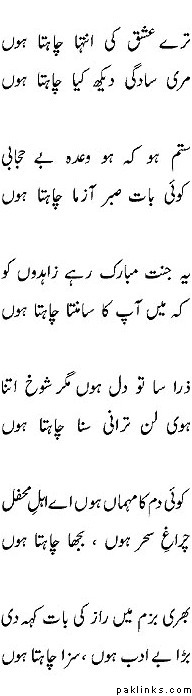
Mandarja Bala Ghazal buhat hi ibtadai adwar ki hy kuch agy chaly tu Ishq ky bary main mandarja zail nazm takhleeq paai,

Yeh janat mubarak rahy zahidon ko
Ky main ap k asamna chata hon
**zara sa tu dill hon magar shaokh itna **
wohi Lan Tranai suna chata hon
Wah kia bat hy My Musa :allaih:Ny Allah ko dykhny ki khwahish ka izhar kiya tu Allah ny farmaya Lan Trani(Tu mujhy dykh nahi paay ga{Dykhy ga tu seh nahi paay ga) Iqbal kehty hain ky mera dill bhi Ishqy Ilahi sy sershar hy or main osy dykhna chahta hon. Ishqy haqeeqi ka aik alag hi andaz hy Iqbal ky han,
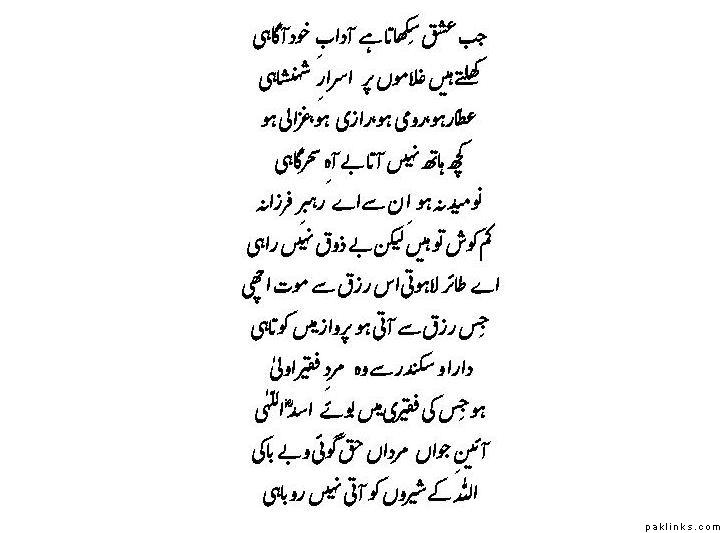

Tery Ishq ki inteh achata hon
Meri sadgi dykh kiya chata hon
Sitm hu ky ho waday by hijabi
Koi bat sebr azma chata hon

Khiyal ki bulandi ki inteha hy Iqbal ky han misal ky tor per yeh rubai,

******Khudi ki khulwaton main gum raha main **
Khuda ky samny guya na tha main
**Na dykha ankh utha ker jalway dost **
Qiamat main tamash aban giya main
In manzeelon sy guzar ker Ishq ka woh marhal aa jata hy ky jahan ghulamon per Asrary shehanshahi khulty hain,

atar hu romi hu razi hu Ghazali hu
Kuch hath nahi ata by ahy sehar gahi
yehi khiyal Jawb-e-Shikwa main nazar at ahy jab Aflak sy jwab atat hy,
Kis qadar tum py giran subh ki bydari hy
Ham sy kab piyar hy han neend tumhin piyari hy
Agar Iqbal ki Ishq o Muhubat ki shari or Atiya Faizi sy on ki mulaqat, Chahal qadmi kerty hoy Tabdlay khiyalat or baz shamon main ikhty khana khana daikhin tu yeh bat sach lagti hy ky, " Ishqy haqeeqi asal main Ishqy Mijazi sy shuru hota hy."
Any way 3 shadian aik nakam ishq ky baad ju nazm “Muhubat” parhin tu Iqbal kehty hain,
Turki bhi sheerin Tazi bhi Sheerin
Harfy muhubat Turki na Tazi

Muhubat Ki rasmain na Kafir na Ghazi
**Woh muhubat nahi kuch or shy hy **
sikhati hy ju Ghaznawi ko Ayazi

Almukhtasir allam Iqbal ny Muhubat ko is duniya ki takhleeq ki bunyad qarar diya hy woh puri nazm yad nahi arahi magar hy kuch is trha sy ky,
Urosy shab ki zulfin thin abhi na Ashna kham sy…
Os nazm main batya ky Allah ny kiya kiya cheezain jama kin or Muhubat takhleeq paai or Muhubat sy yeh duniya jis main Insan ny nafrat ki fasal bo di.

yeh hy mery hisy ka khirajy tehseen Shairy Mashriq o Hakeem Ul Ummat Allama Iqbal ky nam shukriya.

PS:1. Special thanks to SindSagar:)
**& **
**Waqar Khan of **http://waqarkhan.com/urdu/POETRY/IQBAL/iqbal-ishq.gif](http://waqarkhan.com/urdu/POETRY/IQBAL/iqbal-ishq.gif)
http://waqarkhan.com/urdu/POETRY/IQBAL/iqbal-ishq.jpg
2. No thanks 2 sannan time py image bhi nahi diya:barbie:
3. Main ny ziada ter apny hafzy per zor dy ker likhi hy shairi kuch kuch nazmin or ghazlain bhool rahi hain is liy aik misra zaroor batiy yeh nazm tu main zuroor likhna chati thi muhubat ki rasmin na kafir na ghazi wali. Shukriya:bb:

Re: Iqbal Poetry Contest

**Allama Muhammad Iqbal** **علامه محمد اقبال**
NameSir **Muhammad Iqbal**
Birth[November 9](http://en.wikipedia.org/wiki/November_9), [1877](http://en.wikipedia.org/wiki/1877), [Sialkot](http://en.wikipedia.org/wiki/Sialkot), [British India](http://en.wikipedia.org/wiki/British_India) (now [Pakistan](http://en.wikipedia.org/wiki/Pakistan))
Death[April 21](http://en.wikipedia.org/wiki/April_21), [1938](http://en.wikipedia.org/wiki/1938) (aged 60), [Lahore](http://en.wikipedia.org/wiki/Lahore), British India (now Pakistan)
School/tradition[Islamic philosophy](http://en.wikipedia.org/wiki/Islamic_philosophy)
Main interests[poetry](http://en.wikipedia.org/wiki/Poetry), [philosophy](http://en.wikipedia.org/wiki/Philosophy)
Notable ideas[Two-Nation Theory](http://en.wikipedia.org/wiki/Two-Nation_Theory)
Influenced by[Aristotle](http://en.wikipedia.org/wiki/Aristotle), [Rumi](http://en.wikipedia.org/wiki/Rumi), [Goethe](http://en.wikipedia.org/wiki/Goethe), [Nietzsche](http://en.wikipedia.org/wiki/Nietzsche)
Influenced[Pakistan Movement](http://en.wikipedia.org/wiki/Pakistan_Movement), [Ali Shariati](http://en.wikipedia.org/wiki/Ali_Shariati), [Khalilollah Khalili](http://en.wikipedia.org/wiki/Khalilollah_Khalili), [Jawdat Said](http://en.wikipedia.org/wiki/Jawdat_Said)
Sir **Muhammad Iqbal** ([Urdu](http://en.wikipedia.org/wiki/Urdu): **محمد اقبال**) born ([November 9](http://en.wikipedia.org/wiki/November_9), [1877](http://en.wikipedia.org/wiki/1877) – [April 21](http://en.wikipedia.org/wiki/April_21), [1938](http://en.wikipedia.org/wiki/1938)) was a [Muslim](http://en.wikipedia.org/wiki/Muslim) [poet](http://en.wikipedia.org/wiki/Poet), [philosopher](http://en.wikipedia.org/wiki/Philosopher) and [politician](http://en.wikipedia.org/wiki/Politician) born in [Sialkot](http://en.wikipedia.org/wiki/Sialkot), [British India](http://en.wikipedia.org/wiki/British_raj) (now in [Pakistan](http://en.wikipedia.org/wiki/Pakistan)), whose poetry in [Urdu](http://en.wikipedia.org/wiki/Urdu_language) and [Persian](http://en.wikipedia.org/wiki/Persian_language) is considered to be among the greatest of the modern era,[1]](http://en.wikipedia.org/wiki/Muhammad_Iqbal#cite_note-goethezeitportal-0) and whose vision of an independent state for the Muslims of [British India](http://en.wikipedia.org/wiki/British_India) was to inspire the creation of [Pakistan](http://en.wikipedia.org/wiki/Pakistan). He is commonly referred to as **[Allama](http://en.wikipedia.org/wiki/Allama) Iqbal** (**علامہ اقبال**‎, *Allama* lit. *Scholar*.) After studying in [England](http://en.wikipedia.org/wiki/England) and [Germany](http://en.wikipedia.org/wiki/Germany), Iqbal established a law practice, but concentrated primarily on writing scholarly works on politics, economics, history, philosophy and religion. He is best known for his poetic works, including *[Asrar-e-Khudi](http://en.wikipedia.org/wiki/Asrar-e-Khudi)*—which brought a [knighthood](http://en.wikipedia.org/wiki/British_honours_system)— *[Rumuz-e-Bekhudi](http://en.wikipedia.org/wiki/Rumuz-e-Bekhudi)*, and the *[Bang-e-Dara](http://en.wikipedia.org/wiki/Bang-e-Dara)*, with its enduring patriotic song *[Tarana-e-Hind](http://en.wikipedia.org/wiki/Tarana-e-Hind)*. In [Afghanistan](http://en.wikipedia.org/wiki/Afghanistan) and [Iran](http://en.wikipedia.org/wiki/Iran), where he is known as *Iqbāl-e Lāhorī* (اقبال لاهوری‎ *Iqbal of [Lahore](http://en.wikipedia.org/wiki/Lahore)*), he is highly regarded for his Persian works. Iqbal was a strong proponent of the political and spiritual revival of [Islamic civilisation](http://en.wikipedia.org/wiki/Islamic_civilisation) across the world, but specifically in India; a series of famous lectures he delivered to this effect were published as *[The Reconstruction of Religious Thought in Islam](http://en.wikipedia.org/wiki/The_Reconstruction_of_Religious_Thought_in_Islam)*. One of the most prominent leaders of the [All India Muslim League](http://en.wikipedia.org/wiki/All_India_Muslim_League), Iqbal encouraged the creation of a "state in northwestern India for Indian Muslims" in his 1930 presidential address.[2]](http://en.wikipedia.org/wiki/Muhammad_Iqbal#cite_note-1930presidentialaddress-1) Iqbal encouraged and worked closely with [Muhammad Ali Jinnah](http://en.wikipedia.org/wiki/Muhammad_Ali_Jinnah), and he is known as *Muffakir-e-Pakistan* ("The Thinker of Pakistan"), *Shair-e-Mashriq* ("The Poet of the East"), and *Hakeem-ul-Ummat* ("The Sage of [Ummah](http://en.wikipedia.org/wiki/Ummah)"). He is officially recognised as the "[national poet](http://en.wikipedia.org/wiki/National_poet)" in Pakistan. The anniversary of his birth (یوم ولادت محمد اقبال‎ - *Yōm-e Welādat-e Muhammad Iqbāl*) on [November 9](http://en.wikipedia.org/wiki/November_9) is a [holiday in Pakistan](http://en.wikipedia.org/wiki/List_of_holidays_in_Pakistan).

Early life
Sheikh Muhammad Iqbal was born in Sialkot, Punjab, British India (now part of Pakistan); the eldest of five siblings in a Kashmiri family. It is believed that Iqbal’s family were originally Hindu Brahmins, but became Muslim following his ancestor Sahaj Ram Sapru’s conversion to Islam, although this version is disputed by some scholars.[3]](http://en.wikipedia.org/wiki/Muhammad_Iqbal#cite_note-Iqbal.27s_ancestry-2)[4]](http://en.wikipedia.org/wiki/Muhammad_Iqbal#cite_note-Kak-3) Iqbal’s father Shaikh Nur Muhammad was a prosperous tailor, well-known for his devotion to Islam, and the family raised their children with deep religious grounding.
http://upload.wikimedia.org/wikipedia/commons/9/94/Iqbal_Youth.jpg
1899

The boy was educated initially by tutors in languages and writing, history, poetry and religion. His potential as a poet and writer was recognised by one of his tutors, Sayyid Mir Hassan, and Iqbal would continue to study under him at the Scotch Mission College in Sialkot. The student became proficient in several languages and the skill of writing prose and poetry, and graduated in 1892. Following custom, at the age of 15 Iqbal’s family arranged for him to be married to Karim Bibi, the daughter of an affluent Gujrati physician. The couple had two children: a daughter, Mi’raj Begam (born 1895) and a son, Aftab (born 1899). Iqbal’s third son died soon after birth. The husband and wife were unhappy in their marriage and eventually divorced in 1916.
Iqbal entered the Government College in Lahore where he studied philosophy, English literature and Arabic and obtained a Bachelor of Arts degree, graduating cum laude. He won a gold medal for topping his examination in philosophy. While studying for his masters degree, Iqbal came under the wing of Sir Thomas Arnold, a scholar of Islam and modern philosophy at the college. Arnold exposed the young man to Western culture and ideas, and served as a bridge for Iqbal between the ideas of East and West. Iqbal was appointed to a readership in Arabic at the Oriental College in Lahore, and he published his first book in Urdu, The Knowledge of Economics in 1903. In 1905 Iqbal published the patriotic song, Tarana-e-Hind (Song of India).
At Sir Thomas’s encouragement, Iqbal travelled to and spend many years studying in Europe. He obtained a Bachelor of Arts degree from Trinity College at Cambridge in 1907, while simultaneously studying law at Lincoln’s Inn, from where he qualified as a barrister in 1908. Iqbal also met a Muslim student, Atiyah Faizi in 1907, and had a close relationship with her. In Europe, he started writing his poetry in Persian as well. Throughout his life, Iqbal would prefer writing in Persian as he believed it allowed him to fully express philosophical concepts, and it gave him a wider audience.[1]](http://en.wikipedia.org/wiki/Muhammad_Iqbal#cite_note-goethezeitportal-0) It was while in England that he first participated in politics. Following the formation of the All-India Muslim League in 1906, Iqbal was elected to the executive committee of its British chapter in 1908. Together with two other politicians, Syed Hassan Bilgrami and Syed Ameer Ali, Iqbal sat on the subcommittee which drafted the constitution of the League. In 1907, Iqbal travelled to Germany to pursue a doctorate from the Faculty of Philosophy of the Ludwig-Maximilians-Universität at Munich. Working under the supervision of Friedrich Hommel, Iqbal published a thesis titled: The Development of Metaphysics in Persia.[5]](http://en.wikipedia.org/wiki/Muhammad_Iqbal#cite_note-phdthesis-4)

Literary career

Upon his return to India in 1908, Iqbal took up assistant professorship at the Government College in Lahore, but for financial reasons he relinquished it within a year to practise law. During this period, Iqbal’s personal life was in turmoil. He divorced Karim Bibi in 1916, but provided financial support to her and their children for the rest of his life.
While maintaining his legal practise, Iqbal began concentrating on spiritual and religious subjects, and publishing poetry and literary works. He became active in the Anjuman-e-Himayat-e-Islam, a congress of Muslim intellectuals, writers and poets as well as politicians, and in 1919 became the general secretary of the organisation. Iqbal’s thoughts in his work primarily focused on the spiritual direction and development of human society, centred around experiences from his travel and stay in Western Europe and the Middle East. He was profoundly influenced by Western philosophers such as Friedrich Nietzsche, Henri Bergson and Goethe, and soon became a strong critic of Western society’s separation of religion from state and what he perceived as its obsession with materialist pursuits.

1908, in London

The poetry and philosophy of Mawlana Rumi bore the deepest influence on Iqbal’s mind. Deeply grounded in religion since childhood, Iqbal would begin intensely concentrating on the study of Islam, the culture and history of Islamic civilization and its political future, and embrace Rumi as “his guide.” Iqbal would feature Rumi in the role of a guide in many of his poems, and his works focused on reminding his readers of the past glories of Islamic civilization, and delivering a message of a pure, spiritual focus on Islam as a source for socio-political liberation and greatness. Iqbal denounced political divisions within and amongst Muslim nations, and frequently alluded to and spoke in terms of the global Muslim community, or the Ummah.[6]](http://en.wikipedia.org/wiki/Muhammad_Iqbal#cite_note-bio-iqbalsworks-5)

Works in Persian

Iqbal’s poetic works are written mostly in Persian rather than Urdu. Among his 12,000 verses of poem, almost more than 7,000 verses are in Persian. In 1915, he published his first collection of poetry, the Asrar-e-Khudi (Secrets of the Self) in Persian. The poems delve into concepts of ego and emphasise the spirit and self from a religious, spiritual perspective. Many critics have called this Iqbal’s finest poetic work.[7]](http://en.wikipedia.org/wiki/Muhammad_Iqbal#cite_note-6) In Asrar-e-Khudi, Iqbal has explained his philosophy of “Khudi,” or “Self.” He proves by various means that the whole universe obeys the will of the “Self.” Iqbal condemns self-destruction. For him the aim of life is self-realization and self-knowledge. He charts the stages through which the “Self” has to pass before finally arriving at its point of perfection, enabling the knower of the “Self” to become the viceregent of Allah.[6]](http://en.wikipedia.org/wiki/Muhammad_Iqbal#cite_note-bio-iqbalsworks-5)
In his Rumuz-e-Bekhudi (Hints of Selflessness), Iqbal seeks to prove that Islamic way of life is the best code of conduct for a nation’s viability. A person must keep his individual characteristics intact but once this is achieved he should sacrifice his personal ambitions for the needs of the nation. Man cannot realise the “Self” out of society. Also in Persian and published in 1917, this group of poems has as its main themes the ideal community, Islamic ethical and social principles and the relationship between the individual and society. Although he is true throughout to Islam, Iqbal recognises also the positive analogous aspects of other religions. The Rumuz-e-Bekhudi complements the emphasis on the self in the Asrar-e-Khudi and the two collections are often put in the same volume under the title Asrar-e-Rumuz (Hinting Secrets), and it is addressed to the world’s Muslims. Iqbal sees the individual and his community as reflections of each other. The individual needs to be strengthened before he can be integrated into the community, whose development in turn depends on the preservation of the communal ego. It is through contact with others that an ego learns to accept the limitations of its own freedom and the meaning of love. Muslim communities must ensure order in life and must therefore preserve their communal tradition. It is in this context that Iqbal sees the vital role of women, who as mothers are directly responsible for inculcating values in their children.
Iqbal’s 1924 publication, the Payam-e-Mashriq (The Message of the East) is closely connected to the West-östlicher Diwan by the famous German poet Goethe. Goethe bemoaned that the West had become too materialistic in outlook and expected that the East would provide a message of hope that would resuscitate spiritual values. Iqbal styles his work as a reminder to the West of the importance of morality, religion and civilization by underlining the need for cultivating feeling, ardour and dynamism. He explains that an individual could never aspire for higher dimensions unless he learns of the nature of spirituality.[6]](http://en.wikipedia.org/wiki/Muhammad_Iqbal#cite_note-bio-iqbalsworks-5) In his first visit to Afghanistan, he presented his book “Payam-e Mashreq” to King Amanullah Khan in which he admired the liberal movements of Afghanistan against the British Empire. In 1933, he was officially invited to Afghanistan to join the meetings regarding the establishment of Kabul University.
http://upload.wikimedia.org/wikipedia/en/c/cb/Iqbal_with_Javid.jpg
1929, with his son Javid Iqbal

The Zabur-e-Ajam (Persian Psalms), published in 1927, includes the poems Gulshan-e-Raz-e-Jadeed (Garden of New Secrets) and Bandagi Nama (Book of Slavery). In Gulshan-e-Raz-e-Jadeed, Iqbal first poses questions, then answers them with the help of ancient and modern insight and shows how it effects and concerns the world of action. Bandagi Nama denounces slavery by attempting to explain the spirit behind the fine arts of enslaved societies. Here as in other books, Iqbal insists on remembering the past, doing well in the present and preparing for the future, emphasising love, enthusiasm and energy to fill the ideal life.[6]](http://en.wikipedia.org/wiki/Muhammad_Iqbal#cite_note-bio-iqbalsworks-5) Iqbal’s 1932 work, the Javed Nama (Book of Javed) is named after and in a manner addressed to his son, who is featured in the poems, and follows the examples of the works of Ibn Arabi and Dante’s The Divine Comedy, through mystical and exaggerated depiction across time. Iqbal depicts himself as Zinda Rud (“A stream full of life”) guided by Rumi, “the master,” through various heavens and spheres, and has the honour of approaching divinity and coming in contact with divine illuminations. In a passage re-living a historical period, Iqbal condemns the Muslim traitors who were instrumental in the defeat and death of Nawab Siraj-ud-Daula of Bengal and Tipu Sultan of Mysore respectively by betraying them for the benefit of the British colonists, and thus delivering their country to the shackles of slavery. At the end, by addressing his son Javid, he speaks to the young people at large, and provides guidance to the “new generation.”[6]](http://en.wikipedia.org/wiki/Muhammad_Iqbal#cite_note-bio-iqbalsworks-5)
His love to Persian language is evident in his works and poetry. He says in one of his poems:[8]](http://en.wikipedia.org/wiki/Muhammad_Iqbal#cite_note-7)
گرچه اردو در عذوبت شکر است
garche Urdu dar uzūbat shakar ast
لیک پارسی ام ز هندی شیرینتر است
lék Pārsī-am ze Hindi shīrīntar ast
Translation:
Even though in sweetness Urdu is sugar* - (but) My Persian is sweeter than Hindi*

  • Note: In Iqbal’s time the terms Hindi and Urdu were synonyms (see Hindustani)
    Works in Urdu

Iqbal’s first work published in Urdu, the Bang-e-Dara (The Call of the Marching Bell) of 1924, was a collection of poetry written by him in three distinct phases of his life.[6]](http://en.wikipedia.org/wiki/Muhammad_Iqbal#cite_note-bio-iqbalsworks-5) The poems he wrote up to 1905, the year Iqbal left for England imbibe patriotism and imagery of landscape, and includes the Tarana-e-Hind (The Song of India), popularly known as Saare Jahan Se Achcha and another poem Tarana-e-Milli (Anthem of the (muslim) Community), which was composed in the same metre and rhyme scheme as Saare Jahan Se Achcha. The second set of poems date from between 1905 and 1908 when Iqbal studied in Europe and dwell upon the nature of European society, which he emphasized had lost spiritual and religious values. This inspired Iqbal to write poems on the historical and cultural heritage of Islamic culture and Muslim people, not from an Indian but a global perspective. Iqbal urges the global community of Muslims, addressed as the Ummah to define personal, social and political existence by the values and teachings of Islam. Poems such as Tulu’i Islam (Dawn of Islam) and Khizr-e-Rah (The Guided Path) are especially acclaimed.
Iqbal preferred to work mainly in Persian for a predominant period of his career, but after 1930, his works were mainly in Urdu. The works of this period were often specifically directed at the Muslim masses of India, with an even stronger emphasis on Islam, and Muslim spiritual and political reawakening. Published in 1935, the Bal-e-Jibril (Wings of Gabriel) is considered by many critics as the finest of Iqbal’s Urdu poetry, and was inspired by his visit to Spain, where he visited the monuments and legacy of the kingdom of the Moors. It consists of ghazals, poems, quatrains, epigrams and carries a strong sense religious passion.[6]](http://en.wikipedia.org/wiki/Muhammad_Iqbal#cite_note-bio-iqbalsworks-5)
The Pas Cheh Bayed Kard ai Aqwam-e-Sharq (What are we to do, O Nations of the East?) includes the poem Musafir (Traveller). Again, Iqbal depicts Rumi as a character and an exposition of the mysteries of Islamic laws and Sufi perceptions is given. Iqbal laments the dissension and disunity among the Indian Muslims as well as Muslim nations. Musafir is an account of one of Iqbal’s journeys to Afghanistan, in which the Pashtun people are counseled to learn the “secret of Islam” and to “build up the self” within themselves.[6]](http://en.wikipedia.org/wiki/Muhammad_Iqbal#cite_note-bio-iqbalsworks-5) Iqbal’s final work was the Armughan-e-Hijaz (The Gift of Hijaz), published posthumously in 1938. The first part contains quatrains in Persian, and the second part contains some poems and epigrams in Urdu. The Persian quatrains convey the impression as though the poet is travelling through the Hijaz in his imagination. Profundity of ideas and intensity of passion are the salient features of these short poems. The Urdu portion of the book contains some categorical criticism of the intellectual movements and social and political revolutions of the modern age.

Political career

http://upload.wikimedia.org/wikipedia/en/thumb/7/78/Iqbalpolitics.jpg/250px-Iqbalpolitics.jpg
Iqbal, with Muslim political activists.

While dividing his time between law and poetry, Iqbal had remained active in the Muslim League. He supported Indian involvement in World War I, as well as the Khilafat movement and remained in close touch with Muslim political leaders such as Maulana Mohammad Ali and Muhammad Ali Jinnah. He was a critic of the mainstream Indian National Congress, which he regarded as dominated by Hindus and was disappointed with the League when during the 1920s, it was absorbed in factional divides between the pro-British group led by Sir Muhammad Shafi and the centrist group led by Jinnah.
In November 1926, with the encouragement of friends and supporters, Iqbal contested for a seat in the Punjab Legislative Assembly from the Muslim district of Lahore, and defeated his opponent by a margin of 3,177 votes.[9]](http://en.wikipedia.org/wiki/Muhammad_Iqbal#cite_note-bio-politics-8) He supported the constitutional proposals presented by Jinnah with the aim of guaranteeing Muslim political rights and influence in a coalition with the Congress, and worked with the Aga Khan and other Muslim leaders to mend the factional divisions and achieve unity in the Muslim League.

Revival of Islamic polity

Iqbal’s second book in English, the Reconstruction of Religious Thought in Islam, is a collection of his six lectures which he delivered at Madras, Hyderabad and Aligarh; first published as a collection in Lahore, in 1930. These lectures dwell on the role of Islam as a religion as well as a political and legal philosophy in the modern age. In these lectures Iqbal firmly rejects the political attitudes and conduct of Muslim politicians, whom he saw as morally-misguided, attached to power and without any standing with Muslim masses. Iqbal expressed fears that not only would secularism weaken the spiritual foundations of Islam and Muslim society, but that India’s Hindu-majority population would crowd out Muslim heritage, culture and political influence. In his travels to Egypt, Afghanistan, Iran and Turkey, he promoted ideas of greater Islamic political co-operation and unity, calling for the shedding of nationalist differences. He also speculated on different political arrangements to guarantee Muslim political power; in a dialogue with Dr. **(http://en.wikipedia.org/wiki/B._R._Ambedkar), Iqbal expressed his desire to see Indian provinces as autonomous units under the direct control of the British government and with no central Indian government. He envisaged autonomous Muslim provinces in India. Under one Indian union he feared for Muslims, who would suffer in many respects especially with regard to their existentially separate entity as Muslims.[9]](http://en.wikipedia.org/wiki/Muhammad_Iqbal#cite_note-bio-politics-8) Sir Muhammad Iqbal was elected president of the Muslim League in 1930 at its session in Allahabad, in the United Provinces as well as for the session in Lahore in 1932. In his presidential address on December 29, 1930, Iqbal outlined a vision of an independent state for Muslim-majority provinces in northwestern India:
http://upload.wikimedia.org/wikipedia/en/thumb/0/0d/Iqbal-RahmatAli.jpg/250px-Iqbal-RahmatAli.jpg
Iqbal with Choudhary Rahmat Ali and other Muslim activists.

“I would like to see the Punjab, North-West Frontier Province, Sind and Baluchistan amalgamated into a single state. Self-government within the British Empire, or without the British Empire, the formation of a consolidated Northwest Indian Muslim state appears to me to be the final destiny of the Muslims, at least of Northwest India.”[2]](http://en.wikipedia.org/wiki/Muhammad_Iqbal#cite_note-1930presidentialaddress-1)
In his speech, Iqbal emphasised that unlike Christianity, Islam came with “legal concepts” with “civic significance,” with its “religious ideals” considered as inseparable from social order: “therefore, the construction of a policy on national lines, if it means a displacement of the Islamic principle of solidarity, is simply unthinkable to a Muslim.”[10]](http://en.wikipedia.org/wiki/Muhammad_Iqbal#cite_note-Naipaul-9) Iqbal thus stressed not only the need for the political unity of Muslim communities, but the undesirability of blending the Muslim population into a wider society not based on Islamic principles. He thus became the first politician to articulate what would become known as the Two-Nation Theory — that Muslims are a distinct nation and thus deserve political independence from other regions and communities of India. However, he would not elucidate or specify if his ideal Islamic state would construe a theocracy, even as he rejected secularism and nationalism. The latter part of Iqbal’s life was concentrated on political activity. He would travel across Europe and West Asia to garner political and financial support for the League, and he reiterated his ideas in his 1932 address, and during the Third Round-Table Conference, he opposed the Congress and proposals for transfer of power without considerable autonomy or independence for Muslim provinces. He would serve as president of the Punjab Muslim League, and would deliver speeches and publish articles in an attempt to rally Muslims across India as a single political entity. Iqbal consistently criticised feudal classes in Punjab as well as Muslim politicians averse to the League.

Relationship with Jinnah

[http://upload.wikimedia.org/wikipedia/en/b/bb/Pic_iqbal_23.jpg](http://en.wikipedia.org/wiki/Image:Pic_iqbal_23.jpg) Iqbal, in his final years.

Ideologically separated from Congress Muslim leaders, Iqbal had also been disillusioned with the politicians of the Muslim League owing to the factional conflict that plagued the League in the 1920s. Discontent with factional leaders like Sir Muhammad Shafi and Sir Fazl-ur-Rahman, Iqbal came to believe that only Muhammad Ali Jinnah was a political leader capable of preserving this unity and fulfilling the League’s objectives on Muslim political empowerment. Building a strong, personal correspondence with Jinnah, Iqbal was an influential force on convincing Jinnah to end his self-imposed exile in London, return to India and take charge of the League. Iqbal firmly believed that Jinnah was the only leader capable of drawing Indian Muslims to the League and maintaining party unity before the British and the Congress:“I know you are a busy man but I do hope you won’t mind my writing to you often, as you are the only Muslim in India today to whom the community has right to look up for safe guidance through the storm which is coming to North-West India and, perhaps, to the whole of India.”[11]](http://en.wikipedia.org/wiki/Muhammad_Iqbal#cite_note-igbalandpakmovement-10)

There were significant differences between the two men — while Iqbal believed that Islam was the source of government and society, Jinnah was a believer in secular government and had laid out a secular vision for Pakistan where religion would have “nothing to do with the business of the state.”[12]](http://en.wikipedia.org/wiki/Muhammad_Iqbal#cite_note-governorgeneral-11) Iqbal had backed the Khilafat struggle; Jinnah had dismissed it as “religious frenzy.” And while Iqbal espoused the idea of partitioning Muslim-majority provinces in 1930, Jinnah would continue to hold talks with the Congress through the decade and only officially embraced the goal of Pakistan in 1940. Some historians postulate that Jinnah always remained hopeful for an agreement with the Congress and never fully desired the partition of India.[13]](http://en.wikipedia.org/wiki/Muhammad_Iqbal#cite_note-jalal14-12) Iqbal’s close correspondence with Jinnah is speculated by some historians as having been responsible for Jinnah’s embrace of the idea of Pakistan.[14]](http://en.wikipedia.org/wiki/Muhammad_Iqbal#cite_note-iqbal-13) Iqbal elucidated to Jinnah his vision of a separate Muslim state in a letter sent on June 21, 1937:“A separate federation of Muslim Provinces, reformed on the lines I have suggested above, is the only course by which we can secure a peaceful India and save Muslims from the domination of Non-Muslims. Why should not the Muslims of North-West India and Bengal be considered as nations entitled to self-determination just as other nations in India and outside India are.”[9]](http://en.wikipedia.org/wiki/Muhammad_Iqbal#cite_note-bio-politics-8)

Iqbal, serving as president of the Punjab Muslim League, criticised Jinnah’s political actions, including a political agreement with Punjabi leader Sir Sikandar Hyat Khan, whom Iqbal saw as a representative of feudal classes and not committed to Islam as the core political philosophy. Nevertheless, Iqbal worked constantly to encourage Muslim leaders and masses to support Jinnah and the League. Speaking about the political future of Muslims in India, Iqbal said:“There is only one way out. Muslims should strengthen Jinnah’s hands. They should join the Muslim League. Indian question, as is now being solved, can be countered by our united front against both the Hindus and the English. Without it, our demands are not going to be accepted. People say our demands smack of communalism. This is sheer propaganda. These demands relate to the defence of our national existence… The united front can be formed under the leadership of the Muslim League. And the Muslim League can succeed only on account of Jinnah. Now none but Jinnah is capable of leading the Muslims.”[11]](http://en.wikipedia.org/wiki/Muhammad_Iqbal#cite_note-igbalandpakmovement-10)
In his views on Muslim political future, Iqbal was at odds with Sayyid Abul Ala Maududi, who had opposed the partition of India. Maududi had however, been closer to Iqbal’s poetic-philosophy of an ideal Islamic state which would reject secularism and nationalism. After the creation of Pakistan, nine years after Iqbal’s death, Jinnah and other League politicians would publicly credit Iqbal as one of the visionaries and founders of the state.

Death

http://upload.wikimedia.org/wikipedia/en/thumb/c/ca/Allama_Iqbals_Tomb_East_south_walls_July_1_2005.jpg/180px-Allama_Iqbals_Tomb_East_south_walls_July_1_2005.jpg
The Mausoleum of Iqbal, next to Badshahi Masjid, Lahore, Pakistan

In 1933, after returning from a trip to Spain and Afghanistan, Iqbal’s health deteriorated. He spent his final years working to establish the Idara Dar-ul-Islam, an institution where studies in classical Islam and contemporary social science would be subsidised, and advocating the demand for an independent Muslim state. Iqbal ceased practising law in 1934 and he was granted pension by the Nawab of Bhopal. After suffering for months from a series of protracted illnesses, Iqbal died in Lahore in 1938. His tomb is located in the space between the entrance of the Badshahi Mosque and the Lahore Fort, and an official guard is maintained there by the Government of Pakistan.
Iqbal is commemorated widely in Pakistan, where he is regarded as the ideological founder of the state. His Tarana-e-Hind is a song that is widely used in India as a patriotic song speaking of communal harmony. His birthday is annually commemorated in Pakistan as Iqbal Day and is a national holiday. For a long time, Iqbal’s actual date of birth remained disputed, with many believing February 23 to be the date of Iqbal’s birth.citation needed] On February 1, 1974 a Pakistani government committee officially declared Iqbal’s date of birth to be November 9.citation needed] Iqbal is the namesake of many public institutions, including the Allama Iqbal Open University and the Allama Iqbal International Airport in Lahore — the second-busiest airport in the nation. Government and public organizations have sponsored the establishment of colleges and schools dedicated to Iqbal, and have established the Iqbal Academy to research, teach and preserve the works, literature and philosophy of Iqbal. His son Javid Iqbal has served as a justice on the Supreme Court of Pakistan.

Criticism

http://upload.wikimedia.org/wikipedia/en/thumb/7/78/Inside_allama_iqbals_tomb.JPG/175px-Inside_allama_iqbals_tomb.JPG
Interior of Iqbal’s tomb.

Some intellectuals criticised Iqbal for embracing Nietzsche’s concept of Übermensch](http://en.wikipedia.org/wiki/Übermensch), reflected in Iqbal’s descriptions of ego, self, and renewal for Muslim civilization. He has also been criticised for his advocacy of Islamic political revival and rejection of Western cultural influences. Several scholars have called his poetic descriptions of the true practice of Islam impractical and wrongly dismissive of diverse societies and cultural heritages.[10]](http://en.wikipedia.org/wiki/Muhammad_Iqbal#cite_note-Naipaul-9). Nonetheless, it is his advocacy of Islamic political revival and his concept of “khudi” or self-esteem that earns him much of his respect in the Muslim world.
While credited and admired as the conceptual founder of Pakistan, Iqbal is criticised by some historians and scholars for implicitly endorsing the incompatibility of Muslims with other religious communities. Some historians and Indian nationalists criticise Iqbal’s vision for a Muslim state as specifically implying the denunciation of Hindus and Hinduism, as well as the peaceful co-existence of Hindus and Muslims.[10]](http://en.wikipedia.org/wiki/Muhammad_Iqbal#cite_note-Naipaul-9)[15]](http://en.wikipedia.org/wiki/Muhammad_Iqbal#cite_note-IPV-14) Iqbal was also strongly criticised for advocating on occasions, the division and fragmentation of India. Critics also point to the civil war that led to the secession of East Pakistan in 1971, as well as recent sectarian and religious conflict in Pakistan to suggest that Iqbal’s notion of a natural Muslim nation and of Islam as a political, unifying identity was inherently flawed and fanciful.[10]](http://en.wikipedia.org/wiki/Muhammad_Iqbal#cite_note-Naipaul-9) Despite this criticism, Iqbal is widely credited for his work in encouraging the political rejuvenation and empowerment of Muslims, and as a great poet not only in India and Pakistan, but also in Iran, Afghanistan and Muslim nations in the Middle East.

http://www.loveurdu.com/urdu-poetry/iqbal2/iqbal-Ghazal/Shairi/iqbal-02.gif

http://www.loveurdu.com/urdu-poetry/Iqbal2/Iqbal-Ghazal/Shairi/iqbal01.gif

http://www.loveurdu.com/urdu-poetry/iqbal2/iqbal-Ghazal/Shairi/iqbal-30.gif

http://www.loveurdu.com/urdu-poetry/iqbal2/iqbal-Ghazal/Shairi/iqbal-31.gif

-----------------
**

Re: Iqbal Poetry Contest

Translation of "Allama Iqbal-Ek Mehbooba, teen beewiaN, chaar
shadiaN" by Dr. Khalid Sohail)

Laazim hai dil ke paas rahay paas-baan-e-aql
Lekin kabhi kabhi isay tan-ha bhi ch-hoR day

(It's good to keep the heart under the guardianship of wisdom but
sometime the heart needs to be left alone - Iqbal )

When we study the psychological aspect of Iqbal's life, we find out
that despite having a sensitive heart and a brilliant mind, he had to
struggle against many romantic contradictions through out his life. These
contradictions appeared for the first time when Iqbal went to Europe in
the pursuit of higher education. Upon reaching Europe, he discovered that
his
personality possessed certain charm that the opposite sex found
irresistible. He could not have come to this realization in the
traditional
and suppressed romantic climate of his homeland where women were
conditioned not to act upon such attractions. Iqbal, soon, had a coterie of female
friends including women from the West as well as the East and among the
latter was Atiya Faizi.

The relationship between Iqbal and Faizi developed quite rapidly and
soon
they were dining together quite frequently. These dinners were followed
by
long walks during which the two talked about many mysteries of life.
Iqbal,
besides being smitten by Atiya`s beauty, was impressed by her
intellectual
prowess as well which is evident from the fact that Iqbal sought her
opinion
about his Ph.D. thesis.

When we read Atiya Faizi`s diaries, we observe that she mentions Iqbal
in a
way one mentions a lover and not just a friend. [1] Her relation with
Iqbal
had reached the stage where it becomes difficult to differentiate
between
friendship and love.

Iqbals return to India in 1908, after completing his education,
resulted in
a psychological crisis for him. After sampling the liberalism of the
West,
Iqbal could not cope with the conservatism of his own society. In such
a
mental state, Iqbal wrote a letter to Atiya Faizi in which he described
his
thoughts very candidly. This letter is mentioned by many commentators
including Iqbal
s biographer Abdul-Majeed Salik in "Zikr-e-Iqbal". The
letter became one of the most talked about of all the letters Iqbal
ever
wrote. In the letter, Iqbal expressed his frustration and anger towards
his
life. To a certain extent, Iqbal blamed his wife to be the cause of his
miseries. He wrote that his father had wedded him at a young age
against his
will and this marriage had now become an unwanted burden for him. Iqbal
wrote that he sometimes wished to drown his frustration in alcohol
because
he felt that alcohol made committing suicide easy. Iqbal wrote that he
was
perfectly willing to support his wife financially for the rest of his
life
but he just couldn't bear the torture of her being part of Iqbal's
daily
life. In the same letter, Iqbal wrote that being a human being, he had
the
right to be happy and if society tried to deprive him of that right, he
would rebel against it. The only choices he was left with, he wrote,
were to
either leave the cursed country or become an alcoholic to numb his
feelings.
According to Iqbal, dead and barren pages of books could not give him
happiness and he had enough fire in his soul to burn those books along
with
the Eastern traditions to cinder. [2]

This particular letter betrays the depth of despair Iqbal was going
thru at
the time. His suppressed rage-against his wife, the outdated values of
his
society and traditional nature of his family-was coming to the surface.
Atiya Faizi responded to this profound letter in a very sympathetic
manner
and advised Iqbal to seek psychological comfort in the company of his
friends.

It seems that Iqbal's life at this point had come to a crossroads. He
had
turned sour not just towards his marriage but towards his culture,
traditions and religion as well. He was experiencing a conflict between
the
traditional demands of his society and his desire to live in the open
society of Europe which enticed him with economic opportunities as well
as
the proximity of Atiya Faizi.

It is quite possible that Iqbal wanted Atiya Faizi to become his life
partner. If that was the case, he never overtly expressed that
desire-maybe
for the lack of courage. Despite his admission that he was extremely
unhappy
with his marital life, Atiya never made any suggestive moves towards
Iqbal.
She was a wise and seasoned woman who knew that what Iqbal needed was a
psychiatrist and not a second wife.

The realization that Faizi was not going to become his life partner may
have intensified the psychological crisis in Iqbal. When someone is thru an
emotional and psychological crisis, one tends to make emotional
decisions guided by the frustration and rage-and that is exactly what happened to
Iqbal. He decided to marry again and, without seeking anyone's counsel,
Iqbal chose Sardar Begum to be his second wife. Soon after the nikah,
the religious ceremony of wedding, and before the traditional departure of
the bride to the house of her newlywed husband, Iqbal received anonymous
letters questioning Sardar Begum's character. Iqbal was so disheartened by
those
letters that he decided to divorce Sardar Begum.

In the meantime, Iqbal received a proposal to marry Mukhtar Begum, the
daughter of the famous Dr. Subhan Ali from Ludhiana, Punjab. Iqbal's
sister,
Karim Bibi, went to Ludhiana to meet Mukhtar Begum. Upon her return,
Karim
Bibi praised the beauty of Mukhtar Begum in such persuasive manner that
Iqbal immediately agreed to marry Mukhtar Begum.

Iqbal and his new bride arrived back at Lahore after the marriage
ceremony.
The next day, when Iqbal had the first real opportunity to see his wife
closely, he was utterly dismayed because she was nothing like how
Iqbal's
sister had described her. She was not beautiful at all. It was later
revealed that Iqbal had been conned into marrying Dr. Subhan Ali's
niece
whose name was also Mukhtar Begum. By the time Iqbal came to know this,
it
was too late because he had consummated his marriage. It is still a
mystery
as to who was responsible for this deception. At the outset, it seemed
that
Iqbal's sister was deceived on her visit to Ludhiana but it is hard to
rule
her out as an accomplice because of the statements of Rasheeda Begum
(Iqbal's daughter-in-law who married iqbal's elder son Aftab). Rasheeda
Begum alleges that Iqbal's sister had a soft corner for Iqbal's first
wife
and she was the one who wrote the anonymous letters against Sardar
Begum.
It's quite possible that when Karim Bibi saw that her brother was
determined
to marry again even after getting disheartened by Sardar Begum affair,
she
deliberately sabotaged Iqbal's marriage with Mukhtar Begum by
misleading her
brother into marrying a woman who was not as beautiful as Iqbal
expected.

While Iqbal was still suffering from this shock, he received a letter
from
Sardar Begum, his second wife, who he had mentally divorced and who was
still living with her parents. Sardar Begum wrote to Iqbal that she was
waiting for him to take her to his home and if Iqbal rejected her, she
would
never marry again. She expressed her profound sorrow that a person of
Iqbal's mental caliber had judged her only on the basis of gossip and
rumor.
The letter was bound to make Iqbal feel guilty and he became extremely
sad
when he later found out that the anonymous letters regarding Sardar
Begum
were probably written by an advocate by the name of Nabi Bakhsh who
wanted
Sardar Begum to marry his own son (Rasheeda Begum, as quoted above,
disagreed with it and maintained that the letters were the handiwork of
Iqbal's sister). Iqbal talked to some of his friends who knew Sardar
Begum's
family and they told Iqbal that there was no truth in the allegations.
Embarrassed and guilt-ridden, Iqbal wanted to bring Sardar Begum to his
house but there was still an obstacle. Iqbal thought that he had
divorced
Sardar Begum in his mind and according to some of his friends with
religious
bent, once divorced, Iqbal could not marry her. She first had to marry
someone else, get divorced and only then could Iqbal marry her again
according to the religious concept of halala. Confused, Iqbal sought
the
opinion of a Muslim cleric who told him that what Iqbal's friends had
suggested didn't apply to Iqbal's situation because Iqbal had not
consummated his marriage with Sardar Begum. Still somewhat confused,
for the
satisfaction of his mind, Iqbal went thru the marriage rites again with
Sardar Begum before bringing her home and so Sardar Begum, who Iqbal
married
twice, became his second and fourth wife. In the period of two years,
Iqbal
had added three marriages and two wives to his life. Interestingly,
Iqbal's
first wife, who was living in Sialkot till that time, also decided to
live
with him in Lahore with his other two wives. Iqbal had two kids, Aftab
and
Mairaj, with his first wife, so, at a certain point in his life, Iqbal
was
living with three wives and two kids.

This polygamous setup of Iqbal's household was not very practical and
could
not last long. One day, the mother of Iqbal's first wife came over,
told
Iqbal that he was a very irresponsible husband and took her daughter
and her
daughter's kids away with her. [3]

Iqbal's various biographers agree that Sardar Begum was Iqbal's
favorite
wife who was the most beautiful of the three. Iqbal had two kids,
Muneera
and Javed, with her. With the passage of time though, the love started
to
fade away from his relationship with Sardar Begum as well. Iqbal was
not
someone equipped with the abilities of coping with the demands of
traditional family life. Sardar Begum also realized that though Iqbal
was a
successful poet and philosopher, he was a failure at being a good
husband.
This feeling led Sardar Begum to become irate towards Iqbal. Iqbal's
son,
Javed Iqbal, describes the relationship between his parents by writing,
"we
were always short of money for household expenses so my mother wanted
my
father to take his law practice seriously. We were also renting at that
time
and my mother wanted us to buy a house. I can still recall the usual
scene
of my mother crying and cursing at my father and telling him that while
she
was working like a servant and making every effort to save some money,
my
father was busy lying down writing poetry, and my father laughing his
embarrassed laugh." [4]

This description of Iqbal's household tells us that Iqbal, the great
intellectual who could stare any politician, poet or intellectual in
the
eyes, could not give any satisfactory answer to his wife's objections.
If
such was his relation with his favorite wife, one can imagine the state
of
his relationship with his other wives.

While living with three wives, Iqbal continued his correspondence with
Atiya
Faizi. Iqbal's love life was so typical of the life of an Eastern poet;
he
couldn't marry the woman he loved and he couldn't love the women he
married.

Iqbal never moved to Europe but he maintained contacts with European
ladies.
They used to come over to India and meet Iqbal and Iqbal showed equal
enthusiasm meeting them. After the death of Sardar Begum, instead of
hiring
an Indian woman, Iqbal hired a German governess for Javed and Muneera
who
used to call her aunt Doris. It seems that Doris was serving dual
purpose of
looking after the kids and assuaging Iqbal's nostalgia about Europe.

As a psycho-therapist, Iqbal's love life came to me as a surprise. I am
surprised to note that The Poet of the East, who had a solution for
every
problem afflicting his nation, remained clueless about the solutions of
his
own romantic and marital problems. I find it hard to believe that he
got
separated from his first wife and their kids after sixteen years of
marriage, that he divorced his second wife based only on anonymous
letters,
that he realized that he was deceived only after he had consummated his
marriage with his third wife, and more surprisingly, that he sought an
edict
from a cleric and then ignored the edict before marrying Sardar Begum a
second time.

I guess Iqbal must have concluded from these experiences that it was
easier
for him to have a successful creative life than a successful marital
life.
Words came easy to Iqbal but the answers to the tough questions of his
romantic dilemmas did not. Maybe that is why he wrote,

Iqbal baRa updeshak hai, mun baton main moh laita hai.
Guftaar ka yeh ghazi to bana,kirdaar ka ghazi ban naa saka.
PS:Since I am not a participant. It's just detailed Translation of what GN talked about. Thanks:)

Re: Iqbal Poetry Contest

http://www.paklinks.com/gsmedia/files/9503/coollogo_com_21003173.jpg

Great Philosopher of Muslim World, Revolutionary Poet who pioneered the idea of a separate home land for Muslims living in India that came into being as Pakistan

No words or preface could do justice to Hakeem-ul-Ummat Shaair-e-Mashriq Dr. Sir Allama Muhammad Iqba, not only as a poet, but also as a philosopher, politician, thinker, and undying patriot. As a poet Iqbal represented in perhaps the most sensitive manner.

Allama Iqbal and Islam


Zabaan Se keh Bhi Diya La illaha ill’llah To Kya HAsil
Dil-o-Nigah Musalman Nahin To Kuch Bhi Nahin

O Allah! Your Guidance is no doubt The Truth! But our interpreters
can turn Qur’an into Pazhand by their interpretations.

Whitin Islam God has placed such resilience,
The more it is forced down, the more it gains in prominence

O Muslim Youth!

Do not despair from the fury of the opressing wind O eagle;
It blows towards you only to push you to further heights.

Manf-e-at Eik Hai Is Qaum Ki Nuqsaan Bhi Eik

Eik Hi Sub Ka Nabi, Deen Bhi, Imaan Bhi Eik

Haram-e-Paak Bhi, Allah Bhi, Quran Bhi Eik

Kuch Bari Baat Thi Hote Jo Musalmaan Bhi Eik


Khud Badalte Nahin Quran Ko Badal Dete Hain

Huwey Kis Darja Faqeehane Haram Be Taufiq

Allama Iqbal and Muslim of India

Allama Iqbal, who helped his people, the s Muslims of India, in realising social and political worth of the Indian Muslims.

is sarab-e-rung-o-bu ko gulistaa’n samjha hai tu
Ahh aye nadaa’n! qafs ko Ashiyaa’n samjha hai tu

Allama Iqbal, who failed to kept his eyes closed from the atrocities of British and Hindus towards his people, the Muslims of India, claimed for an Independent and Free Muslim Country.

shab gurezaan hogi akhir jalwa-e-khursheed say
ye chaman ma’amoor hoga naghma-e-toheed say

A Man who devoted his life for his people. The dynamic leader of Muslims of India, who dared to preach Self-Respect to subjugated and exploited Muslims of India. Who had been the first drop of rain, who taught the lesson of Dignity, Prestige and Grace to his people.

Nigah-e-fikar mai shaan-e-sikandari kya hai

kharaj ki jo gada ho, woh qeshari kya hai

khudi ko kar buland itna kay har taqdeer say pahlay

khuda banday say khud pochay bata teri raza kya hai

All said and done, his poetry like Shikwa and Jawab-e-Shikwa shook nerve centers of out social system which no one had ever dared to touch.

Iqbal used wonderful Urdu vocabulary in this poem and highlighted achievements of Muslims. In Shikwa, he played an oppressed and frustrated Muslim who is being complaining to Allah Almighty.instead of getting some point out of this wonderful work, some rigid and narrow minded so called Muslim scholars of that era declared Dr. Iqbal a rebellious minded person who is being disrespectful to God. But in the long run, this poem proved its worth and it is still applicable for the whole Muslim world even today.

Re: Iqbal Poetry Contest

Iqbal and Me

It has been often said that all sorts of people find something in Iqbal’s poetry that they can relate with. Like the communists often qoute him

Jis kheet sey dehqaaN ko muyassar nahiN rozi
Us khait key her khosha-e-gandum ko jala do

The modernists love his criticism of Mulla.

Is dour key Mulla haiN nang-e-musalmani

The sufis love his poetry that relates to Ishq.

Kaafir-e-hindi hooN meiN daikh mera zouq-o-shouq
Lab pey durood-salam, dil meiN durood-o-salaam

The activists relish the concept of “shaheen” and its agility and strength.

And the list can go on and on about philosophy, jihad etc.

But what resonates of Iqbal’s poetry with me is when he describes his struggle to understand God and universe. When he comes across as a person who is trying his best to make sense of himself and world around him and feels alone in quest of doing it.

Mein kahaaN hooN tu kahaaN haiYe makaaN key lamakaaN hai
Ye jahaaN mira jahaaN hai, key tiri krishma sazi

Isi kashmakash meiN guzreeN miri zindagi ki rataiN
kabhi sooz-o-saaz-e-roomi, kabhi pech-o-taab-e-razi

Similarly in this beautiful ghazal

He puts this beutifully in this
Gaah miri nigaah-eteez cheer gaye dil-e-wujood
Gaah ulajh key reh gaye merey tawahumaat meiN

Re: Iqbal Poetry Contest

SIR DOCTOR ALLAMA MUHAMMAD IQBAL

http://img37.picoodle.com/img/img37/4/4/18/f_AlamaIqbalm_494c04c.jpg

After “Ghalib” had left the world and signed his name on the chair of poetry, few believed that there would ever be another poet of this level again. One can easily say that Ghalib’s emotions were so alive after his death that he reincarnated. From “Meer” to “Ghalib” there is a long path. When the sun went down for Urdu poetry for a while, it rose in a small city, many miles away from Dehli, the center of Urdu poetry then.

Sir Dr. Allama Muhammad Iqbal, born 1877 in Sialkot, started a revolution, with which a new era of Urdu poetry started. We count Iqbal for inheriting the throne after “Ghalib”. A small fire was lit in the age of darkness and will keep shining as long as the world will last.

If there is anyone who knew the value of Urdu, and if there was ever any, Iqbal would surely be the one

http://www.paklinks.com/gsmedia/files/9503/untitled.JPG

A N I Q B A L C H R O N O L O G Y

1877 == Born in Sialkot, Panjab; father a tailor; large pious family, Kashmiri Brahman ancestry
1892 == Graduates from Scotch Mission High School, Sialkot
1892 == Parents marry him to Karim Bibi
1893 == Enters Scotch Mission College, in liberal arts course
c.1894 == Takes Dagh as his ustad, begins to send him verses by mail
1895 == Daughter, Mi’raj Begam (d. 1914), born to Karim Bibi
1895 == Passes Intermediate examination
1895 == Goes to Lahore, enters Government College
1897 == Receives B.A., second division; stands first in Arabic
1898 == Begins to study Philosophy with Prof. Thomas Arnold
1898 == After some study, appears for exams in law; but fails in Jurisprudence
1899 == Gets M.A. in Philosophy, third division; gets gold medal since he’s the only successful candidate in Phil. at all

1899 on == Becomes known in Lahore for his Urdu poetry
1899 == Son, Aftab Iqbal, born to Karim Bibi; later in life this son (who also studied abroad and became a lawyer) and his father were no longer on speaking terms
1899 == Appointed Reader in Arabic, Oriental College, Lahore
1901 == Baby boy born to Karim Bibi, dies soon after birth
1901 == Applies for post as Extra Ass’t Commissioner, rejected for eye defect
1900 == Recites, or “sings,” his poem Nalah-e yatim (Orphan’s lament) at Anjuman-e Himayat-e Islam; receives tremendous acclaim, becomes instantly famous
1901-05 == Publishes poems in 'Abd ul-Qadir’s new journal “Makhzan,” including the patriotic Taranah-e hindi (Indian song) (Oct. 1904), Hindustani bachchoñ ka qaumi git (Indian children’s national song) (Feb. 1905), Naya shivalah (New Shiva-temple) (Mar. 1905); becomes well-known as a nationalist
1903 == Becomes Ass’t Prof. of Philosophy and English Literature, Government College, Lahore
1903 == Publishes 'Ilm ul-iqtisaad, the first book in Urdu on economics. All his life, he makes a point of publishing his own books himself.
1905 == Goes to Europe: studies in London at Lincoln’s Inn (law), Trinity Colleg e (B.A.); simultaneously prepares doctoral dissertation on “The Development of Metaphysics in Persia” for University of Munich.While in England, he decides to give up writing poetry entirely, in favor of action–so he composes a Persian verse to say so: “Iqbal, let someone take my message to the Editor of the ‘Makhzan’ / Nations which are progressive and are doing constructive work attach no importance to poetry.”
1907 == Meets 'Atiyah Faizi, and begins close personal relationship with her
1907 == Awarded B.A. degree from Trinity College, Cambridge University
1907 == Awarded doctorate in philosophy by University of Munich
1908 == Qualifies as barrister-at-law, Lincoln’s Inn
1908 == Dissertation published in London
1908 == Elected to Executive Committee, London Branch, All-India Muslim League
1908 == Returns from Europe; makes his first speech in English (in Lahore); is offered academic positions, but gives up academia in favor of law for financial reasons
1909 == Marries(?) Sardar Begam; but has doubts about her based on anonymous letters; rejects her
1909 == Marries Mukhtar Begam
1909 == Takes a temporary professorship at Government College, in addition to law practice
1909 == In a letter to Munshi Ghulam Qadir Farrukh, he writes that contrary to his personal views, it may prove “too difficult for the Hindus and the Muslims to forge a common policy” because their “basic cultures” are different “and the Muslims would not like to submerge their identity among the Hindu majority” (M.ul-H. v.1, p. 94)
1910 == Composes Qaumi taranah (Song of the Religious Community)
1910 == Keeps the notebooks which become “Stray Reflections”; in them he writes that Wordsworth had saved him from atheism
c.1910 == Considers writing a long poem about Aurangzeb, his favorite among the Mughals; but doesn’t do so
1911 == Recites Shikvah (Complaint) at annual meeting, Anjuman-e Himayat-e Islam, Lahore; insists on speaking it taht ul-lafz, though the audience demanded singing in tarannum, because the subject is so important
1911 == Resigns from professorship, but continues to act as Examiner
1911- == Acquires an all-India reputation
1912 == 'Atiyah Faizi marries someone else (Faizi Rahman)
1913 == Recites Javab-e shikvah (Answer to the complaint) at a musha’irah in Mochi Gate, Lahore
1913 == Re(?)marries Sardar Begam; lives with both women
1915 == Publishes Asrar-e khudi (Secrets of the self) (P)
1916 == Karim Bibi begins to live separately, supported by Iqbal (d. 1946)

c.1917 == Considers writing the story of the Ramayana in Urdu verse; but never does
1918 ==Publishes Rumuz-e bekhudi (Mysteries of selflessness) (P)
1919 ==Elected General Secretary, Anjuman-e Himayat-e Islam
1920 ==“The Secrets of the Self” (trans. of Asrar-e khudi), translated by Reynold Nicholson of Cambridge University, published in England by Macmillan, with an introduction put together by Iqbal himself
1923 ==Publishes Payam-e mashriq (Message of the east), a response to Goethe’s West Östlicher Divan (P)
1923 ==Knighted by British Government
1924 ==Resigns from Secretaryship of Anjuman
1924 ==Publishes Bañg-e dara (Sound of the bell) (U)
1924 ==Mukhtar Begam dies of pregnancy complications and pneumonia
1924 ==Son Javed Iqbal born to Sardar Begam
1926 ==Elected to a Lahore seat in the new Punjab Legislative Assembly, begins active political involvement
1927 ==Publishes Zabur-e 'Ajam (Persian psalms) (P)
1929 ==Travels to Madras, delivers “The reconstruction of religious thought in Islam” lectures to Madras Muslim Association
1929 ==Schoolchildren greet him in Hyderabad singing Chin o 'arab hamara
1930 ==Daughter Munirah born to Sardar Begam
1930 ==Publishes “The reconstruction of religious thought in Islam” (English), in which he declares the “Bab-e Ijtihad” to be open again
1930 ==Giving his Presidential Address to the Muslim League in Allahabad, speaks of the possibility of a separate Muslim state
1931 ==Last known poetry recitation: Masjid-e Qurtubah, Jamia Millia, Delhi
1931-32 ==Revisits England for Second and Third Round Table Conferences, travels extensively in Europe; visits Bergson in Paris (and delights him by telling him a hadith in praise of the power of time); sees Spain; meets Mussolini in Rome; visits Egypt, Palestine
1931 == In a letter to the London Times (Oct. 12, 1931), Iqbal concludes, “A series of contented and well-organised Muslim provinces on the North-West Frontier of India would be the bulwark of India and of the British Empire against the hungry generations of the Asiatic mainlands” (B. A. Dar, Letters of Iqbal (Lahore: Iqbal Academy, 1978), p. 218).
1932 (?) == composes Masjid-e Qurtubah
1932 ==Giving his Presidential Address to the Muslim League, he declares his opposition to nationalism “as it is understood in Europe”
1932 ==Publishes Javed namah (The book of eternity) (P), perhaps his favorite Persian work, with Miltonic overtones
1933 ==Briefly visits Afghanistan, on commission for educational reforms
1934 ==Health deteriorates; ceases practicing law
1935 ==Publishes Bal-e Jibril (The wing of Gabriel) (U), his Urdu masterpiece
1935 ==Sardar Begam dies
1935 ==Granted pension by Navab of Bhopal
1935-36 ==Visits Bhopal several times
1936 ==Publishes Zarb-e kalim (The rod of Moses) (U)
1938 ==Publishes Armaghan-e Hijaz (Gift of the Hijaz) (U & P)
1938 ==Dies in Lahore; buried next to Badshahi Masjid

Poems and work

Most of Allama Iqbal’s writings were devoted to a revival of Islam. In his presidential address to the Muslim League in 1930, he first suggested that the Muslims of northwestern India should demand a separate nation for themselves. Although many compilations of Iqbal’s poetry also deliver his message very eloquently, his foremost book Reconstruction of Religious Thought in Islam was intended to secure a vision of the spirit of Islam as emancipated from its Magian overlayings.
He encouraged Muslims to embrace ideals of brotherhood, justice, and service. His masterpiece is ‘The Song of Eternity’ (1932). Similar in theme to Dante’s ‘Divine Comedy’, it relates the poet’s ascent through all realms of thought and experience, guided by the 13th-century poet Jalal ad-Din ar-Rumi. He also wrote poetry in the Persian language. He tried to free the Muslim mind from the prevailing colonial mentality and from Muslims’ own narrow self-interests, which is reflected in his classical work “Toloo-e-Islam” (Rise of Islam

Prose Works by Dr. Muhammad Iqbal

The Reconstruction of Religious Thought in Islam (1930)
One of the great thinkers of this century, in this ground-breaking work, attempts to show a path back to the scientific and intellectual striving that Muslims once excelled in. Refuting the current methods of teaching as being from a generation of a cultural outlook different than that facing the modern mind, Iqbal calls for a reconstruction of thought, pointing to the fact that from the first to fourth century no less than nineteen schools of law appeared in Islam to meet the necessities of a growing civilization.

Religion vs. Philosophy-To Embrace or Exclude?

What is the character and general structures of the universe in which we live? Is there a permanent element in the constitution of this universe? How are we related to it? What place do we occupy in it, and what is the kind of conduct that benefits the place we occupy? These questions are common to religion, philosophy, and higher poetry.

The Development of Metaphysics in Persia (1908)
This was a thesis submitted to the University of Munich for his PhD. It was published in London in the same year. The book traces the development of metaphysics in Persia from the time of Zoroaster to Bahaullah.

Summary of Iqbal’s 1930 Presidential Address

“… I lead no party; I follow no leader. I have given the best part of my life to careful study of Islam, its law and polity, its culture, its history and its literature. This constant contact with the spirit of Islam, as it unfolds itself in time, has, I think, given me a kind of insight into the significance as a world fact.”
Essays of Mohammad Iqbal

Poetry

Baang-e-Dara (1924)

First written in Persian, Bang-i Dara (Caravan Bell) was translated into Urdu by popular demand. It is an anthology of poems written over a period of 20 years and is divided into 3 parts.

Baal-e-Jibraeel (1935)

Baal-e-Jibaeel (Gabriel’s Wing) continues from Bang-i Dara. Some of the verses had been written when Iqbal visited Britain, Italy, Egypt, Palestine, France, Spain and Afghanistan. Contains 15 ghazals addressed to God and 61 ghazals and 22 quatrains dealing with the ego, faith, love, knowledge, the intellect and freedom.

Zarb-e-Kaleem (1936)

This, Iqbal’s third collection of Urdu poems, has been described as his political manifesto. It was published with the subtitle “A Declaration of War Against the Present Times.” Zarb-e-Kaleem (The Blow of Moses’ Staff) was meant to rescue Muslims from the ills brought on by modern civilization, just as Moses had rescued the Israelites. English translation

Armaghan-i Hijaz (1938)

This work, published a few months after the poet’s death, is a fairly small volume containing verses in both Persian and Urdu. The title means “Gift from the Hijaz.” He had long wished to undertake the journey to the Arabian Peninsula to perform the Hajj and to visit the tomb of the Prophet, but was prevented from doing so by continuous illness during the last years of his life.

English translation

The Ideal Woman
The Materialistic Culture
The shrine of your street is my refuge!
The ultimate aim of Ego
The world of Body vs. World of Soul
Our thought is the product of your teachings
Profit for one, but Death for many
Communism and Imperialism
The Glory of a Woman
The Choice is yours

Articles by Others on Iqbal’s Works & Thought

Iqbal on the Material and Spiritual Future of Humanity
Iqbal’s world view is based on his deep concern with the future of humanity as well as of religion. On the future of humanity his thoughts are scattered in his poetic works and some of his prose writings. But on the future of religion he has elaborated his ideas in the last chapter of his book: The Reconstruction of Religious Thought in Islam, entitled “Is Religion Possible?”

Religion and Philosophy according to Iqbal

For Iqbal, religion is not something that is isolated from philosophy. He advocates an integration of the two, sometimes suggesting that the science of psychology has not reached an advanced enough level to be able to incorporate spiritual experience as part of a scientific theory of knowledge. Iqbal thinks, given adequate methods, the ultimate reality is within human grasp.

Iqbal, Quran and Muslim Unity

A reflection on Allama Iqbal’s beautiful classical poem, “Tolu-e-Islam” (Rise of Islam). Muslim misery and suffering is as common today as it was in the days of Iqbal. Every day that passes brings more death and destruction to Muslims, only at a much wider scale. Observing the present situation in which Muslims find themselves today, Iqbal’s soul must be feeling extremely restless!

SELECTED PIECE OF POETRY

http://www.hitterimpexsurgical.com/iqbal-1.gif

http://gim.gupshup.org/gal/A/1-1-1.JPG

http://gim.gupshup.org/gal/A/1-1-2.JPG

http://gim.gupshup.org/gal/A/1-2-1.JPG

http://gim.gupshup.org/gal/A/1-2-2.JPG

http://gim.gupshup.org/gal/A/1-3.JPG

http://gim.gupshup.org/gal/A/1-4.JPG

http://gim.gupshup.org/gal/A/1-9-2-3.JPG

http://gim.gupshup.org/gal/A/1-9-3-1.JPG

http://gim.gupshup.org/gal/A/1-9-3-2.JPG