INTERESTING LIVES and INTERESTING FACTS

THE CAST OF THE GREAT - SUPERHIT
“SOUND OF MUSIC” (1965)
GET TOGETHER IN SALZBURG-AUSTRIA

AFTER FORTY YEARS WHEN THEY DID
THE SHOOT OF THE MOVIE THERE…


**IF YOU HAVE SEEN
“SOUND OF MUSIC”

YOU’LL ENJOY WATCHING THIS CLIP;**


SOUND OF MUSIC REUNION AFTER 40 YEARS;

Urdu and I - TH-Delhi

**IN FIRST PERSON

**Urdu and I
Noted filmmaker MAHESH BHATT makes an impassioned plea to save Urdu from extinction. **
**
“I wonder when it will dawn on our nation that Urdu is the language of India. I wonder what will it take for those who oppose Urdu to see that this fight to preserve Urdu is a fight for India!”

**Photo: K. Bhagya Prakash

Man is memory, and memory is sound. The first sound that resonates in my heart is the Urdu word “Shireen”, meaning sweet; the name of my mother, who was by birth a Shia Muslim and remained one till the end of her days.
Shadowing that sweet memory is a bitter one. My mother couldn’t marry my Hindu father because my father couldn’t go against the wishes of his staunch Brahmin family in post-Partition India. She concealed her Muslim identity in the predominantly Hindu area of Mumbai’s Shivaji Park where we lived because, in spite of the Nehruvian vision of India as a plural and diverse nation, the rising Hindu fundamentalist movement looked upon the minority Muslim community as the enemy within. So, to arm herself from a possible Hindu backlash, she tried her best to fit in by submerging her true identity. “Do not call me by my Muslim name,” she would caution us in private. “I do not want the world to know about my Muslim identity.”

Suspect loyalties
Those were the days when Urdu was looked upon as the language of those who partitioned India. The Indian Muslim’s loyalty was always suspect; he had to regularly re-affirm his Indianness and patriotism to quell the nationalist anxieties of the majority, whose Partition-inflicted wounds had not healed. **
**
Is it any wonder then that this Shia woman who was ‘living in sin’ with a Brahmin filmmaker gave all her children Hindu names, hurled us into Christian Schools run by Italian priests where we learned good English and absurd nursery rhymes and brought us up as Hindus?
At the same time, this same Shia woman who masqueraded as a Hindu, ushered me into the magical world of the Hindu mythology of Shiva, Ganesh and Parvati, Ram, Sita and Hanuman, as well as the great epic of the Mahabharata. “You are the son of a nagar Brahmin… you belong to the Bhargav gotra” she would say. And in the next breath, in chaste Urdu, give me a Kalma while telling me to chant “Ya Ali Maddat” if confronted with an adversary ! What a paradox !
A memory bubble bursts… The year is 1958. I am barely nine years old. The atmosphere in our house is sombre. One of the finest flowers of Indian renaissance, Maulana Azad, is dead. My mother is listening to a live relay of his funeral procession on the All India Radio Urdu service. Suddenly my father, who is equally upset by the death of this great nationalist, storms into the house. On hearing the Urdu relay, he angrily says, “Put this Radio Pakistan off! I want to hear this news in Hindi, not in Urdu!” My mother meekly does so, but I can see that she is deeply hurt.

Personal is political
They say the personal is the political. This incident explains the tremendous odds that lay in the path of Urdu, just as the first decade of Independent India was coming to an end. My father, who was a secular Brahmin, taught me a lesson through that action. That ‘tolerance’ implies superiority. .. where the majority community, very condescendingly, ‘ puts up’ with the very existence of the minority. But it is always ‘thus far and no further…’ an implied limit on their so-called tolerance.
My mother’s language was dying, and there was nothing that I could do as a child to keep it alive! As the years deepened, the only place I heard Urdu being spoken was on the sets of my father’s films. My father used to make enchanting Muslim fantasy movies like “The Thief of Baghdad” or “Sinbad the Sailor”. Or during secret visits with my mother to the Majlis during Moharram, where the blood-soaked history of Karbala was enacted with passion. Or, in the dark comfort of the cinema hall, watching “Mughal-e-Azam” or “Chaudvin Ka Chand”… and at the home of my actress aunt Poornima who, unlike my mother, was a successful actress. Poornima Aunty felt no need to hide her Muslim identity. And I loved her for being brave and audaciously speaking Urdu. **

**By the time I became a teenager, I realised that Urdu was the language of the ‘other’; and it also dawned on me that, in spite of all her attempts, my Muslim mother continued to remain an outsider in her own homeland. She would shoot down my rebellious attempts to unveil her real identity by saying, “It’s their country, and we have to get along with them.” But I could never seem to see it her way.

****Emotional syntax
I felt Urdu and Islam were a part of my heritage and, as the years went by, I felt this burning surge within me to express who I really was. I couldn’t be myself by denying a part of me. My consciousness resonated with the chants of Hassan Hussain during Moharram; the bells of Mangal Murti Mauriya during the Ganesh Utsav, and the memories of Ave Maria of my Christian school. The only language that could give expression to a paradox like me was Urdu. And though I do not have an arsenal of words in my vocabulary, the emotional syntax of Urdu is my inner melody. **

After the 93rd Amendment to the Constitution of India, the right of Urdu speakers to obtain education in their mother tongue has to be recognised as a fundamental right. Therefore to promote the teaching and learning of Urdu at the primary and secondary levels of education is the responsibility of the State. I feel that all Urdu lovers must compel the state to act with a sense of urgency and make this fundamental right a reality.

I wonder when it will dawn on our nation that Urdu is the language of India. I wonder what will it take for those who oppose Urdu to see that this fight to preserve Urdu is a fight for India!

BEAUTIFUL...............................


The Softer Side of Mr. Jinnah
*Darwaish *

*More than 61 years have passed since the death of founder of Pakistan , Quaid-i-Azam Mohammad Ali Jinnah. But even today, nothing about Jinnah seems ordinary —not his legal career, politics, personal life, his legacy and even the property he left behind. *
*The great South Asian intellectual Eqbal Ahmed once described Jinnah as an enigma of modern history. His aristocratic English lifestyle, Victorian manners, and secular outlook rendered him a most unlikely leader of India ’s Muslims. Yet, he led them to separate statehood, creating history, and in Saad R. Khairi’s apt phrase, “altering geography”. *
*Much has been written about Jinnah’s legal career, politics, his role as a founder of Pakistan and his vision, but even today, very little is known about Jinnah’s personal life. This was probably because Jinnah never had time to write a diary or an autobiography and whatever little he wrote was formal and matter of fact. *
*For most of his life, he remained reserved, taciturn and secretive. He wrote his will in May, 1939, but it was only after his death that Liaquat Ali Khan, his close associate and the first Prime Minister of Pakistan, came to know that he was its trustee and executor. His only child, Dina Wadia, has hardly ever spoken about her father in public. So furious was Jinnah with Dina that he disowned her after she married a Parsi man against his wishes, and yet he left two lacs for her in his will. Akbar Ahmed’s movie Jinnah had just ten to fifteen minutes on Jinnah’s personal life, which are nowhere near enough. *

*Jinnah’s first wife, fourteen year old Emibai from Paneli village, died just eight months after he left for London at age sixteen in 1892, to join Graham’s Shipping and Trading Company, which conducted business with his father in Karachi. It was a forced marriage, as Jinnah’s mother was afraid that if he went to England , he might end up marrying an English girl. He barely knew Emibai. *
*Jinnah’s second marriage with the most beautiful girl of Bombay - Ruttie: The Flower of Bombay - was like a fairy tale. It began in the summer of 1916 in Darjeeling or “Town of the Thunderbolt” (how appropriate considering what was to happen there). *


Jinnah had established himself as a lawyer and a politician by then and had become friends with Sir Dinshaw Maneckjee Petit, the son of one of the richest and most devoutly orthodox Parsis of the 19th century. The Petit`s chateau overlooked Mount Everest and it was there Jinnah met his only daughter Ruttenbai Petit or Ruttie as she was popularly called. Merely sixteen at that time, Ruttie was a charming young girl. Stanley Wolpert writes in Jinnah of Pakistan: **
*“Precociously bright, gifted in every art, beautiful in every way. As she matured, all of her talents, gifts and beauty were magnified in so delightful and unaffected a manner that she seemed a fairy princess”. *
*A dazzling beauty and full of life, Ruttie had exquisite taste and affable manners. Quick-witted, she was easily one of the best dressed and most popular women among the elitist circles of Bombay . She was intellectually far more mature than other girls of her age, with diverse interests ranging from poetry (Oscar Wilde being her favorite, whom she often recited) to politics. Her large collection of books, which remained in Jinnah’s possession after her death, reflected her deep interest in poetry, literature, history, occultism, mysticism and sorcery. She was an excellent horse-rider. She attended all public meetings and was inspired by Annie Besant’s Home Rule League. A fierce supporter of India for Indians, Ruttie was once asked about rumors of Jinnah’s possible knighthood and whether she would like to be Lady Jinnah. She snapped that she would rather be separated from her husband than take on an English title. *
*Jinnah on the other hand also had a special interest in acting and in Shakespeare’s dramas. While in London , he had acted in some Shakespearean plays and even considered seriously taking up acting as a profession. It was his dream to play Romeo at The Globe in London . Khwaja Razi Haider thinks it was probably Jinnah’s deep interest in Shakespeare that gave him insight into the intricacies of the human character, which he was to use for grasping the essentials of Indian politics. *
*Jinnah was thirty-nine and Ruttie sixteen, but the age difference proved no obstacle in their love. Love has no logic. He was enamored by her beauty and charm and she was awe- struck by “Jay”, as she called him. Jinnah asked Sir Dinshaw for Ruttie’s hand in marriage, who became furious and refused. Jinnah repeatedly pleaded his case but Dinshaw never gave in, as Jinnah had a different faith and he was more than twice Ruttie’s age. Their friendship ended and Dinshaw forbade Ruttie from meeting Jinnah while she lived in his house. He even got a court injunction restraining Jinnah from meeting her (a pity no biographer has yet traced the court papers). The couple continued to meet secretly, and patiently waited for two years until February 1918 when Ruttie turned eighteen, and was free to marry. She walked out of her parental home to which she was never to return, and converted to Islam at Bombay ’s Jamia Mosque, under the Muslim Shiite doctrine, on April 18, 1918. *
*The very next day, Jinnah and Ruttie got married in a quiet ceremony at Jinnah’s Malabar Hill house in Bombay . Located in a most highly-priced area today, with Maharashtra’s Chief Minister as its next-door neighbor, Jinnah House remains a dispute between India , Pakistan and Dina Wadia. Jinnah owned another house at 10 Aurangzeb Road , Delhi , which he sold just before Partition for Rs 3 lacs. The Dutch Ambassador to India lives there now. The Raja Sahib of Mahmudabad, who signed as Jinnah’s witness, and a few other friends, attended the wedding. Maulana Muhammad Hasan Najafi was Ruttie’s witness. Jinnah presented the wedding ring to Ruttie, a gift from Raja Sahab, and paid Rs 125,000 as haq mehr . Nobody from Ruttie’s family attended the wedding. Interestingly, the Nikah Nama stated “Ruttenbai” as the bride’s name instead of Marium, her Islamic name. The honeymoon was first at Raja Sahab’s Nainitaal mansion, and then at the Maidens Hotel, a magnificent property just beyond the Red Fort. *
*Gandhi’s grandson Raj Mohan Gandhi writes about the wedding in his book Understanding the Muslim Mind: *
*“For the first time in his life, a girl had absorbed Jinnah’s emotions. Living for sometime now in a large but somber Malabar Hill house, bowing to ladies (on occasional parties) and praising their sarees but otherwise keeping a distance from them, (he) fell in love with Ruttenbai. Joy and laughter entered Jinnah’s life. The Malabar Hill house became brighter.’ She presented him with a daughter, Dina. But, ‘Alas the happiness was not destined to last; Sarojni’s veiled prediction of trouble came true”. *
*Sarojni Naidu was a huge admirer of Jinnah, wrote several poems and prose pieces on him, and many historians believe she was in love with him. She wrote this about the wedding in a letter to Sir Syed’s son, Syed Mahmud: *
*“So Jinnah has at last plucked the Blue Flower of his desire. It was all very sudden and caused terrible agitation and anger among the Parsis; but I think the child has made far bigger sacrifices than she yet realises. Jinnah is worth it all – he loves her; the one really human and genuine emotion of his reserved and self-centred nature. And he will make her happy.” *
*The first few years of the marriage were a dream for Ruttie and Jinnah, the happiest time of their lives. They traveled across India , Europe and North America together. Ruttie watched with a great sense of pride the feverish political activity of her husband. She would be seen in the visitors’ gallery when Jinnah was due to speak, accompanied him to the High Court, and even attended the Nagpur session of the Congress in December 1920. According to Wolpert: *
*“They were a head- turning couple; he in his elegant suits, stitched in London , she with her long, flowing hair decked in flowers. There was no limit to their joy and satisfaction at that time. Their only woe was Ruttie’s complete isolation and ostracism from her family.” *
*Kanji Dwarkadas, a veteran leader of Congress and a close friend of the couple, who looked after Ruttie during her last days, wrote in his book Ruttie Jinnah: The story of a great friendship: *
*“For Jinnah, who was not generous in many matters, no expense was too great to satisfy the extravagant claims of the baronet’s spoilt child. During a visit to Kashmir , she spent Rs 50,000 in refurnishing the boathouse and Jinnah gladly paid all the bills. He treated her wonderfully well, and paid without a murmur all the bills necessitated by the luxurious life she led. Ruttie’s fabulous beauty, spontaneous wit, and immense charm have been praised to the neglect of her serious interests.” *
*Even though Ruttie was much younger than Jinnah, she made him a very happy man. They had no separate existence and Jinnah found her a great source of inspiration. He resigned from the Orient Club where he used to play chess and billiards. He was so deeply in love with Ruttie that he would return from the law courts on time each day and talk to her for hours on end. *
*Unfortunately, their happiness was short- lived and the marriage started to crack after 1922-3. What caused the ruination of the Jinnah-Ruttie marriage? Was it Jinnah’s busy political life and his inability to give enough time to Ruttie, their age difference, or their incompatibility of temperaments? He was cold, introverted and domineering. She was young, extroverted, glamorous. There is no clear answer but the fact remains that Ruttie and Jinnah still loved each other despite the rift in their marriage. It is evident in every letter Ruttie wrote during that period, and every book written on their relationship. She moved to London with Dina in 1922 and from there too, her heart was still set on her life with Jinnah. She wrote in a letter to Kanji in India :“And just one thing more - go and see Jinnah and tell me how he is - he has a habit of overworking himself and now that I am not there to tease and bother him, he will be worse than ever.” *
**After her return, the couple tried one more time to save their failing marriage and took a five-month tour to Europe and North America together. But the rift grew and by January 1928 they were virtually separated, when Ruttie became seriously ill with cancer. Shortly before her death, she wrote a letter to Jinnah from Marseilles , France where she had gone for treatment. It turned out to be her last letter to him (larger view of original hand-written letter with typed text here and here).


S. S. Rajputana,
Marseilles 5 Oct 1928

*Darling – thank you for all you have done. If ever in my bearing your once tuned senses found any irritability or unkindness – be assured that in my heart there was place only for a great tenderness and a greater pain – a pain my love without hurt. When one has been as near to the reality of Life (which after all is Death) as I have been dearest, one only remembers the beautiful and tender moments and all the rest becomes a half veiled mist of unrealities. Try and remember me beloved as the flower you plucked and not the flower you tread upon.
*

*I have suffered much sweetheart because I have loved much. The measure of my agony has been in accord to the measure of my love.
*

*Darling I love you – I love you – and had I loved you just a little less I might have remained with you – only after one has created a very beautiful blossom one does not drag it through the mire. The higher you set your ideal the lower it falls.
*

*I have loved you my darling as it is given to few men to be loved. I only beseech you that the tragedy which *
*commenced in love should also end with it.
Darling Goodnight and Goodbye ----
Ruttie *

*______________________________________________________
*

*It is a pity that none of the letters that Jinnah wrote to Ruttie have ever been made public. *


*M.C. Chagla, a former Chief Justice of the Bombay High Court and a diplomat at the UN, has described the last days of Ruttie and Jinnah’s marriage in his book “Roses in December”. Chagla knew the couple very well, as he assisted Jinnah at his chambers during that time. He idealized Jinnah but severed all ties when he began working on the idea of an independent state for the Muslims of India. *


*He writes: *
*By 1927, Ruttie and Jinnah had virtually separated. Ruttie’s health deteriorated rapidly in the years after they returned from their final trip together. Ruttie lived at the Taj Hotel in Bombay, almost a recluse as she became more and more bed-ridden. Kanji continued to be her constant companion. By February 18, 1929 she had become so weak that all she could manage to say to him was a request to look after her cats. Two days later, Ruttie Petit Jinnah died. It was her 29th birthday. *


*She was buried on February 22 in Bombay according to Muslim rites. Jinnah sat like a statue throughout the funeral but when asked to throw earth on the grave, he broke down and wept. That was the only time when I found Jinnah betraying some shadow of human weakness. It’s not a well publicised fact that as a young student in England it had been one of Jinnah’s dreams to play Romeo at The Globe. It is a strange twist of fate that a love story that started like a fairy tale ended as a haunting tragedy to rival any of Shakespeare’s dramas.” *


**The second time Jinnah ever broke down was in August 1947 when he visited Ruttie’s grave one last time before leaving for Pakistan . The architect of Pakistan paid a high price for Partition by leaving two of his most beloved possessions on ‘the other’ side of the border, the Jinnah House on Malabar Hill where he had the happiest moments of his life, and his beloved wife Ruttie who remains buried in Bombay. Jinnah left India in August 1947, never to return again, but he left behind a piece of his heart in a little grave in a cemetery in Bombay .

**

CLICK & DOWNLOAD THIS
POWERPOINT PROGRAM
“VACATION PLANNER”
AND ENJOY PLANNING YOUR
FORTHCOMING SUMMER VACATIONS;

VACATION PLANNER:
4shared.com - online file sharing and storage - download VacationPlanner.pps


**Oscar Trivia **
**& **
**Answers!


**Name the two most-nominated films and how many
Oscar nominations they each received.

“All about Eve” (1950) and “Titanic” (1997), 14 nominations each.
**


Which performer has the longest interval between
Oscar nominations for acting?

Henry Fonda, with 41 years between his Best Actor
nomination for “The Grapes of Wrath” (1940) and his Actor in a Leading
Role nomination (and win) for “On Golden Pond” (1981).
**


Name the eight foreign language films that have been
nominated in the Best Picture category.

“Grand Illusion” (1938)
“Z” (1969)
“The Emigrants” (1972)
“Cries and Whispers” (1973)
“The Postman (Il Postino)” (1995)
“Life Is Beautiful” (1998)
“Crouching Tiger, Hidden Dragon” (2000)
and “Letters from Iwo Jima” (2006)
**


Name the most recent film for which the lead actor and actress both
won Academy Awards, and name the performers.

Jack Nicholson and Helen Hunt for “As Good as It Gets”


Name the three films in which married couples
were nominated for acting.

“The Guardsman”
“Witness for the Prosecution”
“Who’s Afraid of Virginia Woolf?”
**


Name the three films that have earned Oscars for Best Picture,
Directing, Actor, Actress and Writing.

“It Happened One Night”
“One Flew over the Cuckoo’s Nest”
“The Silence of the Lambs”


Name the only “Oscar” to win an Oscar.

Oscar Hammerstein II


Name the person who has most often
hosted the Academy Awards.

Bob Hope hosted the Academy Awards a record 19 times.
**


In what year was the Academy Awards
ceremony first televised?

1953
**


When and where was the first Academy Awards
ceremony held?

May 16, 1929, in the Blossom Room of the Hollywood Roosevelt Hotel.


Name the two performers who have each won Best Actress Oscars
for portraying a country music singer.

Sissy Spacek for her performance as Loretta Lynn in “Coal Miner’s Daughter” (1980)
Reese Witherspoon for her performance as June Carter in “Walk the Line” (2005).
**


Of the 80 films named Best Picture, three have been Westerns.
Name them and the years in which they won.

“Cimarron” in 1930/31
“Dances With Wolves” in 1990
“Unforgiven” in 1992


Name the only two married couples to win Oscars for acting.

Laurence Olivier (1948) and Vivien Leigh (1951)
Paul Newman (1986) and Joanne Woodward (1957)


Name the two motion picture trilogies that have received Best Picture
nominations for each installment.

“The Godfather” trilogy in 1972, 1974 and 1990
“The Lord of the Rings” trilogy in 2001, 2002 and 2003


Of the many pictures that have won Oscars in every category in which
they were nominated, which picture received the most awards?

“The Lord of the Rings: The Return of the King” (2003)
with 11 awards in 11 nominations.


Who was the first black performer to win an Academy Award?

Hattie McDaniel, for her supporting performance in 1939’s “Gone with the Wind.”


Which five performers have won Academy Awards for performances
in languages other than English?

Sophia Loren
Robert De Niro
Roberto Benigni
Benicio Del Toro
Marion Cotillard


Who is the only woman to have won three competitive
Oscars in a single year?

*Fran Walsh
*


**
Two actors who played the same character in two different films
each earned an Academy Award for his portrayal.
Name the actors and the role they shared.


**In 1972 Marlon Brando won a Best Actor Oscar for his performance as
Don Vito Corleone in “The Godfather,”

In 1974 Robert De Niro won a Best Supporting Actor Oscar for playing Vito Corleone in “The Godfather Part II.”


**
Name the only director in Oscar history to direct both his father
and his daughter in Academy Award-winning performances.

In 1948 John Huston directed his father, Walter Huston, to a Best Supporting Actor Oscar in “The Treasure of the Sierra Madre.” Thirty-seven years later he directed his daughter Anjelica to a Best Supporting Actress Oscar in “Prizzi’s Honor.”

**

SUBHAN’ALLAH
SUBHAN’ALLAH


4shared.com - file sharing - download movie file Movie.wmv

SUBHAN’ALLAH
**SUBHAN’ALLAH


SUBHA’AN TERI QUDRAT MERE MAALIK

From the Toronto Star of April 05, 2009
TheStar.com | Insight | Dubai: How not to build a city
Dubai: How not to build a city

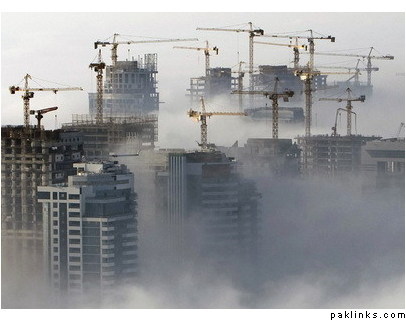
Heavy fog rolls by highrise construction sites near the Dubai Marina.

A cross between Vegas and Mississauga, Dubai is in danger of becoming a ruin-in-waiting
Apr 05, 2009 04:30 AM

Christopher Hume
Urban affairs columnist

DUBAI – If this really is a city and not some sheikh’s mad idea of what a metropolis should be, it’s a city despite itself.
Its vast wealth notwithstanding, the things that make Dubai liveable are those that happened when the planners weren’t looking. But life will out, even in a city built by oil-fuelled hubris.


To most, the image conjured up by Dubai is one of superlatives: This is the location of the world’s tallest tower (the Burj Dubai), the world’s most expensive hotel (the Burj Al Arab), the world’s richest horse race (the Dubai World Cup), the world’s … Well, you get the idea.


And not to be outdone, there’s the brand new The Tiger Woods Dubai, a golf course in the desert that requires four million gallons of water a day to stay green. This in a country built on sand.
It’s also the site of some of the planet’s worst congestion. It’s not just that everyone here drives; everyone drives badly. In March 8 of last year, for example, three people were killed and 277 injured in a highway pile-up that involved more than 200 vehicles.


**Still, it’s hard not to be impressed by what has been accomplished here. The extent of this ruin-in-waiting is truly mind-boggling. **


The question is where to start. The main street, Sheikh Zayed Road, may be as good a place as any. It runs through the city and continues on to Abu Dhabi, Dubai’s quieter, richer cousin, and capital of the United Arab Emirates. This, the road where the accident occurred, reaches 14 lanes in places – and that’s in the heart of the city. Speed limits exist, but only to be ignored.


In neither city are pedestrians welcome anywhere near the street. But in Dubai, the visitor realizes in nanoseconds that this is a city dedicated, enthusiastically, if not slavishly, to the car, the bigger the better. People just aren’t meant to be pedestrians here, but drivers.


According to a recent story in Abu Dhabi’s new English-language newspaper, The National, locals overwhelmingly view traffic accidents as the major cause of death and injury among children. No kidding. Anyone crossing a road in these parts is fair game. To step out means taking your life into your hands.


And if SUV sales have collapsed in North America, Emirates remain as committed as ever to driving the biggest set of wheels they can find. Hummers, Escalades and Cayennes abound. Dubai’s traffic, like its wealth, depends on oil, a commodity that’s already running out. It’s Abu Dhabi, back down the road, that has the vast bulk of the U.A.E.'s oil reserves – 95 per cent. Dubai has less than five per cent, and it is not expected to last more than a decade. The economy relies on real estate, tourism and Abu Dhabi, the emirate that is reported to have invested upwards of $10 billion (U.S.) in Dubai’s economy. The truth may be that this city will be obsolete in less time than it takes most communities to figure out who and what they are.


**But at the moment Dubai is famous for its architecture. Landmarks such as the Burj Al Arab hotel, which sits in the water off the city’s waterfront, have become designated icons, reproduced endlessly in kitsch souvenirs sold everywhere. In another context, such a building, despite its glorious bad taste, would still be a monument. Here it’s just another symbol of built excess, one of hundreds, if not thousands. **


**The most interesting aspect of the hotel is the helipad that extends conspicuously from the top of the sail-like structure. Though obviously intended to convey a sense of riches, it actually addresses the underlying frustration of trying to get around by car. **


To be fair, Dubai is now constructing a new above-ground metro. It will be the region’s first serious attempt at public transit, not including bus lines that serve the huge immigrant underclass brought here to do the dirty work. Keep in mind that fully 90 per cent of Dubai’s population comes from somewhere else, typically Pakistan, Bangladesh and the Philippines.


As for those skyscrapers that crowd Sheikh Zayed Rd., each more outrageous than the next, they have the strange effect of cancelling each other out. Each becomes unexpectedly meaningless, rendering any discussion of architecture irrelevant.


One is reminded that as much as anything architecture derives much of its significance from its context. There’s no better example than the Burj Dubai, which, but for the fact it’s the tallest building in the world, couldn’t be less interesting. What’s so curious is that it’s enough simply to be the tallest; there’s no pressure to aspire for excellence. For all the difference it would have made, it could have been designed by engineers.


As a result of this frantic race to outdo the guy next door, architecture has been turned into a sideshow attraction. Starchitecture is the least of this city’s problems. Dubai resembles nothing so much as a cross between Mississauga and Las Vegas, but on a massive scale; it’s not that there’s no there there, but that there are so many.


Despite everything, Dubai is a thriving city of 1.4 million, the overwhelming majority being expatriates. To wander the streets of the quarters where these guest workers live and work – Bastakiya for example – is to encounter something that approximates what urban Canadians would recognize as neighbourhoods. They don’t resemble anything North American, but there’s life at street level in shops, restaurants and so on. Walking may not be any easier in these parts, but an urban sensibility prevails. It couldn’t be further from the malls, freeways and sprawl of suburbia as we know it, or from “downtown” Dubai for that matter.


Where traditional cities have evolved over centuries, sometimes millennia, Dubai was built in decades. Not much was happening here before the 1960s, a mere blink ago in the life of a Paris, London or Rome. By U.A.E. standards, even Toronto seems positively ancient.


Though there’s something undeniably exciting, even exhilarating, about the idea of Instant City, a place unencumbered by the past and free to embrace the future, the reality says otherwise. Indeed, this isn’t so much a city of the future as a city in denial of the future.


**The old Jane Jacobs’ notion of the city as organized complexity – the sense that order can be found underneath the apparent chaos – becomes almost precious in this context. On the other hand, informal networks of various sorts have been created, self-organized, mostly by foreigners. A small but vivid example is a grassy verge that visiting workers have adopted as an informal meeting place. The expatriates can be seen sitting in groups, large and small, once the heat of the day has subsided. **


Mostly, however, tradition seems more an intrusion. The most obvious instance, perhaps, is the Muslim call to prayers, which cuts through the din five times daily, literally a voice from the past.


Perhaps even that will fall silent once this city has become the “colossal wreck” of which Percy Bysshe Shelley spoke in his famous sonnet Ozymandias. Only the desert will remain, and the sand that covers every surface.


INTERESTING


***MUSLIMS & ISLAM ***
(Video)

4shared.com - file sharing - download movie file MuslimFromEngland.wmv

If A Dog Were Your Teacher !


You would learn stuff like…


**When loved ones come home, always run to greet them.
**


**Never pass up the opportunity to go for a joyride.
**


**Allow the experience of fresh air and the wind in your face to be pure ecstasy.
**


**When it’s in your best interest, practice obedience.
**


**Let others know when they’ve invaded your territory.
**


**Take naps and stretch before rising.
**


**Run, romp, and play daily.
**


**Thrive on attention and let people touch you.
**


**Avoid biting, when a simple growl will do.
**


**On warm days, stop to lie on your back on the grass.
**


**On hot days, drink lots of water and lay under a shady tree.
**


**When you’re happy, dance around and wag your entire body.
**


**No matter how often you’re scolded, don’t buy into the guilt thing and pout - run right back and make friends.
**


**Delight in the simple joy of a long walk.
**


**Eat with gusto and enthusiasm. Stop when you have had enough.
**


**Be loyal.
**


**Never pretend to be something you’re not.
**


**If what you want lies buried, dig until you find it.
**


**And MOST of all…
**


When someone is having a bad day, be silent, sit close by and nuzzle them gently.

Perception


*Washington, DC Metro Station on a cold January morning in 2007. The man with a violin played six Bach pieces for about 45 minutes. During that time approx. 2 thousand people went through the station, most of them on their way to work. After 3 minutes a middle aged man noticed there was a musician playing. He slowed his pace and stopped for a few seconds and then hurried to meet his schedule. *


*4 minutes later:
the violinist received his first dollar: a woman threw the money in the hat and, without stopping, continued to walk.. *


*6 minutes:
A young man leaned against the wall to listen to him, then looked at his watch and started to walk again. *


10 minutes:
A 3-year old boy stopped but his mother tugged him along hurriedly. The kid stopped to look at the violinist again, but the mother pushed hard and the child continued to walk, turning his head all the time. This action was repeated by several other children. Every parent, without exception, forced their children to move on quickly.


45 minutes:
The musician played continuously. Only 6 people stopped and listened for a short while. About 20 gave money but continued to walk at their normal pace. The man collected a total of $32.


1 hour:
He finished playing and silence took over. No one noticed. No one applauded, nor was there any recognition.

No one knew this, but the violinist was Joshua Bell, one of the greatest musicians in the world. He played one of the most intricate pieces ever written, with a violin worth $3.5 million dollars. Two days before Joshua Bell sold out a theater in Boston where the seats averaged $100.


This is a true story. Joshua Bell playing incognito in the metro station was organized by the Washington Post as part of a social experiment about perception, taste and people's priorities. The questions raised: in a common place environment at an inappropriate hour, do we perceive beauty? Do we stop to appreciate it? Do we recognize talent in an unexpected context?


**One possible conclusion reached from this experiment could be this: If we do not have a moment to stop and listen to one of the best musicians in the world, playing some of the finest music ever written, with one of the most beautiful instruments ever made.... **


How many other things are we missing in PAKISTAN?

DST
(Daylight Saving Time)

Rationale and original idea


The main purpose of Daylight Saving Time (called “Summer Time” in many places in the world) is to make better use of daylight. We change our clocks during the summer months to move an hour of daylight from the morning to the evening. Countries have different change dates. Glide your cursor over the map to see how changing the clocks affects different latitudes.

If you live near the equator, day and night are nearly the same length (12 hours). But elsewhere on Earth, there is much more daylight in the summer than in the winter. The closer you live to the North or South Pole, the longer the period of daylight in the summer. Thus, Daylight Saving Time (Summer Time) is usually not helpful in the tropics, and countries near the equator generally do not change their clocks.

A poll conducted by the U.S. Department of Transportation indicated that Americans liked Daylight Saving Time because “there is more light in the evenings / can do more in the evenings.” A 1976 survey of 2.7 million citizens in New South Wales, Australia, found 68% liked daylight saving. Indeed, some say that the primary reason that Daylight Saving Time is a part of many societies is simply because people like to enjoy long summer evenings, and that reasons such as energy conservation are merely rationalizations.
According to some sources, DST saves energy. Studies done by the U.S. Department of Transportation in 1975 showed that Daylight Saving Time trims the entire country’s electricity usage by a small but significant amount, about one percent each day, because less electricity is used for lighting and appliances. Similarly, in New Zealand, power companies have found that power usage decreases 3.5 percent when daylight saving starts. In the first week, peak evening consumption commonly drops around five percent.

The rationale behind the 1975 study of DST-related energy savings was that energy use and the demand for electricity for lighting homes is directly related to the times when people go to bed at night and rise in the morning. In the average home, 25 percent of electricity was used for lighting and small appliances, such as TVs and stereos. A good percentage of energy consumed by lighting and appliances occurred in the evening when families were home. By moving the clock ahead one hour, the amount of electricity consumed each day decreased.

In the summer, people who rose before the sun rises used more energy in the morning than if DST were not in effect. However, although 70 percent of Americans rose before 7:00 a.m., this waste of energy from having less sunlight in the morning was more than offset by the savings of energy that results from more sunlight in the evening.

In the winter, the afternoon Daylight Saving Time advantage is offset for many people and businesses by the morning’s need for more lighting. In spring and fall, the advantage is generally less than one hour. So, the rationale was that Daylight Saving Time saves energy for lighting in all seasons of the year, but it saves least during the four darkest months of winter (November, December, January, and February), when the afternoon advantage is offset by the need for lighting because of late sunrise.
In addition, less electricity was thought to be used because people are home fewer hours during the “longer” days of spring and summer. Most people plan outdoor activities in the extra daylight hours. When people are not at home, they don’t turn on the appliances and lights.
Although a 1976 report by the National Bureau of Standards disputed the 1975 U.S. Department of Transportation study, and found that DST-related energy savings were insignificant, the DOT study continued to influence decisions about Daylight Saving Time.

The argument in favor of saving energy swayed Indiana, where until 2005, only about 16 percent of counties observed Daylight Saving Time. Based on the DOT study, advocates of Indiana DST estimated that the state’s residents would save over $7 million in electricity costs each year. Now that Indiana has made the switch, however, researchers have found the opposite to be the case. Scientists from the University of California, Santa Barbara, compared energy usage over the course of three years in Indiana counties that switched from year-round Standard Time to DST. They found that Indianans actually spent $8.6 million more each year because of Daylight Saving Time, and increased emissions came with a social cost of between $1.6 million and $5.3 million per year. Commentators have theorized that the energy jump is due to the increased prevalence of home air conditioning over the past 40 years, in that more daylight toward the end of a summer’s day means that people are more likely to use their air conditioners when they come home from work.

However, the Indiana research findings don’t necessarily apply elsewhere. In cooler climates, for example, energy savings may well occur.

In addition, some argue that there is a public health benefit to Daylight Saving Time, as it decreases traffic accidents. Several studies in the U.S. and Great Britain have found that the DST daylight shift reduces net traffic accidents and fatalities by close to one percent. An increase in accidents in the dark mornings is more than offset by the evening decrease in accidents.

However, recent research indicates that pedestrian fatalities from cars soar at 6:00 p.m. during the weeks after clocks are set back in the fall. Walkers are three times as likely to be hit and killed by cars right after the switch than in the month before DST ends. Researchers from Carnegie Mellon University, who found a 186 percent jump in the risk of being killed by a car for every mile walked, speculate that drivers go through an adjustment period when dusk arrives earlier. Although the risk drops in the morning, because there are fewer pedestrians at 6:00 a.m., the lives saved in the morning don’t offset those lost in the evening.

This research corroborates a 2001 study by researchers at the University of Michigan, which found that 65 pedestrians were killed by car crashes in the week before DST ended, and 227 pedestrians were killed in the week following the end of DST.

There may also be an economic benefit to DST, as daylight evening hours encourage people to go out and shop, potentially spurring economic growth.
Idea of Daylight Saving Time

The idea of daylight saving was first conceived by Benjamin Franklin (portrait at right) during his sojourn as an American delegate in Paris in 1784, in an essay, “An Economical Project.” Read more about Franklin’s essay.
Some of Franklin’s friends, inventors of a new kind of oil lamp, were so taken by the scheme that they continued corresponding with Franklin even after he returned to America.

The idea was first advocated seriously by London builder William Willett (1857-1915) in the pamphlet, “Waste of Daylight” (1907), that proposed advancing clocks 20 minutes on each of four Sundays in April, and retarding them by the same amount on four Sundays in September. As he was taking an early morning a ride through Petts Wood, near Croydon, Willett was struck by the fact that the blinds of nearby houses were closed, even though the sun was fully risen. When questioned as to why he didn’t simply get up an hour earlier, Willett replied with typical British humor, “What?” In his pamphlet “The Waste of Daylight” he wrote:
“Everyone appreciates the long, light evenings. Everyone laments their shortage as Autumn approaches; and everyone has given utterance to regret that the clear, bright light of an early morning during Spring and Summer months is so seldom seen or used.”

Early British laws and lax observance
About one year after Willett began to advocate daylight saving (he spent a fortune lobbying), he attracted the attention of the authorities. Robert Pearce - later Sir Robert Pearce - introduced a bill in the House of Commons to make it compulsory to adjust the clocks. The bill was drafted in 1909 and introduced in Parliament several times, but it met with ridicule and opposition, especially from farming interests. Generally lampooned at the time, Willett died on March 4, 1915.

Following Germany’s lead, Britain passed an act on May 17, 1916, and Willett’s scheme of adding 80 minutes, in four separate movements was put in operation on the following Sunday, May 21, 1916. There was a storm of opposition, confusion, and prejudice. The Royal Meteorological Society insisted that Greenwich time would still be used to measure tides. The parks belonging to the Office of Works and the London County Council decided to close at dusk, which meant that they would be open an extra hour in the evening. Kew Gardens, on the other hand, ignored the daylight saving scheme and decided to close by the clock.

In Edinburgh, the confusion was even more marked, for the gun at the Castle was fired at 1:00 p.m. Summer Time, while the ball on the top of the Nelson monument on Calton Hill fell at 1:00 Greenwich Time. That arrangement was carried on for the benefit of seamen who could see it from the Firth of Forth. The time fixed for changing clocks was 2:00 a.m. on a Sunday.

There was a fair bit of opposition from the general public and from agricultural interests who wanted daylight in the morning, but Lord Balfour came forward with a unique concern:

“Supposing some unfortunate lady was confined with twins and one child was born 10 minutes before 1 o’clock. … the time of birth of the two children would be reversed. … Such an alteration might conceivably affect the property and titles in that House.”

After World War I, Parliament passed several acts relating to Summer Time. In 1925, a law was enacted that Summer Time should begin on the day following the third Saturday in April (or one week earlier if that day was Easter Day). The date for closing of Summer Time was fixed for the day after the first Saturday in October.

The energy saving benefits of Summer Time were recognized during World War II, when clocks in Britain were put two hours ahead of GMT during the summer. This became known as Double Summer Time. During the war, clocks remained one hour ahead of GMT throughout the winter.

Click on:
Daylight Saving Time - When do we change our clocks?
WORLDWIDE AIR TRAFFIC CONTROL;

This is truely Fascinating---------------Enjoy

The yellow dots are airplanes in the sky during a 24 hour period.

Stay with the picture.
You will see the light of the day moving from the east to the west, as the Earth spins on its axis.

Also you will see the aircraft flow of traffic leaving the North American continent and travelling at night to arrive in the UK/Europe in the morning. Then you will see the flow changing, leaving the UK/Europe in the morning and flying to the American continent in daylight. It is a 24 hour observation of all of the large aircraft flights in the world, condensed down to about 2 minutes.

From space we look like a bee hive of activity. You could tell it was summer time in the north by the sun’s foot print over the planet. You could see that it didn’t quite set in the extreme north and it didn’t quite rise in the extreme south.

I have never seen this before. We are taught about the earths tilt and how it causes summer and winter and have had to imagine just what is going on.

With this 24 hour observation of aircraft travel on the earth’s surface we get to see the daylight pattern move as well.

Click on:

4shared.com - file sharing - download movie file WorldAirTraffic0-24h.wmv

**The Train Journeys of yesteryears!!!
**Raju Jamil

I remember my first ever rail journey from Karachi to Rawalpindi in 1958 enroute to Murree for our summer vacations with grand-mother (Dadee Amaan) my mother, brothers and sisters and our family servant Farid Khan by Tezrao in that inter-class bogey which had wooden seating for eight and sleepers (upper berth) for two each side. The bogey had fans with control knobs, adequate roof lights with switches, a sizeable toilet well maintained. The emergency chain handle always attracted me and I had to control myself from pulling it…that there was a Rs.500 fine those times which should be close to Rs.5000 today!

The best part of train journey was the night time when the holders (known as HOLLDOLL) was unwrapped and laid on the seater and the berths with soft cotton mattress, soft pillow and of course a quilt which, in current modern era, would best be known as a ‘comforter’ ! and then the huge nashtay daan (lunch box) was opened which normally for train journeys, always had parhathaas, qeema, omelletes, tarkari and before the departure of the train…a mud pitcher known as ‘sura’hee’ was essentially purchased for Rs.1/- and filled with water from the railway station tap and by God…we didn’t hear of people being hosiptalised or dying due to cunsumption of railway station’s tap water then !!! in fact we ourselves were the ‘consumers’…of that water!

A game of ludo or rummee during the train journey was sizzling to the extent that instances have been noted of the ludo game board flying out of the train window with tempers flying high on the umpteenth try for SIX on the dice and not getting it! The sweet sound of deisel engine crusing smoothly towards the destination witha down train passing by in speed—was all too exciting and if you were traveling to Quetta or Peshawar, the keen await for a tunnel (surrangg) was more exciting.

The train heading in speed—intially provided the view of Drigh Road, Malir and Landhi areas when proceeding from the ever green, though small, Karachi Cantt., Railway Station which was the commencement point for major trains like; Tezrao at 1.30 pm, Tezgam at 3.45 PM and Khyber Mail at 9.45 pm…Tezrao ended journey at Lahore, Tezga at Rawalpindi and Khyber at Peshawar. Lahore journey took close to 20, Rawalpindi around 22 and Peshawar about 25 hours. It was fun traveling by smooth and sparkling trains then…or say…till late 70’s or early 80’s afterwhich…everything became a dream…!

As time progress, my father’s job also progressed—which provided me three opportunities to travel in what we can describe as “Priority Lounge” we have at Banks these days…yes, I am talking about the German made Airconditioned Coaches and Sleeper Cars attached with an airconditioned dinning cars…where the cooling was ten times better then the cooling you receive in your airconditioned car. There were coupe of two and four berths which more mostly occupied by families. The berths were clad with chamoise cloth in dark green color and the coupe had even a ladder to climb the upper berth when going for slumber. It was heavenly to travel airconditioned coupe and so serene and magical atmosphere was in dinning car that we use to sit there for hours after breakfast or lunch or dinner—enjoying discussions and the sheer excitement of traveling in such a quiet and serene atmosphere!

The BEIRA (attendants or waiters or servers commonly known as..then) in airconditioned coaches/dinning cars, were in white attire with thick belt bearing steel emblem of PWR (Pakistan Western Railway…the new name of NWR…North Western Railway from late 60’s…) and a kulla with a starched fan type cloth emerging out to add to the grace of it being worn…something like the cap worn by our guards at the border between Pakistan and India at Wagah these days.

The dinning car had the best breakfast with all kind of cereals and the dinning car food was quoted in parties—much to the disdain of being made a mockery in the famous TV comedy ‘50-50’ some years later—due to the extremely dilapidated condition/food quality the raliway dining car food turned into on account of the catering business outsourced and quality not controlled!
The other kind of AIRCONDITIONED compartment was the one which was mostly on QUETTA and PESHAWAR routes. The airconditioned was fan controlled with layers of ICE laid on the top duct area…which too provided adequate cooling.

The train journey in Pakistan from any point to any point----was the most exciting affair for the school students like us in late 50’s through late 60’s and for a short while thereafter-----and the maintenance of compartments, bogey and the general atmosphere in trains was incredibly high on quality..!

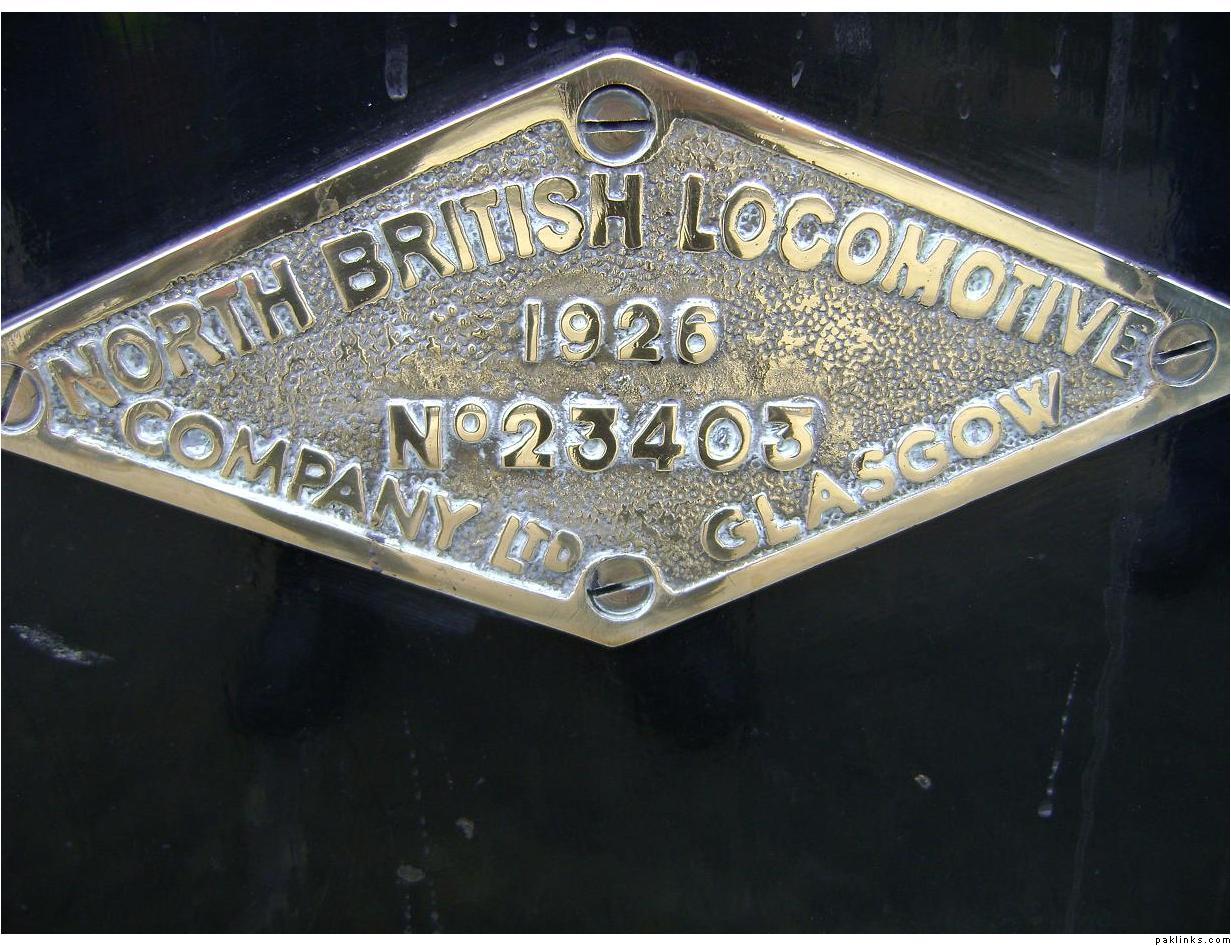
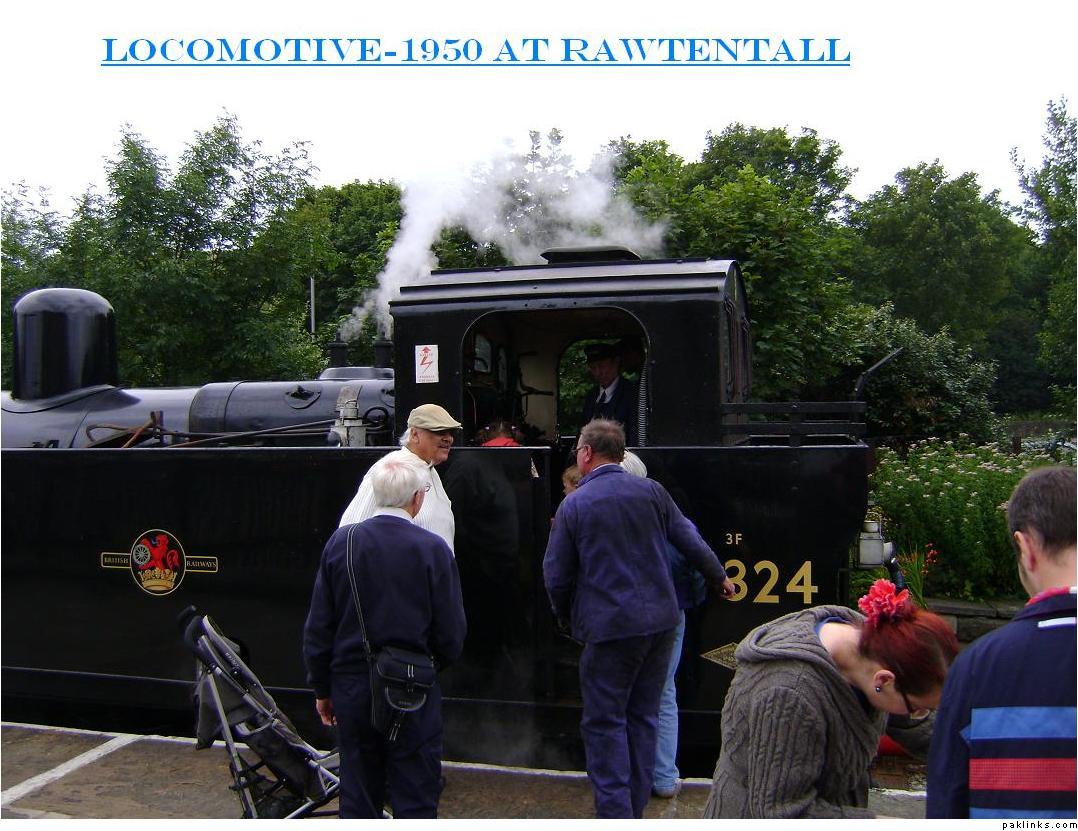
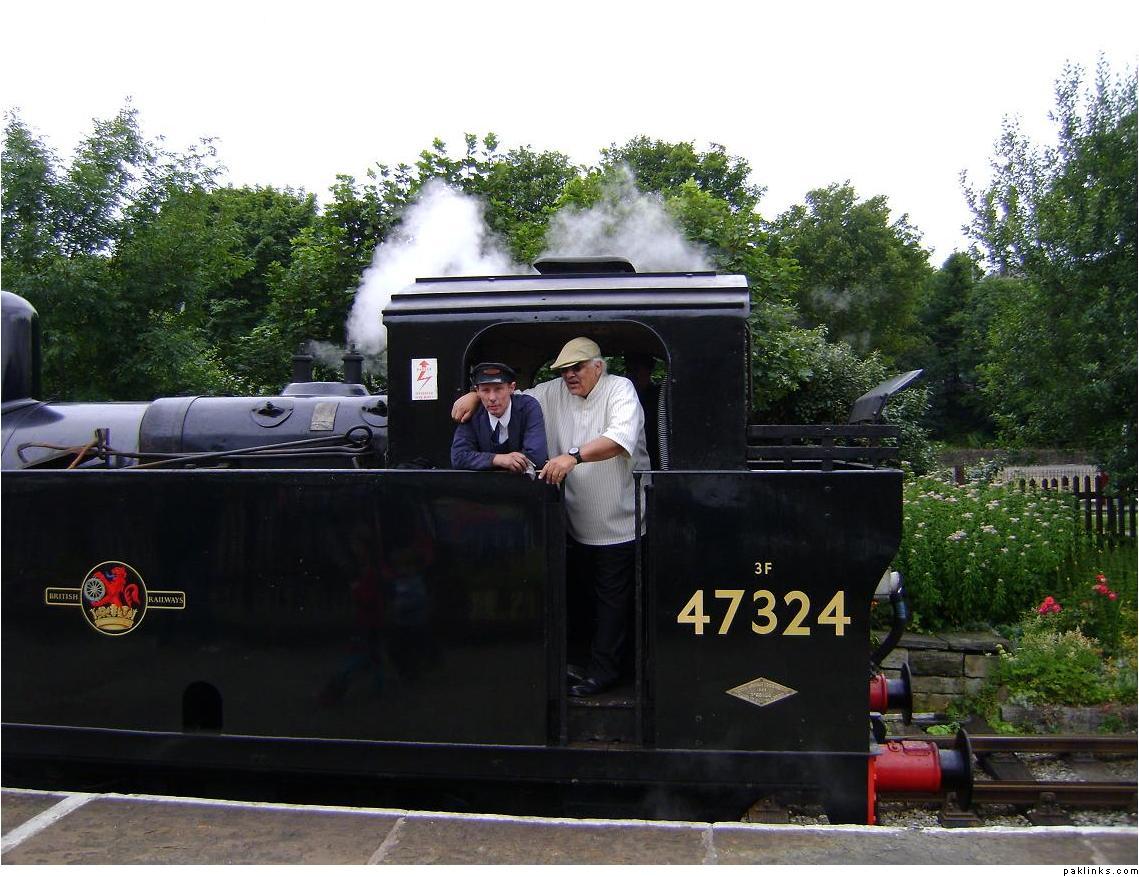
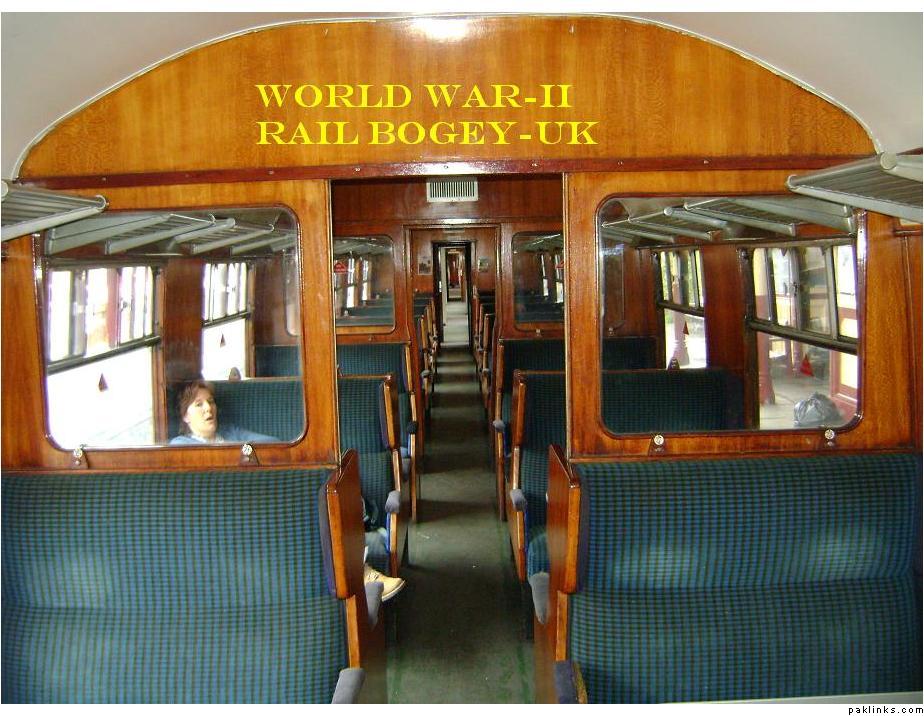
Rail journey to places like QUETTA and PESHAWAR or hilly areas----essentially had LOCOMOTIVES pulling the bogeys as the incline could only be scaled when a LOCOMOTIVE was deployed. Locomotive had steam engine which ran through coal and the first ever Locomotive provided to Pakistan was on 20 August-1947 by the British Government which was manufactured in Glasgow-Scotland and during my last three visits to Scotland for shoot of Zulfi Shaikh’s serials and once of my own for ‘hogmanny’ (new year eve at Edinburgh) I had the opportunity to visit the Locomotive Factory nearby Glasgow which is now a bit quiet. But interesting, a low powered Locomotive still attracts attention of tourist in Rawtentall near Manchester—where you get the opportunity to ride a World War-II train pulled by a locomotive (see the attached picture) and it was during my journey on that train in July this year (2009) that the Locomotive driver told me about the history of Locomotive manufacture and the fact that how some were exported to Pakistan in 1947.

In Pakistan since my phoppa (aunty’s husband) was a senior official in Pakistan Railways, I had the opportunity to travel by the USA gifted DEISEL ENGINE from Lalamusa to Rawalpindi and in a Locomotive from Karachi to halfway through Quetta…years back.

The other fascinating part of rail travel was to travel in a SALOON which were specially provided to senior officials and of course the Minister of Railway while there was a special three bedroom SALOON of the then President of Pakistan fitted with just about everything. There are two categories of SALOONS; an ordinary one and the one fully airconditioned. I traveled both…and it was simply mesmerizing and out of this world that i have not been able to forget about that journey in airconditioned saloon from Sukkur to Lahore with my Phoppa and Phoppi and their family.

One of the most exciting ‘gadget’ in railway…I call, was; TROLLEY but it was always heart wrenching to watch two well built guys pushing the trolley for miles while the DSO or DO Railway sat with his hunter’s hat and a stick under a huge umberella… to inspect the technical sides of railway in connection with the laying or maintenance of railway line (or tracks) then. Thank GOD! that I also saw Electronic Trolleys or Deisel Trolleys…which had a mini engine like a motorboat…handled by the driver sitting nearby it…!!!

There was always a GUARD bogey right at the end of the 12 bogeys usually connected through crankshafts with each other. The guard bogey had an emergency brake system he could apply if required. The guard would always remain vigilant also for getting morse code messages and the management of signals clearing the train to proceed further–at some stations and points with many number of tracks!

PAKISTAN RAILWAYS played an important role in Pakistan’s politics as well…when Field Marshall Ayub Khan then President of Pakistan, went on a crusade on PAK-JUMHOORIYATT SPECIAL TRAIN with his team of cabinet ministers and officials from Karachi to Peshawar…stopping at each major station…addressing the awam and also granting monthly grants to the widows etc., I actually went to that special train and visited the saloon of Brig.Nawazish Ali anf F.R.Khan, MS and Private Secretary to Field Marshall as my father was also traveling with FM by virtue of being his Personal Staff Officer then.

Pakistan railway has come a long way–though sadly, it has not been able to maintain the grandeur RAILWAYS was required to maintain.
Some of the railway stations I remember passing by on journey from Karachi to Hyderabad, Lahore and Rawalpindi and Peshawar—on account of their landmark and importance on something..were;

  1. KOTRI due ‘Kotri Barrage’ we awaited to cross with Indus River flowing proudly (currently we yearn for water there..)
  2. Hyderabad was the busy station all the time. The best buy there were BANGLES.
  3. ROHRI nearby Sukkur as Sukkur was not the stop–it was on left bank and the train went through right bank though we always saw the famous YAQOOB BISCUIT FACTORY almost attached to the railway line our train cfommuted on. Rohri also had a barrage.
  4. KHANPUR was famous for KHOYA and PEIRRAS. We stayed awake at 4 am the time train reached Khanpur…only to buy the khoya.
  5. SAMASATTA near Bhawalpur was famous for pottery works. Flashy kaamdaar surra’hee etc were the attractions.
  6. MULTAN was the most sought after railway station and a junction also…where HAFIZ KA SOHAN HALWA was the main item which everyone use to buy by default. Seniors mostly preferred to buy MULTANI MITTI…
  7. LAHORE was (and still is…) the biggest railway station in Asia. Entering the railway station created a spellbinding effect on us peeking through the window of our compartment—amazingly and keenly awaiting to see the cheerfull faces of our first cousins or friends waiting anxiously for the train to stop and order the QULI to lift the luggage…noting his badge no.
  8. RAWALPINDI came after passing by Lalamusa and Gujrat stations. I always wondered where Lala Musa Sahab lived? and wished that someday I may meet him!!!
  9. The most keenly awaited railway station for me…during the journey from R’Pindi to Peshawar, was NOWSHERA rekindling my sweet memories of stay at my Khala’s several times when my Khalu was posted at the Armoured Corp School as Commandant. The wonderful evenings at Nowshera Club…and the picnis near river Kabul…can never be forgotten.
  10. Passing through tunnels before reaching Peshawar was scary but exciting and a glimpse of Attock Fort…from that railway bridge…was an adventure itself!

The train journey in Pakistan is now limited to a limited people—most of them scared on the ill maintenance of railway tracks, the route and the bogeys and the compartments what to talk about the railway stations and the waiting rooms of our times–which, near matched a three star hotel of today!

A train getting late during our days (late 50’s through early 70’s) was something quite rare…! and so were the happenings we hear—on train journeys of today!

ISHQ VISHQ

NOT ONLY IN AMERICA… BUT ALSO BACK AT OUR END OF THE WORLD..
THE PRE-PARTITION ERA AND THEREAFTER—THE MAJAZI KHUDA
HAD ALL THE CRAPPY REASONS TO THINK HIMSELF ONE :slight_smile:

Ok, when you girls stop laughing long enough to pick yourself off the floor,
forward this to all the women you know, **
so they can have a good laugh too:)
**


KISMET KONNECTED
Raju Jamil

That cloudy day of June-1961 at Karachi Airport gave a weary look due to that mild heat spell which was telling on the faces of the scores of Govt. Officials and Diplomats lined up alongside the President of Pakistan General Mohammad Ayub Khan to receive Lyndon Baines Johnson, Vice President of the United States Of America, due to land any moment in Pakistan on a goodwill tour to take him to our capital then--Karachi followed by Lahore and Peshawar.


The PAN AMERICAN Clipper Jet Boeing 707 landed smoothly and the well decorated turmac saw VP LBJ and MAK take slaute during the sound of their countries National Anthem played by the Naval Band.


There were 12 cars in a motorcade where the black caddillac driven by Presidential Driver Ishaq, had LBJ and MAK with front seat next to the driver occupied by Brig.Nawazish Ali Khan, the MS to MAK and the American Ambassador in Pakistan....followed by a convertible Chevrolet Impala-1959 with DIG-Police Mian Bashir Ahmed followed by an Austin-of-England re-shaped into a Rolls Royce kind of the President's House-Karchi pool....in which my father (Jamiluddin Aali, the then Personal Staff Officer to MAK) and Shaikh Habibur Rahman the Protocol Officer were on duty and of course cars like Dodge Dart and Chevy-Belair carrying Govt and U.S.Embassy officials, took route of main Drigh Road (now Shahrah-e-Faisal) for the President's House (now Sindh Governor House -- we lived in the President's Estate adjacent to the President's House and Shaikh Habibur Rahman Uncle was our wall-to-wall neighbor in that 1912 one story buyilding which now houses Surveyor General of Pakistan's Office).


With Police Motorbikes speeding in line and blowing whistles and siren occassionally ahead of the motorcade...the journey progressed smoothly-------till something happened !!! that Driver Ishaq applied brakes smoothly--good enough not to make the car behind bang the Presidential Car----and all the followers literally ran towards the Presidential Caddillac fearing that something awful has happened to either of the two VVVIPs in that car---when out came Vice President Johnson with President Ayub--and slowly walked towards the site left of Drigh Road at the exact spot where--currently stands the Finance and Trade Centre (FTC) where a 38 year old Camel Cart owner Sar'eban Bashir, clad in shalwar kameez full of dust---stood shivering next to his camel and cart with Mian Bashir Ahmed consoling him to remain calm...!


Vice President of the United States Of America Lyndon Baines Johnson alongside his host President Ayub and many others--including my father----casually walked towards Camel Cart owner Bashir---shook hands with him and said "Hello, I am LBJ from USA and I wanna be your friend!" to which Bashir was translated the address--who said "Salam Sahab, khoosee huee aap se milke!" then 6.5 minutes of invigilated exchanges between a Pakistani Camel Cart owner Bashir and VP USA LBJ continued which ended with LBJ taking out a PARKER'61 from his shirt pocket---handing it to Bashir saying "We are friends now and friends must meet again---so I am inviting you to USA as my guest--please accept?".


Ten days later, two officials from the U.S.Embassy and two officials from the President of Pakistan's Secretariat---visited Bashir at his residence in Lyari (Bashir was a Makrani) for arranging his passport and U.S.Visa and Govt.of Pakistan arranging for three sets of black-sherwani, white-shalwar kameez and Jinnah caps (QADR THIS USS WAQT JINNAH CAP KI!!!) and some Onyx Products from Bashir for LBJ.... and within a week Pakistani Camel Cart owner from Lyari, Karachi....flies to New York by PAN AMERICAN Clipper Jet Boeing 707 where he is received by LBJ aide and the next 12 days of Bashir are spent in New York, Washington DC, Dallas at the personal ranch of LBJ where his daughter Tricia and Ladybird Johnson held Bar-B-Q party, luncheon and breakfast gathering in honor of Vice President of United States of America Lyndon Baines Johnson's Pakistani friend Camel Cart owner (Sar'eban) Bashir Ahmed who returns home---much blessed with some worthwhile gifts which includes a Mack Truck and am American Cycle for his son and some financial package to start a more elevated business.


From that day and date of June-1961 till late 60's...the Bashir Magic was the talk of the country and of the State of Texas in USA.


Kismet Konnected Bashir Ahmed became a businessmen over weeks----and stayed indebted to LBJ by continuing his correspondence through some Govt Officials assistance via U.S.Embassy---which ended with the advent of Vietnam War close by to JFK's assasination in 1963.


EPILOGUE:
In 1972-73 when Zia Moheyuddin started his famous ZIA SHOW by recording it before a live audience at the Fleet Club-Karachi auditorium near Lucky Star-Saddar, I was attached with Zia Bhai as his unaccredited Manager---a young banker at HBL Nursery Branch, PECHS--who marketed the prize account of Zia Moheyuddin and provided home-service for his banking transactions like picking up his PTV cheques and arranging statements etc. hence it was also being a chapperone to him at each of his several shows he recorded there. In one of his shows--Zia Bhai invited Sar'eban Bashir Ahmed and after a good inter-action---Zia Bhai, mildly pulling Bashir's leg---posed a question on him; "YE AAP NE UMREEKA SE WAPIS AANAY KE BAAD----OONTH GAARI KIYON CHALANA BU'NDD KARDEE???" and i remember it as clear as a day----that Bashir...sort of went quiet and suddenly with a spark in his eyes---came back sharply--saying; "WOH....JAANSUNN NNE MUJHE SE KAHA THAH KE MERI 'POOSEE'SUNN' (position) KA KHAYYAL RAKHNA!!!!"


Bashir Ahmed died sometime in late 70's---and the news of his death was widely covered by almost all the Pakistani Newspapers then....!


If I look at this whole KK closely---I think this strange friendship could be the ONLY one of its kind in thw World! unless we also name KISMET KONNECTED to the interesting incidence with that lady in Memphis who was staring at a car in showroom when Elvis Presley walked by and asked her if she likes the car---and on her shy and smiling reply as "who doesn't" Elvis gifted that car to her!! I dont know how far this is true--but I do remember having read about it somewhere!)

-end-

(The "Kismet Konnected" is not a concoction. It is TRUE and the key person who has told me all of what i have fine tuned above---is none the other but my father Jamiluddin Aali who is 85 now and Masha'Allah, good on his past days memory but quiet weak on the current. I was a school student then and this incidence or happening---was too exciting and spellbinding for us then.............)

Please click on the following site to view some remarkable pictures
Eid al-Adha and the Hajj, 2009

Eid al-Adha and the Hajj, 2009 - The Big Picture - Boston.com

Re: INTERESTING LIVES and INTERESTING FACTS

Peace arjay

Very nice pictures ... I must hand it to you ... all your posts demonstrate that you love culture and you have focus in the smallest of details which is coupled with a vision of the widest of scopes ...

All these topics covered by one person! Truly one can get easily lost in this thread ... thanks again.

Thank you---for your kind comments. It also re-assures my faith in my readers here on GS and my blogs on Facebook and other sites.

Best Regards,

Raju Jamil,
Karachi