Insurgency in Balochistan | Impact on Civilian Population

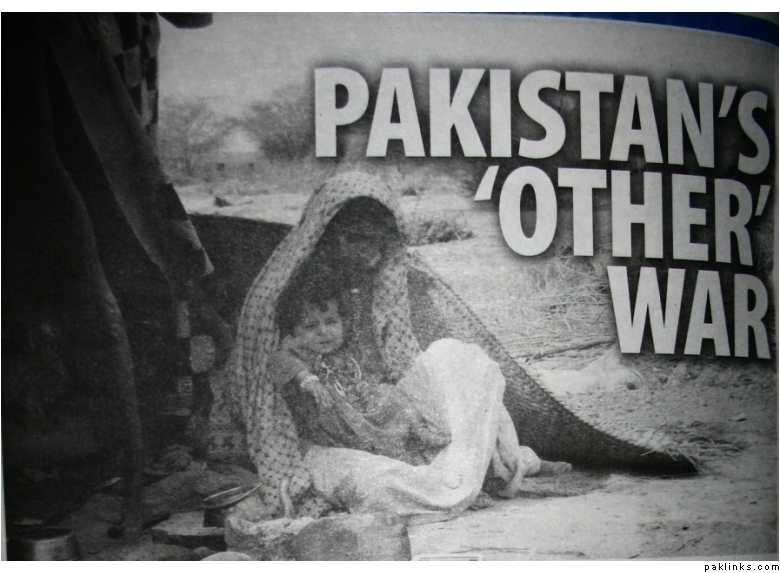
Pakistan’s military government continues to block aid to the thousands displaced by the widening conflict in Balochistan.

           From **Ziad Zafar** in **Balochistan**

“Forget that you are a journalist. If, as a human being, you care at all about those who are suffering, you will not publish this report. I implore you: please don’t aggravate the situation. It is already very precarious,” a senior official from the United Nations Human Rights Council told Newsline on condition of anonymity. “We already made a big mistake by talking to the press earlier. We will never know how many lives were lost because of it. We cannot make that mistake again.”
The report she was referring to (about which only an enquiry was made) was a comprehensive survey carried out by the UNICEF late last year about the condition of thousands displaced by the conflict in Balochistan. An internal document, parts of which were leaked to the press, the survey estimated that over 86,000 displaced persons were living in make-shift shelters with no access to clean drinking water or any health facilities. The report stated that the majority of the IDPs (internally displaced people), 59,000 in number, were women and children. Twenty-eight per cent of the children under the age of five were “acutely malnourished.” In fact, six per cent of the children were so underfed that they were in danger of perishing without immediate medical attention. The assessment also revealed that 80 per cent of the hundreds of deaths among the IDPs were those of children under the age of five. The report concluded that according to WHO standards the “situation is critical.”
For several months now, aid agencies have been desperate to gain access to the parts of Balochistan where villagers are caught in the crossfire between rebel tribesmen and government forces, but their efforts have been consistently blocked. “We have tried everything to get aid across but all our attempts have been systematically undermined,” said Ronald Van Dijk, head of the UNICEF mission in Pakistan. "Meanwhile, surplus supplies of medicine and food are lying in warehouses in Quetta. “I even know of aid groups that tried to deliver relief without permits, but they got turned back on the road.” Officially, the UN cannot deliver aid without formal permission from the host nation, something the agency has been desperately seeking for the last nine months.
Then, on December 21 last year, under pressure from foreign diplomats and donor agencies, the government finally gave the UN official permission to deliver its million-dollar-aid package for Baloch IDPs. The UN was allowed to set up 57 feeding centres in the area (on the condition that no UN official would communicate with the press). The same day, however, an ecstatic official from the UNICEF spoke to journalists and expressed his joy at the decision. “This should have happened ten months ago. Hundreds of children have died needlessly because of the delay,” he said.
A few days later, the permission was abruptly revoked. The same week, Abdul Sattar Edhi, head of the Edhi Foundation, was explicitly told not to deliver any more aid to the affected Baloch people as the situation was highly “sensitive.” Edhi’s son, Faisal Edhi, also made the mistake of talking to the press, but he did so only after their relief efforts had been halted.
The situation in Balochistan is, indeed, bleak. Thousands remain displaced and are living in miserable conditions. Many have poured into neighbouring towns and those with better resources have made it to the urban centres. The low income peasants have fared the worst. Small groups of displaced peasant families remain encamped over a vast and isolated area that is becoming increasingly insecure as the fighting spreads. It is spring now, time for the traditional harvest. But for many like the Bugti tribesman, Issa Khan, there is little to rejoice about. It has been a long, unforgiving winter in the open fields, and many children have not survived. “When the winter came we knew that some of our children wouldn’t make it,” he says. "I am a proud man, but my eyes welled up hearing my children cry in the bitter cold nights when I couldn’t find food for them.‘’ Issa Khan and his family left Dera Bugti after the government launched an offensive on the town. He says he couldn’t find a safe passage out of the area for many days because both the rebels and the military had mined the town to restrict movement. His jaw quivers as he remembers those nights. “It was like doomsday. They (the army) bombed everyone indiscriminately. They didn’t care that we were only poor villagers. The fact that we are Bugtis was enough,” he says bitterly. “I lost three members of my family, and we couldn’t even give them a burial. We had to leave them lying there like animals… and they call us terrorists?”
When asked if he is proud to be a Pakistani, he responds with a resounding, no. “If I am a Pakistani, where are my rights? They don’t treat us like Pakistanis… they use us for target practice and test their new weapons on us.There is a reason why they don’t want anyone to come here. They don’t want the world to see that they are treating people like animals.”
A few miles away, 70-year-old Pir Baksh Marri heads a commune of displaced families. Back home, he says he owned cattle and some modest farmland that he spent his life’s earnings on. His crops were destroyed by the bombing, but now wonders if he should have left. “We left everything we owned to escape, but I think maybe we should have stayed there and died,” he muses. “There is nothing here. We are at the mercy of God… sometimes we gather enough grain to eat, but every day is a gamble.”
There is no clean drinking water in these camps and no medicine. Many women have died in childbirth. Water-borne diseases are rampant and dozens of children have died of typhoid, hepatitis and, of course, malnutrition. “We buried eleven of our children here,” says Pir Baksh. “Nobody should have to see their children die.”
Rebel attacks on government installations in these districts have increased in recent months, often bringing down the wrath of security agencies on the local populace. There is a heavy military and intelligence presence in these areas that extends south from Kohlu and Dera Bugti districts across the provincial border of Balochistan and Sindh into Jacobabad. Residents say that this deployment has only aggravated the woes of the locals, as well as the refugees. “The government won’t let anyone help us, but they still don’t leave us alone,” says Sher Ali, a man living in one of the camps. “People from the agencies come and harass us all the time and call us terrorists. My child hasn’t eaten in days. Do I look like a terrorist?”
On the outskirts of towns like Dera Murad Jamali and Jhapat, some native landowners have allowed several families to stay on as labourers. But the locals are often hostile. Old tribal enmities and newer political alliances further complicate the situation. Fear of reprisal by security agencies also prevents locals from aiding refugees. Locals like Rafiq Soomro, a school teacher, know that government agencies have infiltrated the population and hired countless informers. “You can’t trust anyone here anymore,” he says. “There is so much suspicion; nobody knows who’s working for whom.” The climate of fear and suspicion is hardly surprising in light of the hundreds of reported cases of alleged disappearances at the hands of government agencies in these areas. “They come at night and take away whoever they want,” says Jan Udeho, a local journalist. “If you are talking against the government, they will know…and they will come and pay you a visit. Sometimes they abduct family members of fighters so they can put pressure on them to surrender.”
Almost two years on since the insurgency began, and several months after the government announced that peace had returned to the area, most of the population of Dera Bugti and Sui has not returned. "Why should I go back and live under the rule of those traitors who bombed our women and children,‘’ says Murad Baksh Bugti. "I know I have nothing and can’t fight for my rights, but I would rather my children die of starvation here than go back there in shame.‘’ This sentiment echoes throughout the community of IDPs, who mostly comprise members of the Marri and Bugti tribes. Here, the government and its security agencies are viewed as the enemy who drove them from their homes and killed the man they called their leader, Nawab Akbar Bugti. "We will only go back when someone from our leader’s family is reinstated as the rightful sardar,‘’ is the almost unanimous consensus here.
Any doubt that the government’s killing of Nawab Akbar Bugti has elevated him to the rank of a martyr for the Baloch cause can be laid to rest here. Even other clans like the Marris, who held long-standing grievances against the cantankerous old Nawab, now view him as something of a hero. ‘‘Whatever his other faults, he was a fighter and fought for the rights of his people,’’ says Ghulam din Marri.
Resentment against the armed forces is at an all-time high in Balochistan. But the government vociferously denies that any such situation exists. Officials maintain that peace has returned to Dera Bugti, Sui and other areas, and that those who had fled the fighting have all returned. But this view is refuted by many like Dani Bux Magsi, a local journalist and chairman of the Dera Allah Yaar press club. “Yes, the area has been repopulated but not by those who left it. Dera Bugti is a different place now. It bears no resemblance to what it used to be just a few months ago. It is now ruled by the government and its hired thugs.”
After ceremonially marking an end to the sardari system in November last year, the government resettled expatriate tribes like the Kalpar and Masuri in Dera Bugti and Sui. The Kalpars, a Bugti sub-tribe, were expelled from Sui and Dera Bugti 10 years ago by Nawab Bugti. There is deep resentment between these two tribes, and much blood has been spilled on both sides over the years. “Now that they have come back, they want to exact revenge on the supporters of the Nawab. The government wants to control Dera Bugti, so they are patronising these tribes,” says Dani Bux Magsi. “It is like the British policy of divide and rule.” Even former Prime Minister Mir Zafarullah Khan Jamali, whose constituency is now hosting many of the refugees, acknowledged that “the government seems determined to change the demographic complexion of Dera Bugti.”
It is unclear exactly how many people have been displaced by the fighting. Estimates vary wildly, depending on the source. The Asian Human Rights Commission (AHRC) puts the number at 200,000; the nazim of Dera Bugti, Kazim Bugti, says no less than 100,000 people have been displaced.
Meanwhile, the credibility of the aid agencies is also under fire. “It is up to aid agencies to direct the press and to shed sufficient light on the issue,” says one analyst. “Why are they quiet? Obviously, quiet pressure is not working. This demands a strong international condemnation.” The Christian Science Monitor recently quoted an unnamed western diplomat as saying: “The UN is now desperate. They are literally begging us for help.” The UN is not alone in its frustration. Other organisations such as Oxfam, CARE and the International Committee of the Red Cross (ICRC) have also been trying to gain access to the region. In Islamabad, frustrated aid workers remain quietly furious at being denied access, but in the words of one: “Our aim is still to get help to the people, and we have no choice but to cooperate with the government if we are to stand a chance of doing that. They are slowly coming round.”
For its part, the western media (largely preoccupied with Pakistan’s ‘war on terror’) has also chosen not to focus on what the New York Times calls, ‘Pakistan’s other war’. But this other war will not go away quietly. In fact, all reports indicate that the insurgency is gaining momentum. The army may be winning the military battle against what it calls miscreants, but it is, once again, losing the moral war.

Source: **Newsline June 2007
****-End-

**Civilians are suffering immensely in Baloch insurgency, and the tribal areas of FATA. Its unfortunate the govt. won’t allow independent media to uncover the truth. This is sad.
Re: Insurgency in Balochistan | Impact on Civilian Population

When one’s house is not a sanctuary](http://www.dawn.com/2007/06/21/top11.htm)

  • By Reema Abbasi*

THE scene in Awaran village near Mashkay district in Balochistan is one of mourning. Almost every home wears a pall of grief. A young Ali Akber sits in the hostile heat of a dark hovel and tries to console a newly-wed bride and an old mother. His brother Munir Mengal went missing on April 4, 2006, upon arrival from Bahrain at Karachi Airport. Mengal is just one of many whose identity threatens his life.

“He was running a Balochi channel called Baloch Voice. When we went to report the case, we were told that an FIR cannot be registered against an agency so we had to file a petition in the Sindh High Court,” recounts a helpless Ali.

Ali Akber, along with his family, has taken a 100-day hunger strike to Khuzdar, Kalat, Karachi and Islamabad but remains without his brother. “The first phone call came on December 28, 2006, from the Military Intelligence (MI) to say that they will allow two women to meet Munir,” says Akber.

“My mother went with her elder brother to see him. Eight people dressed as civilians brought him and the meeting lasted for two and a half hours in the airport restaurant,” he continues.

Ali Akber says that the officials with Munir asked the family to withdraw their case. “My mother wanted to withdraw it the next day but the judge said that he would reserve it for 20 days and reopen it if he was not returned.”

“The MI called again and changed their demand. They said that we should give an application stating that the agencies did not abduct my brother but Akhter Mengal’s clan was responsible for it. This was a very difficult time but we decided against it,” says a tearful Akber.

The family has not heard from Munir again and the case continues. “My mother has been very ill and bed-ridden for four months. My sister-in-law, who married Munir just two months before he was taken away, and I have not sat for our exams. We heard some weeks ago that he had been taken to Rawalpindi from Karachi,” he says.

Munir and hundreds of others were gone in a heartbeat. Picked up from obscure streets or yanked out of their homes, these men are not safe anywhere. When the blindfold comes off, most find themselves in dark, damp cells with blood on the walls, where whips of rubber, leather belts and drills are wielded at them. The torment has been indefinite for most.

For Dr Allah Nazar Baloch, it lasted six months where he was stripped naked and hung from the ceiling for hours on end, deprived of sleep for many days and given anaesthesia injections. Baloch returned on a stretcher. He was in hospital for three days and could not stand for two months.

This was easier than Sattar Baloch’s agony. Sattar came back with holes drilled into his feet and many months later, he is still trying to stand. Dr Hanif Shareef was also kept for six months and says that it is unlikely that he will ever lead a normal life. “They gave electric currents to my genitals and I have not recovered in so many months,” cries Shareef.

Kazim Bugti, nazim of Dera Bugti, was picked up on November 22, 2006, when he came to meet his mother in Karachi and his whereabouts remain unknown. Former detainees say they have heard him crying for his medicines.

“Munir said that he had not seen any light for five months and was given food only once a day,” remembers Ali Akber.

However, Brigadier Javed Iqbal Cheema of the National Crisis Cell dismisses such stories as incorrect. “The government does not believe in maltreatment of those who have been confined, extrajudicial custody, or illegal confinement. Nobody has come to us with complaints of torture,” says Cheema.

Zafar Jan, a member of the central organisation committee of Jamhoori Watan Party (JWP) says that in the last three years, a large number of people went missing but not one has appeared in court. “Those who have returned say there are innumerable people there. They have a Kuli camp in Quetta and two camps in Karachi. One is in Cantonment and the other is in Malir Cantt,” says Jan.

Jan claims that the camp in Quetta is far crueler than the ones in Karachi and people are tortured to own up to being a part of the Baloch Liberation Army (BLA). Sher Mohammed Baloch is one of many kidnapped by the authorities. “He was in a rally and taken away in front of the entire public but officials blatantly deny it.”

Jan maintains that most of the victims belong to the JWP, Baloch Students Organisation or to the Bugti or Marri belt. “Many, like Gohram Saleh who was a driver, have nothing to do with politics but have not been spared.”

The Human Rights Commission of Pakistan (HRCP) claims that out of the 99 complaints registered in 2006, 73 were Baloch and maintains that 70 per cent of these people are not ‘jihadis’. “We have 400 complaints from all over the country and out of these, 340 are Baloch,” says Ejaz Hassan of HRCP.

So far, approximately 10 Balochs have been released. The highest number of disappearances occurred in 2006 with 93 cases and 35 cases were reported in 2005. Interestingly, the Baluchvoice website records 262 abductees.

Cheema, on the other hand, calls HRCP records ‘scanty’. “There are no addresses and parentage of many people and only their names and provinces are mentioned, so how can we embark on a wild goose chase in so many cases,” he says. “Out of all those who were missing and not specifically Balochs, approximately 108 have been traced out.”

But an irate Jamil Bugti says: “It is a war zone. This is ethnic cleansing on a smaller scale. There is no way to obtain real figures because most people are afraid to report a case. Many a time, those who go to the police station do not return either.”

Bugti also recounts meeting Rauf Sasoli, an activist of the JWP. Sasoli was recently released by the spy services. “The man is destroyed. He is like a zombie because of the torture inflicted on him,” comments Bugti.

The spy arm’s bid to quell the impending insurgency in Balochistan seems to have swept up more innocents than suspected dissidents. But despite dismal returns, numbers continue to grow by the day.

For most, the safest place to fall foul of the law would be home. But for those whose greatest crime is to belong to an area rooted in bitter conflict, even this is not an option.


There is a serious crisis in Balochistan. I am surprised it doesn’t get more attention in the media.

Re: Insurgency in Balochistan | Impact on Civilian Population

A Personal Story](http://pakistaniat.com/2007/06/16/a-personal-story/)

**Pervaiz Munir Alvi

**Mohammad Tufail Baloch has twelve children. The oldest one is 26 and the youngest one 6. For generations his tribe has lived at Dera Bugti till trouble came to the area few years ago. Nawab Akbar Bugti had demanded more royalty money for the gas fields and unless given promised trouble for the government. Military government responded in negative and the Nawab chose to fight back.

Caught in this cross fire were Mohammad Tufail and his family.No longer able to provide food for his family off his meager income from making and repairing wooden sleeping cots, Tufail decided to leave the area and move to some other parts of the country. He and his family became what have come to be known as internal refugees. After tracking through the hills and mountains of Balochistan and Frontier provinces the family finally reached the banks of Indus River near Attock and set their tents outside the city.

The family crafts of making cots from the wood cut from the open country side and ropes made from the twines has helped it survive. In the last few years his four older children have either gotten married or moved away to the other parts of Punjab in search of jobs. Since like Mohammad Tufail himself, all of his children are totally illiterate their job prospects are very limited.

Now the second part of the story.

My old college room mate (who shall remain nameless) after a long successful career in international banking decided to return to his ancestral village along the banks of Indus. Other than fowl hunting along the river, his life long passion was to open a school in his village. As a child he had daily traveled several miles with an adult chaperon in order to go to school. His parents being the local landowners were able to do that whereas none of the other parents could afford that luxury for their children. As a result none of his childhood friends from the village went to school. For them the village mosque was the school and Moulvi Sahab the only teacher they ever had. With land donated by his father and from his personal funds my friend has opened up a school for the local students.

One day a young 17 years old girl with her three youngest siblings showed up at my friend’s door and asked for his wife. She wanted to enroll her two younger sisters and one brother in the village school but informed that the family would not be able to pay the tuition and instead offered Balochi embroidery as tuition payment that the older girl had done with her own hands.

Now the third part of the story.

On my every trip to Pakistan I always visit my friend and together we go around Lahore desperately trying to re-live our youths. I have been very pleased with his school project and have been helping him in his endeavor in what ever small way I can. We routinely call each other and exchange our e-mails, some times daily. The first and the second parts of the story were told to me by my old friend. I was deeply touched by the story of Mohammad Tufail Baloch and his family. It reminded me the story of my own family. I had never met my own great grand father but had heard the family stories millions of times that how two centuries ago my own people from Persia tracked through the hills and deserts of Afghanistan, Balochistan and Frontier to reach to the fertile plains of Punjab and Sindh. They were not the worriers riding behind Nadir Shah and Ahmad Shah Abdali. They were just the simple goat and sheep herding nomads searching for a better life for their children, very much like Mohammad Tufail Baloch and his twelve children.

I have since then ‘adopted’ Lubna, Hifza and their younger brother Tamim. Lubna has just finished class 6 and secured second place. Hifza has finished class 2 and has stood first by scoring 449 marks out of 500. Tamim has finished class 1. He is not working hard. His position is 6th in his class. Tamim and I have to have a talk.

Re: Insurgency in Balochistan | Impact on Civilian Population

I just read that first article, absolutely gut wrenching...but what do you expect from a government that is willing to even beat up the CJ in broad daylight.

Re: Insurgency in Balochistan | Impact on Civilian Population

So BLA blowing up civilians in their “cause” is ok? :omg:

Re: Insurgency in Balochistan | Impact on Civilian Population

Two wrongs don’t make a right but when UNHCR people and Edhi foundation are being targetted to cover up whats going on thats a travesty.

Re: Insurgency in Balochistan | Impact on Civilian Population

Who said that? why you trying to distract from the situation?

If the same situation happens under BB/NS you and others would be screaming at the top of your lungs

Re: Insurgency in Balochistan | Impact on Civilian Population

^^ Did you scream when Gunja stormed the Supreme Court? Or are you screams "selective"???

As for the situation, I dunno if it is musharraf [you guys think he has a lot of power so it must be] otherwise tribal sellouts blowing up pipeline on balach marri's orders [he sits in luxury himself] aren't taken lightly. Maybe you should REREAD on how your sindhi kaka bhutto treated balochis..

Re: Insurgency in Balochistan | Impact on Civilian Population

That's why I said before Allah's wrath will fall on Pakistani rulers for treating minorities like this.

Re: Insurgency in Balochistan | Impact on Civilian Population

^ I'd say minorites want to like minorites, if they can join the dream with the majority, nothing will be wrong for them, trust me.

Re: Insurgency in Balochistan | Impact on Civilian Population

this is ridiculous, if govt has some valid reasons they need to be transparent about it. I dont see any real justification of not allowing aid agencies access to the affected people. very disappointing.

Re: Insurgency in Balochistan | Impact on Civilian Population

BLA should be bugti-ised. but that does not mean that govt block aid to ppl caught in the crossfire.

Re: Insurgency in Balochistan | Impact on Civilian Population

aaa seeee

some one is going through a change here.

Re: Insurgency in Balochistan | Impact on Civilian Population

no change, whats right is right, whats wrong is wrong.
lets see the rabid anti govt ppl here appreciate what the govt has done right. dont hold your breath for it though. for those ppl barbaric operations in Karachi was just fine ad dandy, because they happened during the watch of their bimbo running the govt.

Re: Insurgency in Balochistan | Impact on Civilian Population

http://www.dawn.com/2007/06/21/images/cartoon.jpg

PS How do I add upload pictures directly to this post? Plus I though putting “img” tags around a link makes it appear from the source???

Re: Insurgency in Balochistan | Impact on Civilian Population

Because it saved Karachi from years of even futher bloodshed, a fact you alway ignore

Re: Insurgency in Balochistan | Impact on Civilian Population

So you believe the sardari system [BLA is a byproduct] is good for the progress of the society? What happens if hypothetically these sardars are independent from Pakistan?

Or you just like to act as Devil’s Advocate no matter what? :omg:

Re: Insurgency in Balochistan | Impact on Civilian Population

This govts days are numbered, so why get bent out of shape about all their under handed dealings...
The more you read and study the situation in Balochistan, them more one feels for them...
In most countries, a state or province as rich in resources as Balochistan would be reaping the fruits of such wealth... And yet Balochistan gets what out of all its resources?
And as regards other issues such as Army contonments, we all know what sort of vice grip the Army has over the rest of the country, can we really blame Balochis for being the ones to resist?!?!?!
If the rest of us are willing to put up with an Army that has become a virus, eating away at the state, should we also expect the Balochis falling in line?
If the Balochis have the courage to stand up for their rights, which are enshrined in that mangled piece of paper called the constitution, then what right does anyone have to deny them or vilify them...
If the rest of Pakistan is willing to allow the govt and Army to undermine the rights of the people, why condemn the Balochis who do stand up for those very rights.