Re: India to assist in building the largest Telescope in the world…
@TLK ..Jii… signs of life can be even the presence of Oxygen… Right?
European Extremely Large Telescope - Wikipedia, the free encyclopedia
and also
The telescope big enough to spot signs of alien life on other planets | Science | The Observer
European Extremely Large Telescope
                                                          From Wikipedia, the free encyclopedia
                                                                                                                [TABLE="class: infobox vcard, width: 22"]
[TH=“class: fn org, colspan: 2, align: center”]European Extremely Large Telescope (E-ELT)[/TH]
http://upload.wikimedia.org/wikipedia/commons/thumb/b/bf/The_European_Extremely_Large_Telescope.jpg/300px-The_European_Extremely_Large_Telescope.jpg
Image Credit: ESO
[TH=“align: left”]Organization[/TH]
ESO
[TH=“align: left”]Location[/TH]
Cerro Armazones, Chile, near Paranal Observatory
[TH=“align: left”]Coordinates[/TH]

24°35′20″S 70°11′32″WCoordinates:
24°35′20″S 70°11′32″W
[TH=“align: left”]Altitude[/TH]
3,060 m[SUP][1]](Extremely Large Telescope - Wikipedia)[/SUP]
[TH=“align: left”]Weather[/TH]
89% clear fraction,[SUP][2]](Extremely Large Telescope - Wikipedia)[/SUP] 0.67″ median seeing at 500nm[SUP][3]](Extremely Large Telescope - Wikipedia)[/SUP]
[TH=“align: left”]Wavelength[/TH]
Visible, near infrared
[TH=“align: left”]Built[/TH]
Construction start: July 2014[SUP][4]](Extremely Large Telescope - Wikipedia)[/SUP]
Planned completion: 2022[SUP][5]](Extremely Large Telescope - Wikipedia)[/SUP]
First light: 2024[SUP][6]](Extremely Large Telescope - Wikipedia)[/SUP]
[TH=“align: left”]Telescope style[/TH]
Reflector
[TH=“align: left”]Diameter[/TH]
39.3 m (129 ft)
[TH=“align: left”]Secondary dia.[/TH]
4.0906 m (13.4 ft)[SUP][7]](Extremely Large Telescope - Wikipedia)[/SUP][SUP]:124[/SUP]
[TH=“align: left”]Tertiary dia.[/TH]
3.75 m (12.3 ft)[SUP][7]](Extremely Large Telescope - Wikipedia)[/SUP][SUP]:134[/SUP]
[TH=“align: left”]Angular resolution[/TH]
0.001 to 0.65 arcseconds depending on instrument
[TH=“align: left”]Collecting area[/TH]
978 m[SUP]2[/SUP]
[TH=“align: left”]Focal length[/TH]
34.5 m (f/0.88) primary[SUP][7]](Extremely Large Telescope - Wikipedia)[/SUP][SUP]:94[/SUP]
420–840 m (f/10 – f/20) final
[TH=“align: left”]Mounting[/TH]
Nasmyth mount
[TH=“align: left”]Website[/TH]
ESO E-ELT
The European Extremely Large Telescope (E-ELT) is a ground-based extremely large telescope for the optical/near-infrared range, currently being built by the European Southern Observatory (ESO) on top of Cerro Armazones in the Atacama Desert of northern Chile. The design comprises a reflecting telescope with a 39.3 metre diameter segmented primary mirror, a 4.2 metre diameter secondary mirror, and will be supported by adaptive optics and multiple instruments.[SUP][5]](Extremely Large Telescope - Wikipedia)[/SUP] It is expected to allow astronomers to probe the earliest stages of the formation of planetary systems and to detect water and organic molecules in proto-planetary discs around stars in the making.[SUP][8]](Extremely Large Telescope - Wikipedia)[/SUP]
On 11 June 2012, the ESO Council approved the E-ELT programme’s plans to begin construction of the telescope, pending agreement with the governments of some member states.[SUP][9]](Extremely Large Telescope - Wikipedia)[/SUP] Construction work on the E-ELT site started in June 2014.[SUP][4]](Extremely Large Telescope - Wikipedia)[/SUP]
Contents
History
On 26 April 2010, the European Southern Observatory (ESO) Council selected Cerro Armazones, Chile, as the baseline site for the planned E-ELT.[SUP][10]](Extremely Large Telescope - Wikipedia)[/SUP] Other sites that were under discussion included Cerro Macon, Salta, in Argentina; Roque de los Muchachos Observatory, on the Canary Islands; and sites in South Africa, Morocco, and Antarctica.[SUP][11]](Extremely Large Telescope - Wikipedia)[/SUP][SUP][12]](Extremely Large Telescope - Wikipedia)[/SUP]
Early designs included a segmented primary mirror with a diameter of 42 metres and area of about 1,300 m[SUP]2[/SUP], with a secondary mirror with a diameter of 5.9 m. However, in 2011 a proposal was put forward to reduce its size by 13% to 978 m[SUP]2[/SUP], for a 39.3 m diameter primary mirror and a 4.2 m diameter secondary mirror.[SUP][5]](Extremely Large Telescope - Wikipedia)[/SUP] It reduced projected costs from 1.275 billion to 1.055 billion euros and should allow the telescope to be finished sooner. The smaller secondary is a particularly important change; 4.2 m places it within the capabilities of multiple manufacturers, and the lighter mirror unit avoids the need for high-strength materials in the secondary mirror support spider.[SUP][7]](Extremely Large Telescope - Wikipedia)[/SUP][SUP]:15[/SUP]
http://upload.wikimedia.org/wikipedia/commons/thumb/9/95/The_ESO_Council_during_their_meeting_in_Garching_on_11%E2%80%9312_June_2012.jpg/220px-The_ESO_Council_during_their_meeting_in_Garching_on_11%E2%80%9312_June_2012.jpg The ESO Council during their meeting in Garching on 11–12 June 2012.[SUP][13]](Extremely Large Telescope - Wikipedia)[/SUP]
ESO’s Director General commented in a 2011 press release that “With the new E-ELT design we can still satisfy the bold science goals and also ensure that the construction can be completed in only 10–11 years.”[SUP][14]](Extremely Large Telescope - Wikipedia)[/SUP] The ESO Council endorsed the revised baseline design in June 2011 and expected a construction proposal for approval in December 2011.[SUP][14]](Extremely Large Telescope - Wikipedia)[/SUP] Funding was subsequently included in the 2012 budget for initial work to begin in early 2012.[SUP][15]](Extremely Large Telescope - Wikipedia)[/SUP] The project received preliminary approval in June 2012, with full funding still needing to be worked out.[SUP][9]](Extremely Large Telescope - Wikipedia)[/SUP]
The design phase of the 5-mirror anastigmat was fully funded within the ESO budget. With the recent changes in the baseline design (such as a reduction in the size of the primary mirror from 42 m to 39.3 m), the construction cost is estimated to be €1.055 billion (including first generation instruments). The start of operations is planned for the mid-2020s.[SUP][16]](Extremely Large Telescope - Wikipedia)[/SUP]
Goals and planning
http://upload.wikimedia.org/wikipedia/commons/thumb/3/3f/Cerro_Armazones_night-time_panorama.jpg/220px-Cerro_Armazones_night-time_panorama.jpg A real night-time panorama of Cerro Armazones, chosen in April 2010.
The ESO focused on the current design after a feasibility study concluded the proposed 100 metres (330 ft) diameter Overwhelmingly Large Telescope would cost €1.5 billion (£1 billion), and be too complex. Current fabrication technology limits single mirrors to being roughly 8 metres (26 ft) in a single piece. The next-largest telescopes currently in use are the Keck Telescopes, the Gran Telescopio Canarias and the Southern African Large Telescope, which each use hexagonal mirrors fitted together to make a mirror more than 10 metres (33 ft) across. The E-ELT will use a similar design, as well as techniques to work around atmospheric distortion of incoming light, known as adaptive optics.[SUP][17]](Extremely Large Telescope - Wikipedia)[/SUP]
A 40m-class mirror will allow the study of the atmospheres of extrasolar planets.[SUP][18]](Extremely Large Telescope - Wikipedia)[/SUP] The E-ELT is the highest priority in the European planning activities for research infrastructures, such as the Astronet Science Vision and Infrastructure Roadmap and the ESFRI Roadmap.[SUP][19]](Extremely Large Telescope - Wikipedia)[/SUP] The telescope underwent a Phase B study in the past couple of years that included "contracts with industry to design and manufacture prototypes of key elements like the primary mirror segments, the adaptive fourth mirror or the mechanical structure (…) [and] concept studies for eight instruments.”[SUP][20]](Extremely Large Telescope - Wikipedia)[/SUP]
Design
http://upload.wikimedia.org/wikipedia/commons/thumb/8/8c/Eelt_night5krerender_potw.jpg/220px-Eelt_night5krerender_potw.jpg Render of the 40-metre class E-ELT at dusk
Image credit ESO.
http://upload.wikimedia.org/wikipedia/commons/thumb/f/fd/The_E-ELT_from_above.jpg/220px-The_E-ELT_from_above.jpg Render of the E-ELT from above
Image credit ESO.
The telescope’s “eye” will be 39.3 meters in diameter and will gather 15 times more light than the largest optical telescopes operating at the time of its development. The telescope has an innovative five-mirror design that includes advanced adaptive optics to correct for the turbulent atmosphere, giving exceptional image quality.[SUP][17]](Extremely Large Telescope - Wikipedia)[/SUP]
The primary mirror for the 39.3 metre design will be composed of 798 hexagonal segments, each 1.45 meters across but only 50 mm thick. A special correcting mirror in the telescope will be supported by more than 6,000 actuators that can distort its shape a thousand times per second.[SUP][21]](Extremely Large Telescope - Wikipedia)[/SUP] The telescope main structure will weigh about 2,800 tons.[SUP][22]](Extremely Large Telescope - Wikipedia)[/SUP]
Science goals

Play media
This is the official trailer for the E-ELT. The design for the E-ELT shown here is preliminary.
The E-ELT will search for extrasolar planets — planets orbiting other stars. This will include not only the discovery of planets down to Earth-like masses through indirect measurements of the wobbling motion of stars perturbed by the planets that orbit them, but also the direct imaging of larger planets and possibly even the characterisation of their atmospheres.[SUP][23]](Extremely Large Telescope - Wikipedia)[/SUP] The telescope will attempt to image Earthlike exoplanets, which may be possible.[SUP][5]](Extremely Large Telescope - Wikipedia)[/SUP]
Furthermore, the E-ELT’s suite of instruments will allow astronomers to probe the earliest stages of the formation of planetary systems and to detect water and organic molecules in protoplanetary discs around stars in the making. Thus, the E-ELT will answer fundamental questions regarding planet formation and evolution and will bring us one step closer to answering the biggest question in human history: are we alone?[SUP][8]](Extremely Large Telescope - Wikipedia)[/SUP]
By probing the most distant objects the E-ELT will provide clues to understanding the formation of the first objects that formed: primordial stars, primordial galaxies and black holes and their relationships. Studies of extreme objects like black holes will benefit from the power of the E-ELT to gain more insight into time-dependent phenomena linked with the various processes at play around compact objects.[SUP][23]](Extremely Large Telescope - Wikipedia)[/SUP]
The E-ELT is designed to make detailed studies of the first galaxies and to follow their evolution through cosmic time. Observations of these early galaxies with the E-ELT will give clues that will help understand how these objects form and evolve. In addition, the E-ELT will be a unique tool for making an inventory of the changing content of the various elements in the Universe with time, and to understand star formation history in galaxies.[SUP][24]](Extremely Large Telescope - Wikipedia)[/SUP]
One of the goals of the E-ELT is the possibility of making a direct measurement of the acceleration of the Universe’s expansion. Such a measurement would have a major impact on our understanding of the Universe. The E-ELT will also search for possible variations in the fundamental physical constants with time. An unambiguous detection of such variations would have far-reaching consequences for our comprehension of the general laws of physics.[SUP][24]](Extremely Large Telescope - Wikipedia)[/SUP]
Instrumentation
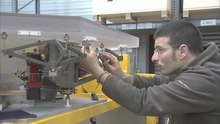
Play media
This video shows engineers adjusting the complex support mechanisms that control the shape and positioning of two of the 798 segments that will form the complete primary mirror of the telescope.
The telescope will have several science instruments. It will be possible to switch from one instrument to another within minutes. The telescope and dome will also be able to change positions on the sky and start a new observation in a very short time.
Eight different instrument concepts and two post-focal adaptive modules are currently being studied, with the aim that two to three will be ready for first light, with the others becoming available at various points over the following decade.[SUP][25]](Extremely Large Telescope - Wikipedia)[/SUP] The instruments being studied are:
The two post-focal adaptive optics modules currently being studied are:
Comparison
http://upload.wikimedia.org/wikipedia/commons/thumb/c/c5/Comparison_optical_telescope_primary_mirrors.svg/300px-Comparison_optical_telescope_primary_mirrors.svg.png Comparison of nominal sizes of primary mirrors of the European Extremely Large Telescope and some notable optical telescopes (click for detail)](http://en.wikipedia.org/wiki/File:Comparison_optical_telescope_primary_mirrors.svg)
One of the largest ground-based telescope operating today is the Gran Telescopio Canarias, with a 10.4 m aperture and a light-collecting area of 74 m[SUP]2[/SUP]. Other planned extremely large telescopes include, the 25 m/368 m[SUP]2[/SUP] Giant Magellan Telescope and 30 m/655 m[SUP]2[/SUP] Thirty Meter Telescope, which are also targeting the end of this decade or beginning of the next for completion. These other two telescopes roughly belong to the same next generation of optical ground-based telescopes.[SUP][39]](http://en.wikipedia.org/wiki/European_Extremely_Large_Telescope#cite_note-GMT_Overview-39)[/SUP][SUP][40]](http://en.wikipedia.org/wiki/European_Extremely_Large_Telescope#cite_note-About_TMT-40)[/SUP] Each design is much larger than previous telescopes.[SUP][5]](Extremely Large Telescope - Wikipedia)[/SUP] Even with the descale to 39.3 m it is significantly larger than these other planned observatories; it is the largest of the planned new generation extremely large telescopes.[SUP][5]](Extremely Large Telescope - Wikipedia)[/SUP] It has the aim of observing the Universe in greater detail than the Hubble Space Telescope by taking images 15 times sharper, although it is designed to be complementary to space telescopes, which typically have very limited time available.[SUP][18]](Extremely Large Telescope - Wikipedia)[/SUP]
[TABLE=“class: wikitable sortable jquery-tablesorter”]
[TH=“class: headerSort”]Name[/TH]
[TH=“class: headerSort”]Aperture diameter (m)[/TH]
[TH=“class: headerSort”]Collecting area (m²)[/TH]
E-ELT
39.3
978
Thirty Meter Telescope (TMT)
30
655
Giant Magellan Telescope (GMT)
24.5
368
Southern African Large Telescope (SALT)
11.1 × 9.8
79
Keck Telescopes
10.0
76
Gran Telescopio Canarias (GTC)
10.4
74
The 4.2 meter secondary mirror is the same size as the primary mirror on the William Herschel Telescope, the second largest optical telescope in Europe.
Stills
The images below show artistic renderings of the E-ELT and were produced by ESO.
Diagram of the 40m-class E-ELT primary mirror.
E-ELT compared with one of the four existing VLT Unit Telescopes at Cerro Paranal, Chile
Rendering of E-ELT during the day.
Model of the gigantic and intricate structure inside the enclosure of the E-ELT.
Video
http://upload.wikimedia.org/wikipedia/commons/thumb/3/33/E-ELT_Laser_Guide_Star.ogv/320px--E-ELT_Laser_Guide_Star.ogv.jpg
Play media
Artist’s impression of the European Extremely Large Telescope (E-ELT) in its enclosure on Cerro Armazones during night-time observations. The four beams shooting skywards are lasers that create artificial stars high in the Earth’s atmosphere.
http://upload.wikimedia.org/wikipedia/commons/thumb/c/c4/The_E-ELT_gets_ready_for_action_(artist's_impression).ogv/320px--The_E-ELT_gets_ready_for_action_(artist's_impression).ogv.jpg
Play media
This video shows an artist’s impression of the European Extremely Large Telescope, the E-ELT. The protective dome is seen opening for a night observing the optical and infrared skies.
http://upload.wikimedia.org/wikipedia/commons/thumb/e/ee/The_E-ELT_in_Action_(artist's_impression).ogv/320px--The_E-ELT_in_Action_(artist's_impression).ogv.jpg
Play media
http://upload.wikimedia.org/wikipedia/commons/thumb/f/ff/Fly-over_of_the_planned_road_to_armazones.ogg/320px--Fly-over_of_the_planned_road_to_armazones.ogg.jpg
Play media
An 3D view of the new road to Cerro Armazones area in the Chilean desert. The road extends from the public Route B-710 to the top of the mountain where the European Extremely Large Telescope (E-ELT) will sit.
http://upload.wikimedia.org/wikipedia/commons/thumb/a/ac/E-ELT_Groundbreaking_event.ogg/320px--E-ELT_Groundbreaking_event.ogg.jpg
Play media
On 19 June 2014, a major milestone towards construction of the E-ELT was reached. Part of Cerro Armazones was blasted. This video provides a closer look at the event. Note that only natural sound is provided.
http://upload.wikimedia.org/wikipedia/commons/thumb/d/d9/Flattening_the_Cerro_Armazones.ogg/320px--Flattening_the_Cerro_Armazones.ogg.jpg
Play media
Numerous construction workers using heavy machinery working in the Atacama Desert to flatten the top of the mountain for a platform large enough to host the E-ELT with its main mirror of 39.2-metres in diameter.
Comparable instruments
http://upload.wikimedia.org/wikipedia/commons/thumb/3/3e/Artist%27s_impression_of_the_E-ELT_and_the_starry_night_sky.jpg/220px-Artist%27s_impression_of_the_E-ELT_and_the_starry_night_sky.jpg Artist’s impression of the E-ELT and the starry night sky.[SUP][41]](http://en.wikipedia.org/wiki/European_Extremely_Large_Telescope#cite_note-41)[/SUP]
See also
Email](http://www.theguardian.com/science/2014/apr/20/spot-alien-life-european-extremely-large-telescope-chilean#)
[LIST]
-
[Robin McKie](http://www.theguardian.com/profile/robinmckie), Observer science editor
-
[The Observer](http://observer.guardian.co.uk/), Saturday 19 April 2014 19.55 BST
-
[Jump to comments (279)](http://www.theguardian.com/science/2014/apr/20/spot-alien-life-european-extremely-large-telescope-chilean#start-of-comments)
[/LIST]
http://static.guim.co.uk/sys-images/Guardian/Pix/pictures/2014/4/10/1397152616762/An-artists-impression-of--011.jpg
An artist’s impression of the European Extremely Large Telescope (E-ELT).
Cerro Armazones is a crumbling dome of rock that dominates the parched peaks of the Chilean Coast Range north of Santiago. A couple of old concrete platforms and some rusty pipes, parts of the mountain's old weather station, are the only hints that humans have ever taken an interest in this forbidding, arid place. Even the views look alien, with the surrounding boulder-strewn desert bearing a remarkable resemblance to the landscape of Mars.
Dramatic change is coming to Cerro Armazones, however – for in a few weeks, the 10,000ft mountain is going to have its top knocked off. “We are going to blast it with dynamite and then carry off the rubble,” says engineer Gerd Hudepohl. “We will take about 80ft off the top of the mountain to create a plateau – and when we have done that, we will build the world’s biggest telescope there.”
Given the peak’s remote, inhospitable location that might sound an improbable claim – except for the fact that Hudepohl has done this sort of thing before. He is one of the European Southern Observatory’s most experienced engineers and was involved in the decapitation of another nearby mountain, Cerro Paranal, on which his team then erected one of the planet’s most sophisticated observatories.
The Paranal complex has been in operation for more than a decade and includes four giant instruments with eight-metre-wide mirrors – known as the Very Large Telescopes or VLTs – as well as control rooms and a labyrinth of underground tunnels linking its instruments. More than 100 astronomers, engineers and support staff work and live there. A few dozen metres below the telescopes, they have a sports complex with a squash court, an indoor football pitch, and a luxurious 110-room residence that has a central swimming pool and a restaurant serving meals and drinks around the clock. Built overlooking one of the world’s driest deserts, the place is an amazing oasis. (See box.)
Now the European Southern Observatory, of which Britain is a key member state, wants Hudepohl and his team to repeat this remarkable trick and take the top off Cerro Armazones, which is 20km distant. Though this time they will construct an instrument so huge it will dwarf all the telescopes on Paranal put together, and any other telescope on the planet. When completed, the European Extremely Large Telescope (E-ELT) and its 39-metre mirror will allow astronomers to peer further into space and look further back into the history of the universe than any other astronomical device in existence. Its construction will push telescope-making to its limit, however. Its primary mirror will be made of almost 800 segments – each 1.4 metres in diameter but only a few centimetres thick – which will have to be aligned with microscopic precision.
It is a remarkable juxtaposition: in the midst of utter desolation, scientists have built giant machines engineered to operate with smooth perfection and are now planning to top this achievement by building an even more vast device. The question is: for what purpose? Why go to a remote wilderness in northern Chile and chop down peaks to make homes for some of the planet’s most complex scientific hardware?
The answer is straightforward, says Cambridge University astronomer Professor Gerry Gilmore. It is all about water. "The atmosphere here is as dry as you can get and that is critically important. Water molecules obscure the view from telescopes on the ground. It is like trying to peer through mist – for mist is essentially a suspension of water molecules in the air, after all, and they obscure your vision. For a telescope based at sea level that is a major drawback.
“However, if you build your telescope where the atmosphere above you is completely dry, you will get the best possible views of the stars – and there is nowhere on Earth that has air drier than this place. For good measure, the high-altitude winds blow in a smooth, laminar manner above Paranal – like slabs of glass – so images of stars remain remarkably steady as well.”
The view of the heavens here is close to perfect, in other words – as an evening stroll around the viewing platform on Paranal demonstrates vividly. During my visit, the Milky Way hung over the observatory like a single white sheet. I could see the four main stars of the Southern Cross; Alpha Centauri, whose unseen companion Proxima Centauri is the closest star to our solar system; the two Magellanic Clouds, satellite galaxies of our own Milky Way; and the Coalsack, an interstellar dust cloud that forms a striking silhouette against the starry Milky Way. None are visible in northern skies and none appear with such brilliance anywhere else on the planet.
Hence the decision to build this extraordinary complex of VLTs. At sunset, each one’s housing is opened and the four great telescopes are brought slowly into operation. Each machine is made to rotate and swivel, like football players stretching muscles before a match. Each housing is the size of a block of flats. Yet they move in complete silence, so precise is their engineering.
Building the four VLTs, which have been named Antu (Sun), Kueyen (Moon), Melipal (Southern Cross) and Yepun (Venus) in the language of Mapuche people of Chile, was a formidable challenge, needless to say. Each has a giant mirror that is 8.2 metres in diameter but only 17cm thick: any thicker, and the mirror would be too heavy to move and point. Such thinness leaves the mirrors liable to deform as temperatures and air pressure fluctuate, however, and so each has 150 actuators fitted to its unpolished side. These push the mirrors to keep them within a few billionths of a centimetre of their proper shape. In addition, ESO astronomers use a laser-based system known as adaptive optics to measure turbulence in the upper atmosphere and to change each telescope’s internal mirror configuration to compensate for any disturbance they can measure.
The result is a cluster of astronomical devices of incredible power and flexibility, one that has been involved in an astonishing number of critically important discoveries and observations over the past decade, as ESO astronomer Olivier Hainaut explains. “Perhaps the VLT’s most spectacular achievement was its tracking of stars at the centre of the Milky Way. Astronomers followed them as they revolved around… nothing. Eventually they were able to show that something incredibly small and dark and massive lay at the centre of this interstellar waltz. This was the first time, we now know, that scientists had directly observed the effect of the supermassive black hole that lies at the heart of our galaxy.”
http://static.guim.co.uk/sys-images/Guardian/Pix/pictures/2014/4/10/1397152788888/The-Milky-Way-seen-from-t-006.jpg
The Milky Way seen from the Paranal Observatory in Chile. Photograph: National Geographic Image Collec/Alamy The VLTs also played a key role in providing observations which showed, from the behaviour of distant supernovae, that the expansion of the universe was actually accelerating thanks to the action of a force now known as dark energy. This discovery later won Saul Perlmutter, Brian Schmidt and Adam Riess the 2011 Nobel prize for physics. And in 2004 the telescopes were used to make a direct observation of an exoplanet – a planet that orbits around a star other than our Sun. It was another astronomical first. Until then scientists had only been able to infer the existence of exoplanets from the way they affected the movement of their parent star or its light output. “This was history-book material, a discovery of the same quality as Galileo’s drawings of the mountains on the moon or the satellites of Jupiter,” says Hainaut.
These discoveries have only whetted astronomers’ appetites for more, however. Hence the decision to build the £800m E-ELT – whose British funding will come through a £88m investment from the UK Science & Technology Facilities Council. Engineers have now completed a road to the mountain from Paranal and on 16 June are set to begin blasting to remove the top from Cerro Armazones. Then they will start to build the E-ELT using 798 hexagonal pieces of mirror to create a mammoth device that will be able to collect a hundred million times more light than the human eye. When completed in around 2025, the 2,700-tonne telescope will be housed in a 74 metre high dome and operated by astronomers working 20kms away in Paranal. It will be the world’s biggest eye on the sky.
An indication of the E-ELT’s potential is provided by ESO astronomer Linda Schmidtobreick. “There are fundamental issues that only a telescope the size of the E-ELT can resolve,” she says. “Its mirror will have a surface area 10 times bigger than any other telescope, which means it will take a 10th of the time to collect the same amount of light – ie the same number of photons – from an object compared with these other instruments.”
http://static.guim.co.uk/sys-images/Guardian/Pix/pictures/2014/4/15/1397558292662/Robin-001.jpg
The astronomers’ residence: ‘As accommodation goes, it’s as exotic as you can get.’ For Schmidtobreick, this ability to collect light quickly is crucial to her research. She studies stars known as cataclysmic variables: pairs of stars in which one is pulling vast amounts of gas, mainly hydrogen, from its companion, a process that can trigger gigantic thermonuclear eruptions, sometimes within 30 seconds or so. “With current instruments, it can take minutes or hours to collect light from these objects, which is too long to resolve what is happening,” says Schmidtobreick. “But with the E-ELT, we will be able to study many, many more cataclysmic variables because we will be able to collect significant amounts of light from them in seconds rather than minutes or hours and so will be to resolve their behaviour.”
Simone Zaggia, of the Inaf Observatory of Padua, is another frequent visitor to Paranal and has a very different reason for backing the E-ELT. He believes it will play a vital role in the hunt for exoplanets – in particular, exoplanets that are Earth-like and which could support life. “At present, our biggest telescopes can only spot really big exoplanets, giants that are as big as Jupiter and Saturn,” he says.
“But we really want to know about the smaller worlds that make up the solar systems in our galaxy. In other words, we want to find out if there are many Earth-like planets in our part of the universe. More importantly we want to find out if their atmospheres contain levels of oxygen or carbon dioxide or methane or other substances that suggest there is life there. To do that, we need a giant telescope like the E-ELT.”
This point is backed by Gilmore. “We can see exoplanets but we cannot study them in detail because – from our distant perspective – they appear so close to their parent stars. However, the magnification which the E-ELT will provide will mean we will be able to look at them directly and clearly. In 15 years, we should have a picture of a planet around another star and that picture could show its surface changing colour just as Earth does as the seasons change – indicating that vegetation exists on that world. We will then have found alien life.”
                                **Astronomers' amazing home**

             A walk down the alleyway that leads from Paranal observatory's  entrance gate into its astronomers' residence produces one of the most  striking changes in  surroundings you can experience in a few footsteps.  Outside the air is parched and the ground bleached by sunlight from a  sky that is hardly ever troubled by clouds. Push through the double  swing doors and you enter a rainforest – and a path that leads down  through towering ferns and tropical plants until you reach a swimming  pool in the residence's lowest level. As accommodation goes, it's as  exotic as you can get - though hedonism was far from the minds of the  architects when they designed it.
To battle the arid conditions of the air at 8,600ft-high Paranal, they wanted a way to keep it moist and fresh for the scientists staying there. The answer was a swimming pool and an indoor tropical garden that is constantly watered with supplies imported by trucks from the coast every day. Moist air from the pool and garden then circulates around the rest of the residence. The result is a building that is remarkably airy and light – until 7pm when, every night, all openings and windows, including the vast glass dome over the pool, are closed and shuttered automatically to prevent any chink of light from affecting observations made on the mountain top.
The scale and style of Paranal and its residence is extraordinary and movie producers have fallen over themselves in their attempts to film it. Most have been turned down – with the exception of the 2008 Bond film, Quantum of Solace](http://www.theguardian.com/film/movie/122628/quantum.of.solace), whose final scenes were filmed here. (In contrast the last X-Men film was turned down flat because its producers wanted to fly helicopters near the observatory’s precious telescope complex.) Given the vast cost of building and running Paranal, filming was not allowed to disturb its tight observing schedule. “I was woken up by the sound of someone repeatedly jumping on to the balcony in the room next to mine,” one astronomer recalls. “It turned out to be the actress Olga Kurylenko - who plays the film’s heroine Camille. It was quite a shock. I mean you don’t get that sort thing happening at other observatories.”


