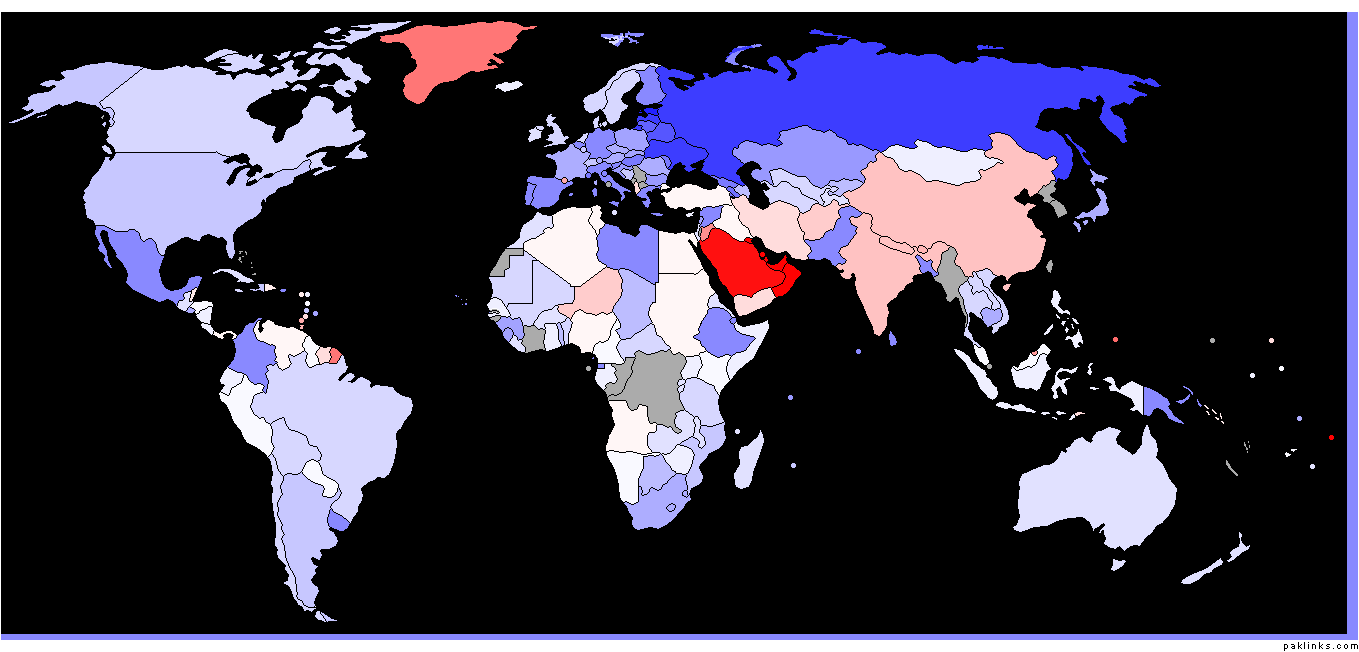
Unfortunately, it is done in other countries, including Pakistan…just not at anywhere near the same level as in India & China.
Ultrasounds further skew Pakistan’s sex ratio in favour of males
LAHORE: Ultrasound technician Dr Zaheer wearily shakes his head as a young couple leave his office in Lahore. He had declined to tell them the gender of the child they are expecting.
“It is unethical. I do not tell people the sex of their child, unless I am certain it is a boy,” he said. “But they will probably go somewhere else. There are quite literally hundreds of ultrasound facilities in this city and despite the code of conduct on this, it is not hard to find a technician who will tell them the gender,” Zaheer added.
Should the foetus turn out to be female, there is a real likelihood that the parents may choose to abort it. Terminations based on gender have become increasingly common since ultrasound technology, able to detect the gender of a baby at around four months gestation, became commonly available.
Amina, aged 25, from a village near Faisalabad, is childless. She has been married for five years. In this time, she has been pregnant three times but each time, she says, her in-laws forced her to have an abortion because she was carrying a female child.
“I desperately want a baby, but I am terrified of once more having a girl in my belly,” Amina told IRIN. She lives in a society where there is a strong stigma against childlessness as well as girl babies but she adds: “This time I will fight really hard to keep the baby.”
While the ‘missing girls’ phenomena has been fairly extensively documented in India, where a strong preference for a male child has also led to millions of abortions of ‘unwanted’ females, less data is available on the situation in Pakistan.
Nevertheless, estimates suggest that by 2020, there will be an excess of four million men. This suggests that, when roughly even numbers of each sex may expect to be born, an almost equal number of girls have not survived.
Pakistan is one of the few countries in the world where population gender statistics are skewed in favour of men, demographers say. Out of a population of 149 million people, there are already 105 men for every 100 women, according to the latest demographic profiles.
The reasons for this go beyond the issue of pre-natal gender selection. As many doctors will testify, many more girls than boys die under the age of five, since they are often fed less well than their male counterparts and are less likely to receive prompt medical care when ill.
“It is generally true, parents bring in sick boys far more often than sick girls. A girl’s health and physical well-being is placed at a far lower value compared to that of a boy child,” said Dr Ahad Abbas speaking to IRIN. He has been posted for two years to a tiny rural health centre near Taxila.
Parents do not deny this bias. “For each of my four daughters, I will need to pay out a huge sum when they wed, as dowry and as expenses. My two sons will however add to the household earning,” said Rafiuddin, a father of six children who lives in the rural area of Narang Mandi, some 100 km from Lahore. “I love my daughters, but they are some harsh economic realities that poor people like us must face.”
Nearly a decade ago, as gender determination through pre-natal ultrasound screening became increasingly common, both the Pakistan Medical Association (PMA), the body of medical professionals, and the Pakistan Medical and Dental Council (PMDC), the main regulatory body for the profession, declared it to be ‘unethical’ to tell parents the gender of an unborn child.
However, the adherence to the declaration is almost impossible to enforce, with ultrasound clinics offering gender determination services now operating in almost every urban locality in a city like Lahore. Too often, the announcement that the baby is a girl will be followed by a visit to a back-street abortionist, functioning illegally in the Temple Road area.
“Women come weeping to us, because they are carrying a second or third or fourth daughter. They are often too scared even to tell their husbands they are pregnant with another girl. They just want the foetus aborted, so they can try again for a boy,” says Lubna Baji, who runs a busy Lahore ultrasound clinic.
Police are often bribed not to intervene in the illegal trade, according to human rights and gender activists. They say some of the clinics have now even gone so far as to set up ‘one stop’ gender detection and if required, abortion facilities.
“Such abortions are disastrous for women. Many suffer infections that damage their reproductive organs and in fact leave them unable to bear future children, male or female,” Dr Tabbasum, a gynaecolgist, told IRIN.
Campaigns by the Pakistan government to persuade people that daughters are to be valued as highly as sons have had only limited impact. So too have efforts by organisations such as the United Nations Children’s Fund (UNICEF).
“Obviously there is lots of discrimination against girl children. We need more studies to determine in exactly what way this takes place,” said Sylvia Pastie, at UNICEF’s Islamabad office.
In families higher up the social scale, where economic pressures alone are not a major consideration, the desire for sons is still huge. “No family is complete until there is at least one son,” insists Nuzhat Saleem, who gave birth to four daughters and finally a son.
“It’s all a question of the status of women in society. No policy, whether it aims at preventing pre-natal gender detection, or aspires to persuade families that daughters are as good as sons, can work unless it is part of a holistic plan,” said Nawera Ahmed, a researcher at the Human Rights Commission of Pakistan (HRCP). She holds that policies must aim at empowering women, educationally, economically and socially.
http://www.dailytimes.com.pk/default.asp?page=story_1-6-2005_pg7_20