Independence Celebration - Reflections

Dear fellow Guppies,

Another August is here reminding us of our glorious freedom struggle, dedicated leaders of the nation, and one of God’s greatest gifts-FREEDOM!
This 14 August marks 59 years of independence and as our Pakistan enters its 60th year we ought to take some time out to reflect upon the past, prepare well for a harmonious future, and as a tribute refresh our memories of the people who by God’s grace made **Pakistan **a reality.
We have compiled threads to celebrate the occasion. Among what these threads contain are; speeches, some views, reflections and recollections of a few important people on the character and personality of the Quaid-e-Azam, his personal examples highlighting the importance of Faith, Unity, Discipline, similar recollections of Fatima Jinnah’s personality and some profiles of various leaders of the freedom movement.
Long live Pakistan!

*Our valuable member Zakk offered inspiring energy and his interest and research made these compilations possible. *

Personal recollections and views about Quaid-e-Azam M. A. Jinnah;
From various people who remained close to the Quaid (or his legacy) in various capacities.

Some of these reflections about the Quaid, his persona and manner highlight the towering personality traits of the great leader, who lead by example and whose entire life is a reflection of his most famous motto;
Faith, Unity, Discipline.
The depth of these words is remarkable, and so far quite unfathomed by our masses.


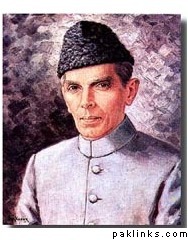
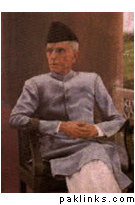
*Father of the Nation, Quaid-e-Azam Mohammed Ali Jinnah.
*
Lt Gen Gul Hasan Khan;

“Whenever he could, the Quaid-e-Azam, accompanied by Miss Jinnah, would drive out to Malir in the evening. This was his only relaxation. I always took a spare car, in which Inspector (later SP) FD Hansotia of the police rode behind us. He was permanently assigned to protect the Quaid-e-Azam. There was no other escort. It seems strange when I compare those days with what happens now, when the escort of any dignitary is as menacing as the advance guard of an armoured division, if not more dangerous. On one of these drives, the rail crossing at Malir was shut and our car stopped. I looked around and saw that the train was some distance away, so I went to the gatekeeper and asked him to let us go through, of course telling him who was in the car. He obliged, I returned to my seat next to the driver, Aziz, and told him to move on. He answered that the Quaid-e-Azam had told him to stay put. Just then the Governor-General told me to go and tell the gatekeeper to close the gate. I did as I was bid and resumed my seat. He then said, ‘Gul, do you know why I told the driver not to move the car?’ I replied, ‘No sir’. He said the reason was simple: ‘If I do not obey the law, how should I expect others to do so?’ This brief statement affected me greately. Though the Head of State, he considered himself as bound by law as any other citizen. Such a demonstration is only possible by men who are truly great.”

(‘Memoirs’, by Lt Gen Gul Hasan, Oxford, Karachi, 1993, pp. 75-76).

Re: Independence Celebration - Reflections

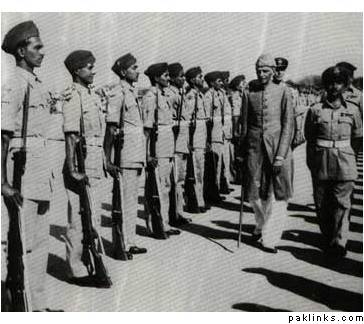
Quaid inspecting the guard of honour at Peshawar airport in 1948**

‘U’ for Unity-Col (Retd) Riaz Jafri;**

It was April 1948 that the Quaid-e-Azam accompanied by Miss Fatimah Jinnah came to Edwardes College Peshawar. I was 17 then and am 73 now, but I remember vividly each and every moment of this historic visit.
Our Principal, Mr A.M. Dalaya, had requested the Quaid, then head of state, to address the students and staff of the college, which he had graciously accepted. It was an afternoon function out in the open in the college hockey ground which was between the Science Block and the college hostel.
All the students, around 350, meticulously dressed in green college blazer and striped ties were seated on the chairs under the shamiana. A stage had been set on a raised platform under a canopy with chairs for the college staff, Miss Fatimah Jinnah and the NWFP Chief Minister Khan Abdul Qayoom Khan. Professor Imdad Hussain was in attendance to Quaid and Miss Jinnah. Captain (retd) David, the PTI, was the overall in-charge of the arrangements.
There were no fanfares, no pompous ceremonies, no bureaucrats around, only the Chief Minister and the students and staff of Edwardes College. Not even official photographers or cameramen. It was an exclusive function for us only. Mr. Dalaya had taken good care of even the smallest detail and ensured orderliness and clock-like precision of all matters, which was to the liking of the Quaid.
In his brief and to-the-point address of welcome, the Principal did not ask for any funds or grant, which used to be and probably still is the norm on such occasions. He instead thankfully mentioned the Chief Minister saying that he took care of college’s such monetary needs.
The Quaid moved majestically to the rostrum to deliver his speech. He looked visibly pleased with the arrangements around, the display of discipline by the students and the general atmosphere of great orderliness. He thanked the Principal for his welcome address and appreciated his gesture of not burdening the economy of a newly born state by requesting a grant. And then, the Quaid looking at Khan Abdul Qayoom Khan jokingly expanded his both arms around his waist mimicking the Khan’s plump belly and said smilingly, “You say that Khan takes care of your monetary needs, but I am sure it will be very rare in his case.” Every one present laughed, albeit decently. Those who had heard the Quaid before said it was the first time he had made a joke in public and that too on stage.
The Quaid spoke for about 25 minutes. He dwelt mainly on the role of the youth and the nation’s expectations of it in a newly born state. He advised us to gird up our loins and set about making Pakistan worthy of its name. There was a pindrop silence throughout his speech. This caught up his attention too and he appreciatively remarked, “Churchill said that ‘V’ stands for victory”, and he made a V with his two fingers.
“But I must say that ‘U’ stands for Unity” and made a U with the thumb and index finger of his right hand. While saying “U stands for Unity,” the Quaid was continually pointing the ‘U’ made by his fingers at the students and moving his arm from side to side to cover the entire assemblage. This ‘U stands for Unity’ resounds even today in my ears, but alas did we ever stand for it ?
On this 126th birthday of the Quaid-e-Azam, allow me to make an appeal to all, particularly the youth of the nation, to revive this ‘U stand for Unity’ by greeting each other from now on with making a U with our thumb and index finger and pointing it at each other, the way the great Quaid did in April 1948. Let’s greet each other from here onwards on every occasion warranting display of patriotism, unity, jubilation or a personal victory with a raised U, the way others do in the world by making a V with their fingers. It will remind us of the Unity that we owe to the Quaid-e-Azam.

Re: Independence Celebration - Reflections


Baba-e-Qaum*

Professor Stanley Wolpert;**
*
*‘The most definitive writer on South Asia; Stanley Wolpert’s comments about Jinnah probably stand out as a tribute which few could have matched.’

  • ”Few individuals significantly alter the course of history. Fewer still modify the map of the world. Hardly anyone can be credited with creating a nation-state. Mohammad Ali Jinnah did all three.

Hailed as “Great Leader” (Quaid-e-Azam) of Pakistan and its first governor-general, Jinnah virtually conjured that country into statehood by the force of his indomitable will. His place of primacy in Pakistan’s history looms like a lofty minaret over the achievements of all his contemporaries in the Muslim League. Yet Jinnah began his political career as a leader of India’s National Congress and until after World War I remained India’s best “Ambassador of Hindu-Muslim Unity.” As enigmatic a figure as Mahatma Gandhi, more powerful than Pandit Nehru. Quaid-e-Azam Jinnah was one of recent history’s most charismatic leaders and least known personalities. For more than a quarter century I have been intrigued by the apparent paradox of Jinnah’s strange story, which has to date never been told in all the fascinating complexity of its brilliant light and tragic darkness.

Students, barristers and benchers rushing in and out of Lincoln’s Inn nowadays rarely glance at the oil painting, hung since July 1965 on the stone wall over the entrance to their Great Hall and Library in London. Those who do may wonder why on earth the gaunt, unsmiling face of “M.A.Jinnah, Founder and Governor-General of Pakistan” should be staring down at them. Tall, thin, monocled, astrakhan-capped, the portrait’s subject was, so the strip of brass secured to its frame attests, “born 25 December 1876 and died 11 September 1948.” Nothing more is revealed of M.A.Jinnah’s history. The anonymous artist captured his upright, unbending spirit, as well as his impeccable taste in clothes, yet Jinnah’s face is almost as enigmatic and spare as the shinning brass plate beneath. His eyes, opened wide, are piercing; his lips, tightly closed, formidable. One would guess that he was a man of few words, never easily thwarted or defeated. But why is he there-in so honored a place on that hallowed wall of British jurisprudence.

Across the timeworn stairs of stone that supported Queen Victoria and Her Majesty’s entourage when she came to dedicate that Great Hall and oak-beamed Library in 1845 are two portraits of Englishmen who obviously do belong. Sir William Henry Maule was baron of the Exchequer, a judge of the Common Pleas, and a bencher, one of four officers elected to administer Lincoln’s Inn. Lord Arthur Hobhouse was legal member of the Executive Council of India’s Viceroy in 1875, the year Prime Minister Benjamin Disraeli persuaded Queen Victoria to add “Empress of India” to her regalia. Two marble busts flank M.A.Jinnah’s portraits, like horseguards, their unblinking eyes staring ahead. These also seem appropriate to the setting for one is Lord Macnaghten, who was “Lord of Appeal in Ordinary” and not only a bencher but treasurer, while the other immortalizes Sir Francis Henry Goldsmit, “First Jewish Barrister,” bencher and member of Parliament. Jinnah, however, held no office at Lincoln’s Inn, nor was he ever elected to Parliament or appointed to preside over any British court, nor did he even serve on the cabinet of a single British viceroy.

Yet the story of Jinnah’s unique achievement was so inextricably the product of his genius as a barrister, perhaps the greatest “native” advocate in British Indian history, that his portrait richly deserves the place of high honor it holds. During the last decade of his life, in fact, Jinnah may have been the shrewdest barrister in the British Empire. He was certainly the most tenacious. He crossed swords with at least as many great British-born as Indian barristers, defeating them all in his single minded pleas for Pakistan. He burned out his life pressing a single suit, yet by winning his case he changed the map of South Asia and altered the course of history.”

Stanley* Wolpert is one of America’s leading experts on South Asia. He has taught South Asian history at the University of California at Los Angles. Apart from Jinnah, Wolpert has written biographies of prominent South Asian leaders such as Gandhi, Nehru, and Z.A.Bhutto. The above excerpt is from his book “Jinnah of Pakistan”. *

Re: Independence Celebration - Reflections


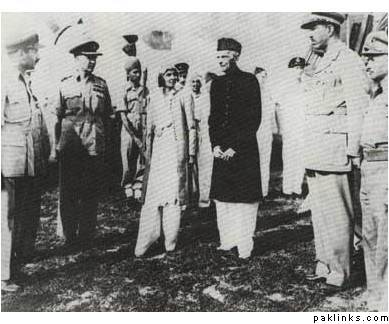
*Quaid at Risalpur
*
***Ata Rabbani; ***

13 April 1948

“It was a perfect spring day with clear blue skies. A gentle and refreshing cool breeze was blowing from the north. Visibility extended to the top of the hills and beyond. The place was decked with flowers, roses were in abundance and Risalpur seemed to be sitting in a bowl decked with roses. The hills that encircle Risalpur were sporting their last residue of winter snows. It was a beautiful sight. People from the surrounding areas started to converge on Risalpur airfield from the early hours and were directed to one end of the apron reserved for the general public. The cadets were busy polishing their belts and boots themselves to ensure proper shine, an unusual activity for them. They considered it a great honour that they would be receiving their Quaid-i-Azam who had chosen their station for his first visit to a military installation after taking over as Governor-General of Pakistan. It was a real red-letter day in the history of Risalpur.

The Governor-General was scheduled to take the salute at 9 a.m. The parade markers were in position on the parade ground at 8:40 a.m. and the parade was marched on to the parade ground at 8:45 a.m. The Governor-General’s silver Dakota flying the Governor-General’s flag taxied to the saluting base and parked behind the dais. After reviewing the smartly turned out parade, the Governor-General spoke,

“…There is no doubt that any country without a strong air force is at the mercy of any aggressor. Pakistan must build up her air force as quickly as possible…The Royal Pakistan Air Force started with very few assets except loyalty and determination to succeed, but it is already taking shape; this school formed only seven months ago is a worthy example of this. I know you are short of personnel…I know also that you are short of aircraft and equipment … I am pleased to learn of the progress which this school has made and as desired by the Air Commander and yourselves, I name it from today ‘the Pakistan Air Force College…”

Parade over, the Governor-General was driven to the PAF Officers Mess, where he was to have his breakfast with all the senior officers of the PAF. The Governor and the Chief Minister of NWFP were also present. Immediately after the parade I was rushed to the Mess to receive and greet the Governor-General at the entrance door of the Mess. He was pleased to see me and acknowledged my greetings with, ‘So you are here Rabbani, how are you?’ Without waiting for my response he added, ‘I am sure you must be happy to be back to your flying.’ I remember having managed to say, ‘Yes sir, I was very happy in the Governor-General’s House and I am happy here as well.’ While entering the reception hall, he looked at me and with a glint in his eyes enquired, ‘Mr. First, are there any more firsts here?’ I replied, ‘Yes Sir, Risalpur is very proud today, as you are the first Head of the State to ever visit this place.’ He smiled and continued to walk. In accordance with the rules of protocol I introduced the Commandant to him and then withdrew. After about half an hour’s chit chat with the guests the Commandant led the Governor-General to the breakfast table. I had prepared a table plan for the head-table only. My seat was diagonally opposite the Governor-General and directly opposite Miss Jinnah. After serving a grapefruit, cereal was passed around which the Governor-General refused as usual. The next dish siri-paya was meant to be a surprise for the Governor-General. I was watching his reactions. He was pleased and satisfied, for before taking a helping, he looked at me and nodded his head twice. I knew the Quaid occasionally liked to have siri-paya at breakfast and I had arranged that it be served to him today. Miss Jinnah also reacted promptly by remarking, ‘Rabbani, so you have been disclosing home secrets!’ and smiled.

Breakfast over, he stayed for another eight to ten minutes and then left. I was the last to say good-bye to him. He stood in front of me and for the first and last time put his hand on my shoulder in farewell, and said, ‘Well, young man, it is now your turn to come to Karachi. Good luck.’ ‘Certainly, Sir’, I said in a voice choking with emotion. I was overwhelmed and honoured by this rare gesture of kindness. For me it was like the symbolic tap on the shoulder with the ceremonial sword, made by a British sovereign while conferring a knighthood on a subject. The joy the Quaid-i-Azam’s touch gave was unbounded. Little did I know then that would be my last meeting with my ‘Leader’. His words and the feel of his hand on my shoulder are still with me. I feel guilty that I could not visit him in Karachi as I said I would. I went to Karachi all right, not to Governor-General House, but to his mausoleum to pay my last respects.”

Ata Rabbani**, from ‘I was the Quaid’s ADC’, Ata Rabbani,*
OxfordUniversity** Press, 1996*

Re: Independence Celebration - Reflections


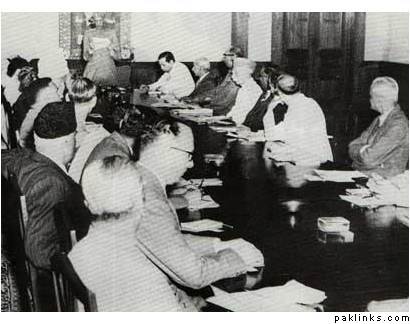
Quaid presiding over a meeting in Karachi.

**Sahabzada Yaqub Khan;

**It is a privilege to have been asked to write a few lines regarding a subject on which much has been written and much more remains to be recorded, by way of personal memories and recollections.
I could have tried to add my modest share of vignettes to this priceless collection in spite of my brief and far from intimate contact with the Quaid, but I have decided to concentrate instead, on depicting briefly a vivid and living image which abides with me as an enduring inspiration. It emerges from my recollection of his frequent formal visits to the Viceroy’s House for meetings with Lord Wavell and Lord Mountbatten at Delhi. After partition, I also served briefly as Commandant of the Governor General’s Bodyguard at Karachi till June 1948. As I try to piece together remembrances of the past I find myself looking at the gestalt of a live personality overshadowing snatches of anecdotes and incidents – a heap of fragments – which is all that personal memory offers. I would like to share with you the vividness of that single all-embracing recollection and its insistent and manifold message.

I recall a talk with Stanley Wolpert about the time his book Jinnah of Pakistan had been withheld from distribution in our country for a short period. Wolpert expressed his sorrow and dismay and explained his refusal to make any alterations or deletions in the book he had so painstakingly written. He went on to add an observation that left a deep impression on me.

During the course of his researches for writing Jinnah of Pakistan, he had lived so closely with the subject of his biography that some of the matchless traits of the Quaid’s personality ‘had rubbed off on him’. He could ‘never betray that integrity which had enhanced his own strength of character as a person.’

Those words echo in my mind when I envision the image of the Quaid as it stands out in my recollection – an image of wholeness – a personality that was of a piece and entire. His integrity shone not only through his heroic crusade for Pakistan against formidable odds, overcoming inner doubts and misgivings, but also in many other ways: the harmony between the inner and outer man which manifested itself in the effortless thrust of strength and power that distinguishes the great statesman. His demeanor, the way he spoke and moved, his gravitas, the grace and dignity that were his ordinary companions, produced a union of effect that lent an air of effortless distinction. This is the memory of him that stands out in my recollection above all other events and reminisces, a luminous image suffused by integrity. Indeed, he gave to that abstract virtue a concrete splendour.

Sahabzada Yaqub Khan*
April 1999* www.majinnah.com.pk

Re: Independence Celebration - Reflections


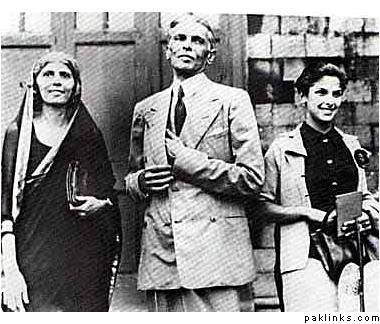
Quaid with Faitma Jinnah and his daughter Dina in London.***

Fatima Jinnah;


"He slept for about two hours, undisturbed. And then he opened his eyes, saw me, and signalled with his head and eyes for me to come .near him. He made one last attempt and whispered, “Fati, Khuda Hafiz. … La Ilaha Il Allah … Mohammad … Rasul … Allah.” His head dropped slightly to his right, his eyes closed.
I ran out of the room, shouting, screaming, “Doctor, doctor. Be quick. My brother is dying. Where are the Doctors?” In a few minutes they were there, examining him and giving him injections. I stood there, motionless, speechless. Then I saw them cover his whole body, head to foot, with a white sheet. I knew what it meant. Death had come to take him away from this life that must end to a life which is Eternal; Immortal.
Col. Ilahi Bux walked on heavy feet towards me, put his right palm over my left shoulder, and wept like a little child. Those tears, in a language without words or voice, conveyed to me the fatal news. I searched for tears, but the well where one finds them had dried up. I wanted to scream and cry, but my voice had sunk into the abyss of speechlessness. I dragged myself to his bed side, and flung myself like a log of wood on the floor.
The news of his death must have spread far and wide. The huge iron-gates of the Governor-General’s House, where normally strict security measures prevent unauthorised entry, opened themselves wide, and endless streams of peoples came from all directions.
Soon many of them were in the room, where he lay, undisturbed, in a sleep that was beyond awakening. I sat there, oblivious of my surroundings. I lost count of time, I had completely lost myself in my irreparable loss.
I do not know how long I sat there, staring at the white sheet that covered my brother’s body. "

-“My Brother” by Fatima Jinnah

Re: Independence Celebration - Reflections


Quaid-e-Azam reading Dawn*

Ardeshir Cowasjee;***

Should we rejoice?

TOMORROW, August 14, will be a day of celebration (of sorts) for the 170 million-odd citizens of this Republic, many of them homeless, hungry and, above all, thirsty. On the 59th anniversary of Independence we continue to be ruled by a vast government made up of members of dubious political parties all of whom claim to have ‘vision’ (of grandeur, no doubt, and of nothing else).

Should we rejoice that we have managed to survive for 59 years, or should we hang down our combined heads in shame and disgrace at what we have made of this country, and how we have betrayed and mocked its founder and maker, the unique Mohammad Ali Jinnah.

The other day, on re-reading Hector Bolitho’s biography of Jinnah ( first published in 1954 and now sadly out of print) I came across this passage on Hindu-Muslim unity – on the unity of majorities and minorities – after all, it was Jinnah who coined our national slogan ‘Unity [comes first], faith and discipline.’

On December 28, 1928, he addressed an All-Parties Conference in Calcutta. It was a very long speech, but certain passages warrant comment and reproduction.

“I think it will be recognised that it is absolutely essential to our progress that a Hindu-Muslim settlement should be reached and that all communities should live in a friendly and harmonious spirit in this vast country of ours.” Majorities, he said, “are apt to be oppressive and tyrannical;” and minorities “dread and fear that their interests and their rights” might suffer and be prejudiced. He repeated his demands for justice for the Muslim community – and, above all, for unity. He warned of the dangers of a constitution under which minorities may feel insecure and of the inevitable result – dangerous discord.

Bolitho writes: “Among those who listened to Jinnah’s speech was a Parsee, Jamshed Nusserwanjee, who was to become the builder, and the mayor, of the new city of Karachi. This fine old gentleman, who has since died, was an admirer and a friend of Jinnah. He said [to Bolitho], ‘Yes, his memory is very beautiful to me. He was never a demonstrative person; he was reserved, dignified and lonely. But I wish to tell you about the day in 1928 – and it is a fine thing that I can tell you. Mr Jinnah stood up – wearing the fashionable clothes he had brought back from England – and he pleaded for his people. I knew the greatness of his heart.

“He believed that the Hindus and Muslims could be brought together. There was no hate in him. Some years later, after partition, he told me how much he wished the Muslims to be tolerant of the minorities in Pakistan. I beg you to believe that Mr Jinnah was a humanitarian. He was never generous with tears but I saw him weep, twice. Once was after Partition, in January 1948, when I went with him to see an encampment of Hindus who had stayed on in Pakistan…

“ ‘The first time I saw him weep was after his amendments had been rejected at the Calcutta meeting in 1928. It is a fine thing that he did – pleading, as a great man, for his people. His demands were rejected. One man said that Mr Jinnah had no right to speak on behalf of the Muslims – that he did not represent them. He was sadly humbled . . .

Mr Jinnah left Calcutta by train . . . He was standing at the door of his first-class coupe compartment, and he took my hand. He had tears in his eyes as he said ‘Jamshed, this is the parting of the ways’.’ ”

Moving ahead to August 11, 1947, Jinnah told the members of his Constituent Assembly, “The first observation I would like to make is this. You will no doubt agree with me that the first duty of a government is to maintain law and order so that the life, property and religious beliefs of its subjects are fully protected.”

Yesterday, a front page headline in this newspaper read :’Independent judiciary key to rule of law : Aziz.’ Underneath, “Prime Minister Shaukat Aziz on Friday said an independent judiciary was vital to ‘ensure accountability of public authorities and to interpret, enforce the rule of law and the Constitution’.”

Now what is the implication of this statement? Do we have the rule of law? The answer we all know – but further comment may open up contempt charges, so I will refrain.

Back to Bolitho, who quotes from the August 11 speech, the text of which he was officially and falsely fed. Jinnah was clear : “You may belong to any religion, or caste, or creed – that has nothing to do with the business of the state.” This passage was maliciously and dishonestly mangled in the text provided to Bolitho to read : “You may belong to any religion or caste or creed – that has nothing to do with the fundamental principle that we are all citizens and equal citizens of one state. . . .”. Why?

Now, over the 59 years of this country’s existence, ignorance and falsification prompted by that ignorance have grown and multiplied side by side. Let us take the revamped Jehangir Kothari Parade at Clifton, here in Karachi. Rumour has it that there will be a grand inauguration ceremony tomorrow, surrounded with whatever trashy pomp and circumstance can be ruffled up. The corrupt have had a field-day. An old marble plaque embedded in the wall of the parapet commemorates the inauguration of the ‘Lady Lloyd Pier’ built by Jehangir Kothari in 1920 and its donation to the people of Karachi for their pleasure.

Another plaque has recently been embedded nearby in the parapet, due to be unveiled in the grand re-inauguration of the revamped Parade announced to the public, ‘Inspired by Her Excellency Lady Lloyd Pier,’ and tells them how the Sindh Governor, Dr Ishrat ul Ibad of the MQM, visited the site and ‘directed’ that millions may be spent (rather wasted) on doing up and tattifying the old Parade.

Three inches (75 mm) of rain fell in Karachi over the space of three days starting on July 30. This has prompted the Muttahida Majlis-i-Amal to suggest that the government declare that Karachi is a ‘calamity-hit area.’ This insignificant amount of rain would not even be noticed elsewhere and have no effect on the conditions of any decently planned city. In Bombay, for instance, three inches falling during the course of a day would not even warrant a comment.

Dawn.com 13 Aug 2006
Re: Independence Celebration - Reflections

very nice work Haris bhai. Long Live Pakistan!!!:jhanda:

Re: Independence Celebration - Reflections

thank u for all the hard work, very well done

Re: Independence Celebration - Reflections

:clap: great job guys, thanks for posting.

Re: Independence Celebration - Reflections

:k: awesome thread guys!

Re: Independence Celebration - Reflections

Thanks guys, glad you all like it :)

Re: Independence Celebration - Reflections

A job well done my man Haris. Keep up the good work :jhanda: