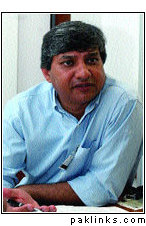
ABLE SON OF AN ABLE PERSON; PROF HAMID SHAFQAT, PAKISTAN’S KNOWN CARDIOLOGIST…DR. SAAD SHAFQAT IS THE FOUNDER MEMBER OF MY “PAKISTANI_CRICKETWALLAS” INTERNET-YAHOOGROUP (1999).
HE IS ALSO THE AUTHOR OF JAVED MIANDAD’s AUTOBIOGRAPHY…HE WROTE HONORING ME OF MY CONSISTENT APPROACH TO HIM WHEN HE WAS AT BOSTON…
DR. SAAD SHAFQAT is a Neurologist at the Agha Khan University Hospital, Karachi..having pursued higher studies & worked at BOSTON from 1995 to 2002.
-Raju
------------------
**DAWN-MAGAZINE-SUNDAY : October 05, 2008 **
REVERSE SWING: The Captaincy Conundrum
By Saad Shafqat

Shoaib Malik has failed to earn the respect of the team’s frontline players, several of whom are now positioning themselves to replace him.
Pakistan’s current captain, Shoaib Malik, was appointed in April 2007 in the wake of the team’s disastrous World Cup performance in the Caribbean.
Last November, the PCB extended his term until December 2008. As the team struggles with poor form, dismal results and a mess of controversies, the storm clouds are already starting to gather over Malik’s captaincy.
Is his record really questionable, or is he being sacrificed just to put the past behind and make a fresh beginning?
The answer in a nutshell is ‘yes’ to both. Malik has captained in three Tests (two against South Africa and one against India), won none, and lost two. He could have captained another two Tests against India, but sat them out with an ankle injury. In the ODIs, he has won 20 of the 30 matches that he’s captained, but 13 of these wins might as well be discounted, having come against Bangladesh, Zimbabwe or Hong Kong.
Not counting victories over the minnows, these results amount to a winning margin of zero per cent in Tests and 41 per cent in ODIs — figures that compare starkly with the wining margins of many of Pakistan’s past captains. Even if we dismiss the sample of three Tests as being too few, Malik’s ODI captaincy record compares no less poorly. Of the 11 players who have captained Pakistan in a minimum 17 ODIs (which is the number of matches Malik has captained against authentic opponents), Malik’s winning margin of 41 per cent ranks at no.10.
You might say that even the number of ODIs is too small for a reliable assessment, but in these urgent times we can ill-afford the luxury of persisting with the status quo, a strategy that will likely only confirm what we already know. Pakistan cricket is in bad need of a mood and morale changer, and it is Malik’s lot to be judged on the available record.
Of course, there is a great deal more to captaincy than mere numbers, because it isn’t just how many matches you win but which ones.
Imran Khan’s Test winning margin is only 29 per cent, yet few would dispute he has been Pakistan’s greatest captain. Among his 14 wins (from 48 Tests) are hard-fought scuffles that produced groundbreaking series wins in England and India, and among his 75 ODI wins (from 139 matches) is the final of the World Cup 92. Imran even made history when he didn’t win, as in staring down the West Indies at the height of their powers to a bitter draw on home turf. As Peter Roebuck commented in his recent book In It To Win It, “Imran prowled his domain like a lion.”
No one will make the mistake of comparing Shoaib Malik to a lion. Ex-captains such as Intikhab Alam and Wasim Akram have expressed disappointment with his leadership, and Javed Miandad has even termed him a ‘misfit’. Wisden, in reviewing Malik’s captaincy against South Africa, described him as ‘misguided’. This criticism is well-founded. Malik has been uncertain on the field, hesitant with command and tentative with tactics. He has had a difficult, at times even petulant, relationship with selectors. And he has abdicated responsibility to lead from the front.
In a recent interview to Cricinfo, Wasim Akram pointed out that Malik has typically bowled the full 10-over quota in matches against Zimbabwe or Bangladesh, but shied away from bowling against the tougher teams.
Most important, Malik has failed to earn the respect of the team’s frontline players, several of whom are now engaged in positioning themselves to replace him. Who will win this battle is anybody’s guess, but there is no denying that the battle is on.
Each candidate has his pluses and minuses. Misbahul Haq has been elevated to the vice-captaincy and, armed with an MBA, is believed to possess a cool, strategic head; but with a slender record of only 10 Tests, there is a sense that he hasn’t quite earned his stripes yet.
Salman Butt has also had a stint as vice-captain, but is considered impetuous and unseasoned. Mohammad Yousuf and Younis Khan are both stalwarts and have even served as stand-in captains; but Yousuf is sidelined because of what might be termed off-the-field interpersonal issues, and Younis because he turned down the captaincy after last year’s World Cup disaster, rejecting Pakistan in the country’s hour of need.
Shoaib Akhtar is another senior player with captaincy ambitions, but his fractious relationship with the PCB and turbulent history within the team virtually eliminate his prospects.
That leaves — you guessed it — Shahid Khan Afridi. Most observers dismiss the suggestion, but the idea deserves serious and unemotional consideration. Afridi made his ODI debut in 1996 and his Test debut in 1998, making him a seasoned veteran. He is an unquestioned match-winner — as a batsman as well as a bowler. He is one of the most agile fielders Pakistan has ever produced. And he is a spirited, energetic challenger whose mere presence in the team can raise everyone’s game. Importantly, Afridi is a tenacious competitor who can lift himself after a fall and fight back hard.
It is Afridi’s reckless batting that gives everybody nightmares, but there are positives in this as well. Insistently batting on your own terms conveys a certain moral honesty, a pre-requisite for good leadership. Afridi’s batting also embodies assault and aggression, and God knows we could use some assault and aggression in the Pakistan captaincy. At the same time, it is crucial to appreciate that recklessness isn’t part of Afridi’s makeup. He is, after all, anything but reckless when bowling or fielding. Authority and responsibility have the power to transform adolescent temperament into adult outlook and bearing. Afridi has already begun speaking of his interest in the authority and responsibility that come with captaining Pakistan. For the sake of Pakistan cricket, he deserves to be tried.