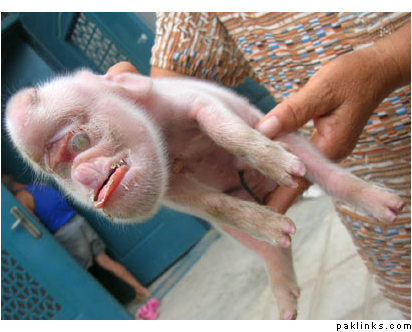
For those of you who are discussion outsourcing motherhood this would be even more disturbing. Outsourcing motherhood to animals. It is not weird science . It is in the works.
Read the article on National Geographic.
Some excerpts are quoted for your reference.
Scientists have begun blurring the line between human and animal by producing chimeras—a hybrid creature that’s part human, part animal.
Chinese scientists at the Shanghai Second Medical University in 2003 successfully fused human cells with rabbit eggs. The embryos were reportedly the first human-animal chimeras successfully created. They were allowed to develop for several days in a laboratory dish before the scientists destroyed the embryos to harvest their stem cells.
Modified Mice Stay Super-Fit—Without Exercise
Fluorescent Mice Herald Gene-Transfer Breakthrough
Mice Used as Sperm Factories for Pigs, Goats
Cloned Pigs Modified for Use in Human Transplants
Scientific Pitfalls Complicate Cloning Debate
Anti-Aging Drug for Humans Hinted at by Worm Study
In Minnesota last year researchers at the Mayo Clinic created pigs with human blood flowing through their bodies.
And at Stanford University in California an experiment might be done later this year to create mice with human brains.
Scientists feel that, the more humanlike the animal, the better research model it makes for testing drugs or possibly growing “spare parts,” such as livers, to transplant into humans.
Watching how human cells mature and interact in a living creature may also lead to the discoveries of new medical treatments.
Human Born to Mice Parents?
For example, an experiment that would raise concerns, he said, is genetically engineering mice to produce human sperm and eggs, then doing in vitro fertilization to produce a child whose parents are a pair of mice.
“Most people would find that problematic,” Magnus said, “but those uses are bizarre and not, to the best of my knowledge, anything that anybody is remotely contemplating. Most uses of chimeras are actually much more relevant to practical concerns.”