How to Perform Salah/Namaz/Prayer

:salam2:

**TAHARAH **

Before a person can say his prayer, he must be clean and pure. The Qur’an says: “Truly Allah loves those who turn to Him and those who care for cleanliness”. Cleanliness of mind, of body, and of clothes is called Taharah or purification. It is only in such a condition of purification that a Muslim may perform the Salah.

Purification of the body is attained by partial or total washing with clean water. The partial wash is known as Al-Wudu or the ablution, and the total wash is called Al-Ghusl or the washing (bath) of the whole body.
If they are removed, it is necessary to re-wash the feet for Wudu. The process ends with the recitation of the Kalimatus-Shahadah.
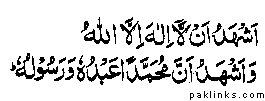

**ASH-HADU ALLA ILAHA ILLALLAHU WA-ASH-HADU AN-NA MUHAMMADAN 'ABDUHU-WA-RASULUH **

A fresh performance of Wudu is necessary if one breaks wind, touches genitals, or becomes sexually excited, or pays a visit to the lavatory, or falls into sleep lying down, or vomits violently, or incurs a flow of blood from an injury, or a flow of impure fluid.

**AL-GHUSL (THE WASHING OR BATH) **

The greater purification, Ghusl, is obligatory when one is defiled as a result of nocturnal emission (or a wet dream), marital intercourse, child birth, or when entering into the fold of Islam.

The procedure is as follows:

Begin with the name of Allah as for Wudu. Wash the hands and the affected parts of the body with water to remove any impurity. Perform Wudu as above. Then wash the whole body three times, using clean water for each wash.

**TAYAMMUM (DRY ABLUTION) **

On certain occasions, it may become either impossible (eg. when water cannot be found or just enough for drinking is available), or it is dangerous, because of illness, to use water for Wudu or Ghusl. In such situations, Tayammum (dry ablution) is perform ed. The procedure:

Begin with the name of Allah. Strike both palms on sand, or anything containing sand or dust, like a wall or a stone etc. Pass the palms of the hands over the face once. Strike the sand etc., again with the palms. Rub the right hand with the left palm from the wrist to the elbow and similarly for the left hand with the right palm. Finish with the Kalimatus-Shahadah as for Wudu.

**1. TIME **

Each of the Salah must be offered at or during its proper time. No Salah can be said before its time. There are five obligatory prayers in a day.

Fajr… - the morning prayer.
Zuhr… - the early afternoon prayer.
'Asr… - the late afternoon prayer.
Maghrib… - the sun-set prayer.
'Isha… - the night prayer.

2. DRESS

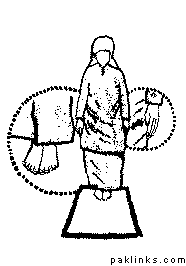
Before offering your Salah make sure that you are properly dressed. For men and boys, the dress should be such that it covers their bodies from the navel to the knees at least.

Women are required to cover themselves from head to foot, leaving only the face and hands uncovered. The dress for Salah must be clean and free from all filth. During the monthly period women are free from obligation of Salah.

**3. PLACE **

Wherever a man might be, he can turn towards Allah in Salah and in devotion. The prophet has said, “The (whole of the) earth has been rendered for me a mosque: pure and clean”. Preferably Salah is to be offered in jama’at (congregation). Whenever possible, one should pray facing the Ka’bah, Makkah.

FARZ OR NAFILAH

Salah is composed of the Farz (obligatory) and the Nafilah (superogatory) prayers.

The Farz Salah are five in a day. Failure to perform any one of them is a blameable sin. The Nafilah includes the Sunnah, which the Prophet (S.A.W.) used to perform regularly before or after each Farz Salah.

**THE CONTENTS OF SALAH **

Salah in Islam is a unique institution. It brings man closer to Allah by harmonising his mental attitude with physical posture. In Salah, a Muslim submits himself completely to his Creator.
When you are sure that you have fulfilled all the necessary conditions for Salah, you ready to offer Salah. A detailed account of how to say Salah is given below:

Say to yourself that you intend to offer this Salah(Fajr, Zuhr, 'Asr, Maghrib or 'Isha) Farz or Sunnah. Then raise your hands to your ears (as in figure)


ALLAHU AKBAR
**Allah is the greatest. **

NOTE: The hand is in line with ear lobe

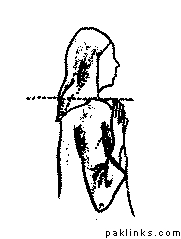
NOTE: Ladies lift their hands up to their shoulders only as shown above.
Now placing your right hand on the left, just below, above or on the navel (as shown in figure and ladies placing their hands on their chest as shown in figure) recite the following:
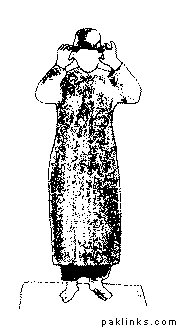
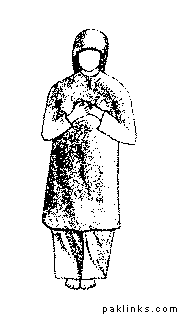


SUBHANA-KALLAH-HUMMA WA BI-HAMDAKA
**O Allah, Glorified, praise worthy. **

WATABARAKAS-MUKA WATA`ALA JADDUKA
**and blessed is They Name and exalted Thy Majesty **


WA-LA ILAHA GHAIRUK
**and there is no deity worthy of worship except Thee. **


A`U-THU-BIL-LA-HI MINASHAITANIR RAJEEM
**I seek refuge in Allah from the rejected Satan **


BISMILAHIR RAHMANIR RAHIM
In the Name of Allah, the Beneficent, the Merciful.

After this recite the opening Surah, Al-Fatihaha:


ALHAMDU LIL-LAHI RAB-BIL `ALAMIN
**Praise be to Allah, Lord of the worlds. **


AR-RAHMAN-NIR RAHIM
**the Beneficent, ther Merciful **


MALIKI YAW-MID-DIN
**Master of the Day of Judgement **


IYYA-KA NABUDU WA-IYYAKA NASTAIN
**Thee alone we worship and to Thee alone we turn for help. **


IHDI-NAD-SIRA TAL MUSTAQIM
**Guide us in the straight path. **


SIRA TAL-LATHINA AN-AMTA ALIAHIM
**the path of those whom You favoured **


GHAIRIL MAGHDUBI `ALAINHIM
**and who did not deserve Thy anger **

WALAD-HALLIN (AMEEN)
or went astray.

Now recite the following or any other passage from the Holy Qur`an:


BISMILA-HIR RAHMA-NIR RAHIM
**In the Name of Allah, the Beneficent, ther Merciful **


QUL HU-WAL-LAHO AHAD
**Say: Allah is one and the only God **


ALLA-HUS-SA-MAD
**Allah, upon whom all depend **


LAM YALID WALAM YULAD
**He begots not, nor is He begotten, **
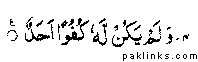

WALAM YAKUL-LAHU KUFU-WAN AHAD
and there is nothing which can be compared to Him.

Now bow down saying:


ALLAHU AKBAR
Allah is the greatest.

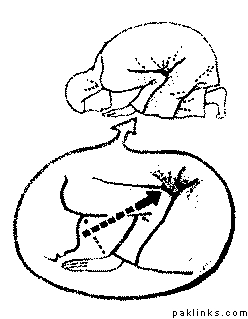
Place your hands on your knees and in this inclined position (Ruku` as shown in figure) recite these words thrice:
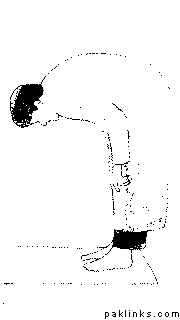

SUBHANA RAB-BI-YAL ATHIM
Glory to my Lord the great.

Postrure for ladies in Ruku` is slighty different to that of a man
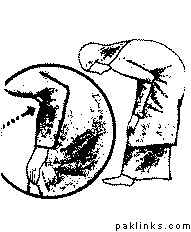

SUBHANA RAB-BI-YAL ATHIM
Glory to my Lord the great.

Then come to the standing position (both figures) saying:
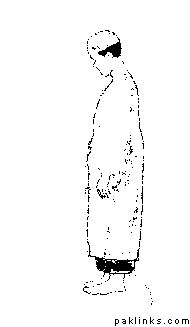

SAMI `ALLAHU LIMAN HAMIDAH
Allah has heard all who praise Him.


RAB-BANA LAKAL HAMD
Our Lord: Praise be to Thee

Now saying “Allahu Akbar” prostrate on the ground with your forehead, the knees the nose and palms of both hands touching the ground. In this position sajdah - as shwon in figures) repeat these words three times at least:


SUBHANA RAB-BI-YAL A`ALA
**Glory to my Lord the most high **


SUBHANA RAB-BI-YAL A`ALA
Glory to my Lord the most high

NOTE: Your nose & forehead in with carpet
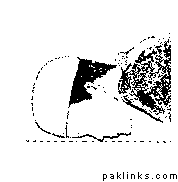


Sit upright with knees still on the ground after a moments rest perform the second Sajdah saying:


ALLAHU AKBAR
**Allah is the Greatest **

In the second Sajdah as before recite the following words thrice:


SUBHANA RAB-BI-YAL A’ALA
Glory to my Lord the most high.

This completes one raka’at of Salah. The second raka’at is. said in the same way except that after the second Sajdah you sit back, with the left foot bent towards the right, which should be placed vertical to the mat with the toes touching the mat. The palms should be lifted from the mat and placed on the knees.
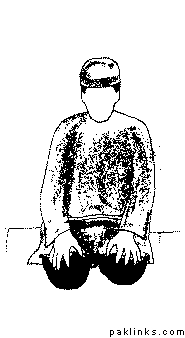
In this position (Q’adahas shown in figures silently say these words (Tashahhud):
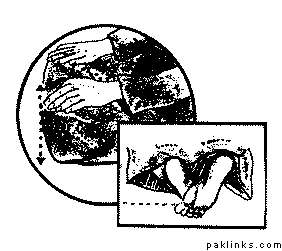

AT-TAHI-YATU LIL-LAHI WAS-SALAWATU WAT-TAY-YIBATU
**All prayers and worship through words, action and sanctity are for Allah only. **


AS-SALAMU `ALAIKA AY-YUHAN-NABIY-YU
**Peace be on you, O Prophet **


WARAHMATUL-LAHI WABARAKATUH
**and Mercy of Allah and His blessings. **


AS-SALAMU ALAINA WAALA `IBADIL-LAHIS-SALIHIN
**Peace be on us and on those who are righteous servants of Allah. **


ASH-HADU AL-LA ILAHA IL-LAL-LAHU
**I bear witness to the fact that there is no deity but Allah. **
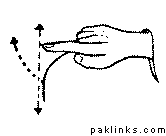

WA-ASH-HADU AN-NA MUHAMMADAN `ABDUHU WARASULUH
**I bear witness taht Muhammad is His slave and messenger. **

In a three rakaat (i.e. Maghrib) or four rakaat (like Zuhr, Asr and Isha) Salah you stand up for the remaining rakaat after Tashahhud. On the other hand if it is a two rakaat (Fajr) Salah, keep sitting and after this recite Darud (blessing for the Prophet) in these words:


AL-LAHUM-MA SAL-LIALA MUHAMMAD-IN WA ALA ALI MUHAMMADIN
**O Allah, exalt Muhammad and the followers of Muhammad **


AL-LAHUM-MA SALAITA ALA IBRAHIMA WAALA ALI IBRAHIMA
**As Though did exalt Ibrahim and his followers. **


IN-NAKA HAMIDUM MAJEED
**Thou art the praised, the Glorious. **


AL-LAHUM-MA BARIK MUHAMMAD-IN
**O Allah, exalt Muhammad **


WA 'ALA ALI MUHAMMADIN
**and his followers **


KAMABARAKTA 'ALA IBRAHIMA WA 'ALA ALI IBRAHIMA
**as Thou has blest Ibrahim and his followers. **


IN-NAKA HAMIDUM-MAJEED
**Thou art the Praised, the Glorious. **


**Then say silently: **
RAB-BIJ-'ALNI MUQIMAS-SALATI WAMIN DHUR-RIY-YATI


**O Lord! Make me and my children steadfast in Prayer; **

**RAB-BANA WATAQAB-BAL DU’A’ RAB-BIGH FIRLI **
WA LIWALIDAY-YA WALIL-MU’MININA YAUMA YAQUM-UL HISAB


**Lord! Accept the prayer. Our Lord! forgive me. **and my parents and believers on the Day of Judgement. ****

Now turn your face to the right (as in figure) saying;


AS-SALAMU 'ALAIKUM WA-RAHMATUL-LAH
Peace be on you and Allah’s blessings.

Then turn your face to the left (as in figure) and repeat the above words (aloud).
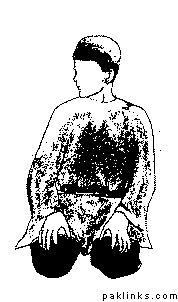
This completes your two raka’at Salah. The four raka’at of Zuhr, 'Asr and 'Isha are said in an identical manner with the only difference that in the first two Raka’at of Zuhr and 'Asr, Al-Fatihah is said silently while in 'Isha prayer it is recited aloud.

If you are performing a three raka’at (like Maghrib) or four raka’at (like Zuhr, 'Asr and 'Isha) Salah stand up after Tashahhud saying ALLAHU AKBAR and recite Al-Fatihah. You must remember that Al-Fatihah is always recited silently in the third and fourth raka’at of every Salah. When you are offering Farz Salah do not recite any additional passage from the Holy Qur’an after Al-Fatihah in the last two raka’at. After the second Sajdah in the fourth raka’at say the Tashahhud, Darud and end with “AS-SALAMU 'ALAIKUM WA-RAHMATUL-LAH” to each side (first right, then left as shown in the above pictures). This marks the end of Salah.

**SALAT-UL-WITR **

The three raka’at prayers said after the Farz and Sunnah of the 'Isha is called Salat-ul-Witr. It is strongly recommended in the practice of the Holy Prophet (peace be upon him) and is Wajib (necessary) according to one section of Muslims. Others regard it a mere Sunnah Salah.

The first two raka’at of this Salat-ul-Witr are said like the first two raka’at of the Maghrib prayers. In the third raka’at after Al-Fatihah, recite some additional Surah or verses of the Quran.

Then, saying ALLAHU AKBAR raise your hands above your shoulders, fold your hands, and recite the following or any other similar Du’a silently. This is called Dua-al-Qunut or the prayer of submission:


ALLAHUM-MA IN-NA NASTA’INUKA
**O Allah, we seek Thy help, **

WANASTAGHFIRUKA
**and ask Thy forgiveness, **


WANU’MINU BIKA WANATAWAK-KALU 'ALAIKA
**and believe in Thee and trust in Thee, **


WANUTHNI 'ALAIKAL-KHAIRA WA NASHKURUKA
**and we praise Thee in the best manner and we thank Thee, **


WALANAKFURUKA WANAKHLA’U WANATRUKU
**and we are not unqrateful and we cast off and forsake him **


**MAY-YAF JURUK ALLAHUM-MA IY-YAKA N’ABUDU **
**also disobeys Thee. O Allah, Thee alone do we worship, **


WALAKA NUSAI -LI WA-NASJUDU WA-ILAIKA NAS’A
**and to Thee we pray, and beforo Thee do we prostrate, to Thee do we turn to **


WANAHFIDU WANARJU RAHMATAKA WANAKHSHA ADHABAKA
**in haste, and hope for Thy mercy, and we fear Thy punishment. **


IN-NA 'ADHABAKA BIL KUF-FARI MULHIQ
Thy punishment surely overtakes the unbelievers.

**SALAH ON SPECIFIC OCCASIONS **

**JUMU’AH (or Friday) Prayer **

Beside the daily Salah, the Friday prayer is also obligatory upon Muslim men. For Muslim women it is not obligatory, but is desirable if they are able to do so without upsetting their household work.
The Friday Salah is offered in congregation on Friday at Zuhr time. First the Imam delivers a sermon (Khutabh). Then he leads the congregation in a two raka’at Salah. After this two or more raka’at of Sunnah or Nafilah prayers are offered individually.

**TARAWIH (or Ramadan) PRAYER **

These prayers are offered during the month of Ramadan after 'Isha Salah. These consist of eight, twelve or twenty raka’at, and are offered two by two with a short rest between every four raka’at. They may be said alone but 4 collective prayers are recommended. These are additional 4 Sunnah prayers.
THE ID PRAYERS (Salatul-ldayu)

There are two 'Id or occasions of great festivity for the Muslims. The first is called ldul-Fitr or the festival of fastbreaking. It is celebrated on the first day of the tenth Islamic month (Shawwal) following Ramadan, the month of fasting. It marks great thanks-giving for the Muslims all over the world.

The second 'Id is the `Idul-Adha or the festival of great sacrifice, which is observed on the tenth of Dhul-Hijjah, the last Islamic month. The animals are sacrificed to celebrate the great sacrifice of the Prophet Ibrahim (peace be upon him).

:jazak:

P.S. I tried my best to error free. Please notify my if there is any error while compiling it.

Modz! if possible could u make it Sticky thread. :aliyish:

Re: How to Perform Salah/Namaz/Prayer

This is a superb thread! I learned a lot.

My questions:
1. I know cleanliness is important in Islam, but I just can't get over the fact about scarcity of water in some parts of the world today such as Pakistan. So what could be more important... cleanliness or water? I try to ignore the sad feelings of using up a resource that others don't have enough to even stay alive, by telling myself that God has granted me a great favor, as he can grant it to anyone whenever he wishes, and I should use it as much as I need to, for he never runs out of anything. The best I can do is simply be grateful every time I get his favor.

  1. @ Tayammum: So just the face and arms? I always wondered how one can rinse mouth with sand... so just any clean wall or stone eh... but then again, what if clothes or body is not clean just like mentioned in the part earlier about having sexual intercourse, etc. One simply can't ghusl with sand now, can he?

  2. "Each of the Salah must be offered at or during its proper time"
    and what's the proper time for isha? in masjids of the city I live in, it's read as soon as just 1.5 hour after magrib... while I was told the later the better, in case of isha... so I wana know if it's better to pray alone late, or pray early with congregation.

  3. "from the navel to the knees at least."
    so I can wear sleeveless shirts? or maybe no shirt at all, provided I got a high waist trouser or something

  4. "The (whole of the) earth has been rendered for me a mosque: pure and clean"
    but environment... like a dusty allergy causing mat with noisy kids(who keep cutting your personal area during a prayer) and women in tight jeans all around you... should one not wait for a better opportunity under such dire circumstances?

  5. "Prophet (S.A.W.) used to perform regularly before or after each Farz Salah."
    so if we read 2 sunnah before 3 farz of magrib, we can skip the 2 after it? you said 'before OR after'
    thing is, I've been sort of 'forced' to read 2 sunnah before magrib... was told that I shouldn't sit unless done with them

  6. Duno about the female rukuh, but the male rukuh seems wrong to me :s I mean I've seen and done it completely different my whole life... and I've never seen anyone do it like this... the arms are suppose to be stretched and pressing hard against the legs, as to push the legs to their limits... and so giving us a tough stance and showing commitment. The only people I've seen do it different are elderly or ones who are praying for fun/show-off and not virtue(they don't put in enough effort, and bend barely 5 degrees -NO EXAGGERATION- while the way I do it, I go all the way 45 degrees...)

  7. You might want to add that it is HIGHLY recommended that these words are said after 'rabbana wala kal hamd'
    "Hamdan kasceeran taiyeeban mubarakal fee" - DO NOT USE THIS TO RECITE, FIND THE PROPER ARABIC PRONUNCIATION

  8. Spelling mistake :P
    "On the other had" = hand*

  9. What's your opinion about the movement of the finger during "ashshadhuAllah ilaha illAllah" at the end of the prayer... should it be continuous, or should it be done only once

  10. "recite the following or any other similar Du'a silently"
    what exactly is the point of 3 witrs, and what are the example of 'similar' duas to dua-e-qunood

  11. can you please repost the arabic text, a bit larger or zoomed this time... it's too straining on the eyes to read...

  12. I didn't get this part about taravee prayers
    "They may be said alone but 4 collective prayers are recommended. These are additional 4 Sunnah prayers."

جزاک اللہ

Re: How to Perform Salah/Namaz/Prayer

:insh: Bro! i’ll try my best to answer/clarify ur points later if u don’t mind. Thanx 4 notifying the spelling mistake.

Re: How to Perform Salah/Namaz/Prayer

lolz.... no problemo... bro o.o

:salam2: ChocoKukkr

1. I know cleanliness is important in Islam, but I just can’t get over the fact about scarcity of water in some parts of the world today such as Pakistan. So what could be more important… cleanliness or water? I try to ignore the sad feelings of using up a resource that others don’t have enough to even stay alive, by telling myself that God has granted me a great favor, as he can grant it to anyone whenever he wishes, and I should use it as much as I need to, for he never runs out of anything. The best I can do is simply be grateful every time I get his favor.

2. @ Tayammum: So just the face and arms? I always wondered how one can rinse mouth with sand… so just any clean wall or stone eh… but then again, what if clothes or body is not clean just like mentioned in the part earlier about having sexual intercourse, etc. One simply can’t ghusl with sand now, can he?

Tayammum is done as a substitution for water. The proof for this is Allaah’s saying: “…and you find no water, then perform Tayammum with good earth, wiping your faces and hands with it.” [Surah Al-Maa’idah: 6] And also the Prophet’s (sallAllaahu 'alayhi wa sallam) saying: “The earth was made a masjid (place of prayer) and purity for me.” [Reported by Al-Bukhaaree and Muslim]

Tayammum is permitted in two situations:

1. When there is no water to be found
*2. When one is not able to use it due to sickness and so on. *

*Tayammum can be performed for both types of ritual impurities (hadath): *

1. Minor Impurity such as urine and feces, and
2. Major Impurity such as sexual relations or semen excretion.

It is permissible to perform Tayammum with everything that is found on the earth from its various types, such as sand, dust and other types of earth. Some scholars say that Tayammum is permissible even if the earth is smooth land and there is no sand or dust found on it, it is permissible to perform Tayammum on it.

The evidence for this is what has been reported by Jaabir (radyAllaahu 'anhu) that the Prophet (sallAllaahu 'alayhi wa sallam) said: “The earth was made a masjid (place of prayer) and a purity for me. So any man from my ummah (nation) who has the time for prayer come upon him, then let him pray, for he has his place of prayer and his purifier with him. So if the prayer time comes upon him and he is in a land in which there is sand or the prayer time comes upon him and he is in a smooth surfaced land, then in this situation, he is ordered to perform Tayammum with this earth.” [Reported by Al-Bukhaaree and Muslim]

Such a person can pray what he wishes from the prayers with this Tayammum, whether the prayer be obligatory or supererogatory. This is because the ruling that Tayammum takes is the same ruling as water. So whatever nullifies one’s wudoo (ablution), then it also nullifies and renders void one’s Tayammum. (Some scholars are on the opinion that Tayammum is nullified by the expire of the time of the present salat, i.e. if the Muslim performs Tayammum for Dhuhr salat he can pray Dhuhr and the supererogatory salat he wills until the time of Asr. Then he has to perform another Tayammum for Asr.)

However, if water is found (and one has Tayammum), something extra is required. So if water becomes available it becomes obligatory for this person to make wudoo (ablution) with it even if his Tayammum hasn’t gotten nullified by one of the factors that cancel out wudoo. This is based on the hadeeth of Abu Hurairah (radyAllaahu 'anhu) who said: “Allaah’s Messenger (sallAllaahu 'alayhi wa sallam) said: 'The earth serves as the wudoo (ablution) of the Muslim even if he doesn’t find water for ten years. But if he finds water, then he should fear Allaah and let his skin touch it.” However, he does not have to repeat the prayers he performed while using that Tayammum.

*How to Perform Tayammum: *

The description of Tayammum, is that one must first make his intention based on the hadeeth: “Verily, actions are only by intentions.” And then he must mention the name of Allaah (saying Bismillaah). Then he is to strike the earth with his two hands one time and then wipe the palms together along with the back of each hand and his face. This is based on the hadeeth of 'Ammaar bin Yaasir in which occurs: “He (i.e. Allaah’s Messenger) struck the earth one time and then wiped his left palm on his right palm, the back of his hands and his face.” [Reported by Al-Bukhaaree and Muslim]

3. “Each of the Salah must be offered at or during its proper time”
and what’s the proper time for isha? in masjids of the city I live in, it’s read as soon as just 1.5 hour after magrib… while I was told the later the better, in case of isha… so I wana know if it’s better to pray alone late, or pray early with congregation.

Volume 1, Book 10, Number 516: [sahi bukhari]

Narrated Abu Al-Minhal:

*Abu Barza said, “The Prophet used to offer the Fajr (prayer) when one could recognize the person sitting by him (after the prayer) and **he used to recite between 60 to 100 Ayat (verses) of the Qur’an. He used to offer the Zuhr prayer as soon as the sun declined (at noon) **and the ‘Asr at a time when a man might go and return from the farthest place in Medina and find the sun still hot. (The sub-narrator *forgot what was said about the Maghrib). He did not mind delaying the ‘Isha prayer to one third of the night or the middle of the night"

*The verse of the Qur’an where Allah says: ****“Verily, the prayer is enjoined on the believers at fixed hours.” **[Al-Qur’an - Surat Al-Nisa 4:103] *

conclusion: Isha prayers must be offered ‘ba-jamat’ either its offered early or late (shouldn’t cross the isha time).

4. “from the navel to the knees at least.”
so I can wear sleeveless shirts? or maybe no shirt at all, provided I got a high waist trouser or something

*Please c this video: *http://english.islamway.com/prayer/BegSound.htm](http://english.islamway.com/prayer/BegSound.htm)

Volume 1, Book 8, Number 363: :[Hadith Bukhari]

Narrated Abu Said Al-Khudri

*Allah’s Apostle forbade Ishtimal-As-Samma’ (wrapping one’s body with a garment so that one cannot raise its end or take one’s hand **out of it). He also forbade Al-Ihtiba’ (sitting on buttocks with knees close to abdomen and feet apart with the hands circling the knees) *while wrapping oneself with a single garment, without having a part of it over the private parts.

Volume 1, Book 8, Number 354: [Hadith Bukhari]

*Narrated Abu Huraira: *A person asked Allah’s Apostle about the offering of the prayer in a single garment. Allah’s Apostle replied, “Has every one of you got
two garments?”

5. “The (whole of the) earth has been rendered for me a mosque: pure and clean”
but environment… like a dusty allergy causing mat with noisy kids(who keep cutting your personal area during a prayer) and women in tight jeans all around you… should one not wait for a better opportunity under such dire circumstances?

Hope this will clear what u wrote above. “Har Aane Wala Zamana Guzre Zamane Se Bura Ho Ga”.

  1. “Prophet (S.A.W.) used to perform regularly before or after each Farz Salah.”
    so if we read 2 sunnah before 3 farz of magrib, we can skip the 2 after it? you said ‘before OR after’
    thing is, I’ve been sort of ‘forced’ to read 2 sunnah before magrib… was told that I shouldn’t sit unless done with them

:hmmm: let me check then i’ll answer :slight_smile:

7. Duno about the female rukuh, but the male rukuh seems wrong to me :s I mean I’ve seen and done it completely different my whole life… and I’ve never seen anyone do it like this… the arms are suppose to be stretched and pressing hard against the legs, as to push the legs to their limits… and so giving us a tough stance and showing commitment. The only people I’ve seen do it different are elderly or ones who are praying for fun/show-off and not virtue(they don’t put in enough effort, and bend barely 5 degrees -NO EXAGGERATION- while the way I do it, I go all the way 45 degrees…)

8. You might want to add that it is HIGHLY recommended that these words are said after ‘rabbana wala kal hamd’
“Hamdan kasceeran taiyeeban mubarakal fee” - DO NOT USE THIS TO RECITE, FIND THE PROPER ARABIC PRONUNCIATION

9. Spelling mistake :stuck_out_tongue:
**"*On the other had" = hand

*done. *:smiley:

10. What’s your opinion about the movement of the finger during “ashshadhuAllah ilaha illAllah” at the end of the prayer… should it be continuous, or should it be done only once

*For Questions **7, 8, & 10 **Please c this video: *http://english.islamway.com/prayer/BegSound.htm](http://english.islamway.com/prayer/BegSound.htm)

**11. "**recite the following or any other similar Du’a silently"
what exactly is the point of 3 witrs, and what are the example of ‘similar’ duas to dua-e-qunood

*I don’t knw the exact point except that ke 'Jo Allah SWT or US ke Rasool :saw2: ne sikhaya/bataya bs mein wohi janta hoon. *
btw Nammaz mein almost 1200 differences hain (i heard from individuals).

And if i didn’t get ur question wrong then if u don’t know dua-e-qunood then u can read three ‘Qul’ in witrs.

12. can you please repost the arabic text, a bit larger or zoomed this time… it’s too straining on the eyes to read…

:slight_smile: Bro click on arabic text (imgae) Go to option view and select zoom. hope this will work.

13. I didn’t get this part about taravee prayers
“They may be said alone but 4 collective prayers are recommended. These are additional 4 Sunnah prayers.”

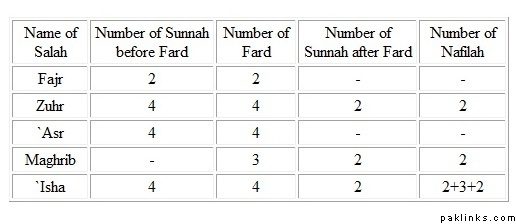
SUNNAH AND NAFILAH OR ADDITIONAL PRAYER

As you can see in the chart below, each Salah is composed of (a) Fard, the prescribed prayers, (b) Sunnah and (c) Nafilah or additional prayers. The Holy Prophet (peace be upon him) said these additional prayers before or after the prescribed (Fard) prayers. These are therefore recommended. The sequence of these additional prayers in each Salah is given below in image:

جزاک اللہ

Added How to do the Wudhu:
http://www.islamway.com/islambase/IslamWayAbultioneng.html

:jazak:

Re: How to Perform Salah/Namaz/Prayer

Jazak Allah ...... very nice kami :) thank u for share this knowldge with us

Re: How to Perform Salah/Namaz/Prayer

:aliyish:

Re: How to Perform Salah/Namaz/Prayer

:salam2:

Here is more information about TAYAMMUM.

Allah SWT said in Qur’an Surat An-Nisa [4:43] "O you who have believed, do not approach prayer while you are intoxicated until you know what you are saying or in a state of janabah, except those passing through [a place of prayer], until you have washed [your whole body]. And if you are ill or on a journey or one of you comes from the place of relieving himself or you have contacted women and find no water, then seek clean earth and wipe over your faces and your hands [with it]. Indeed, Allah is ever Pardoning and Forgiving.


and in Surat Al-Ma’idah [5:6] O you who have believed, when you rise to [perform] prayer, wash your faces and your forearms to the elbows and wipe over your heads and wash your feet to the ankles. And if you are in a state of janabah, then purify yourselves. But if you are ill or on a journey or one of you comes from the place of relieving himself or you have contacted women and do not find water, then seek clean earth and wipe over your faces and hands with it. Allah does not intend to make difficulty for you, but He intends to purify you and complete His favor upon you that you may be grateful.


Tayammum is also narrated i Hadeeth Sahi Muslim too.

Here is some information when u can do Tayammum.

  1. When u don’t get water in 1 Mile Shar’ai (1 Mile Shar’ai = 1 Mile 1 farlang 20 gz ka 1 shar’ai mile hota hay, 1 Shar’ai Mile = 1km approx. 239 meter or 1km = 609 meter).

  2. You are sure about if u used the available water it will caused illness or will increase in sickness.

  3. If u think ur enemy is kept his eye on you and the prayer time will be over till u get the water.

  4. hav little quantity of water but u fear for life (die thristy) if used it for wudu.

  5. Water is available but u don’t have enuf money to buy it.

  6. well (kunwah) is there but u don’t hav any equipment i.e rope, bawl to pour out water.

Re: How to Perform Salah/Namaz/Prayer

"*conclusion: Isha prayers must be offered 'ba-jamat' either its offered early or late (shouldn't cross the isha time)."
*that conclusion is for men only... so women can read isha whenever they want coz they don't read 'ba-jamat' anyway

"Hope this will clear what u wrote above. "Har Aane Wala Zamana Guzre Zamane Se Bura Ho Ga"."
where did you get that?

"And if i didn't get ur question wrong then if u don't know dua-e-qunood then u can read three 'Qul' in witrs."
any 3 out of 4 quls... okay... are you sure of this? I do know dua-e-qunood too...

Re: How to Perform Salah/Namaz/Prayer

Jazzak-Allah …
Great work and guidance …:k:

:salam2:

Hope this info will be useful. Please correct me if i’m wrong. Thanx :slight_smile:

Re: How to Perform Salah/Namaz/Prayer

JazakAllah your efforts but your answers fall just short of my expectations, as my main ideas remain untouched o.o

Re: How to Perform Salah/Namaz/Prayer

thankss

Re: How to Perform Salah/Namaz/Prayer

No Prob. :k:

Re: How to Perform Salah/Namaz/Prayer

honestly long post to read all at once but very useful...thnx for posting

Re: How to Perform Salah/Namaz/Prayer

Thanks. This topic has helped me ALOT!!! I am still learning from it :k:.

Re: How to Perform Salah/Namaz/Prayer

please check the text of the last part of the namaz (from rabbi jalni onwards). This is from Surah 14:40-41. instead of "RAB-BIGH FIRLI " it should be "RABBA NAGH FIRLI"

Re: How to Perform Salah/Namaz/Prayer

Thanks for sharing.