Re: Historical Places of the Subcontinent
Some history of Taxila:
Taxila (ancient city, Pakistan) – Britannica Online Encyclopedia
Taxila, Sanskrit Takshashila,
http://media-1.web.britannica.com/eb-media/58/74758-003-CF0A2C55.gif
ancient city of northwestern Pakistan, the ruins of which are about 22 miles (35 km) northwest of Rawalpindi. Its prosperity in ancient times resulted from its position at the junction of three great trade routes: one from eastern India, described by the Greek writer Megasthenes as the “Royal Highway”; the second from western Asia; and the third from Kashmir andCentral Asia. When these routes ceased to be important, the city sank into insignificance and was finally destroyed by the Huns in the 5th century ce. Taxila was designated a UNESCO World Heritage site in 1980.
History
Taxila is known from references in Indian and Greco-Roman literary sources and from the accounts of two Chinese Buddhist pilgrims, Faxian and Xuanzang. Literally meaning “City of Cut Stone” or “Rock of Taksha,” Takshashila (rendered by Greek writers as Taxila) was founded, according to the Indian epic Ramayana, by Bharata, younger brother of Rama, an incarnation of the Hindu god Vishnu. The city was named for Bharata’s son Taksha, its first ruler. The great Indian epic Mahabharata was, according to tradition, first recited at Taxila at the great snake sacrifice of King Janamejaya, one of the heroes of the story. Buddhist literature, especially the Jatakas, mentions it as the capital of the kingdom of Gandhara and as a great centre of learning. Gandhara is also mentioned as a satrapy, or province, in the inscriptions of the Achaemenian (Persian) king Darius I in the 5th century bce. Taxila, as the capital of Gandhara, was evidently under Achaemenian rule for more than a century. When Alexander the Great invaded India in 326 bce, Ambhi (Omphis), the ruler of Taxila, surrendered the city and placed his resources at Alexander’s disposal. Greek historians accompanying the Macedonian conqueror described Taxila as “wealthy, prosperous, and well governed.”
Within a decade after Alexander’s death, Taxila was absorbed into the Mauryan empire founded by Chandragupta, under whom it became a provincial capital. However, this was only an interlude in the history of Taxila’s subjection to conquerors from the west. After three generations of Mauryan rule, the city was annexed by the Indo-Greek kingdom of Bactria. It remained under the Indo-Greeks until the early 1st century bce. They were followed by the Shakas, or Scythians, from Central Asia, and by the Parthians, whose rule lasted until the latter half of the 1st century ce.
According to early Christian legend, Taxila was visited by the apostle Thomas during the Parthian period. Another distinguished visitor was the neo-Pythagorean sage Apollonius of Tyana (1st century ce), whose biographer Philostratus described Taxila as a fortified city that was laid out on a symmetrical plan and compared it in size to Nineveh (ancient city of the Assyrian empire).
Taxila was taken from the Parthians by the Kushans under Kujula Kadphises. The great Kushan ruler Kanishka founded Sirsukh, the third city on the site. (The second, Sirkap, dates from the Indo-Greek period.) In the 4th century ce the Sāsānian king Shāpūr II (309–379) seems to have conquered Taxila, as evidenced by the numerous Sāsānian copper coins found there. There is little information about the Sāsānian occupation, but, when Faxian visited the city at about the beginning of the 5th century ce, he found it a flourishing centre of Buddhist sanctuaries and monasteries. Shortly thereafter it was sacked by the Huns; Taxila never recovered from this calamity. Xuanzang, visiting the site in the 7th century ce, found the city ruined and desolate, and subsequent records do not mention it. Excavations begun by Sir Alexander Cunningham, the father of Indian archaeology, in 1863–64 and 1872–73 identified the local site known as Saraikhala with ancient Taxila. This work was continued by Sir John Hubert Marshall, who over a 20-year period completely exposed the ancient site and its monuments.
Archaeology
http://media-1.web.britannica.com/eb-media/53/60053-003-97378D1C.gif
The structural remains at Taxila include the Bhir mound area, the palace area at Sirkap, the Jandial and Pippala temples, the Giri fortress, the Mohra Moradu and Jaulian monasteries, and the Dharmarajika, Bhallar, and Kunala stupas (burial mounds). Different types of masonry used in the monuments indicate their period of origin. The earliest remains are those of the Bhir mound. The palace area, modeled on the same lines as its Assyrian counterpart, Nineveh, has several entrances and outer fortifications. It reveals traces of successive settlements, with the oldest parts of the buildings consisting of rubble masonry. A spacious Buddhist temple, several small shrines, and blocks of dwelling houses were uncovered . The shrine of the double-headed eagle is interesting for its pilasters of the Corinthian order on the front and for niches in the interspaces. Other antiquities of the palace area include terra-cottas and potteries; small bronze, copper, and iron objects; and beads, gems, and coins of Indo-Greek, Parthian, and early Kushan rulers.
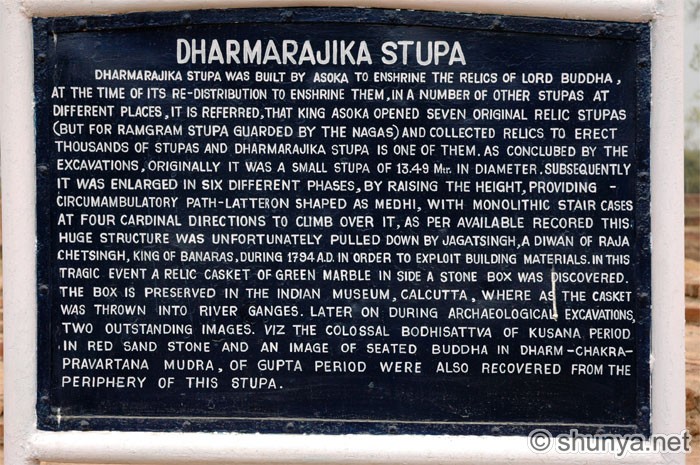
The Dharmarajika stupa, popularly known as Chir Tope, is a circular structure with a raised terrace around its base. A circle of small chapels surround the great stupa. Three distinctive types of masonry in the buildings around the main stupa suggest the contributions of different periods to the building activity. A silver scroll inscription in Kharoshti and a small gold casket containing some bone relics of the Buddha were found in one of the chapels. The inscription refers to the enshrinement of the relics, by a Bactrian named Ursaka from the town of Noacha in the year 136 bce, for the bestowal of health on “the great King, Supreme King of Kings, the Son of Heaven, the Kushana” (probably Vima Kadphises, son of the Kushan conqueror Kujala). That site also contained several statues of the Buddha and bodhisattvas.
The Jandial temple, set up on an artificial mound, closely resembles the Classical temples of Greece. Its Ionic columns and pilasters are composed of massive blocks of sandstone. Built in the Scythio-Parthian period, it is probably the temple described by Philostratus in his Life of Apollonius of Tyana. Though the Jandial temple is not Buddhist, the Jaulian remains are. These include a monastery and two stupa courts.
Taxila, besides being a provincial seat, was also a centre of learning. It was not a university town with lecture halls and residential quarters, however, such as have been found at Nalanda in the Indian state of Bihar. At Taxila the preceptor housed his own pupils, who paid for their board and lodging in cash or in the form of service to the teacher and his family. The Buddhist monasteries also catered to the needs of the students and monks.
Baij Nath Puri


 overall it was a good flyover and it resolved many traffic related problems in that area, but now again during the past 10-15 years nothing has been done for expansion of the bridge or some alternate routes resulting in traffic jams. Shahbaz sharif ki rangeen mizaaji bhi baadshahon wali hain.