HAPPY NOTE, MUSIC RETURNING TO AFGHANISTAN

Nothing is more beautiful then people getting together laughing and listening and dancing to the sounds of music. AGHANISTAN IDOL is really a huge popular hit with the afghanistan especially amongst the young who are overjoyed that singing is once again happining.

Music is a lovely note uniting people’s spirit in joy. May many more happy voices singing joyously and loudly.

Re: HAPPY NOTE, MUSIC RETURNING TO AFGHANISTAN

actually hip-hop MTV culture is a good thing for white children. Hip-hop should be reserved for white children, that way they won't grow up to be republicans. white girls should be encouraged to go black. Heidi Fleiss should be set as role models of white kids !!!! :D

for non-whites MTV culture should be discouraged and these non-white kids should be encouraged to focus on education and become successfull. They should be encouraged to have good work ethics and become good citizens

Re: HAPPY NOTE, MUSIC RETURNING TO AFGHANISTAN

Actually what the black kids need is a FATHER in their lives. As both white and black have easy access to MTV but it seems the gang youth all lack one thing--- A FATHER. Most of them are too cowardly and weak to handle the life of an african kid as they are the ones who truly have real struggles. Dare , I say it, the slave boat rescued these gang youth from ebola, machete annihilation, starvation and the ilks of Mugabe, Idi Amin etc and now run around like hooligans instead of respecting the struggles of Martin Luther King. Martin Luther King would be appalled that his fight and struggle are so disrespected by the violence of the black gang youth . These sub group are whiners , they have opportunity and squander it. Blame it on the hos with several children by different men and no father at home.

Re: HAPPY NOTE, MUSIC RETURNING TO AFGHANISTAN

^ today's "music" (and i use that term VERY loosely) is just garbage. I used to watch MTV when it was a kid and it was nowhere near as trashy as it is now. Sadly, this MTV culture is what ppl overseas watch and think that's how ppl here are...hence their disdain for americans. No doubt ull find good music, but NOT on mtv....u know...since we're talking abt MTV and all.

Re: HAPPY NOTE, MUSIC RETURNING TO AFGHANISTAN

Thank you NA and Karzai now we have musics resurraction.

Re: HAPPY NOTE, MUSIC RETURNING TO AFGHANISTAN

Uberalles - I agree that lack of fathers in their households is a major factor for the gansta. But I don't understand how or why you try to connect slave boats (that happened centuries ago to the contemporary ills of Africa.

Re: HAPPY NOTE, MUSIC RETURNING TO AFGHANISTAN

Brown "I can turn any thead about anything into an anti-white tirade" Sugar, please get a grip. This obsessiveness is childish, racist and distracting.

Re: HAPPY NOTE, MUSIC RETURNING TO AFGHANISTAN

Music is haraam in Islam. So is this a good thing?

Re: HAPPY NOTE, MUSIC RETURNING TO AFGHANISTAN

Can we have web link for this info?

Re: HAPPY NOTE, MUSIC RETURNING TO AFGHANISTAN

Music training ‘good for heart’ BBC NEWS | Health | Music training 'good for heart'

Learning an instrument could boost relaxation abilities

Learning a musical instrument could be good for the heart, a study suggests.
Italian and British researchers compared the effect of a range of pieces, from Beethoven to techno, on musicians and non-musicians.
Tempo, rather than style, was found to be the greatest stress-buster in both groups, the study in Heart found. But the effects were stronger for the musicians among the 24 people studied, as they had been trained to synchronise breathing with musical phrases.

Scientists from the University of Pavia and the University of Oxford studied breathing and circulation in 24 young men and women, before and while they listened to short excerpts of music.
Half were highly-trained musicians, who had been playing instruments such as the violin, piano, flute, clarinet or bass for at least seven years. The remainder had had no musical training.
Each participant listened to short tracks of different types of music in random order, for two minutes, followed by the same selection of tracks for four minutes each.
A two-minute pause was randomly inserted into each of these sequences.
Relaxation techniques
Participants listened to raga (Indian classical music), Beethoven’s ninth symphony (slow classical), rap (the Red Hot Chili Peppers), Vivaldi (fast classical), techno, and Anton Webern (slow ‘12 tone music’).

Faster music, and more complex rhythms, speeded up breathing and circulation, irrespective of style, with fast classical and techno music having the same impact.
Slower or more meditative music had the opposite effect, with raga music creating the largest fall in heart rate.
Indications of relaxation were particularly evident during the pauses between tracks.
The effects were most evident in those with musical training.
The researchers suggest the effects of slow rhythms and pauses could be helpful in preventing or treating heart disease and stroke.
Writing in Heart, the team, led by Dr Luciano Bernadi and Professor Peter Sleight, said: “Appropriate selection of music, by alternating fast and slower rhythms and pauses, can be used to induce relaxation, and so can be potentially be useful for cardiovascular disease.”
Dr Charmaine Griffiths, spokesperson at the British Heart Foundation (BHF), said: "This small study adds to the work BHF scientists are doing to understand how positive emotional state and relaxation can contribute to our wellbeing.
"BHF researchers have already shown associations between emotions and signs of good heart health.
"People relax in different ways and it may be that music is key for some while for others curling up with a good book or taking a long walk is just as beneficial. “One person’s Mozart may be someone else’s Madonna and it may be that different people find relaxation in different types of music.” Other research has shown that music can cut stress, improve athletic performance, improve movement in neurologically impaired patients, and even boost milk production in

Re: HAPPY NOTE, MUSIC RETURNING TO AFGHANISTAN

I asked for the link for the Information you gave about music and happiness and joy and unity in Afghanistan, I didn’t ask what BBC has to say about the benefits of music.

Re: HAPPY NOTE, MUSIC RETURNING TO AFGHANISTAN

www.beautyden.com/healingmusic.shtml - 18k - Cached
www.mum.edu/gandharva/health.html - 8k - Cached
www.amc-music.com/seniors_social.htm - 55k - Cached
stress.about.com/od/tensiontamers/a/music_therapy.htm - 22k - Cached

THE above links will give you more infor how music is good for the heart, the overall health and the mental stimulation for children, adults and seniors. The many benefits of music for the health.

As the scientists and doctors discover and do more studies regarding music and healthy benefits , one day doctors will be prescribing TWO SONATAS instead of TWO ASPIRINS.

Re: HAPPY NOTE, MUSIC RETURNING TO AFGHANISTAN

We now demanding links for proof that music unites people's spirit in joy.

UNBELIEVABLE. Seriously folks, UNBELIEVABLE.

Re: HAPPY NOTE, MUSIC RETURNING TO AFGHANISTAN

Yes, just like you ask for proofs of religion uniting people.

Ignorance at its peak.

Re: HAPPY NOTE, MUSIC RETURNING TO AFGHANISTAN

KABUL, August 15 (UNHCR) – His songs evoke the harsh beauty of his native Afghanistan, a country he fled more than 12 years ago, but they were composed in a green and tidy suburb of Toronto, Canada, where he now lives. Like his music,Saboori is a man capable of crossing boundaries, maintaining links with his past while embarking on a new life in what initially seemed like a strange and distant land.
Among his admirers in Afghanistan and Afghan communities around the world, Saboori is considered one of the leading figures in Afghan folk music. A new CD titled "This is Life" is his first release since seeking refuge from his country's civil war more than a decade ago.
"For an entire month, I hid in a basement because of the rockets landing everywhere in the city," he says, recalling the months before he fled the violence for Uzbekistan. There, he registered with UNHCR and lived for 11 years with his wife and three children. Then came the offer to relocate to Canada.
"It was hard at first, especially for the children," he says of the initial days in Canada. "They were attending a new school, they didn't speak English and they had to try and make new friends. I had an easier time as I was immediately welcomed by the Afghan community. But now the kids speak English very well and are always eager to go to school each morning."
Back in Afghanistan for a personal visit, Saboori points to his children's attachment to their new home and the warm welcome his family has received in Canada as reasons why they have no immediate plans to return to their homeland. But he remains committed to helping to rebuild Afghanistan.
"For me, being back home is not simply about being here physically and meeting my friends and relatives. I may not live here any longer, but helping this nation is still my responsibility, particularly in the field of music."
The study and practice of traditional Afghan music suffered during Afghanistan's decades of conflict. During the years of the Taliban, music of any kind was strictly forbidden.
While in Afghanistan, Saboori is meeting with government officials and academics in an effort to create music schools where a new generation can learn about the traditions of Afghan music while safeguarding its future.
"The best way to help strengthen the field of music in Afghanistan is to establish schools where musicians both living here and in other countries can come together and exchange ideas," he says.
Nearly 4 million Afghans have made the journey home since UNHCR began its voluntary repatriation programme in 2002, following the fall of the Taliban.
Although Saboori has opted to stay in Canada for now, he remains committed to the development of Afghanistan. And he is convinced that all Afghans have a role to play. As he says in one of his songs: "Whether you are near or far, let's put our hands together to rebuild this nation."

Re: HAPPY NOTE, MUSIC RETURNING TO AFGHANISTAN

[FONT=Times New Roman]The people of Afghanistan under Taliban rule are subjected to an extreme form of music censorship. The only musical activity permitted is the singing of certain types of religious song and Taliban “chants”.
The report traces the gradual imposition of music censorship since 1978, when the communist government of Nur Ahmad Taraki (the correct name is Noor Mohammad Taraki -RAWA) came to power in a violent coup d’etat. During 14 years of communist rule, music in Afghanistan was heavily controlled by the Ministry for Information and Culture, while in the refugee camps in Pakistan and Iran all music was prohibited in order to maintain a continual state of mourning. The roots of the Taliban ban on music lie in the way these camps were run.
In the Rabbani period (1992-1996) music was again heavily censored. In the provincial city of Herat, which the author visited for 7 weeks in 1994, professional musicians had to apply for a licence, which specified the kinds of material they could perform, songs in praise of the Mujahideen and songs with texts drawn from the mystical Sufi poetry of the region. This cut out a large amount of other music, such as love songs and music for dancing. The licences also stipulated that musicians must play without amplification. Music could be performed by male musicians at private parties indoors, but Herat’s women professional musicians were forbidden to perform. While in theory male musicians could perform at wedding parties or Spring country fairs, experience had shown that often in such cases the agents of the Office for the Propagation of Virtue and the Prevention of Vice, religious police, had arrived to break up the party and confiscate the instruments, which were usually returned to the musicians some days later when a fine or bribe had been paid.
There was very little music on local radio or television in Herat. Broadcasting time was anyway severely curtailed, to about two hours per day. If a song was broadcast on television one did not see the performers on screen but a vase of flowers. Names of performers were not announced on radio or television. Instrument maker had re-opened their businesses, and the audio cassette business continued, with a number of shops in the bazaars of Herat selling music cassettes, some of locally recorded Herat musicians.

When the Taliban took control of Kabul in 1996 a number of edicts were published against music. For example:
“To prevent music… In shops, hotels, vehicles and rickshaws cassettes and music are prohibited… If any music cassette found in a shop, the shopkeeper should be imprisoned and the shop locked. If five people guarantee, the shop should be opened, the criminal released later. If cassette found in the vehicle, the vehicle and the driver will be imprisoned. If five people guarantee, the vehicle will be released and the criminal released later.
To prevent music and dances in wedding parties. In the case of violation the head of the family will be arrested and punished.
To prevent the playing of music drum. The prohibition of this should be announced. If anybody does this then the religious elders can decide about it.”
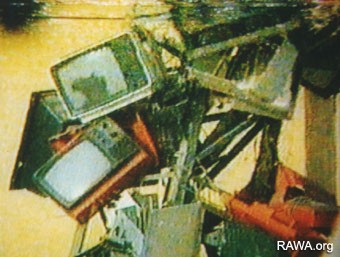
All musical instruments are banned, and when discovered by agents of the Office for the Propagation of Virtue and the Prevention of Vice are destroyed, sometimes being burnt in public along with confiscated audio and video cassettes, TV sets and VCRs (all visual representation of animate being is also prohibited).
The only forms of musical expression permitted today are the singing of certain kinds of religious poetry, and so-called Taliban “chants”, which are panegyrics to Taliban principles and commemorations of those who have died of the field of battle. These chants are themselves highly musical: the singing uses the melodic modes of Pashtun regional music, is nicely in tune, strongly rhythmic, and many items have the two-part song structure that is typical of the region. There is also heavy use of reverberation. But without musical instruments this is not “music”.
The effects of censorship of music in Afghanistan are deep and wide ranging for the Afghans, both inside and outside the country. In the past, the people of Afghanistan were great music lovers and enjoyed a rich musical life. Music was an integral part of many rites of passage, such as celebrations of birth, circumcision (male only), and most important of all, marriage. Only death was a rite of passage lacking in musical expression. The lives of professional musicians have been completely disrupted, and most have had to go into exile for their economic survival. The continuation of these rich musical traditions is also under treat.
The report makes the following recommendations.
(1) To highlight the critical situation as it exists today.
(2) To try to give musicians both inside and outside the country economic support, and in the transnational communities, to persuade aid agencies of the importance of music in the lives of refugees.
(3) To make sure that what is left from the past is adequately documented, so that something is left for the future.
(4) To support the craftsmen who make traditional Afghan musical instruments, for traditional music cannot be played without the appropriate instruments.
(5) To support practical musical education programmes in the transnational community and to persuade the relevant agencies of the importance of music coping with the traumas of refugee life.

Re: HAPPY NOTE, MUSIC RETURNING TO AFGHANISTAN

Yes we all like Music and appreciate its joy. We have a very long musical tradition

tell us something new !

Re: HAPPY NOTE, MUSIC RETURNING TO AFGHANISTAN

silly thread

Re: HAPPY NOTE, MUSIC RETURNING TO AFGHANISTAN

Silly thread, gee , see the silly faces as kids go singing joyously again in Afghanistan. If that is silly then great!!! Its what Afghanistan kids and adults need , sillly , silly , silly and not mad mullahs and crazy clerics influencing the growth of suicide bombers because someone sang loudly , proudly and maybe even out of tune. Hurrah, Afghanistan Idol has brought joy to many. I am sure Allah loves to hear the joyous song of youth then a youth strapping on a suicide vest or do you disagree?

Re: HAPPY NOTE, MUSIC RETURNING TO AFGHANISTAN

Afghanistan’s Pop Idol breaks barriers
By Alastair Leithead
BBC News, Kabul

**In the corner of the kebab shop a small television with a crackly picture draws everyone’s eye as they plunge their Afghan nan bread into oily sauce and slurp up a chunk of meat. **
The cross-legged diners lean to one side as they peer around a sheep’s carcass that momentarily blocks the screen as it’s passed from the freezer to the hook from which it then hangs in the window.
It’s nine o’clock on Friday night and Afghan Star is on the TV, with just a handful of wannabe singers left, competing for fame and fortune in the glitzy and glamorous Afghan version of the talent show Pop Idol.
It’s a huge hit on one of the national private stations, Tolo TV, but it’s controversial in a country that’s still very conservative.

**Liberal stance **
Most of the contestants who’ve not yet been voted out are men, but there is still one woman left. Lima Sahaar is from the southern province of Kandahar and each week she travels up to the studios in Kabul for the show with her mother.

Her hair is usually covered with a scarf, her face not. The fact that a young woman from the birthplace of the Taleban is on stage performing each week says a lot about the way Afghanistan has changed in six years.
Taking such an obvious liberal stance can be dangerous, and although she explained she had the support of her family, there are many people opposed to her.
“I’m not afraid,” she told me. "Afghan people don’t care about risks or dangers.
“I think all of Afghanistan is in danger, but if we worry about those dangers we can’t move on and the country’s not going to develop.”
She’s already got the precocious traits of a young star - the dismissive attitude, the mobile phone texting while we talk - and the hallmarks of a manager looming large in the shape of her forceful mother.
She’s not just the only woman left, she’s also the only Pashtun, and in a country where ethnicity still means so much, she’s almost guaranteed to stay in the show a little longer at least.

**Modern beat **

At the rehearsals the night before the weekly studio recording it was good to see the mix of young Afghans, their sights set on a better future for themselves.

They each stand up and perform this week’s traditional song in front of their competitors - a modern beat accompanying them on the keyboard.
The presenter, Daud Sediqi, was a medical student when the Taleban were in power, but he also used to be an underground television and video repair man when TV was banned by the oppressive government.
“I always wanted to be in the music industry and now my life has totally turned around,” he said.
And indeed it has - he’s now one of the most famous people in Afghanistan with a huge crowd clamouring to get in to see his programme every week.
There’s barbed wire around the entrance to the Afghan wedding hall that has been temporarily converted into a TV studio.
That, and the armed guards clutching their AK-47s and patting down those holding a golden ticket to the show, indicates how much further the country still has to go.

**‘Sleeping talent’ **

The women go straight upstairs and take their seats first and then the male majority push and shove, whistling and shouting excitedly and the men with guns and bodyguard style earpieces let them through one by one.

“Afghan Star is very good as it shows all the sleeping talent across Afghanistan,” one young man in the crowd told me in good English.
“The young generation before, during the decades of war, could not stand up and show what they had, but now all the young generation can show their talents. Their talent is therefore very important for everyone.”
And another laughed when I asked if this would have been possible under the Taleban.
“Back then we couldn’t even listen to music in our own homes,” he said.

Story from BBC NEWS: