NEVER EVER EVER POINT OUT OR MAKE FUN OF ANY KHANDAAN OR FAMILY…I HAVE TAKEN A VERY STRONG EXCEPTION OF 'lilly’s COMMENTS!
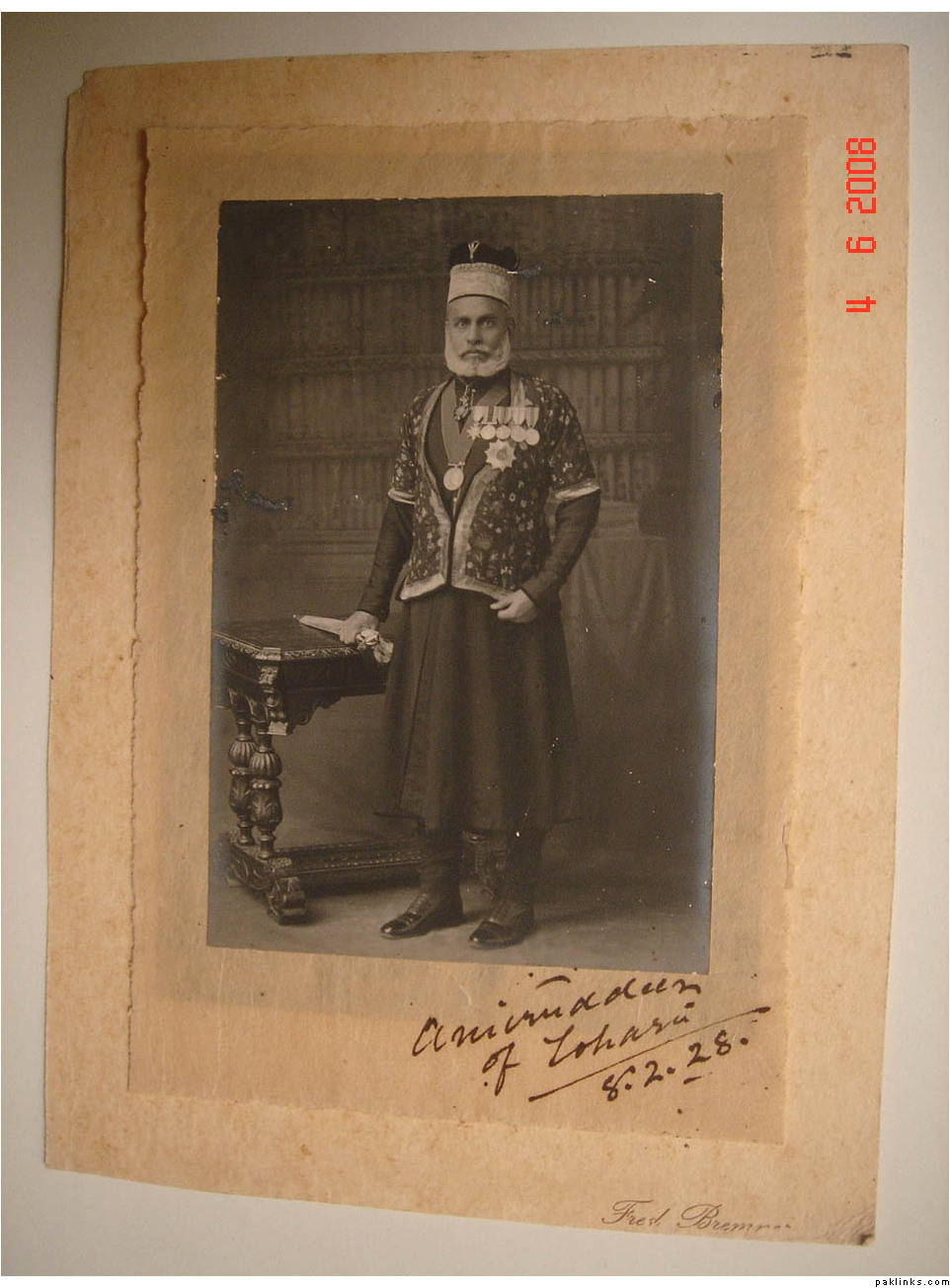
Autographed Photograph of my grand-father; Nawab Sir Amir Ud Din Ahmad Khan, Nawab of Loharu in full regalia.
Photograph by Fred Bremner.
Photograph Size: 4in x 6in
Mounted on photographers card. Size: 6 1/2in x 8 1/2in
BRIEF HISTORY
The ruling family claim descent from an ancient family of khwajas from Bokhara, in Central Asia. They migrated to India during the middle of the eighteenth century and took service under the Mughals. They rose to rank amongst the principal nobles of the Delhi court but sided with the British during after the Marathas took control of the capital.
The state was founded by Nawab Ahmad Baksh Khan in 1803, after he received Loharu from the ruler of Alwar, and Ferozepur Jhirka from Lord Lake. Both forming his reward for services rendered during the Maratha Wars. However, most of the lands so granted were confiscated after his son and successor, Nawab Shams ud-din Ahmad Khan, was deposed and executed for the murder of the British Resident, Simon Fraser, in 1835. Thereafter, the family territories were restricted to Loharu and some property in the City of Delhi.
Despite their loss of territory, the family continued to play and important part in public affairs throughout the period of British rule, and beyond. Several members of the family have been amongst the finest poets and literary figures of the Urdu language. Amongst them, Dagh Dehlvi, the son of Nawab Shams ud-din, and Mirza Ghalib and Sir Syed Ahmad Khan, both connected by marriage to the family.
Nawab Sir Amir ud-din Ahmad Khan, grandson of Nawab Ahmad Bakhsh Khan, played a role in Indian affairs far greater than his tiny state could warrant. He was frequently consulted by the British authorities on most matters that concerned the Muslim communities, not only in India, but also abroad. A member of the Punjab and Central Legislatures, and the Council of State, he served as Manager of the state of Malerkotla and on the staff of the Political Department in Iraq. He abdicated in favour of his eldest son in 1920, but then returned to act as regent for his infant son on his death in 1926. He finally retired for good in 1931 after fifty years of public service.
Nawab Amin ud-din Ahmad Khan, grandson of Sir Amir ud-din, was no less distinguished than his predecessors. Unlike many in his family, he opted for India in 1947 and served his country throughout his lifetime. After brief army service during the conquest of Portuguese India, he went on to serve as a MLA in Rajasthan for several years, and then as a highly popular Governor of Himachal Pradesh and the Punjab for six years. He donated the famous and valuable library amassed by his family to the Raza Library in Rampur. He was succeeded as head of the house by his eldest surviving son, Nawab Ala ud-din Ahmad Khan in 1983.
SALUTE:
9-Guns.