on Tuesday March 02
The name needs no introduction. While I cannot honestly say that I have read his work or even listened to his recent speeches, Dr Qadri is a highly respected scholar. He has a large following both in Pakistan and the UK and comes across as someone who understands Islam really well.
And while a single fatwa will not stop every radicalized nutcase eager to kill and maim innocent civilians, the trickle-down effect is important. It is a step in the right direction. More muslim scholars like Dr Qadri should come forward and denounce violence committed in the name of islam.
May Allah keep him safe from the radicals
Is this a triumph for the Islamic peace-makers?
On Tuesday in London, a revered Muslim scholar will announce a fatwa against suicide bombing in the name of Islam. Here, Allegra Mostyn-Owen talks exclusively to Dr Tahir ul-Qadri as he outlines his historic vision…
I meet Dr Tahir ul-Qadri in a neat, terraced house in Barking where he emerges from his studies resplendent in an elegant silk striped grey and white juba and a black woollen hat.
I am honoured to be in his presence because he is considered a living saint by his followers. All Sunni and mainly Pakistani, they celebrate his birthday and his photograph adorns all the mosques which are part of Minhaj-ul-Quran, the movement which he has spent years raising into an international organisation. It now operates in 33 countries and advises the British Government](http://www.paklinks.com/standard/related-10777-parliament-of-the-united-kingdom.do) on how to combat youth radicalisation.
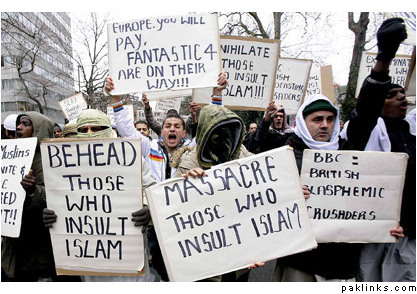
Minhaj-ul-Quran welcomed, for example, the news last month that plans to build Europe’s biggest mosque close to the Olympic site had been blocked. Weeks earlier, the group urged police to prevent Islamic extremists marching through Wootton Bassett. “These kind of extremists do not represent the British Muslims,” they said. Dr ul-Qadri is impressively ecumenical in his relations with other faiths such as Shia and Christian. He gets a lot of flak for this from those who do not agree with his views.
On Tuesday, in central London, Dr ul-Qadri, friend of former prime minister of Pakistan Benazir Bhutto who was assassinated in 2007, will declare suicide bombings and terrorism un-Islamic. Taken from a 600-page document published in Pakistan last month, Dr ul-Qadri will use texts in the Koran and other Islamic writings to argue that suicide and terrorist attacks are “absolutely against the teachings of Islam and that Islam does not permit such acts on any excuse, reason or pretext”.
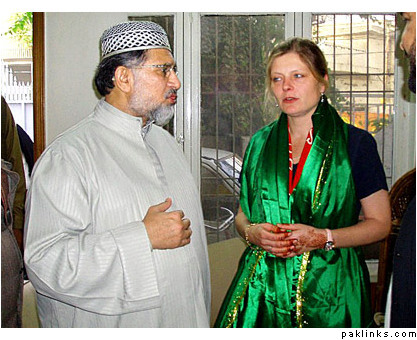
I first met Dr ul-Qadri five years ago at his headquarters in Lahore, where I was for a wedding. I was recently married myself for the second time — as the former wife of Mayor Boris Johnson I’d wed again in secret to my 23-year-old Muslim lover, himself from Lahore. His parents knew nothing about it. Since 2005, I have been giving art classes for women and children at the Minhaj-ul-Quran mosque in Forest Gate.
Today, in Barking, Dr ul-Qadri is focusing on the problems of how many young British Pakistanis are being radicalised. Although the Government is working hard, says Dr ul-Qadri, they are working on the wrong lines. In other words, he believes, that the Government has not kept abreast of the multi-culturalism of its own people. “England is the hub of the Western world. There is a big community here of around two million with a Pakistani background. The communities are in great numbers.” As Dr ul-Qadri sees it, no terrorists have emerged from a Sunni or Sufi background: instead, they have come from the Salafis (Wahhabis) or Deobandis. The Deobandis are a South Asian variant which is close to the Gulf-orientated Wahhabis.
“Every Salafi and Deobandi is not a terrorist but I have no hesitation in saying that everyone is a well-wisher of terrorists and this has not been appreciated by the Western governments,” he said.
Dr ul-Qadri, who has the authority of a Sheikh–ul-Islam, a title given to those who have superior knowledge of the principles of the faith, is coming out with his statement now because the Wahhabis and Deobandis have been silent in condemning the killings in Pakistan and abroad.
They dominate much of the apparatus of state in Pakistan — as well as most of the mosques in London — which is why in the West we receive mixed messages: the military launches vast offensives while the religious and education ministries say nothing. As a result, many in the West believe that the church in Pakistan is not doing enough to counter the violence.
British-Pakistanis lured into extremism present a peculiar problem because, when they go to Pakistan to further their murderous ambitions, they have mixed loyalties. They do not feel British but nor do they feel wholly Pakistani and yet they are a diplomatic nightmare for both countries. Terrorism is, Dr ul-Qadri says, an intellectual phenomenon as it applies to British-Pakistanis. They have been groomed from an early age in their Deobandi-leaning mosques where they are taught that they are living in a kafir society where they cannot integrate.
It is an “us and them” way of thinking and the narrow-mindedness starts when children attend mosque from the age of five. But, as Dr ul-Qadri says: “isolation is not the Islamic model — integration was the practice of the Holy Prophet in the society of Medina”.
The maulvis (untutored clerics) give a misguided concept of Jihad: “This is the burning issue of the whole world,” says Dr ul-Qadri. Once these children have been groomed into intellectual conservatism, they are very susceptible to extremism especially if they are not attached to society by a job. “Those who still have contact with [such clerics], whether they act out their ideas or not, they will be well-wishers of the Taliban,” he says. Since the governments and agencies working on anti-terrorism are not brought up in Muslim culture, Dr ul-Qadri believes they do not understand. “Still their policies are not on the right track.” **I ask him about the role of art in children’s education. It is commonly thought that Islam is contrary to art. He has no quibbles: he sees art as helping to satisfy one aspect of the human personality. “Islam wants a balanced personality,” he says. **
“We teach children intellectually and academically. The fight against the darkness of ignorance, the fight for charity: this is the true jihad.”