Welcome philosophers! ~ I shall be starting some topics over the next few weeks going over the subject of “Logic” and “Reasoning” - It is the basis for a grown mind to be able to discern and undertake critical thinking.
Discussion will be based on theory and we can all get involved by citing examples from within the texts of discussions that have been taking place on Gupshup. So let’s begin …
Lesson 1 - Homonyms, Synonyms and Paronyms
**Vocabulary:
Object = This is a grammatical term and means the thing or entity upon which the discussion is being undertaken. The Object as the name suggests contains within it a “reason” or “purpose” which is where we derive the term “objectify” … and it can relate to abstract things and concrete things alike.
Abstract = Conceptual
Concrete = Physical
(Other terms will be defined in the text)
The basis for this lesson is to introduce terms that will be used to help us with the core of logic. In order to achieve that we need to make sure that we are all synchronous in our understanding of those terms that we use to build our world of logic together. (We are following the methods of Aristotle in this course).
**Homonym
**Consider two Objects where their names are the same but their Definitions (substance / nature of its matter) are different.
Here I would like you to consider a child who is holding a photograph of himself … we have before us “child” twice. One in person and the other as an image of that person. They are by name both "child’ however they differ in definition i.e. their phsycial make-up is different and hence they are different. A homonym will be a word which is equivocal to another …
This is where you can now contribute … I will introduce topics but the core of the learning should be through discussion … at a suitable point on this thread I’ll introduce the other terms and when we move to other subjects I’ll open new threads …
So please provide some good examples of homonyms and some definitions that you have seen that you like … or if you wish to comment about the above or ask a question …
The word “bar” is a homonym where at least two different definitions exist namely a metal rod and a unit for pressure measurement. Although the word is equivocal the substance is different.
**Synonym
**
A synonym in modern days is defined as “different names for the same definition” for example - diary and journal … The Torch and The Sun, and so on …
Please add some your own synonyms … however in Aristotelian logic the “synonym” is defined another way. Here a synonym is defined as - ‘the relationship of the name with its corresponding definition is the same as another name definition couplet’. For example “a man” and “an ox” are considered synonyms purely because when either are described the manner of that description will be the same. A living physical creature - animal. Hence a photo of a man and a photo of an ostrich would be considered synonyms.
Here man and ox have been replaced with a common name - animal …
At this point it would be equally good to diversify this course with the ideas of symbolic logic - which can be used to help us with our thoughts. These are formulated by the much more modern Lewis Carroll … Here that what we earlier defined as “object” is invoked as “things” … which is “nouns” and denoting these nouns are their “names” … It is interesting therefore to recognise that the first man according to many faiths was taught the “NAMES of THINGS” by God. It is also highly interesting that computer language declares variables and constants and hence is naming things before it can be run as a code that will work.
The next point is that Things have Attributes - now we have an analogy with the Names and Definitions spoken about earlier. Examples of “things” - , I, London, Roses, redness, etc …and examples of “Attributes” - large, red, old, that what I received yesterday, etc … Here Carroll draws a distinction by separating attributes out in to smaller units. Stating that:
One Thing may have Many Attributes; and one Attribute may belong to many Things.
The reason that most believe Aristotle began his treatise with these terms was so he could introduce the Categories or Predicaments without having to take side tracks to explain the terms he would use to illustrate the Category. We have heard of a simple sentence which contains “Subject and Predicate” and thus we will leave this here and return to our terms until we again arrive at this topic.
**Paronym
**This term is to do with the relationship of two nouns one derived from another. A grammarian from grammar for example. Also note that the Arabic root word system is the most obvious linguistic presence of paronyms, where the simplest forms are found in the male, single, third person past tense - usually to present a triliteral root … which with some modification can result in derived meanings, but also derivative shapes for the terms that form.
The term KaTaBa means He wrote, from this we can derive KiTaaB which means book and maKTaB which means desk, or that what is written, or the place where writing takes place … to provide functional meanings of those derived words.
Similarly in Object Orientated Programming and also with scripts such as CSS we will have classes from which a set of objects are derived. They would be paronyms as well.
Some very useful paronyms can be found in taxonomy - For example: Cat family (Felidae) we will have the group Panthera, derived from this we have Leo, Pardus, Tigris, Onca and Uncia …
This deals with the idea that two or more specific nouns can be grouped together to make common nouns, or that certain nouns can be subdivided to make special types that differ from one another, but are essentially from the same origin.
Adjunct - It is important here to note that A “thing” or a “noun” may have a number of “Attributes” so these will be called by the term Adjunct - A set may only be one Attribute long, which means Adjunct can be equivalent to Attribute as well as mean a set of Attributes.
Okay these Homonyms, are they concrete or conceptual in nature? Or both? For example, we have ‘well’ (good) and then we have ‘well’ (hole in the ground where people draw water from), one is conceptual or abstract and the other is materialistic or concrete in nature. So does this word qualify as a homonym?
Yes they do … I was going to add some more on homonyms to discuss the types we have … for example the one you gave above is a good one to start with … but we’ll come back to that in a sec …
Consider from the example above: “child” it is not unreasonable to name the object “child” and the image of the object “child” … However when we start to introduce more ideas such as “child of the mother” then we associate a relationship for the subject - child with the object - mother. Take a russian doll and inside it is a small russian doll … let’s say the small russian doll is the “child” and hence we now associate the being of “child” as a function that is associated with something else. Whereas in the first instance it was totally acceptable to have a child without a mother. It was because in that case the child was deemed as a member of an age group … whereas the the child doll is probably the same age as the mother doll but is being considered with a parallel of one of the Attributes of motherhood or childhood which is to come from the inside of the other …
To group this discourse so far we have -
The thing ‘A’, an image of ‘A’, a thing which shares a key Attribute with ‘A’ - these are relative homonyms, whereas other homonyms can be those words which merely are the same word but have completely different meanings or definitions.
Now to deal with abstract and concrete - yes both are considered “things” in logic … abstract things are what we create in our minds to deal with several matters of our universe. They can also be things that happen and exist in non-physical ways … Attributes are often abstract.
I can think and create a poem, the poem can then be called my “brainchild” - “child of my brain” this particular child would be abstract however some people have argued that this definition encroaches rhetoric or peotry and to be honest I need to do more reading up to work out what is happening here.
The short answer is that abstract “things” are still homonyms to concrete things because the definition of homonym does not preclude the nature of the “thing” to qualify it.
Thanks Muzna … hopefully you’ll be contributing as well soon.
Coming back to homonyms there is a certain term in contemporary grammar called “heteronym” which is unlike the homonym, because the word is pronounced differently … for example produce as a verb would place vocal emphasis on the “du” … whereas as a noun the emphasis lies on the “od” … others would be object, wound, etc.
Homonyms in contemporary grammar is part of a super group of words called Homophones.
Homophones are words which sound the same but are not necessarily spelled the same - those which are spelled the same are called Homonyms …
Likewise Homographs is a super group that contains heteronyms, they are spelled the same but are not necessarily pronounced differently if there are then they would be heteronyms.
For my last post on this lesson before we go on to lesson 2 to discuss predicates, subjects, propositions and the biliteral diagram … here is a small test …
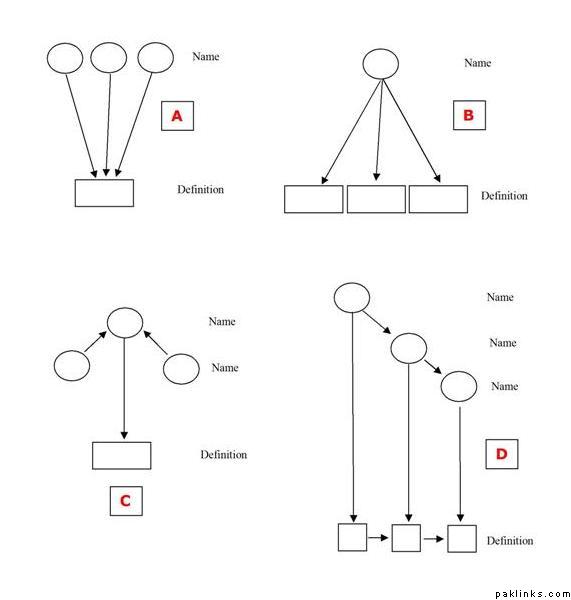
All you need to do is attach a label A, B, C and D with the corresponding term, Homonym, Synonym (New), Synonym (Old), and Paronym.
The lines show the inference, the circles are the names of a “thing” and the rectangles are the “definition” or the “meaning” … the rest should be elementary.