**Please visit **this thread**for discussions on various folk tales **
Mirza-Sahiban
The story came down to us through a 17th century Punjabi poet, Piloo (Peeloo), in an oral or ballad form. Since then many poets and writers have written the story. But because of its unique rustic style, brevity and boldness, Piloo’s version of the story became popular and is widely sung and celebrated in rural Punjab even today.
The story has also been translated into Urdu, both in poetry and prose. Also, a short version in English is included in a book ‘The Legends of the Punjab‘ written by one Captain R. C. Temple in 1884.
In a village called Khewa, near present day Jhang, a woman named Nooran gave birth to a boy. Nooran died while the child was still in infancy. Therefore, the boy was wet-nursed by another woman who had a suckling daughter. Thus, according to the traditions of the time the boy and the girl became siblings. The boy grew up to become the chief of his village and of the Sayyal tribe that inhabited the area, and came to be known as Khewa Khan. His “sibling”, the baby girl, grew up to become Fateh Bibi and was married to a man named Wanjal (or Banjal), of the Kharral tribe, who lived in village Danababad, which is today in Tehsil Jarranwala, district Faisalabad.
Khewa and Danabad were short of a day’s ride from each other on horseback.
Mirza, the hero of our story, was born to Fateh Bibi and Wanjal while Sahiban, the heroine, was the daughter of Khewa Khan. As already explained, since Fateh Bibi and Khew Khan were suckled by the same woman Mirza and Sahiban ended up being “cousins”.
Mirza must have been 8 or 9 when his parents decided to send him to Khewa to live with his “mamoo”, Khewa Khan. It was not unusual those days for parents to send their kids to live with their nanihal (mother’s relatives) or dadihal (father’s relatives) for education or for other reasons.
Khewa Khan enrolled both Mirza and Sahiban at the local mosque, the usual place for basic education those days. A student would start off with alphabet, patti as it was called, and then graduate to reading the Quran, chapter by chapter, and then to other subjects, if any, depending on the interest of the student and his/her parents. The imam of the mosque, commonly called maulvi or qazi, would be the sole teacher.
Like most teachers of his time, the maulvi who taught Mirza and Sahiban was a stickler for pedagogical rules, and the golden rule was “spare the rod and spoil the child”. As a tool of punishment he used what in Punjabi is called a chimmak. It is a thin green twig or branch of a tree shorn of leaves or any thorns. When struck on any part of the body it sends a flaming sensation through the body - and the soul, too, I guess.
Years passed and both Mirza and Sahiban, while graduating from one year to the other, also advanced into adolescence and to adulthood. They discovered that they liked to be in each other’s company.
Actually, Mirza and Sahiban fell madly in love with each other - a love that was honest, blind and reckless. Often in the ‘class’ they would be more absorbed into each other than to paying attention to the maulvi who had to resort to the chimmak to get their attention. According to the story, Sahiban, once when struck by the maulvi for not memorizing her lesson correctly, addresses him thus:
Na maar qazi chimkaaN, na day tatti nooN taa
Parrhna sada reh gaya lay aaye ishq likha
O qazi, don’t beat me with the stick; don’t burn me. I am already burning [with love]. Books are of no use to us, for love is now writ in our destiny.
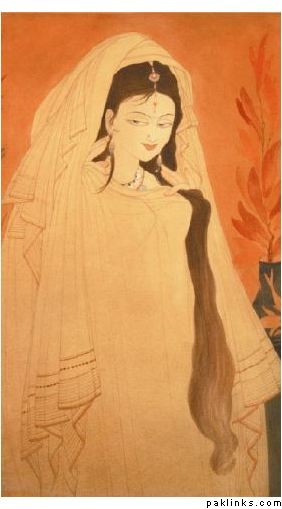
Sahiban had grown into a very beautiful young woman. Piloo, the poet, describes her beauty with the usual poetic exaggeration. He says that when Sahiban went shopping the grocer would be so distracted by her beauty that he would place wrong weights in the tarakrri (weighing scale), and instead of oil that she wanted he would pour honey. At another place the poet says when Sahiban walked past the fields the farmers would stop plowing and would stand transfixed by her beauty.
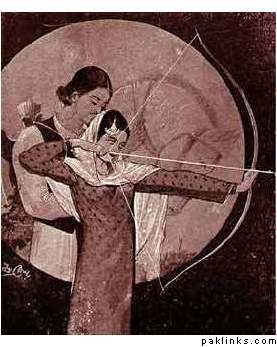
Mirza also grew into a strapping, handsome young man. He had shoulder length hair, was a good horse rider, was known for his bravery and physical courage, and was a deadly shot with his bow and arrow. His marksmanship was legendary. His arrow would never miss its target.
Mirza and Sahiban’s love affair soon became the talk of the town. Sahiban’s father would have none of it and soon packed Mirza off to his home in Danabad. Also, a suitable young man from his own tribe, named Tahir Khan, was found to marry Sahiban and a date was set for the wedding.
Sahiban, when she came to know of her imminent marriage, sent an emissary to Mirza asking him to come and get her before she was bundled off to a new home.
Mirza couldn’t and wouldn’t let this happen. He announced his decision to go to Khewa and get Sahiban. His parents and sister tried to dissuade him from going, saying that the Sayyal women could not be trusted and that he was taking a big risk going to Khewa. His father’s words of advice and warning are quite revealing of the values of the time, some of which persist even today. He says: “To hell with these women. Their brains are in their heels. They fall in love laughing and tell their story to everyone crying. One should not step inside the house of a woman with whom he is in love. Honor, once lost, cannot be purchased back even by spending millions.” However, when the father realized that Mirza would not be dissuaded, he says: “I see you are determined to go. Then don’t come back without Sahiban. It’s a question of our honor. Bring her with you!”
Mirza readies his horse, collects his bow and quiver and sets off to Khewa on the day Sahiban’s wedding is to take place. He reaches Khewa when the wedding party (barat) has just arrived and is being feasted. Sahiban, decked in her bridal dress, her hands and feet died with henna, is tucked away in a room somewhere upstairs. Mirza, knowing the layout of the house from the years he had spent in it, quietly slips inside and asks a woman confidante to alert Sahiban of his arrival. Then he climbs up to her room, brings her down, helps her climb his horse and, with Sahiban clinging to him, gallops away into the night.
It takes a while for Khewa Khan’s household to find out what has happened. Sahiban’s brother, Shamair, accompanied by his other brothers, the bridegroom and others set off on their horses after the runaway couple.
Confident that he had gained sufficient distance and that it would not be easy for his pursuers to catch up with him, Mirza wanted to stop and rest for a while. He was too tired.
Sahiban warns him that her brothers might catch up with them and therefore urges him not to stop. But Mirza boastfully tells her that, first, they won’t be able to catch up with them, and if they did it would take only one arrow to take care of Shamair, and one more to get rid of her betrothed. And that he had sufficient arrows to take care of the whole bunch of Sayyals. So, confident but tired, he lies down under a clump of trees and dozes off while Sahiban keeps a watch.
In the quiet of wilderness Sahiban is assailed with doubts. What if they catch up and kill Mirza? What if Mirza, quick and accurate marksman that he was, kills his brothers? Like a typical Eastern sister, her loyalties seem to be equally divided between her lover and her brother. She doesn’t want either of them to be killed. Somehow she believes, or hopes, that this whole thing could end without bloodshed. So, she quietly takes Mirza’s quiver and hangs it on a branch out of his reach.
Soon there is the drumming sound of hoofs. And in no time the pursuers appear on the scene. Sahiban shakes Mirza out of sleep. Mirza wakes up with a start and reaches for his bow and quiver but doesn’t find the quiver. An arrow from Shamair’s bow pierces Mirza’s throat and he falls to the ground. Another arrow pierces his chest. At that moment Mirza looks accusingly into Sahiban’s eyes and utters those memorable words in the story, somewhat reminiscent of “Et tu, Brute?“
Bura kitoyee Sahiban, mera turkish tangiya jand!
Sahiban, you did a terrible thing by hanging away my quiver!
Sobbing and shaking, Sahiban throws herself over Mirza to cover him from any further hits. Another shower of arrows hits Sahiban. Her body twiches and then lays still.
Thus, both Miraz and Sahiban enter the world of lore and literature.
In Punjabi literature today, just as Ranjha is identified with his flute and Sohni with her unbaked water pitcher (kacha gharra), Mirza has become a metaphor for courage and marksmanship. This is evident in one of Munir Niazi’s poignant poems. When engulfed in a pall of gloom, the poet invokes Ranjha and Mirza in the following lines:
Jattan karo kujh dosto, torro maut da jaal
Pharr murli O Ranjhiya, kadh koi teekhi taan
Maar koi teer O mirziya, khich kay wal asmaan
Do something, friends, lift this pall of despair
O Ranjha, take out your flute and play a different tune
O Mirza, shoot an arrow at the sky to pierce this web of gloom
*----------------------------------------****QUESTION: ***
*What was the Preference of Sahiban (the heroin) supposed to be? Her Brothers or Her Lover (Mirza)? Do You think she took the right Decision?