First phase of economic corridor approved

**Connecting Gwadar to China and in future also to Central Asia & Russia for inbound/outbound logistics …

Another Trade-Transit Corridor will be East West Corridor connecting India with Iran , Afghanistan & Central Asia …**

First phase of Economic Corridor approved

Khaleeq Kiani
Updated about 12 hours ago

[TABLE=“class: media one-whole palm–one-whole, width: 650”]
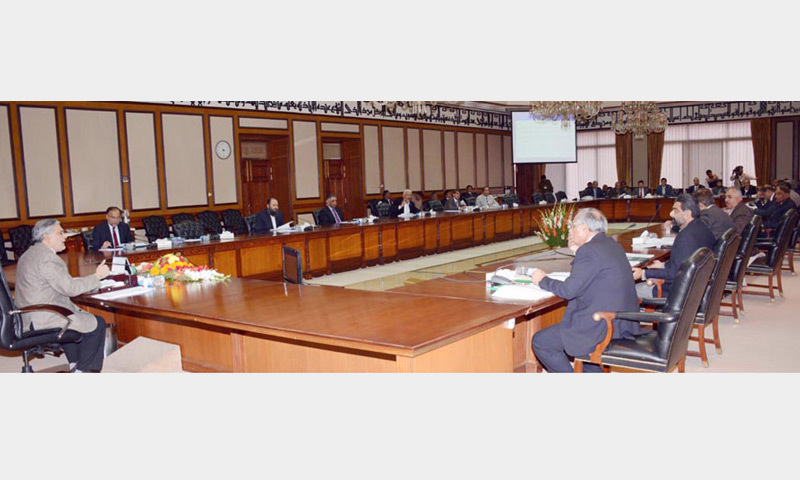
ISLAMABAD: Finance Minister Ishaq Dar chairs the meeting of Ecnec on Thursday.

**ISLAMABAD: The Executive Committee of the National Economic Council (Ecnec) on Thursday approved eight development projects worth Rs157 billion, including two signature projects of the ruling Pakistan Muslim League-N – first phase of Pakistan-China Economic Corridor (PCEC) and another dedicated rapid transit system for Karachi from Saddar to Surjani.
**

Among the other projects okayed included a couple of projects related to power generation.

The meeting, presided over by Finance Minister Ishaq Dar, approved the construction of 120 km road from Havelian to Thakot – first phase of Islamabad to Raikot sector of PCEC project. Prime Minister Nawaz Sharif laid the foundationstone of the project last week. The project cost has been estimated at Rs 95.4bn.

Ecnec also formally approved Green Line Bus Rapid Transit System at a total cost of Rs 16.085 bn. The dedicated track for rapid bus system is to start from **Saddar, Karachi, and culminate at KESC Power House Chowrangi Surjani.
**

The project envisaged construction of 17.80km long two-lane dedicated signal-free bus rapid transit system. Japan International Cooperation Agency (JICA) has conducted a detailed feasibility of the project that suggested the mega scheme to benefit 400,000 passengers per day.

Last week, the CDWP had cleared the project, in principle, with the condition that its estimated cost should be rationalised. The project at that time involved 21km length at a cost of Rs27.6bn, but within a week, the length of road was cut down to 17.8km and its cost reduced to Rs16.085bn. The start and termination points of the project would remain unchanged but its route is reported to have been realigned.

The committee also approved Rs13.87bn for procurement of six maritime patrol vessels for Pakistan Maritime Security Agency.

It also approved a Rs 4.97bn project of the** Ministry of Railways **for special repair of **100 diesel locomotives. **After repairs, the locomotives are anticipated to improve freight and passenger service of Pakistan Railways.

**Energy Projects: **The meeting also approved two power generation projects with the combined capacity of 75MW. The 40MW Dowarian Hydro Power Project and 35MW Nagdar Hydropower project will be located in district Neelum and will be executed and operated by AJK Hydroelectric Board.

The first project has total cost of Rs5.973bn and will be completed in three years. The hydropower project will be connected by laying 45km, 132kv transmission line from Dowarian to 35MW Nagdar hydro-power project. The second energy project has the total cost of Rs6.845bn to be completed in four years.

The Ecnec also approved a Rs10.335bn on the request of Pakistan Audit Department for a project to improve financial reporting and auditing (PIFRA) Phase-II. The project has an estimated cost of Rs10.335bn, including foreign exchange component of Rs8.930bn, coming from the World Bank.

**Livestock Project: **The meeting also approved the Livestock and Access to Markets Project (LAMP) of Punjab. The project will cost Rs3.853bn. It will be sponsored by Livestock and Dairy Development Department, Punjab, and strengthen the beneficiary communities, including vulnerable women, private sector players and live-stock and dairy development department.
*

Published in Dawn, December 5th, 2014*

Re: First phase of economic corridor approved

https://scontent-a-mad.xx.fbcdn.net/hphotos-xap1/v/t1.0-9/10690159_950727561622335_1422436711121748547_n.jpg?oh=8088448670a1cb8173955d72129a22b8&oe=55092CF5

Re: First phase of economic corridor approved

Energy cooperation: Pakistan, Iran to discuss how to push ahead

By Zafar Bhutta
Published: December 5, 2014

http://i1.tribune.com.pk/wp-content/uploads/2014/12/801900-powertransmissionelectricityAPP-1417726657-748-640x480.jpg

Negotiations on the electricity price could take around six months and there are hopes that in the meantime issues will be settled between Tehran and Washington. PHOTO: APP

**

ISLAMABAD: **With hopes high for a settlement of the nuclear dispute between Iran and global powers, Islamabad and Tehran will meet next week to steer the way towards power and gas supply deals stalled since long due to economic sanctions on the Gulf state.

Officials of Pakistan and Iran will meet in Islamabad on December 8 and 9 in a meeting of the Joint Ministerial Commission (JMC), say officials.

Key issues that will come up for discussion include gas and power supply deals and breaking the deadlock with the US over Iran’s nuclear programme to pave the way for implementing the agreements.

http://i1.tribune.com.pk/wp-content/uploads/2014/12/1000MW.jpg

Pakistan has already told Iran that it could not press on with energy trade unless economic curbs are lifted by the US and European Union. It believes that its companies and banks will have to face US and EU penalties if they engage with Iran in any deal.

Last month, Tehran and Washington agreed in Vienna to extend the deadline to March 2015 for a political agreement and reach a final deal by the end of June. This has revived hopes that the Iran-Pakistan gas pipeline project and 1,000-megawatt power import plan could be undertaken.

According to officials, Pakistan has submitted an alternative plan according to which a liquefied natural gas (LNG) pipeline will be laid from Gwadar to Nawabshah and connected with Iran after US sanctions are lifted.

Pakistan has also signed an initial deal for the award of a $3-billion LNG terminal and pipeline contract to China. “This will be discussed with Iranian authorities in the upcoming JMC meeting,” an official said.

Officials pointed out that Pakistan had signed a memorandum of understanding (MoU) with Iran for the import of 1,000MW electricity but progress on the plan stalled in the wake of international restrictions.

Separately, 73MW was being imported from Iran to meet the needs of Gwadar, but payments could not be made since 2011 as no bank was ready to offer its services for clearing the outstanding amount worth millions of dollars.

The government has even failed to pay dues from barter trade also because of the reluctance of banks and shipping companies.

“In the JMC, officials will discuss the progress on the 1,000MW power import plan and suggest ways how to move forward in the face of restrictions,” the official said.

Negotiations on the electricity price could take around six months and there are hopes that in the meantime issues will be settled between Tehran and Washington.

Pakistan is now studying Turkish and Indian models to clear earlier power bills of Iran owed to energy firm Tavanir.

Turkey is making payment against supply of gas by offering precious metals like gold to Iran. India, on the other hand, is paying for the import of petroleum products through a local bank which does not have branches worldwide.
Officials said these models would be discussed with the Iranian authorities in the upcoming meeting.
*

Published in The Express Tribune, December 5[SUP]th[/SUP], 2014.*

Re: First phase of economic corridor approved

This China corridor seems to be the real problem and the agitation by IK shall continue until this and few other infrastructure projects are cancelled.

Re: First phase of economic corridor approved

NOT IK , It is disturbing US , China is spending 40 billion$ on this , already allocated by them

Re: First phase of economic corridor approved

^^

IK being the delivery guy...either he is being fooled or he is doing it on purpose...

Re: First phase of economic corridor approved

Pak-China Economic Corridor a ‘fate changer’ for Pakistan

Soon after taking oath of his office, Prime Minister Nawaz Sharif announced to initiate a great number of projects in a bid to correct the ailing economy of the country. Of the many projects, power seems the most crucial sector, a sector that would strengthen other sectors of the economy. These projects have, enthusiastically, been taken on by the strategic cooperative partnership between Pakistan and China, now being referred to as the Pak-China Economic Corridor.

The name ‘Corridor’ suggests a gateway or a passage that connects the two separate countries, continents or regions. This ‘economic corridor’ will not be the first in history. Rather, as Hedrick points out, the use of sea and land routes have assisted in the globalization process of opening Asia, as early as the 19th century. He argues that the Suez Canal, opened in 1869, acted to aid the empires of great powers during the time. The canal through the Sinai Peninsula made trade and empire faster but also economical. The world’s superpower of the time, Great Britain, made great strategic use of it, by transport of goods, officials and soldiers to Bombay and other key colonial hubs in an easier and affordable manner. Similarly, Pakistan and China’s economic corridor sets out to achieve the same goals in a cooperative and democratic manner.

The China-Pakistan Economic Corridor is an under-construction development program to connect Gwadar Port in southern Pakistan to China’s northwestern autonomous region of Xinjiang via highways, railways and pipelines to transport oil and gas.

Chinese Premier Li Keqiang was among the first advocates of the project; since then Chinese President Xi Jinping, former Pakistani President Asif Ali Zardari and Prime Minister Nawaz Sharif have become strong supporters of the project. When the corridor is constructed it will serve as a primary gateway for trade between China and the Middle East and Africa. In particular oil from the Middle East could be offloaded at Gwadar, which is located just outside the mouth of the Persian Gulf, and transported to China through the Balochistan province in Pakistan. **Such a link would vastly cut the 12,000-kilometre route that Mideast oil supplies must now take to reach Chinese ports.
**

The project received a major boost when control of Gawadar was transferred to China’s state-owned China Overseas Ports Holding in February 2013. Built by Chinese workers and opened in 2007, Gwadar is undergoing a major expansion to turn it into a full-fledged deep-water commercial port. Pakistan and China have signed agreements for constructing an international airport at Gwadar, upgrading a section of the 1,300-Kilometre Karakorum Highway connecting to Islamabad and laying a fibre-optic cable from the Chinese border to the Pakistani city of Rawalpindi. With the development of the corridor Central Asia, traditionally an economically closed region owing to its geography and lack of infrastructure, will have greater access to the sea and to the global trade network. The Pak-China Economic Corridor Secretariat was inaugurated in Islamabad on August 27, 2013.

On November 2014, Chinese government announced that it will finance Chinese companies to build $45.6 billion worth of energy and infrastructure projects in Pakistan as part of CPEC. Documents show that China has promised to invest around $33.8 billion in various energy projects and $11.8 billion in infrastructure projects which will be completed by 2017 at most. The deal includes $622 million for Gwadar port. Under the CPEC agreement, $15.5 billion worth of coal, wind, solar and hydro energy projects will add 10,400 megawatts of energy to the national grid of Pakistan.

Physically, the corridor is a 2,700-Kilometre highway that stretches from Kashghar to Gwadar through Khunjrab. But in essence, these road and rail links will further strengthen the bond of brotherhood, as highlighted by the two governments. China Pakistan Economic Corridor from Kashgar to Gwadar will integrate the economies of the two friendly countries. The project is establishing several economic zones and physical links connecting Pakistan and China. Both the countries believe that this economic corridor will benefit new emerging regional cooperation in South Asia. This project is set out to transform the future of the region, driven by economy and energy, and the building of pipelines and ports with roads rail infrastructure.

Pakistan serves as an important ally for China in the South Asian Region. Pakistan’s geographical location puts it on the main route connecting China and the Middle East and China and Central Asia. For economic and strategic connectivity with these regions, China requires safe passage through Pakistan especially after China’s growing share in world trade. In addition, China wishes to secure its position through Pakistan in South Asia to balance India’s emergence as it can potentially jeopardize the Chinese ambitions of leading Asia.

**Chairman of the Pakistan-China Institute, Senator Mushahid Hussain Sayed believes that the economic corridor “will play a crucial role in regional integration of the ‘Greater South Asia’, which includes China, Iran, Afghanistan, and stretches all the way to Myanmar.” A strong Pakistan is valuable as it warrants that Indian claim of regional hegemony will not go unchallenged. He opined that the Pakistan-China Economic Corridor is of immense importance for the revival of Pakistan’s economy, resolution of energy crisis and strengthening the Federation through development and infrastructure.
**

The emergence of the Asian Infrastructure Investment Bank, with an outlay of $ 100 billion, would be an Asian alternative to the Western financial system, he added.

He said relations with China were a factor of national unity in Pakistan since all political parties and provinces supported it, while Pakistan has always backed China in its ‘core interests’ including China’s unity and territorial integrity, leading role of the Communist Party in China, China’s peaceful rise and issues like Taiwan, Tibet and terrorism in Xinjiang, and strongly opposes any policy of ‘containment of China’ as Asia cannot afford a New Cold War.

According to Director General, Planning Commission, Syed Mujtaba Hussain, Pakistan-China Economic Corridor is strategically important for both China and Pakistan keeping in view the growing regional trade and investment collaboration. It is a win-win opportunity for Pakistan and China and the agreements of early harvest projects during Prime Minister Nawaz Sharif visit to China have great significance. These projects would be completed within a span of two to three years time and these include rail, road network besides several long and short term energy projects.

Pakistan is the first South Asian country to sign a free trade agreement and currency swap agreement with China and is also the largest destination of Chinese investment in South Asia. China is Pakistan’s second largest trading partner and fourth largest export market. China-Pakistan Economic Corridor has the potential to turn Pakistan into a hub of regional cooperation. If Pakistan uses this opportunity wisely and is able to reap the economic benefits this corridor has to offer, it can greatly enhance its regional power and prestige and prove a more valuable long-term ally for Beijing.

Re: First phase of economic corridor approved

**Concerns of KPK & Balochistan over changing route of CPEC

**

Re: First phase of economic corridor approved

I think, these projects were initiated by President Musharraf. I really like the continuation of previous government project policy by PMLN… :k:

Re: First phase of economic corridor approved

India today objected and warned China on the issue