**So what if the Indians are boasting of women empowerment through the cheerleaders at IPL, we have our own reasons to brag and that too very significant. The arrival of eight, motorbike-riding women wardens, smartly dressed in grey-blue uniforms in Lahore, is like a milestone in the history of the Pakistan"s traffic police.
**
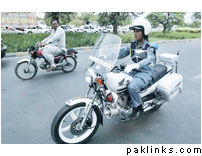
Riding their 250cc motorcycles these wardens patrol key areas such as The Mall, Jail Road, Gulberg Main Boulevard and Defence, regulate traffic, help out commuters and yes issue “tickets”.
This change has not been brought overnight. It has taken years to change the system. It all began with the Motorway Police that took the first step in ensuring a traffic discipline like never before. Then, last year came the special force of traffic wardens.
“The main focus of the women wardens will be on extending emergency help to commuters. We want the women wardens to be supportive, not to create nuisance for the public,” Chief Traffic Officer SSP Ghulam Mehmood Dogar told TNS.
He says these women have got special elite training along with the male wardens at Sihala. The specialised ladies squad and Honda Company from Japan have extended their help in training the wardens about safety travelling features. Other than that, these female wardens have been imparted coaching through ticketing and traffic course for challan.
There is optimism that the presence of women wardens may help improve public behaviour towards the police and introduce greater courtesy on the roads.
But how do these wardens take this optimism? Are they happy with the public behaviour?
Saima, a traffic warden, tells TNS, “people get very excited when they see us on road. Especially women always have a welcoming response. We too enjoy this.”
“While patrolling I feel confident. There is some sort of an adventure. I feel on top of this world,” says Asifa, a 20 year old girl from the suburbs of Lahore.
When asked about the harassment they may have to face" at work, Saima categorically says, “I don"t think that there is any such thing as “harassment” and even if it is, it only exists in the media.”
Asifa has a different approach altogether. She says, “If people stare at girls, it is something that is prevalent in our society. This is not something exclusive to the female wardens. I see so many girls passing by who are subject to such discrimination but we are thankful to God and our families who have always supported us.”
For the masses the introduction of the wardens was refreshing. At least it got them rid of the traffic sergeants or the chillar in local vernacular. Where the male wardens made many heads turn, is it now the turn of their female counterparts.
Sadiq Hussain, a commuter, tells TNS, “I have stayed in the UK for a long time but this patrolling female wardens has been somewhat very refreshing and I do believe it will also improve people"s attitude towards the opposite sex.”
Sunaina opines, “The male wardens are nice. These young boys talk decently and never have a threatening behaviour. And above all these wardens are very cute.”
That"s one side of the story. There are many in our society who like teasing these new patrolling officers such as Zubair who very candidly says, “Last week I purposely broke my motorbike"s light so that the female warden comes up and talks to me. Yes it will cost Rs 100-150 but what the heck!” (he laughs).
With the new government taking charge in Punjab there have been speculations that this traffic system might be revoked. However, SSP Ghulam Mehmood Dogar rejects the rumours saying that there has been a very positive feedback on this system. "In fact very soon the Sindh government would adopt this traffic structure