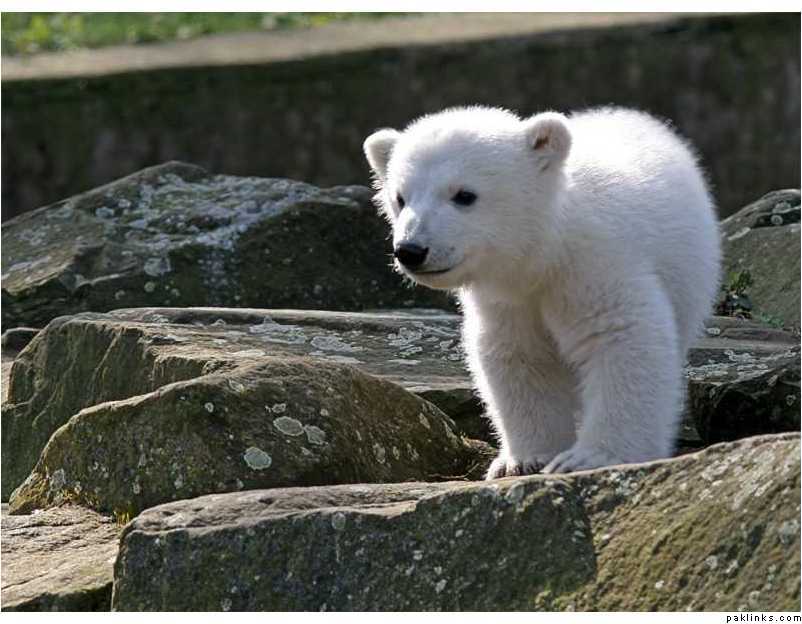
Knut, a young polar bear at the Berlin Zoo, has been referred to in news media as “cute”.[1]Cuteness is a kind of attractive beauty commonly associated with youth, innocence and helplessness, as well as a scientific concept and analytical model in Ethology, first introduced by Konrad Lorenz. This is usually characterized by (though not limited to) some combination of infant-like physical traits, especially small body size with a disproportionately big head, large eyes, a small nose, dimples, and round and softer body features. Infantile personality traits, such as playfulness, fragility, helplessness, curiosity, innocence, affectionate behavior and a need to be nurtured are also generally considered cute. Psychology of cutenessKonrad Lorenz argued in 1949 that infantile features triggered nurturing responses in adults. Lorenz argued that this was an evolutionary adaptation, which helped ensure that adults cared for their children, ultimately securing the survival of the species. As evidence for this theory, Lorenz noted that humans react more positively to animals that resemble infants—with big eyes, big heads, shortened noses, etc.—than to animals that do not.
Another way to phrase Lorenz’s point is to say that humans prefer animals which exhibit pedomorphosis. Pedomorphosis is the retention of child-like characteristics—such as big heads or large eyes—into adulthood. Thus, pedomorphosis and cuteness may explain the popularity of Giant Pandas and Koalas. The widely perceived cuteness of domesticated animals, such as dogs and cats, may be due to the fact that humans selectively breed their pets for infant-like characteristics, including non-aggressive behavior and child-like appearance.
Some later scientific studies have provided further evidence for Lorenz’s theory. For example, it has been shown that human adults react positively to infants who are stereotypically cute. Studies have also shown that responses to cuteness—and to facial attractiveness generally—seem to be similar across and within cultures.[2]
Additionally, the phenomenon is not restricted to humans. The young of many mammal and bird species share are a similar set of typical physical proportions, beyond absolute body size, that distinguish them from adults of their own species.
