China Confirms Pakistan Nuclear Projects

Latest Project is K-2 and K-3 for Karachi …**

China Confirms Pakistan Nuclear Projects**

Top official confirms extent of the growing Sino-Pakistan nuclear link.

By Prashanth Parameswaran
February 10, 2015

1.2k
1

A Chinese official publicly confirmed Monday that Beijing is involved in at least six nuclear power projects in Pakistan and is likely to export more to the country, media reports said.

In a press conference in Beijing, Wang Xiaotao, the vice-minister of the National Development and Reform Commission, said China “has assisted in building six nuclear reactors in Pakistan with a total installed capacity of 3.4 million kilowatts.”

Wang, who was unveiling plans for new guidelines for Chinese exports in the nuclear sector, also said that Beijing was keen to provide further exports to countries, which would presumably include Pakistan given previous reports and trends.

The Sino-Pakistan nuclear link has been well-known even though some specifics are often shrouded in secrecy. This is reportedly the first time that a top official has publicly admitted to such a scale of China’s cooperation with Pakistan.

Revelations about the growing Sino-Pakistan nuclear axis comes amid continuing concerns expressed by some that ongoing cooperation is occurring without the sanction of the Nuclear Suppliers Group (NSG) which helps supervise the export of global civilian nuclear technology. China is a member of the NSG and existing regulations prohibit members from exporting such technology nations like Pakistan which do not adopt full-scale safeguards.

China declared the first two reactors it already agreed to construct for Pakistan – the Chashma-1 and Chashma 2 – at the time it joined the Nuclear Suppliers Group in 2004, with the expectation that no new deals would follow. But in 2010, the China National Nuclear Cooperation announced it would export technology for two new reactors, Chashma-3 and Chashma-4 because it argued – rather controversially – that these projects were already grandfathered in under previous agreements rather than being fresh proposals.

News of other deals has since followed, including a November 2013 announcement that China would help build **two reactors in Karachi **and a January 2014 report about talks on three other reactors, which *The Diplomat *reported on here.

Pakistani officials say this is part of broader plans to produce around **8,800 megawatts **of electricity from nuclear power by 2030 and overcome crippling power shortages that plague the nation.

Pakistan has also previously sought to secure an exception within the NSG which would allow it to conduct nuclear commerce freely with suppliers. India had received one with U.S. support in 2008 and New Delhi is now seeking membership in the NSG. Both India and Pakistan are not members of the Nuclear Non-Proliferation Treaty

http://thediplomat.com/2015/02/china-confirms-pakistan-nuclear-projects/
Re: China Confirms Pakistan Nuclear Projects

PAEC explains why it opted for Chinese reactor

Saher Baloch Published 3 days ago

[TABLE=“class: media media–stretch one-whole palm–one-whole, width: 694”]

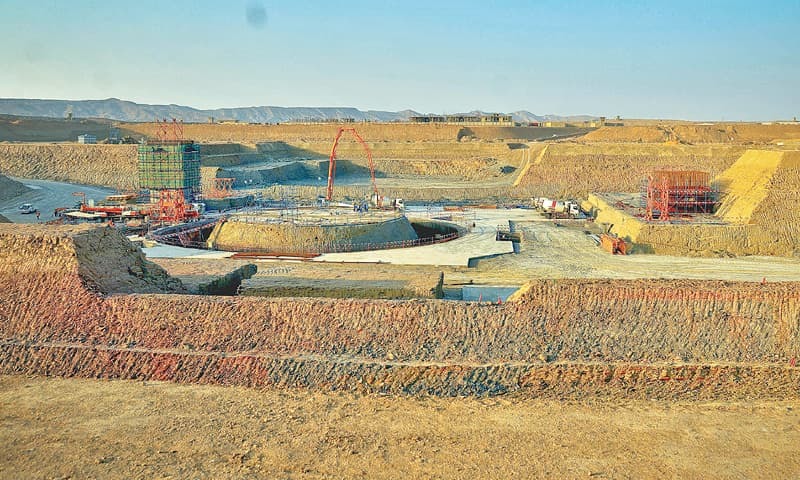
A nuclear reactor and other facilities for the K-2 and K-3 project are being built near Paradise Point on Monday.—Fahim Siddiqi / White Star

KARACHI: While opting for a nuclear reactor for energy generation project K-2 and K3, Pakistan chose to go for an improved version provided by China, as it is most reliable, rather than going for one that may not work in the future, said the Pakistan Atomic Energy Commission (PAEC) on Monday.

China is the only country physically helping Pakistan in building the reactor while international organisations are helping us in following safety guidelines, said PAEC representatives before a visit to the site of the Karachi Nuclear Power Plants (Kanupp) unit 1 (K1) and unit 2 (K2).
Presentations on the nuclear reactors site were given at a meeting of PAEC representatives before the visit.

Speaking about what they termed misconceptions related to the project, the PAEC representatives headed by Kanupp director-general Mohammad Tahir Ahmad said they weighed some options before starting the project. Explaining, he said: “We had two options, either to go for an innovative version of the reactor or an improved one. We opted for the latter because it is reliable and unlike developed countries such as the United States, we can’t afford to have a design that may not work in the future.”

[HR][/HR]**
‘Kanupp was a gift from Canada to Pakistan in the 1970s and was also never experimented before.’**

[HR][/HR]

Mr Ahmad also said there was a problem with alternative energy sources such as solar and wind. “Solar and wind projects can work as an added source for creating energy but both lack sustainability. An entire project can’t be based on it, though it can be considered as a second option. We are not averse to the idea. However, generating power through nuclear energy is the most dependable option for the need of a city as big as Karachi,” he added.

According to the activists, who have been raising concerns over the project, the reactors for K-2 and K-3 will be designed and built by the China National Nuclear Corporation. Their main concern revolves around the point that the design of the reactor has not been experimented anywhere before, not even in China, and that Pakistan will be a ground for experimentation.

When the question was raised at the meeting, general manager of the K-2, K-3 project at the PAEC Azfar Minhaj said that Kanupp was also never tried before. “Kanupp was a gift from Canada to Pakistan in the 1970s and was also never experimented before. But it’s been 40 years and it worked well while it lasted. Similar concerns are also raised for this project, but time will tell how well it works,” he added.

Mr Minhaj argued that the K-2, K-3 project was first initiated in 2006 and “interestingly, for the past six years, nobody raised a concern or a doubt”.

About safety concerns, he said that chances of an accident at the K-2, K-3 site are “almost one to nothing”. Currently there were 71 under-construction nuclear power plants worldwide, “so the perception that the world has shunned the practice is incorrect”, he added.

Mr Minhaj said the “indigenous Chinese model reactor passed the Generic Reactor Safety Review of the International Atomic Energy Agency as a third-generation plant after one-year evaluation”.
Asked if it would have been easier to hold a public hearing earlier than providing too many clarifications at present, the project general manager said: “We’ll hold a public hearing as per the ruling of the Sindh High Court soon after the 90-day period given by the court is over, sometime in March.”

The PAEC representatives maintained that some of the project information related to the strategic position of Pakistan and thus could not be divulged. Otherwise, they remained open to questions related to the site and safety concerns. According to their conservative estimate, they said, in case of an emergency at Kanupp, the population residing within the “five kilometre radius of the site will be evacuated and rehabilitated by us. We already have standard operating procedure for that.

The area surrounding Kanupp includes 15 goths with a population of around 93,000,” they added.
Meanwhile, work was under way at the K-2, K-3 project site near Paradise Point.
*

Published in Dawn, February 10th, 2015*

Re: China Confirms Pakistan Nuclear Projects

Who is supplying the centrifuges? I hope not Siemens.

Re: China Confirms Pakistan Nuclear Projects

What other choice does PAEC have? IRAN !??

Re: China Confirms Pakistan Nuclear Projects

Amreeka ki G... mein bohat takleef ho rahi hey... I summon Centcom right now :)