The competitors begin to arrive in the blazing heat of late afternoon. Each one is a heavyweight, and some tip the scales at over a ton. They are here to fight, and though none of them will die in the dust of the arena today, defeat may mean a quick end for the loser soon afterwards.
Spectators start to gather at the bull fighting grounds in Fujairah, in the United Arab Emirates, from about 4.30pm. By 5pm there’s usually a good crowd, made up mostly of families. They make themselves comfortable on mats on the ground, or stay in their cars, which they have parked for a good view of the proceedings. The vehicles are a safer option, should any of the competitors decide to make a break for it!
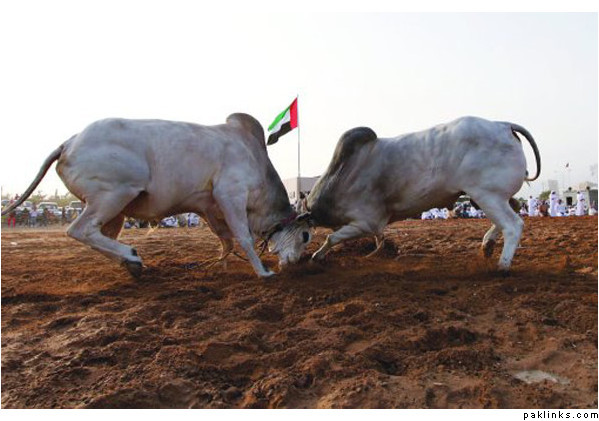
The air is charged as the first bulls are led out by their owners, who tug on ropes attached to the enormous animals’ noses. Announcements are blared through a megaphone in Arabic, and the combatants are herded toward the center of the arena.
The Brahman bulls – with their humped backs, curved horns and massive bulk – are magnificent beasts. Yet despite their fearsome appearance, they are generally placid animals. Not that you’d know it from the way they scrape the ground with their hooves, eager to charge at their opponents!
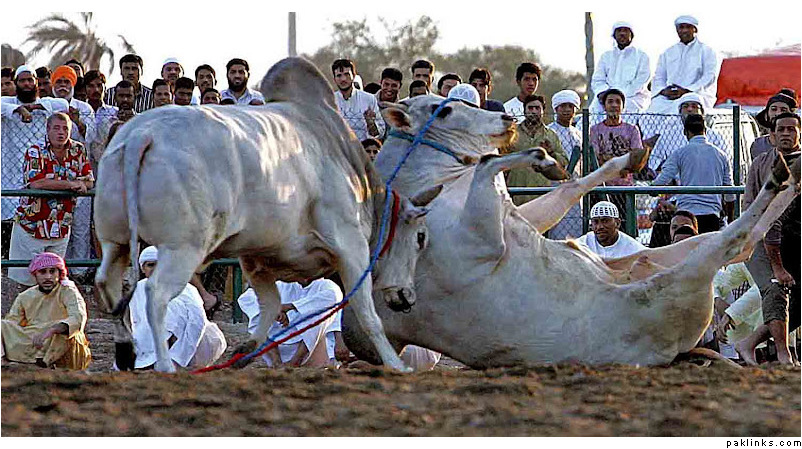
The crowd roars as the bulls are released and come together in a clash of horns. Dirt and dust flies up as they push and strain against each other. The animal that can thrust its rival farthest from the center will be declared the winner – making it almost like a bovine version of Sumo wrestling. The entire contest is over in minutes.
As the tussle continues to the sound of snorts and colliding horns, brave men armed only with thin canes stay close to the battle, making sure the raging beasts keep a safe distance from the audience – and that the bulls are riled enough to clash.
If a rampaging bull manages to make a run on the spectators, the only thing left for an audience to do is flee for their cars. Until recently, the lack of fences around the arena added an extra thrill to these occasions!
The only thing worse than an overly aggressive entrant is an overly passive one. Some bulls seem to think that he who fights and runs away may live to fight another day. Sadly, given the humiliation suffered by the owner of a cowardly bull, the poor animal is more likely to end up sold or even slaughtered than be entered in another tournament.
When one bull cannot be said to have definitely overpowered the other (as often happens), the match ends in a draw. The final decision on the winner is made by a judge; he has the final word. But there’s no cash prize or medals on offer; the honor of owning the winning animal is the only prize at these events.
Owning a fighting bull is a big investment. A good animal can cost from around 24,000 Emirati Dirhams ($6,500) to 50,000 Dh ($13,600) to buy and up to 5,000 Dh ($1,360) a month to look after. A lot of that money goes into the bull’s diet, which can include milk, spiced clarified butter, mountain honey and dried fish as well as the more mundane dried grasses. A potential prizefighter needs to reach his optimum weight and fitness, after all.
Not many people would be willing to part with so much money for a pastime unless they were getting something in return, and fighting bull owners are no different. Although no prize is offered at the fights, owners stand to gain large sums if they sell their winning bulls – not to mention the prestige of owning a prizefighter!
On the flipside, a bull that decides it would rather not fight in the arena lowers its value considerably. Not only does the owner lose face, but also a good deal of cash, as a bull can be worth anything up to 80% less after a loss.
Bullfighting in the UAE has a long tradition, believed to date back to the Portuguese settlers of the seventeenth and eighteenth centuries. A founding member of the bullfighting committee here, Abdulla Ali Kindi, says the tradition is especially prevalent along the coast. “We don’t have camels here,” he says. “Camels are in the desert. The one thing here is the bull.”
These days the younger generation are being drawn to the pastime, not only because of the excitement of the ring, but also thanks to its links with local culture and heritage. It also serves as a social gathering, both for the elders who have been involved in bullfights for decades and for the more recent enthusiasts – some of whom are as young as 12!
Like all sports involving animals, the bullfights in Fujairah have their detractors. However, as the bulls are not killed in the ring and no blood is spilled, Fujairah bullfighting has not experienced the widespread criticism that the gorier Spanish and Portuguese versions involving armed humans have.
The tournaments themselves must follow strict rules. No bulls are allowed to fight any other bull that is not of equal pedigree, breed or weight. Also, there is no gouging with horns allowed, and bulls are separated if one of them becomes too aggravated.
Restored attachments:


