Re: Brahuis of Kalat and Shah Hussain Hotaki
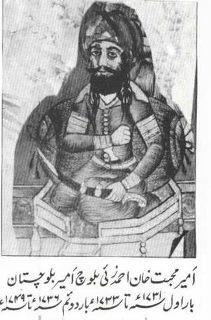
**Mir Noori Naseer Khan Ahmedzai Baloch (1749–1794)
Khan of Kalat Mir Naseer Khan Baloch (1749–1794) was the ruler of the Balochistan during the eighteenth century. He was also known as Noori Naseer Khan the Great. He utilized his nine years of imposed ‘captivity’ under Nadir Shah in studying the history of nations their rise and falls their concepts and ideologies;and the role of religion in the shaping of individuals and states. Nadir Shah observed, “This Baloch Prince is destined to become a great king in the future.”
He was the first ruler of the region who brought about healthy friendly relations with nations, and knit the tribal organization of the Baloch into one Baloch entity. He established a Baloch parliament to function on a workable constitution based on Islamic Sharia (Laws) and Baloch traditions. People came to append the word Wali, meaning ‘a saint’, to his name. Mosques were constructed all over the State, and arrangements were made on Government level to collect Zakat (pool tax incumbent upon all Financially sound Muslims); and laws militating against Islamic concepts were repealed. Through a special decree he made Purdah(veil) compulsory for all Muslim women irrespective of their age. ‘Turan’ -the original name of the land-was changed to ‘Baluchistan’.
The Caliph in Turkey conferred upon him the distinguished titles of Ghazi-e-Deen (Hero of Islam) and Naseer-e-Millat-e-Mohammadiya (the supporter of the followers of Mohammad).
Victory Against Persians in 1751 and 1770
Consequently, Mir Naseer Khan and the Army of Baloch participated with Ahmed Shah Abdali in several expeditions and in some expeditions Naseer Khan was himself in command of the joint forces. His bold and victorious steering of the Battle of Nishapur and Mashhad against the Persians in particular with his 3,000 Baloch forces in 1751 and 1770,so greatly impressed the Afghan King that the latter gave him the title of Brather-e`-Wafadar(the faithful brother),
Defeat of Ahmed Shah Abdali and Treaty of Kalat in 1758
Mir Noori Naseer Khan was in an Alliance with Ahmed Shah Durrani from 1749 to 1757 but he declared himself independent and broke the alliance with Afghans in 1758 as Ahmed Shah started interfering in the internal affairs of Balochistan Ahmed Shah Abdali tried every means of reconciliation to induce him to return to his alliance and agree to pay his usual tribute but Mir Naseer Khan treated the advance of Ahmed Shah with contempt and sent to him in reply a register of the Baloch army which exhibited an aggregate of two hundred thousand armed men ready to take up arms against him and Naseer Khan Baloch also told Ahmed Shah that don’t interfere in my internal affairs for the next time. left with no alternative Ahmed Shah had to dispatch an army against Naseer Khan Baloch under the command of his prime minister Shah Wali Khan Mir Naseer Khan was not frightened at the approach of the Afghan army he levied his troops and as soon as he was informed of the arrival of shah wali khan he issued forth from Mastung to meet him the battle was fought near Pedangabad Mastung, the troops of Shah Wali were defeated by Noori Naseer Khan and forced to retire to a distance of thirty miles from the field of action. hearing the news of defeat Ahmed Shah Durrani came with a huge army of Afghan and non Afghan tribes and defeated Noori Naseer Khan in Mastung District Naseer Khan retreated in all haste to his stronger position in Kalat where Mir Noori Naseer Khan Baloch Defeated Ahmed Shah Abdali after which the treaty of Kalat was signed between both countries.all those historians who researched on Balochistan, majority of them accepted these reasons and events and as well as the treaty of Kalat in 1758 A.D. like, Mason, Hennery Pottinger, Ganda Singh, Elphinston e and Akhund Mohammad Siddique.The main points of the treaty were following:-
-
Khan - e- Baloch, Mir Naseer Khan Baloch will not pay any tribute to Shah-e-Afghan in the future
-
Khan -e-Baloch will not supply San (Military assistance) to Ahmed Shah Durrani. But provided he is at war against external enemies, the Khan will supply a military contingent as a token of help, on the condition that the Afghan King provide annually Rs. 100,000 and military weapons and provide for the expenditure of the army as rewards
-
Khan -e- Baloch will not provide any help or asylum to rebel princes of the Sadozai or Afghan Chiefs. On the other hand, the Afghan King also will not give any help or refuge to prince of the Royal family of Kalat -e- Ahmedzai
-
Shah-e-Afghan in future will never interfere in the internal affairs, disputes and matters of Balochistan
-
all those areas of Khan -e- Baloch, which are in the possession of Shah-e-Afghan will be handed over today to Khan -e-Baloch
Third Battle of Panipat in 1761
Similarly, it was Mir Naseer Khan again who, with his army of 25,000 Baloch, came to the help of Ahmed Shah Abdali at the famous Battle of Panipat (1761). It was this combination of outstanding military valor and fighting skill which crushed once and for all the rising Maratha menace in Northern India.
Victory Against the Sikhs in 1765
The Sikhs had formed themselves into a force to be reckoned with as early as 1710,when they made their first incursions into the Upper Doab under Banda-a nondescript follower of Guru Govind Singh. They had sacked Sharanpur, Ambehtan and Nanavath in the Upper Doab; but moved no further till after the Third Battle of Panipat in 1761, when they once again resumed their infiltrations deeper into the region, finally capturing Lahore in 1764, where they established their short-lived Khalsa State extending from Jhelum to the banks of Jamuna.
It was then that they rose against the Muslims, whose condition was getting progressively weaker due to the onset of the general decline of the Moghul Empire. Sensing danger to the cause of Islam, Ahmed Shah Durrani call for Jehad(religious war) against the Sikh and also sent a massage to Mir Naseer Khan to join him Khan-e-Baloch Mir Naseer Khan, responded readily to it, the latter’s contribution being a contingent of twelve thousand Baloch warriors headed by himself in the front.
Thus it was that a combined Muslim Army of 12,000 Baloch with Afghans who marched into India to meet their common foe in 1765. As always, Naseer Khan was in the forefront but in this particular engagement, he was more enthusiastic and reckless than ever, for if he fell on the battlefield, it would mean Shahadat(martyrdom)-a Divine distinction which every true Muslim must live for.
And so it happened that while Mir Naseer Khan was piercing his way on his horse through the Sikh ranks in a furious outburst near Lahore, he fell off his steed; and as he fell to the ground, the turban he was wearing got loose. As a result, his long hair popped out from beneath his head-wear. One of the Sikh combatants noticing the fall rushed out at him with the sword to secure what could have been his ‘prize-kill’. But as fate would have it, another Sikh hastily halted his comrade’s blow in the nick of time, saying that the man(i e Naseer Khan) was a Khalsa(Sikh)!
The Sikh had naturally mistaken the turban-less Nasir Khan for a Sikh! For, his long hair and unmistakably communal resemblance.
However, by the time the Sikhs became aware of their self-deception, Naseer Khan was once again on his feet and the other Baloch Swordsmen, too, charged and drove back the Sikhs, who eventually suffered a crushing defeat and retreated in haste after which Ahmed Shah encamped in the fort of Rohtas here Ahmed Shah Durrani Thanked Naseer Khan Baloch for his valuable help,granted him the Territory of Quetta and also offered him the territories of Derajat, Multan and Jhang which he declined to except.
On returning to his camp after the encounter, Mir Naseer Khan immediately sent for a barber and got his long hair and beard cropped short in strict accordance with requirements of Sharia(Islamic code of conduct).
For a long time after this, he regretted to have missed the enviable attainment of martyrdom in the cause of Islam on account his resemblance to a kafir(infidel) just because of his misleading long hair and flowing beard.
Military Organization under Naseer Khan Baloch
I must here assert that the Baloch are inherently a militant group of tribes. This statement is further substantiated (not that the fact needs any confirmation) by Firdausi in his famous Shahnama in these words:
Thus, we see the Baloch depicted as: “People with a warlike spirit, wearing exalted plumes,like the cock’s comb, on their turbans. ”
Baluch Society, since ancient times has been military oriented. The annals of Baloch history bear testimony to the fact that even it’s women-folk and children were remarkably skilled in marksmanship and horse-riding. In fact,every male in the tribe who wore a shalwar was a perfect soldier. The Baloch, therefore never needed to maintain a ‘regular army’ as understood in the modern sense of the word. Martial spirit and pursuits were an integral part of their lives. As such, one can almost say that every Baloch home was an epitome of an army by itself. Thus, though there was no ‘recruited’ army, every young and able-bodied man in the tribes held himself in readiness for action whenever his Sardar made the call.
However, with the passage of time and evolution of tribal Chieftaincy through the ages, the concept of war-craft underwent a steady transformation, till eventually it assumed the form of a collective fighting force compromising of baggage-men, footmen, infantrymen, cavalrymen and other essential personnel.
Mir Naseer Khan, himself an accomplished fighter and commander-who had tackled Indian insurgent elements like the Marhattas and Sikhs, and had watched the warfare techniques of The Persian King Nadir Shah and realized the necessity of maintaining a well-organized army for his Kingdom. Accordingly, he chose and stationed a permanent army unit, called Dast-e-Darbar(Palace Regiment) in his capital, numbering twelve hundred men. In emergencies, three additional Divisions used to be raised from among the tribes. These reinforcement units were called Dasta-e-Khas(Special Division); Dasta-e-Doem(Second Division) or the 'Sarawan Lashkar'; and Dasta-e-Soem(Third Division) or the ‘Jhalawan Lashkar’. The Khan-e`-Baluch, Mir Nasir Khan, was the Supreme Commander of this whole body of the State Army.
With each Dasta or Division went a long retinue of Loris(artisans), poets, Hakeems(physicians), and surgeons accompanied by adequate personnel and non combatants to man supplies, transport and communications. The Loris formed,as it were, a ‘mobile workshop’ during war time, repairing damaged arms,spears,swords,saddles,horseshoes,tents and other military wares at the base camps not far off from the scene of action. Their services were thus indispensable to the fighting units.
The Raizwars or poets and ballad-singers, too, played an important role during military engagements,inspiring the warriors and maintaining their morale with their moving verses and melodious eulogies of the warriors’ bravery on the battlefield. These poets and bards were,in fact the chroniclers, of dates and events past as well as contemporary history, who preserved the age-long traditions of the Baluches and their fearless performances of valor and chivalry, both on and off the field.
The Hakeems or physicians and surgeons came from the venerable class of Muslims, known as Saadats. Well-versed in religion as well as in medicine and surgery, they played a dual role,treating the wounded and the sick, and leading the congregational prayers and preaching the temporal and spiritual values of Jehad(religious war). Belonging to the genealogical lineage of the Holy Prophet, they commanded a high place and reverence in the esteem of all.
The Dehwars,Jamotes,Jats, and Hindus were in charge of supplies and transport and other executive works of the war machinery. The Hindus dealt mainly with supply of rations to the units.
Thus, the entire tribal community contributed its might in an apportioned manner during military engagements, with each single Baloch actively involved in his respective operation on the field and at the base.
A word about the army formations and their mode of deployment will not be amiss here. I have already mentioned that the State Army compromised of three main Divisions,namely Dasta-e-Khas(the Special Division), Dasta-e-Doem(the Sarawan Division), and Dasta-e`-Soem(the Jhalawan Division).
Army of Mir Noori Naseer Khan Baloch
-
Zagar Mengal 1000
-
Lasi 1000
-
Kharani 1000
-
Sanjrani 1000
-
Marri 1000
-
Bugti 1000
-
Derajati 1000
-
Makrani 1000
-
Mirwani 1000
10.Qambrani 1000
-
Altzai 50
-
Gurnari 100
-
Qalandrani 100
-
Sumalani 1000
-
Pandrani 100
-
Dehwar 60
-
Dehwar of Mastung 60
-
Jamali 200
-
Raisani 300
-
Shahwani 800
-
Bangulzai 700
-
Kurd 500
-
Mohammad Shahi 300
-
Sarparah 300
-
Lehri 700
-
Rind 1000
-
Langova 700
-
Pirkani 150
-
Dehwar of Kalat 50
-
Various Tribes from Kachi 300
-
Tribes from Khangarh 500
-
Tribes from Nasirabad 500
-
Zehri 1000
-
Mohammad Hasani 800
-
Bizenjo 300
-
Mengal 1000
-
Magsi 800
-
Sasoli 300
-
Khadrani 100
-
Nichari 100
-
Jattak 100
-
Bajoi 100
-
Sajidi 100
-
Mohammad Shahi 300
-
Satakzai 40
-
Lashari 100
-
Gichki 100
-
Rodeni 200
Military Intelligence
Obtaining of intelligence has always been the most important and integral aspect of warfare since time immemorial. Termed as Chari in the Baluchi Language, this unit or -Dasta-, functioned as the Intelligence Corps of the Khan-e`-Azam’s Armed Forces, it’s a primary purpose gathering information of military value. This unit of picked intelligence men was charged with the mission of supplying information upon which the plan of action would be chalked out
Weapons
Baloch traditional weapons of war numbered six, as per lullaby which Baloch mothers even today sing emotionally to the babies at their breasts or in the cradle. This is how a mother wishes to see her son in his manhood:
“May Alam Din(the son) grow into a white-clothed youth and bind on his person the six weapons: shield,gun and dagger,and carry his own quiver full of arrows and the Shirazi Sword of the Rinds. May he ride a swift mare.”
Thus a Baloch mother not only suckles her son with her divine lacteal fluid, but also at the same time instills a martial spirit in her infant through her maternal secretions, longing to see him grow into a fearless youth.
However during the times of Mir Noori Naeer Khan, Baloch Military hardware consisted mostly of matchlocks,pistols(durhani),swords,daggers,shields and bags(kisag) containing gunpowder. Matchlocks and pistols were used for making a target of the enemy at a distance; but when the fighting became a hand-to-hand affair, the traditional weapons like swords,shields and the daggers would come into their full play. These light and handy weapons were home-made; for practically every Baloch was a competent armorer during his leisure time. Mending and making these implements of war was a pastime of the ever-vigilant youths of the Baloch tribal society. Nevertheless, it was also always an appealing pursuit of the tribesmen to snatch weapons from their enemies and preserve them as cherished souvenirs, which changed hands from father to son as valuable articles of family inheritances.
Development of Artillery
Artillery had yet not made its appearance in Baluch engagements on the front. The honor of introducing artillery in this part of the Indian subcontinent goes to Khan-e`-Azam Mir Naseer Khan, who did so when he returned victoriously after humbling the Marhattas at the famous Third Battle of Panipat in 1761, in co-ordination with Ahmed Shah Abdali of Afghanistan.
Transport
There were one thousand sound-bred camels for transport purposes which were used during campaigns and long marches. One man was in charge of four camels. One hundred horses and camels of the finest pedigree were reserved for the transport of Court Nobles,State Officials,Elder-men,Saadats and other high ranking persons.
Whenever the Khan-e`-Azam used to travel between Kalat and Kachi, s retinue of one thousand camels would accompany him,alternating with another one thousand camels which rested for future occasions.
Donkeys, too, had their due share in civil as well as military activities,these domesticated animals being used mainly by lower cadres like Loris, cooks and other such personnel.
“All those regions where the Baloch are settled are part and parcel of our State.”
Mir Naseer Khan the Khan-e-Baloch”
His Majesty Mir Noori Naseer Khan Baloch is the Father of Balochistan, he bought together the Baluch as one nation under God, a nation state stretching from Bandar Abbas Iran to Nimruz Afghanistan and in the west to Kulachi (Karachi)in the east ,and from Gawader in the south to Harand-Dajal (Dera Ismail Khan) in the north.
Map of Balochistan after getting Freedom from Afghanistan in 1758 in the 18th century during the time of Khan of Kalat Mir Noori Naseer Khan Ahmedzai Baloch The Greatest
http://1.bp.blogspot.com/-r8HkS_1j3pU/VCqxxYk794I/AAAAAAAAAWI/KojdZCmOjEY/s1600/10645151_1503182243254544_6272663650394703890_n.jpg
REFERENCE
- Akhund Muhammad Siddiqui,1984, Akhbar-ul-Abrar, (Tarikh-e-Khawanin-e-Kalat), Translated by: Mir Gul Khan Naseer, Nisa Traders, Quetta
- Baloch, Inayatullah,1987, The Problem of Greater Balochistan, GMBH, Stuttgart, Germany
- Dames, Long Wroth, 1988, Popular Poetry of Baloches, Balochi Academy, Quetta
- Dehwar, Muhammad Saeed, 1990, Tarikh-e-Balochistan, Nisa Traders, Quetta
- Durrani. Ashiq Muhammad Khan, Prof. Dr. 1999, Tarikh-e-Afghansitan, Sang-e-Meel Publications, Lahore
- Elphinstone, Mont Stuart, 1990, 2nd Edition, The Kingdom of Caboul, Vol-II, Gosha-e-Adab, Quetta
- Ganda Singh, Ahmed Shah Durrani, 1990, Gosha-e-Adab, Quetta
- Ganjabvi, Noor Mohammad, 1990 Jang Nama, Tohfatul-Naseer, Pakistan Study Centre, University of Balochistan, Quetta
- Hart, Lawrance Lak, , 2007, Nadir Shah, (Translated by: Tahir Mansoor Farooqui) Takhliqat Lahore
- Hittu, Ram, N.D. Tarikh-e-Balochistan, Sang-e-Meel Publications, Lahore
- Hughes, A. W. reprint, 2002, The Country of Balochistan, Sales and Services, Quetta
- Khan, Ahmed Yar, Mir, 2007 Tarikh-e-Qaum-o-Khawanin-e-Baloch, Al-Asar Publications, Lahore
- Marri, Shah Muhammad, 2000, Baloch Qaum Aed-e-Qadeem say Asre Hazir Tak, Takhliqat, Lahore
- Naseer, Gul Khan, Mir, 1984, Balochi Razmia Shairi, Balochi Academy, Quetta
- Naseer, Gul Khan, Mir, 2000, 4th Edition, Tarikh-e-Balochistan, Kalat Publisher, Quetta
- Pottinger, Henry, 1986,Travel in Sindh and Balochistan, Indus Publications, Karachi
- Sykes, Persi Monsorth, 1940, A History of Afghanistan, Vol -II, London
- Sykes, Persi Monsorth, 1940, A History of Persia, Vol-II, London
- G.P. Tate, 1973, Kingdom of Afghanistan, Indus Publications, Karachi.
Mir Noori Naseer Khan Ahmedzai Baloch
**