Arts and Craft of Pakistan

For years, nameless artisans have produced arts and crafts that has decorated buildings, our homes, clothes and other things in Pakistan and other parts of the world without getting the due credit they deserve.

Please post examples of arts and crafts of Pakistan.

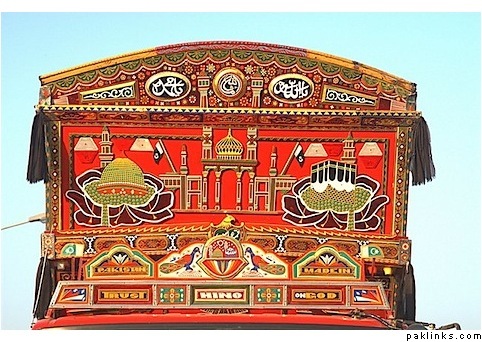
Truck Art

With its all colorful floral patterns, depiction of human heroes with creative aspect ratios, calligraphy of poetic verses and driver’s words of wisdom, this form of art is truly a part of Pakistani transport tradition.

These truck bodies are immaculately painted by the street artists who can be found at Truck stands all across the country. e.g. Hawkes Bay/Mauripur Road Road Karachi, Pir Wadhai Rawalpindi, Badami Bagh Lahore, Sariab Road Quetta etc. These hired artists then paint the whole truck in brightly colored patterns. It is said that everty city’s artists have perfected their art in their own signature way. Trucks decorated in Quetta and Peshawar get lots of wood trimming where as those in Rawalpindi get lots of plastic decoration. Karachi excels in using reflective tapes, also called ‘chamak patty’ in local language. Camel bone decoration is used by artists of rural Sindh.

Pakistani trucks are also used as means of displaying the owner or the Painter’s Poetic taste. It also serves as a calligraphic board as well as a notice board for public messages.

The truck owners and truck artists of Pakistan also pay homage to their heroes and heroines in their own innocent ways. These painting do not strictly follow the aspect ratio of real life figures.

*Source/More information: Pakistan’s Indigenous Art of Truck Painting : ALL THINGS PAKISTAN

**

Chiniot Wood - Carving**

Chiniot is famous world-wide for the quality and intricacy of its wood carving. An ancient city, it’s located on the bank of Chenab. The carvers of Chiniot have achieved a level of craft and creativity and good that other artisans in Pakistan and around the world can only hope to attain. A special kind of furniture and brightly colored lacquered woodcarving is made in chiniot. Everything under the sun which can be made out of wood is made here. Tables, beds, swings, treasure chests, you name it, it’s made there.

A worker

http://img529.imageshack.us/img529/9616/img4875nd3.jpg

http://img135.imageshack.us/img135/5287/picture006xw5.jpg

Re: Independence Day Celebration: Aug 11-17 : Arts and Craft of Pakistan

Unbelieveable trucks :eek: Wow!

Re: Independence Day Celebration: Aug 11-17 : Arts and Craft of Pakistan

Street artists really don’t get credit for what they do and can do. Don’t forget the people who decorate wedding halls with flowers. But that would be another thread. More truck art:

Re: Independence Day Celebration: Aug 11-17 : Arts and Craft of Pakistan

oh absolutely! it’s hard to make arrangements :bummer:

that is so cool! the guy is definitely expressing his religious fervour

subtlety is a word lost on truck art :stuck_out_tongue:

Re: Independence Day Celebration: Aug 11-17 : Arts and Craft of Pakistan

Beautiful images Khumar .. amazing ...

thanks for sharing

Re: Independence Day Celebration: Aug 11-17 : Arts and Craft of Pakistan

Truck art - a unique Pakistani invention. Great images.

Embroidery/Mirror Work

Embroidery has been an old art that has been around as long as people can remember. Over the years in Pakistan it’s taken a beautiful turn, with various stitches being invented, and each as spectacular as the next one. While a lot of the stitches are distinctive, and are named after the region they are mostly found in, such as a Sindhi Karhai, Kashmiri Karhai, there are even some that have even been named after the big politicians of Pakistan, such as a Benazir Stitch and a Nawaz Sharif stitch.

Similarly, sheesha or mirror work has also been used to decorate fabric. Sewing mirror into a design is hard enough, but when you combine elements of design and pattern into it, as well as bright, beautiful colors, it transforms the piece into an immediate piece of art.

These days, a lot of embroidery is done by machines. But the intracy of hand-embroidery is still unbeaten. For many women in the rural areas, it’s their primary source of income. A lot of non for profit organizations in Pakistan employ such women, so they can earn a livelihood and then sell their work on their behalf. It might take a longer time to finish a work by hand, but it’s absolutely worth it.

Kashmiri shawl from 1830-1840

Hunza Valley

http://img166.imageshack.us/img166/313/hunza1xo0.jpg

Thar Desert Work

http://img165.imageshack.us/img165/8608/thar1ly6.jpg

http://img166.imageshack.us/img166/2767/thar2vl3.jpg

A woman in Thar embroidering

http://img137.imageshack.us/img137/8606/thar3qh4.jpg

A Wall Hanging

http://img166.imageshack.us/img166/8383/img4859eu6.jpg

Detail from Wall Hanging

http://img217.imageshack.us/img217/2641/img4860ss0.jpg

http://img225.imageshack.us/img225/9090/img4878pj8.jpg

Multani Art:

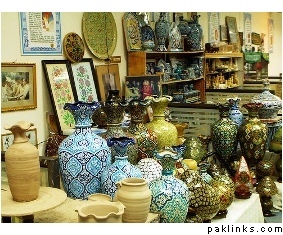
Blue Pottery:

The history of Multani arts and crafts also goes back to medieval period. Kashi work, glazing and hand painting of ceramic products is an important art for which Multan is famous the would over. The use of foliage branches and leaves of trees and superb richness of colours (mainly blue) in Kashi work is an evidence of Persian influence. As Persian arts themselves have been under Chinese (Mongol) influence, therefore some historians are of the view that Kashi work had originally come from Kashghar, China. Over a period of centuries Multani Kashi work has matured and developed a unique and distinctive style of its own.

http://www.paklinks.com/gsmedia/files/12072/blueartmultan5.jpg

The art has survived for centuries through generations as its trade secrets like composition of colours were zealously guarded by a handful of artist and their families. Artists like Ustad Allah Wasaya and others have left lasting work in the field and their work ahs lent an immortality to the art.

In 1853, during a limited excavation on Qillah Kohna Qasim Bagh, Alexander Cunningham found glazed tiles made in Multan in about 900 AD. These tiles had been used in the mosque built by Muhammad Bin Qasim on his arrival in Multan.

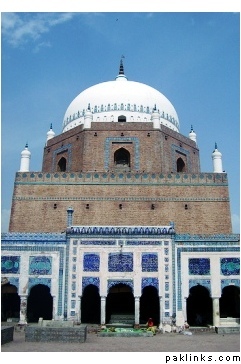
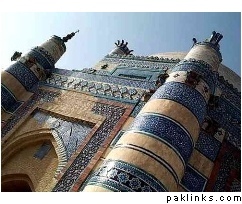
The highest quality Multani tiles have been used in shrines, mosques and other important buildings including house ever since. The shrines of Shah Yousaf Gardezi (1153), Shah Rukne Alam, Ali Akbar, mosque Nawaban, Shrines of Uchh Sharif in Cholistan and Talpur tombs in Sindh are classic examples of tile work. Kashi work on the walls of shrine of Hazrat Haqani, Sawi Mosque, Shrines of Shah Abdul Latif Bhittai, Eidgah Multan and Lahore museum is very distinctive and of a fine quality. Lately Akhtar Abbas Bharwana (ex minister Punjab) has used the tiles from Multan at his house in Jhang. A contemporary artist Ustad Muhammad Alam has executed Kashi work in the house of late actor Sultan Rahi in Lahore.

http://www.multantv.com/pics/m2.jpg

The process of making blue pottery and tiles has undergone many changes with the development in technology. Gas furnaces with controllable and uniform temperature are being used for biscuit firings and glazing instead of wood and dung cake fire. Clay is being procured from Manshera (NWFP), Tharparker (Sindh) and Gujrat (Punjab) instead of local red clay.

“Baking of raw material as per the formula, grinding, kneading, filtration, moulding, biscuit firing at the temperature of 800-850 degree centigrade, Kashi work and glazing at the temperature of 1200 centigrade are all necessary steps in the process,"
“The special blue colour prepared from cobalt oxide and copper oxide is a special technique and distinctive feature of the Kashi work.”

http://www.himultani.com/test/art%20n%20craft%20work/kashi%20gar%20work.jpg

http://www.himultani.com/test/art%20n%20craft%20work/blue%20pottery15.jpg

http://www.himultani.com/test/art%20n%20craft%20work/blue%20pottery10.jpg

Among the various arts that are practiced in Pakistan, Multani*** Kashi ***work has attained a higher state of refinement. There is always a room to bring into the art new innovations, endow it with fresh spirit and set the science as its guide. Assistance can be sought from international agencies like UNESCO and the World Bank. The range of possibilities in the field of ceramics is very vast. The whole world can be the market for Blue Pottery from Multan.

**

http://www.multantv.com/pics/m4.jpg

**

**

http://www.apnamultan.com/urdu/Picture%20008.jpg

**

**

http://www.himultani.com/test/art%20n%20craft%20work/blue%20pottery.jpg

**

**

http://www.himultani.com/test/art%20n%20craft%20work/blue%20pottery12.jpg

**

Multan TV - The Biggest Multani Portal - Multan, Pakistan

http://farm4.static.flickr.com/3112/2537581408_b999f84c76.jpg?v=0

http://farm4.static.flickr.com/3212/2536765803_5c1b064788.jpg?v=0

http://farm4.static.flickr.com/3042/2536750783_0f22625b64.jpg?v=0

http://farm3.static.flickr.com/2225/2537562392_eea8ecc686.jpg?v=0

Multan Craft Bazar

http://hamaramultan.com/multancraftbazar.jpg

http://img369.imageshack.us/img369/773/tttt5vo.png

A traditional cushion made of cotton and golden “tilla” thread with mirror-work on it.

Traditional table with inlay work from camel bones.

Leather “khussa” shoes with embroidery on them are very popular in the villages. They are made from vegetable- tanned leather

4-panelled partition screen in ‘sheesham’ wood with intricate cut-work and brass inlay work on it.

Traditional ‘aftaba’ in brass with emboss and cut-work.

Brass Teaset (actually we have this one at home, I will take a pic :cheegum: )

ohh i should take a picture of my khussa too! :smiley:

I went to Multan and had the oppurtunity to go to a shop where they use they make traditional multani pottery, as well as making tiles to fix the mizaars in multan. everything in there is hand made. from the making of the actual pottery, to putting in this HUGE kiln, to painting it. the artists who would have spent years honing their technique would be sitting in front of the store, painting with the thinest of the brushes, while the rest of the work would be done in the back. and everything was done right then and there. like there isn’t a plan that they have drawn on a paper sitting somewhere. it was just a few rough lines drawn with a pencil on whatever they had to paint, and then they were painting it. i bought a little bowl from there too :blush:

http://img233.imageshack.us/img233/1709/img4867hy7.jpg

http://img156.imageshack.us/img156/3562/img4868ox3.jpg

http://img233.imageshack.us/img233/1681/img4871ur0.jpg

Re: Independence Day Celebration: Aug 11-17 : Arts and Craft of Pakistan

my woodcarving.

http://farm4.static.flickr.com/3148/2634344000_850b595d65.jpg

which type of wood n tools u have used?
its very very beautiful

http://www.paklinks.com/gsmedia/files/12072/khussay.jpg

http://atiquetextiles.com/pic_shoe.jpg

http://us.st11.yimg.com/us.st.yimg.com/I/yhst-33496594265616_1991_1375122

http://atiquetextiles.com/pic_shoes.jpg

Re: Independence Day Celebration: Aug 11-17 : Arts and Craft of Pakistan

Oh those khussas are to die for!

Re: Independence Day Celebration: Aug 11-17 : Arts and Craft of Pakistan

Old Pakistani tribal women dress

http://www.quiltersmuse.com/images/Pakistani_embroidered_dress.jpg

http://www.quiltersmuse.com/images/Pakistani_front_dress_close.jpg

Traditional dress of women of Kalash in Rumbur, Chitral

http://farm1.static.flickr.com/128/362059730_cbde308ada.jpg?v=0

Kalash is a tribe found in 3 valleys Rumbur, Bumburet and Birir. They are a warrior like people who ruled from near Kabul to the Lowari Pass. They are not Muslims but follow their own way of life and there is only a few thousand Kalasha left as many have converted to Islam, the majority religion in the region. If they change religion they are no longer considered Kalasha. Non-Kalash women do not wear the black dress with voluminous embroidery.

*The women wear voluminous black or brown dresses reaching to ground, bound at the waist with a sash. Over thin plaits they wear headpieces decorated with cowrie shells, beads, buttons and coins. Ceremonial versions can be spectacular with exotic embroidery, mounds of bead necklaces, bells and plumes. The women often decorate faces with mulberry-juice *
tattoo’s, or pomegranate.

Traditional Sindi Dress for women with sindhi embroidery work.

http://www.marlamallett.com/E-5049DD-Sind_Dress.jpg

http://www.paklinks.com/gsmedia/files/12072/sindhishirt.JPG

Traditional Sindi Topi for men and sindhi shawl known as Ajrak.

http://sindocas.org/assets/images/J_Kelly_in_ajrak.jpg

Ajrak

Ajrak is a name given to a unique form of shawls and tiles found in Sindh, Pakistan. These shawls display special designs and patterns made using block printing by stamps. Common colours used while making these patterns may include but are not limited to blue, red, black and yellow. Over the years, ajraks have become a symbol of the Sindhi culture and pride.

http://www.al-rijaal.com/ajrak01.jpg

Traditional Aplique Art

*Patchwork, Appliqué and Embroidered Quilts *
Ralli quilts are made in the remote regions of Pakistan and India by women artisans, many of whom will not travel out of their own village without their husbands or another male. Patchwork ralli quilts are patterned textiles made of old cloth from discarded clothing and household fabrics that are sometimes hand dyed to give them a new appearance. The cloth is torn or cut into geometric shapes, then stitched together on a palm mat on the ground using a large needle and cotton thread. Three quilting methods are used: patchwork, appliqué and embroidery.

http://www.news.wisc.edu/wisweek/12-May-2004/images/Elvehjem_Pakistani_quilt04.jpg

http://www.ralliquilt.com/ralli_web/Ralli-027.jpg

http://www.ralliquilt.com/bottom.jpg

http://www.fairtradequilts.com/newindbs1b_edited-1.jpg

http://64.78.29.176/images/uploads/Pakistan_LilaHandicrafts5_RalliQuilts.jpg

http://64.78.29.176/images/uploads/Pakistan_LilaHandicrafts2_RalliQuilts.jpg

http://www.fairtradequilts.com/100_0753a.jpg

http://farm1.static.flickr.com/186/480820930_9262e63a5c.jpg?v=0

Beautiful handmade embroidery with great distribution of colors, thread and mirror work by craftswomen from Thar/Rajasthan/Kutch…They do embroidery in their leisure time…which shows the great culture and heritage of Pakistani people…Thar/Rajasthan women are famous to use cotton fabric and cotton thread in their work.

Re: Independence Day Celebration: Aug 11-17 : Arts and Craft of Pakistan

Traditional Balochi Embroidery and dress

http://farm4.static.flickr.com/3113/2639088314_8e27e800c0.jpg?v=0

http://www.jozan.net/upload1/tehrani/1717.jpg

http://farm3.static.flickr.com/2415/2358092872_ca2a7f58c8.jpg?v=0

http://farm3.static.flickr.com/2120/2358092880_30bba707eb.jpg?v=0

http://farm3.static.flickr.com/2307/2358092892_f4baffc53d.jpg?v=0

http://farm4.static.flickr.com/3042/2358092894_7737a826e1.jpg?v=0

http://farm3.static.flickr.com/2214/2358092898_fd131a07ff.jpg?v=0

Re: Independence Day Celebration: Aug 11-17 : Arts and Craft of Pakistan

Unbelievably beautiful art!
Thanks a lot for shairng this guys :)