Artist of the week "Van Gogh"

Birth Year : 1853
Death Year : 1890

Vincent van Gogh, for whom color was the chief symbol of expression, was born in Groot-Zundert, Holland. The son of a pastor, brought up in a religious and cultured atmosphere, Vincent was highly emotional and lacked self-confidence. Between 1860 and 1880, when he finally decided to become an artist, van Gogh had had two unsuitable and unhappy romances and had worked unsuccessfully as a clerk in a bookstore, an art salesman, and a preacher in the Borinage (a dreary mining district in Belgium), where he was dismissed for overzealousness. He remained in Belgium to study art, determined to give happiness by creating beauty. The works of his early Dutch period are somber-toned, sharply lit, genre paintings of which the most famous is “The Potato Eaters” (1885). In that year van Gogh went to Antwerp where he discovered the works of Rubens and purchased many Japanese prints.
In 1886 he went to Paris to join his brother Théo, the manager of Goupil’s gallery. In Paris, van Gogh studied with Cormon, inevitably met Pissarro, Monet, and Gauguin, and began to lighten his very dark palette and to paint in the short brushstrokes of the Impressionists. His nervous temperament made him a difficult companion and night-long discussions combined with painting all day undermined his health. He decided to go south to Arles where he hoped his friends would join him and help found a school of art. Gauguin did join him but with disastrous results. Near the end of 1888, an incident led Gauguin to ultimately leave Arles. Van Gogh pursued him with an open razor, was stopped by Gauguin, but ended up cutting a portion of his own ear lobe off. Van Gogh then began to alternate between fits of madness and lucidity and was sent to the asylum in Saint-Remy for treatment.

In May of 1890, he seemed much better and went to live in Auvers-sur-Oise under the watchful eye of Dr. Gachet. Two months later he was dead, having shot himself “for the good of all.” During his brief career he had sold one painting. Van Gogh’s finest works were produced in less than three years in a technique that grew more and more impassioned in brushstroke, in symbolic and intense color, in surface tension, and in the movement and vibration of form and line. Van Gogh’s inimitable fusion of form and content is powerful; dramatic, lyrically rhythmic, imaginative, and emotional, for the artist was completely absorbed in the effort to explain either his struggle against madness or his comprehension of the spiritual essence of man and nature.

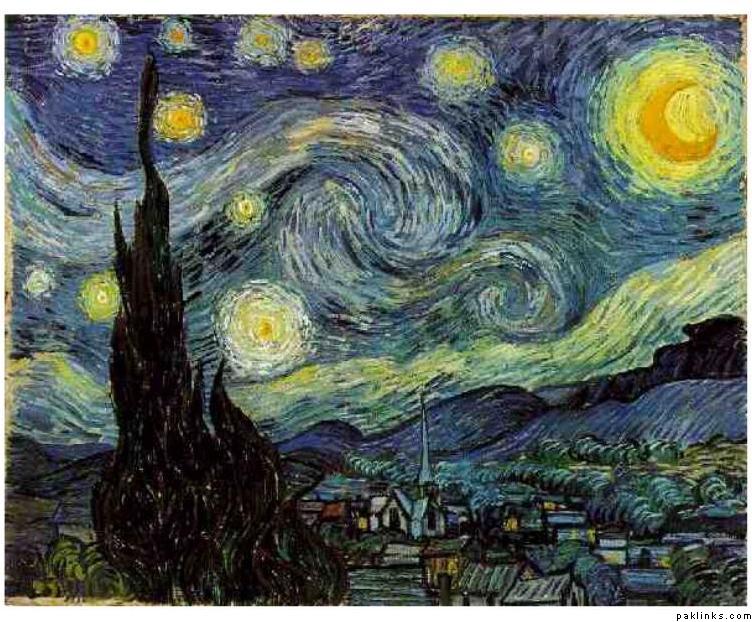
His famous painting starry night
You can share more of his history or more of his paintings.

Purpose of opening this series of thread is we should learn about art history and how many great painters are there. :slight_smile:

Re: Artist of the week "Van Gogh"

Starry Night is Van Gogh's one of the most well known images in modern culture as well as being one of the most replicated and sought after prints. Well this one inspired me to write a poem too!

One may begin to ask what features within the painting are responsible for its ever growing popularity. There are actually several main aspects that intrigue those who view this image, and each factor affects each individual differently.

•1. There is the night sky filled with swirling clouds, stars ablaze with their own luminescence, and a bright crescent moon. Although the features are exaggerated, this is a scene we can all relate to, and also one that most individuals feel comfortable and at ease with. This sky keeps the viewer's eyes moving about the painting, following the curves and creating a visual dot to dot with the stars. This movement keeps the onlooker involved in the painting while the other factors take hold.
•2. Below the rolling hills of the horizon lies a small town. There is a peaceful essence flowing from the structures. Perhaps the cool dark colors and the fiery windows spark memories of our own warm childhood years filled with imagination of what exists in the night and dark starry skies. The center point of the town is the tall steeple of the church, reigning largely over the smaller buildings. This steeple casts down a sense of stability onto the town, and also creates a sense of size and seclusion.
•3. To the left of the painting there is a massive dark structure that develops an even greater sense of size and isolation. This structure is magnificent when compared to the scale of other objects in the painting. The curving lines mirror that of the sky and create the sensation of depth in the painting. This structure also allows the viewer to interpret what it is. From a mountain to a leafy bush, the analysis of this formation is wide and full of variety.

Van Gogh painted Starry Night while in an Asylum at Saint-Remy in 1889.

My dedication to the Maestro -

Van Gogh Paints the Stars

He sits, his brush clasped in fingers numbed by
cold, and stares at the evening sky as though
it might pull off its hinges with a cry
reminiscent of ravens in the glow
of early morning and soar down to take
him to Heaven on jewel-encrusted wings.
Vincent watches the light dance on the lake.
Blind-eyed to the crowds passing by, he clings
to the strange comfort that comes with the stars,
watching as midnight leans on the tired
horizon like a friendly drunk. As Mars
spins in the unmapped distance, admired
sights appear on his canvas, and he thinks
he knows the thoughts of the sun as it sinks.

Re: Artist of the week “Van Gogh”

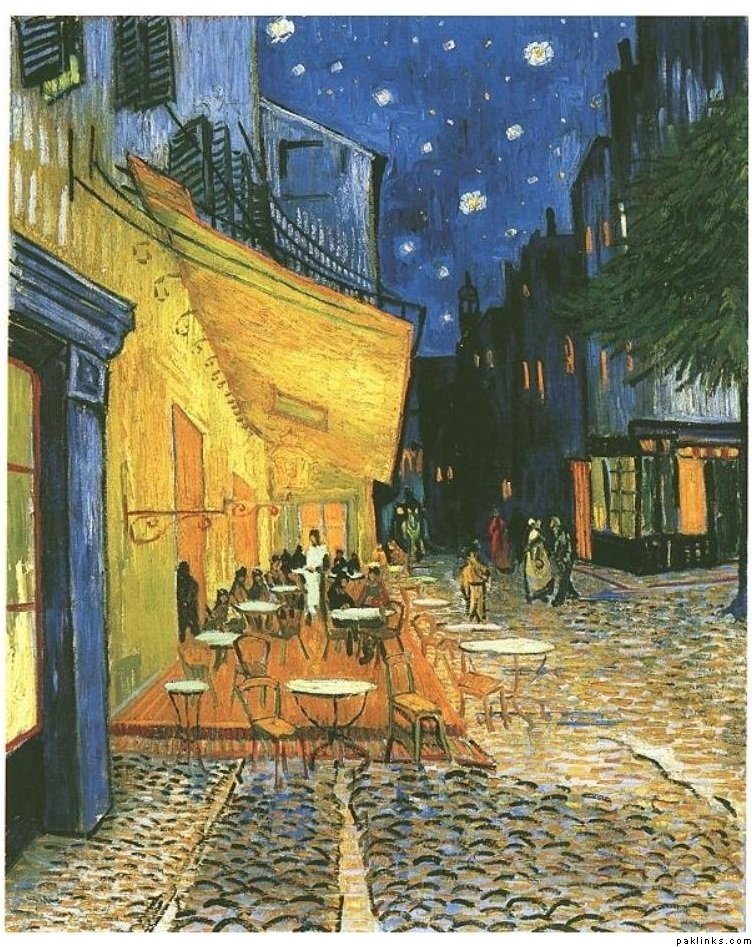
Cafe Terrace At Night was painted in Arles in 1888. The similarities between this piece the previous are vaguely similar. This piece offers a new type of perspective on the star filled sky.

•The Stars are barely consumed in their own light.
•The bright yellow wall draws in ones attention rather then assisting to move one’s eyes around the painting.
•There is a sense of balance attributed to the dark cityscape silhouette to the right of the painting (Contrasting the bright yellow wall).

Never the less these paintings have astounded millions of people and remain three of the best works ever to flow from Van Gogh’s paint brush (The third being ‘Starry Night Over the Rhone’). Each Day hundreds of people crowd around the original paintings located in various art museums to offer their own personal interpretation as to the meaning of the pieces. Although we may never know how Vincent himself truly felt about these paintings, mankind still embraces their greatness.

Re: Artist of the week “Van Gogh”

Nice information N :k: I will post more soon too :slight_smile:

Re: Artist of the week “Van Gogh”

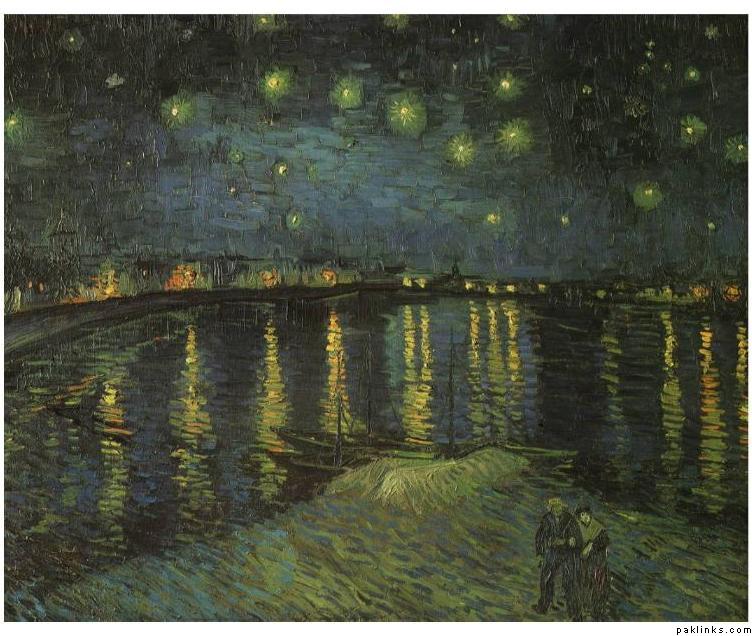
Starry Night Over the Rhone

During Van Gogh’s younger years he wanted to dedicate his life to evangelization of those in poverty. Many believe that this religious endeavor may be reflected in the eleven stars of the painting. In Genesis 37:9 the following statement is made:
“And he dreamed yet another dream, and told it his brethren, and said, Behold, I have dreamed a dream more; and, behold, the sun and the moon and the eleven stars made obeisance to me.”

Whether or not this religious inspiration is true, it is known that the piece is not the only Starry Sky painting that Van Gogh ever created. Gogh was quite proud of a piece he had painted earlier in Arles in 1888 that depicted stars reflecting in the Rhone River. Like Starry Sky this previous piece shares many of the qualities that have made Starry Sky such a popular painting. For instance:

•The stars in the night sky are surrounded with their own orb of light.
•The Reflection of artificial light (new to the time period) from Arles in the river makes the one’s eyes move around the painting; thus keeping the viewer visually involved.
•There are structures in the distant lit up in a warm glow of light.

Starry Night over the Rhone contains one final aspect that is not featured in the Starry Night piece; humans. In the bottom right corner of the painting there is a couple walking along the river. This gives the painting a down to earth feel with a natural quality. Although this painting is not nearly as popular as the seconded Starry Night piece, it still creates a pleasurable and life like environment to look at. It is also resides as a very sought after piece when it is placed with Starry Night and the following painting to create a montage of Van Gogh’s Starry Night works.

Re: Artist of the week “Van Gogh”

Waiting eagerly…:slight_smile:

Re: Artist of the week “Van Gogh”

Workman Sitting on a Basket, Cutting Bread

The Hague: late November, 1882…

Technical data
Signed on the transfer paper at lower left: Vincent

Transfer lithography; crayon and autographic ink on transfer paper. All the impressions are printed in black ink…

I Like His Portraits N Graphics !!!


Restored attachments:

Re: Artist of the week “Van Gogh”

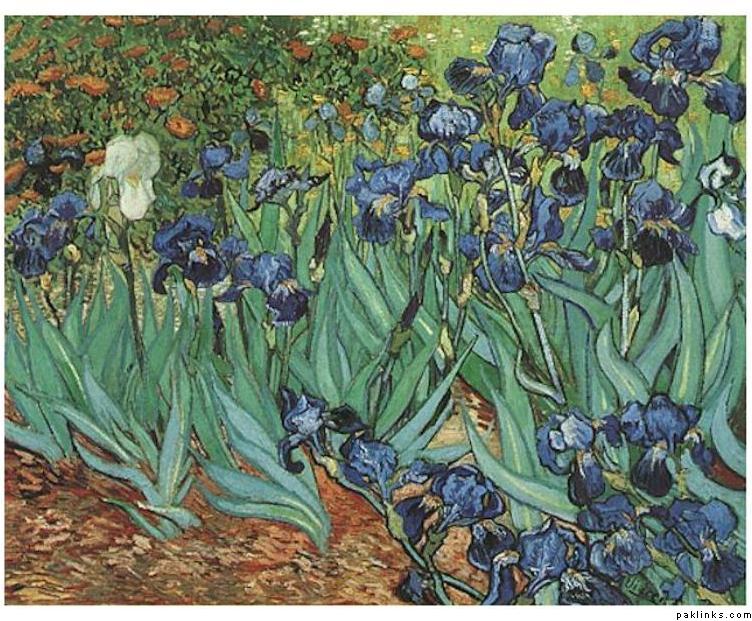
Irises :

Irises is among the most recognized of his pieces. On May 8, 1889, Vincent Van Gogh committed himself to the asylum at Saint Paul-de-Mausole in Saint-Remy, France after many instances of hospitalization and self-mutilation. During his stay he painted some 130 paintings with the surrounding gardens and clinic becoming his main subjects for painting. Among these were the famous The Starry Night and Irises.

     Inspired by the nature surrounding him, Van Gogh began his work on  Irises within the first week of his stay at the asylum.  Irises was most  likely influenced by Japanese woodblock prints which were produced  beginning in the 17th century.  Like many artists of his time Van Gogh  was influenced by the Japanese works.  The use of black contours in  Irises is a typical element of Japanese woodblock prints.  It helped to  reinforce the expressive power of the painting.                             
          There are no known drawings of the piece, probably because Van Gogh  did not consider it a masterpiece but simply a study.  Upon receiving  the canvas Van Gogh’s brother, Theo, submitted it, along with The Starry  Night, to the Salon des Independants in September of 1889.     
          Irises is on the list of the most expensive paintings ever sold,  selling for 54 million dollars in 1987.  Currently Irises is on display  at The Getty Center in Los Angeles, California.

Re: Artist of the week “Van Gogh”

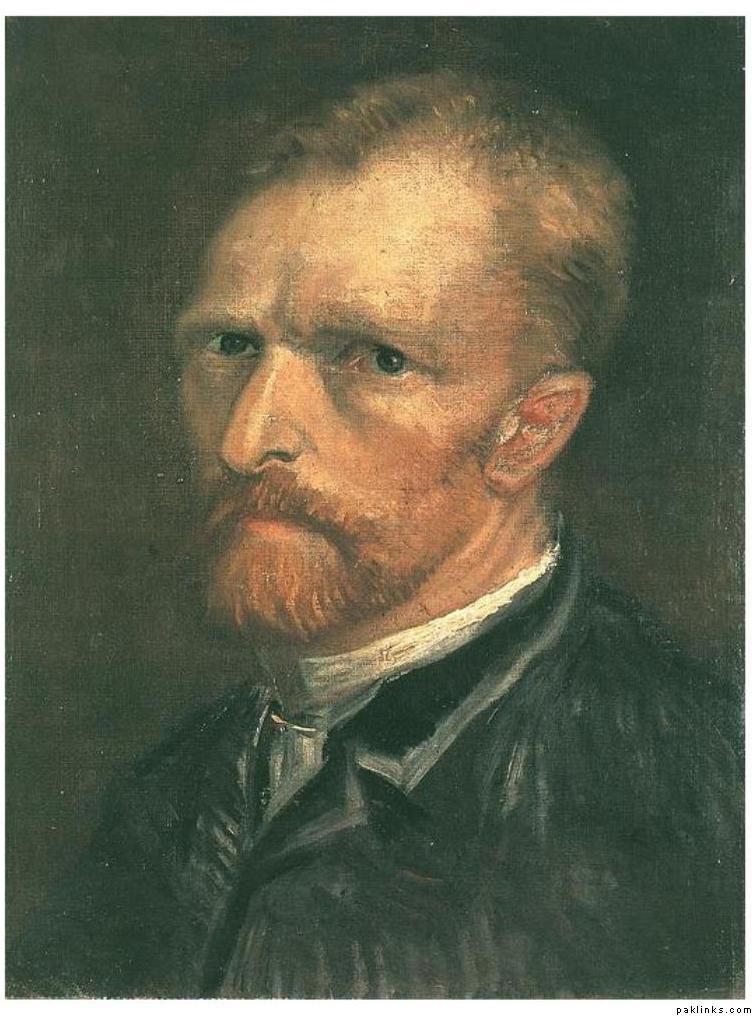
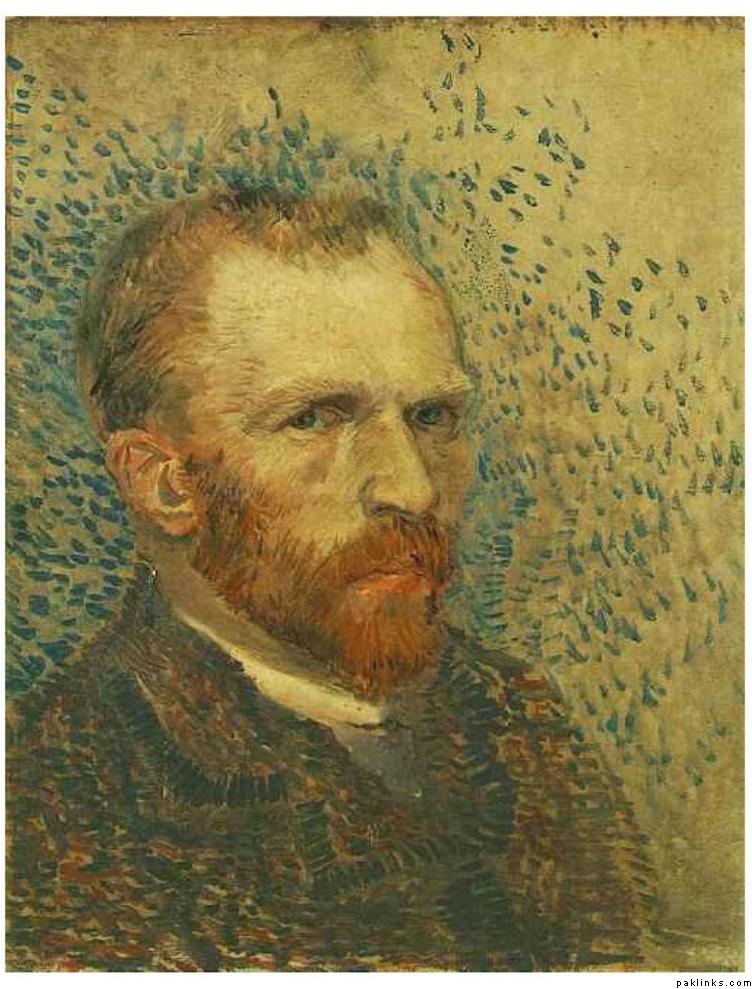
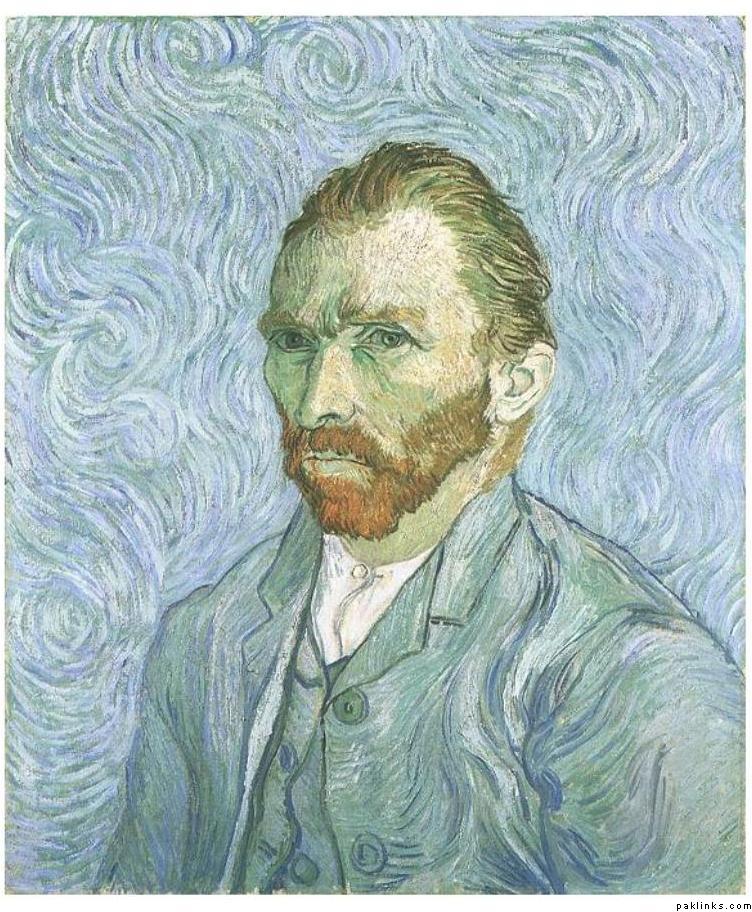
Self portraits :

Vincent van Gogh painted over 30 self-portraits between

http://www.vangoghgallery.com/in_his_steps/images/self-portrait.jpg

the years 1886 and 1889. His collection of self-portraits places him among the most prolific self-portraitists of all time. Van Gogh used portrait painting as a method of introspection, a method to make money and a method of developing his skills as an artist.

When Van Gogh first began painting he used peasants as models. After this stage, he worked more on experimenting with his use of color in painting landscapes and flowers, primarily because he could not afford to pay models. He explains this in a letter to his sister Wilhelmina van Gogh in 1887,

*“Of my own work I think that the picture of peasants eating potatoes *I did in Nuenen is après tout the best I’ve done. But since then I’ve had no chance of getting models, though on the other hand I did have the chance to study the colour question. And if I should find models again for my figures later, then I would hope to be able to show that I am after something other than little green landscapes or flowers.” As Van Gogh struggled to make a living as an artist he became reliant on his brother Theo and the charity of others such as Julien “Père” Tanguy, who ran the paint store that Van Gogh frequented in Paris. With their generosity of money and supplies, Van Gogh continued working as an artist and thought of portrait painting as a practical application of his talent. In a letter to his brother Theo in July of 1888 Van Gogh wrote,
“Besides, I think I have spoken the truth, but if I should succeed in replacing in goods the money spent, I should only be doing my duty. And then, something practical I can do is portrait painting.”
Van Gogh did not have money to pay models to pose for portraits nor did he have many people commissioning him to do portraits, so Van Gogh painted his own portrait. Van Gogh did not see portrait painting as merely a means to an end; he also believed that portrait painting would help him develop his skills as an artist. In a letter to his brother Theo dated September 16, 1888, Van Gogh writes about a self-portrait he painted and dedicated to his friend and fellow artist Paul Gauguin,
*“The third picture this week is a portrait of myself, almost colourless, in ashen tones against a background of pale veronese green.**I purposely bought a mirror good enough to enable me to work from my image in default of a model, because if I can manage to paint the colouring of my own head, which is not to be done without some difficulty, I shall likewise be able to paint the heads of other good souls, men and women.”

*

in autmn 1886

Spring -summer 1887

September 1889

Re: Artist of the week “Van Gogh”

In a letter to Theo from 1882 Van Gogh wrote,

“Where in this little sketch the black is darkest, there in the watercolour are the strongest effects, dark green, brown and grey. Well, adieu, and believe me that sometimes I laugh heartily, because people suspect me of all kinds of malignity and absurdities, of which I do not nourish an inkling. (I who am really nothing but a friend of nature. of study. of work, and of people in particular.)”


Restored attachments:

Re: Artist of the week “Van Gogh”

Thanks for sharing LK :k:

Re: Artist of the week “Van Gogh”

Remember :hypo: no thanx n sorry :smiley:

Re: Artist of the week “Van Gogh”

OK :wink: ab next paragraph kab likhien gay :faizy:

Re: Artist of the week “Van Gogh”

next paragraph hmmmmmmmmm korn ke likhnay ke baad :whistling:

Re: Artist of the week “Van Gogh”

Haye Korn kahaan reh gaii hai :emmy:

Re: Artist of the week “Van Gogh”

:k: nice share

Re: Artist of the week "Van Gogh"

Thanks RC I will share his work more

Re: Artist of the week “Van Gogh”

Van Gogh sunflowers

** Painting, Oil on Canvas
Arles, France: August, 1888**

Re: Artist of the week “Van Gogh”

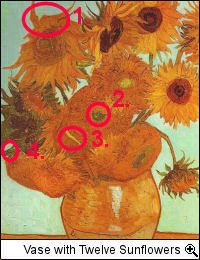
There are pieces of artwork drifting through galleries around the world that have become nearly synonymous with the artists name and techniques. The various paintings of Sunflowers and Vincent van Gogh are a perfect example of this. Not only can one make a mental connection between the artists name and painting but also between the artist and their influence on the development of art through these paintings. Vincent van Gogh’s Sunflower paintings have been duplicated many times by various artists (although never reaching the vivacity and intensity of Van Gogh’s) and displayed everywhere; from households to art expos.he colors are vibrant and express emotions typically associated with the life of sunflowers: bright yellows of the full bloom to arid browns of wilting and death; all of the stages woven through these polar opposites are presented. Perhaps this very technique is what draws one into the painting; the fulfillment of seeing all angles of the spectrum of life and in turn reaching a deeper understanding of how all living things are tied together. There are many pieces within this series of paintings (each is clearly identifiable as a Van Gogh work) in which there are only minor differences that separate them. The overall layout of the painting along with positioning of the actual sunflowers usually remains the same in the similar paintings. Below you can see highlighted areas of difference between two similar sunflower paintings.

To the left you can see two sunflower paintings of the series under the same title; however, these two pieces have some minor differences.

    1. There are differences in petal structure on a few of the flowers. Located in bubble number one you can see how the second piece has more petal “bulk” and does not follow the sweeping “V” motion as is seen in the first piece.
    1. The center “eye” of the flower contains different colors. In the first example the center is filled with a greenish yellow, while in the second piece the center is filled with black.
    1. This is also the case for bubble number three. The leafy structure is yellow in the first piece and resides as light brown in the second piece.
    1. The leaf located in bubble number four is nearly identical in both pieces; however in the first piece it is overlapped by the large drooping flower and is green in color. In the second piece there is a small but clear gap between the drooping flower and the leaf, and the leaf is black in color.

Although Van Gogh’s sunflower paintings are very similar in many aspects, each stands out as its own unique work of art. Van Gogh began painting sunflowers after he left Holland for France in pursuit of creating an artistic community. The firsts were created to decorate his friend Paul Gaulin’s bedroom. The majority of Van Gogh’s sunflowers in vases were created in Arles, France during 1888-1889. Van Gogh did create some sunflower paintings prior to this time though in Paris, France around the time of 1887. This series consists of sunflower clippings verses sunflowers in vases. You can see an example of this series to the right.

Re: Artist of the week “Van Gogh”

^
Interesting but very long :book: