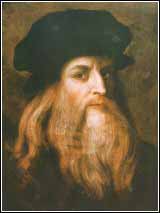
Artist of the week Leonardo Da Vinci

Childhood
**

** Leonardo Da Vinci was born on April 15, 1452 in the small Tucson town of Anchiano, near Florence. His parents, Ser Piero, a notary, and Caterina, a peasant woman, were unmarried, and the illegitimate Leonardo was raised by his father. Some experts claim that due to his illegitimacy Leonardo was unworthy of a proper education, and that this is the reason that he did not follow in his father’s footsteps to become a notary, or why he did not study to become a doctor. Meanwhile, other Da Vinci sources claim that the young Leonardo was treated as a legitimate child, and was offered the same education as other children of that day.
Apprenticeship and First Florentine Period
At the age of 15 Leonardo had already mastered skills in the fine arts and the young man was sent to Florence to work as an apprentice in the renowned workshop of Andrea del Verrocchio.
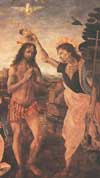
Leonardo worked with del Verrocchio until 1477, during which time del Verrocchio had been commissioned for a painting that would be The Baptism of Christ, and the painter had Leonardo aid him with the work by having his pupil paint the kneeling angel in the painting. Leonardo’s angel was so outstanding that it shadowed del Verrocchio’s portion of the work, and Leonardo is quoted to have later stated that “poor is a pupil that does not surpass his master.” It is also said that Andrea del Verrocchio gave up his career as a painter, having suffered such humiliation by being out-painted by his own student.
In 1472, while still working with del Verrocchio, Leonardo Da Vinci was honored as he was accepted into the painter’s guild of Florence.
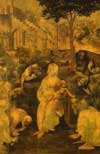
After leaving Verrocchio’s studio, Leonardo remained in Florence where he worked independently until 1481. In his final years in Florence, Leonardo Da Vinci received two substantial commissions. The first was for the painting The Adoration of the Magi for the monastery of San Donato a Scopeto; and the second was for a painting that was to be completed in the Altar of St. Bernard Chapel in the Palazzo della Signoria. The first painting was never completed and the second, Leonardo never even began, abandoning the projects to move to Milan.
While Leonardo’s career seemed to be taking flight, his reputation was damaged in 1481 when he was charged with sodomy. Though the charges were later dropped, the public humiliation may have played a role in Da Vinci’s abandonment of these commissions. His humiliation was even more so accentuated when Leonardo was not chosen amongst those commissioned to paint the Sistine Chapel.
**First Milanese Period **
In 1482, Leonardo Da Vinci moved to Milan where he had been hired by the city’s duke, Duke Ludovico Sforza, and had been given the title of “painter and engineer of the duke.” He worked as a painter, sculptor, served as an architect, and he aided in the design of fortifications and military conceptions. Da Vinci would remain in Milan for 17 years, leaving his position with the falling out of power of the Duke with the entry of the French into Milan.
During this first Milanese period Leonardo completed at least six works. Among these works are, from 1483-1486, The Virgin of the Rocks, (which now has a home in the Louvre in Paris) and the monumental The Last Supper between 1495-1498. The extremely difficult to visit painting remains on the walls at the refectory of the Santa Maria delle Grazie, and is one of the most widely sold Da Vinci Posters of all time.

Re: Artist of the week Leonardo Da Vinci

Second Florentine Period
Around the year 1500, Leonardo decided to leave Milan and head back to Florence where his good reputation had him readily received by the city. By 1502 Da Vinci had entered the service of Cesare Borgia, the much-feared son of Pope Alexander the VI, as senior military architect and general engineer. This position had him travelling and surveying the surrounding lands, at which time Leonardo had sketched some city plans and early maps.

Leonardo Da Vinci returned to Florence once more in 1503, at which time he was commissioned to paint a mural in the council hall in Florence's Palazzo Vecchio. The wall across was commissioned to Leonardo's rival, Michelangelo, who never completed his piece. Leonardo's work, entitled The Battle of Anghiari, which was never completed either, would have measured 23 x 56 feet, double the size of The Last Supper. While working on this piece, the French governor of Milan hired Leonardo, and once again Da Vinci abandoned his project to begin employment elsewhere.
Before leaving, Leonardo accepted a commission from a wealthy Florentine merchant who wanted a portrait of his wife, Mona Lisa. From 1503-1506 Leonardo Da Vinci completed one of the most renowned works of all time, The Mona Lisa. Many scholars doubt the story of the merchant and the commission, and there are several conflicting stories about who the woman in the painting really may have been. However, the mystery behind the painting is shadowed by the genius of the work that is now seen by thousands of tourists each day at the Louvre in Paris. The painting is available today as a popular Da Vinci poster and has also been transformed into numerous novelty items.
Second Milanese Period
In 1506 Leonardo traveled back to Milan to work for the French governor of Milan, Charles d'Amboise. During his time there, Leonardo Da Vinci created few paintings, and acted mainly as an architect. Some of his sketches from this period have survived and are sold alongside the many other Da Vinci posters.
Besides his work for the governor, during this time Da Vinci underwent extensive research on the human anatomy.
Final Years
In 1513 the French were expelled from Milan, forcing Leonardo to seek work outside the city. Da Vinci headed to Rome where his friend, Giuliano de'Medici, the brother of the Pope Leo X, offered him living space in his residence in the Vatican.
For about three years, Leonardo stayed in Rome, and did not receive any commissions, while his rivals, Michelangelo and Raphael, where hard at work.
By 1516 the king of France, Francis I, requested that Leonardo join his service. At this time, Leonardo chose to leave Italy, his native country, where he would never return again. He bore the title of "First painter, architect, and engineer to the King," and he lived in the small town of Cloux, near the king's palace.
At the age of 67, in 1519, while living in France, Leonardo Da Vinci died and was buried in the church of Saint-Florentin. The church was ruined during the French Revolution, and completely torn down during the 19th Century. Today, there are no markings to identify Leonardo's gravesite. The Renaissance Master, as he is often referred to, continues to live on through his surviving paintings, his many notebooks and through the extensive selection of Da Vinci posters and prints that have been produced over the years.

Re: Artist of the week Leonardo Da Vinci

I am glad you did not post Mona Lisa aunty's painting straight away. I really hate it when people confine Da Vinci only with that one particular painting so prominently.

Re: Artist of the week Leonardo Da Vinci

I think he was one of greatest engineer of all time too. That man was some thing.

Re: Artist of the week Leonardo Da Vinci

Thanks Nihal I will post some of his paintings soon.

Re: Artist of the week Leonardo Da Vinci

Yep he was

Re: Artist of the week Leonardo Da Vinci

Leonardo da Vinci (1452–1519) was an Italian polymath, regarded as the epitome of the “Renaissance Man”, displaying skills in numerous diverse areas of study. Whilst most famous for his paintings such as the Mona Lisa and the Last Supper, Leonardo is also renowned as a scientist, engineer and inventor. The areas of his scientific study included aeronautics, anatomy, astronomy, botany, cartography, civil engineering, chemistry, geology, geometry, hydrodynamics, mathematics, mechanical engineering, optics, physics, pyrotechnics and zoology.


Restored attachments:

Re: Artist of the week Leonardo Da Vinci

i didnt know much about him but wow he was aries n april born too :slight_smile: thanks for the info :k:

Re: Artist of the week Leonardo Da Vinci

Ahaan Leonardo , waiting for more of his paintings :k:

Leonardo Da Vinci

Every week I am going to share some facts and figures and work about one of the assets from the World of Art

This week’s selected artist is LEONARDO DA VINCI

Leonardo di ser Piero da Vinci (April 15, 1452 – May 2, 1519) was an Italian polymath, having been a scientist, mathematician, engineer, inventor, anatomist, painter, sculptor, architect, botanist, musician and writer. Born as the illegitimate son of a notary, Piero da Vinci, and a peasant girl, Caterina, at Vinci in the region of Florence, Leonardo was educated in the studio of the renowned Florentine painter, Verrocchio. Much of his earlier working life was spent in the service of Ludovico il Moro in Milan. He later worked in Rome, Bologna and Venice, spending his final years in France at the home given to him by King François I.

Leonardo has often been described as the archetype of the “Renaissance man”, a man whose seemingly infinite curiosity was equalled only by his powers of invention. He is widely considered to be one of the greatest painters of all time and perhaps the most diversely talented person ever to have lived.

It is primarily as a painter that Leonardo was and is renowned. Two of his works, the Mona Lisa and The Last Supper occupy unique positions as the most famous, most reproduced and most parodied portrait and religious painting of all time, their fame approached only by Michelangelo’s Creation of Adam. Leonardo’s drawing of the Vitruvian Man is also iconic. Perhaps fifteen of his paintings survive, the small number due to his constant, and frequently disastrous, experimentation with new techniques, and his chronic procrastination. Nevertheless, these few works together with his notebooks, which contain drawings, scientific diagrams, and his thoughts on the nature of painting, comprise a contribution to later generations of artists only rivalled by that of his contemporary, Michelangelo.

As an engineer, Leonardo’s ideas were vastly ahead of his time. He conceptualised a helicopter, a tank, concentrated solar power, a calculator, the double hull and outlined a rudimentary theory of plate tectonics. Relatively few of his designs were constructed or were even feasible during his lifetime, but some of his smaller inventions, such as an automated bobbin winder and a machine for testing the tensile strength of wire, entered the world of manufacturing unheralded.[d] As a scientist, he greatly advanced the state of knowledge in the fields of anatomy, civil engineering, optics, and hydrodynamics. (From Wikipedia)

HIS WORK:


Restored attachments:

Re: Artist of the week Leonardo Da Vinci

Aha, Leonardo..

Thanks For The Info.
Waiting To See More Of His Work :-)