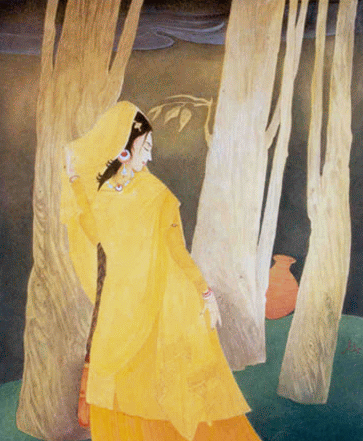
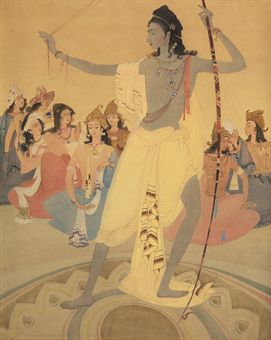
Abdur Rahman Chughtai (1897–1975) was a painter and intellectual from Pakistan, who created his own unique, distinctive painting style influenced by Mughal art, miniature painting, Art Nouveau and Islamic art traditions. He is considered 'the first significant modern Muslim artist from South Asia, and the national artist of Pakistan. He was given the title of Khan Bahadur in 1934, awarded Pakistan’s Hilal-i-Imtiaz in 1960, and the Presidential medal for Pride of Performance in 1968.
[RIGHT]
[/RIGHT]
Chughtai’s early watercolours take off from the revivalism of the Bengal School - his Jahanara and the Taj, for instance, shows the influence of Abanindranath’s The Last Moments of Shah Jahan. By the 1940s he had created his own style, strongly influenced by Islamic art traditions, but retaining a feel of Art Nouveau. His subject matter was drawn from the legends, folklore and history of the Indo-Islamic world, as well as Punjab, Persia and the world of the Mughals.
[RIGHT]
[/RIGHT]
Artist and gallery owner Salima Hashmi deems Chughtai one of South Asia’s foremost painters. “He was part of the movement that started in the early part of the 20th century to establish an identity indigenous to the subcontinent,” she said. “He rejected the hegemony of the British Colonial aesthetic.”
He was considered one of the most famous representatives of Pakistan and Chughtai’s paintings were gifted to visiting heads of states. Allama Iqbal, Pablo Picasso, Queen Elizabeth II were amongst his admirers. An estimated 25 million people saw his Wembley show in 1924.
In 1927, Chughtai published Muraqqa, his first major work, which comprised a series of illustrations he made for new edition of the thought-heavy and highly imaginative verses of Ghalib, 19th century “poet’s poet” of Urdu and Persian.
His works are displayed at the British Museum, the Victoria and Albert Museum, the Peace Palace (in The Hague), United Nations Headquarters, New York, the Kennedy Memorial in Boston, the US State Department (in Washington, D.C.), President’s House Bonn, Nizam of Hyderabad’s Palace, Queen Juliana’s Palace in the Netherlands, Emperor’s Palace Bangkok, President House Islamabad, Governors’ Houses in Lahore and Karachi, and the National Art Gallery, Islamabad.
Among his famous works are the logos of Pakistan Television and Radio Pakistan and his painting of Anarkali for the cover of a 1992 drama. Additionally, one of the most successful UNICEF cards features a Chughtai.
The paper used for some paintings were made in Germany and England during 1920s or 30s. This paper is not being produced any more because the factories, which were used to make this paper, were destroyed during World War II.
On some paintings “Abdur Rehman Chughtai” is written while on some just “Chughtai Lahore“
“Muraqqa-e-Chughai” is a rare publication in which Chughtai transformed the poetry of great Urdu poet Asad Ullah Khan Ghalib with his brilliant skilful strokes and elegant art-work
Chughtai also designed a number of postage stamps of Pakistan from 1949 to 1960s.On the independence day of 1951, he produced a set of 9 stamps, internationally known as Chughtai Art set, was considered as the most beautiful stamps of the world at that time



 Hazrat Aurangzeb ke karname yahan bhi pohunch gae


