Re: Another View of Waziristan
Here’s another well-written article by newsweek on the topic:
Is Pakistan Really Cracking Down on Terrorism?BY R. M. SCHNEIDERMAN 1/31/15 AT 2:45 PM
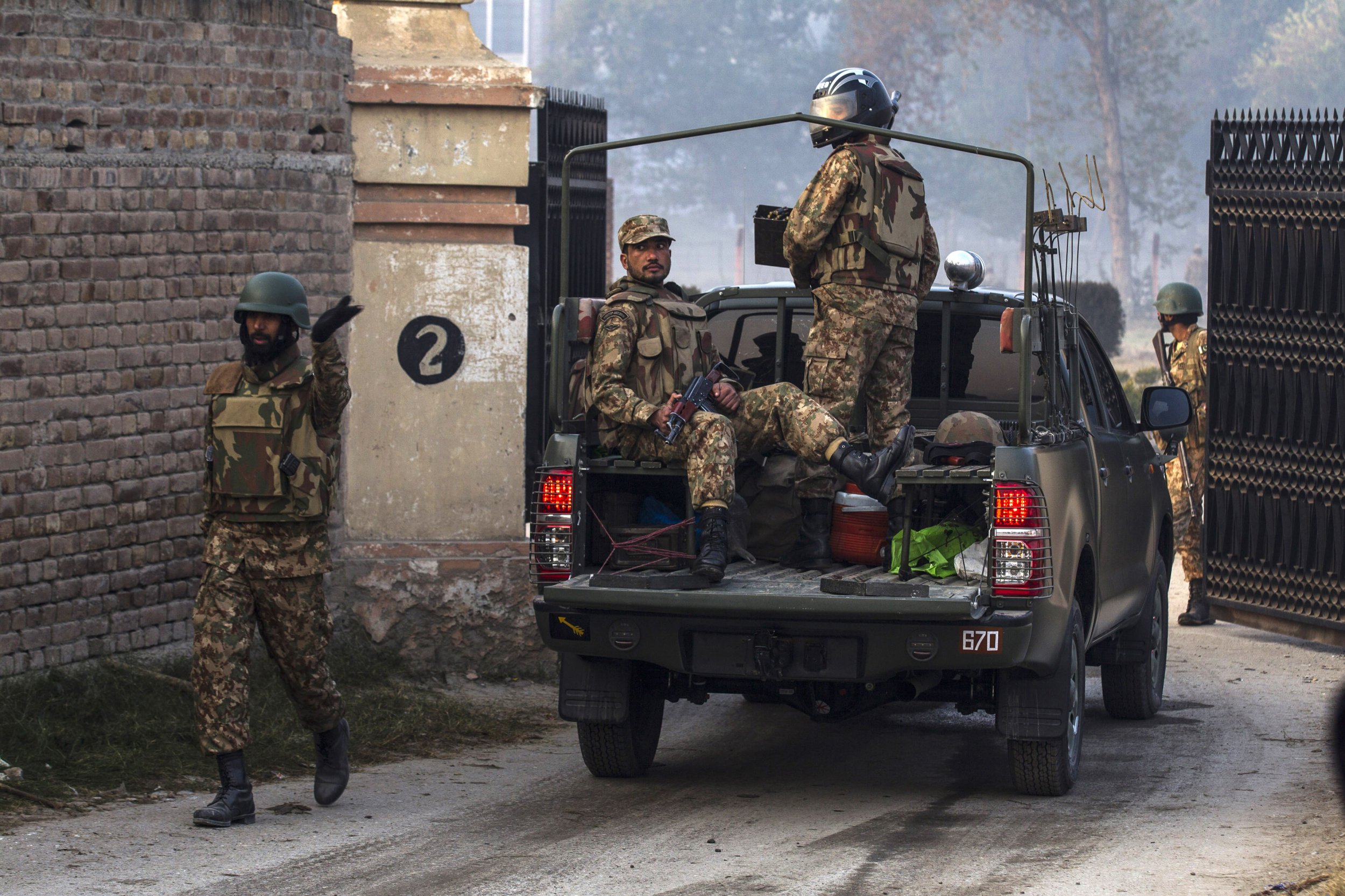
An army soldier gestures as his comrades enter Army Public School, which was attacked on Tuesday by Taliban gunmen, in Peshawar on December 17, 2014. ZOHRA BENSEMRA/REUTERS
*=center]](Is Pakistan Really Cracking Down on Terrorism? - Newsweek)
*=center]
*=center]
*=center]
*=center]
*=center]
FILED UNDER: World, Pakistan, Terrorism
Many have called it a game-changer. On December 16, gunmen loyal to the Pakistani Taliban attacked a military school in Peshawar, killing 148 people. Most of the victims were children, and many were killed as they hid under the desks. The violence was so gruesome it seemed to rattle the country like never before. Quickly, the Pakistani government rushed to assure people it had the situation under control. In the aftermath of the attack, the government set up special military tribunals in which to try suspected terrorists, and the penalties are expected to be harsh. Meanwhile, the army reportedly broadened its crackdown in the federally administered tribal areas, in hopes of thwarting terrorism. “There will be no differentiation between ‘good’ and ‘bad’ Taliban,” Prime Minister Nawaz Sharif said. As Matthew Green wrote in Newsweek, Sharif’s words were “a rare public acknowledgement of Pakistan’s murky record on state sponsorship of extremist proxies.” But more than a month after the massacre in Peshawar, has anything really changed? To explore that question, I chatted with Christine Fair, a professor of South Asian political and military affairs at Georgetown and the author of Fighting to the End: The Pakistan Army’s Way of War (Oxford University Press, 2014).
Was the school shooting a turning point for Pakistan?
It absolutely was not. The army has said very clearly that they’re hoping these [tribunals] are going to give Pakistanis confidence that the military has the situation under control, but they don’t have anything under control.
Try Newsweek for only $1.25 per week
Who are the “bad militants” in Pakistan?
For the most part, almost all of the so-called bad militants have their origins in groups that the state has long sponsored, aided, abetted, trained and in some cases even developed from the grassroots, either to fight in India or in Afghanistan. So there would be no Pakistan Taliban if there had not been this flotilla of militant groups that the state developed.
The groups targeting the state follow the Deobandi interpretative tradition of Islam. This is important because this means that they share a significant common organizational infrastructure. For example, they rely on mosques and madrassas that adhere to the Deobandi tradition of Islam. When 9/11 happened and Pakistan was forced to work with the Americans, these Deobandi groups were furious. Many of these groups came to know Al-Qaeda through their association with the Taliban in Afghanistan. [The Afghan Taliban emerged from Deobandi madrassas in Pakistan.] And these Deobandi groups were furious that the Pakistani state was aiding the overthrow, not only of the Taliban government, but the only government in the world that was exercising a Deobandi version of Sharia [Islamic law]. After 9/11…[some] of these Deobandi groups began fracturing and disobeying the [Pakistani] state. That’s when the insurgency began. Over time these Deobandi organizations began calling themselves the Pakistani Taliban.
Who are the “good militants”?
The “good militants” are, of course, the Afghan Taliban, the Haqqani Network, which continue to be loyal to the Pakistani state. And elements of the Pakistani Taliban that refuse to kill Pakistanis. All of those groups kill in Afghanistan on behalf of Pakistan’s interests. The other “good militant group” is Deobandi is Jaish-e-Mohammed, which was raised to kill Indians in Kashmir and beyond. Over the past year or so, Pakistan has been trying to resurrect Jaish with the aim of luring away some members of the Pakistani Taliban into Jaish for operations against India. There’s one other group that we haven’t talked about, because they’re not Deobandi, and that’s Lashkar-e-Taiba. That organization belongs to the Ahl-Hadith tradition of Islam. This organization has never conducted an operation in Pakistan. They have exclusively focused on India for the vast majority of its history. In recent years, they have been operating against Americans and our Afghan and other allies in Afghanistan.
Is Pakistan unable to crack down on the “bad militants”? Or do they simply choose otherwise?
The problem is they want to preserve the networks that produce terrorists because those networks are the same networks that also produce the “good militants.” When the “bad militants” come after the state, the Pakistanis do try and kill them. And they try and kill them rather than arrest them because Pakistan’s [civilian] legal system is so decrepit, judges are afraid to convict. But they can’t shut down the system comprehensively because Pakistan still hopes to use “good militants” as tools of foreign and defense policy in the region.
What purpose do these “good militants” serve?
Pakistan is an ideological state, not a security-seeking state. Pakistan was founded as the homeland for South Asia’s Muslims. The Pakistan movement mobilized around the Two Nation Theory, which held that Muslims and Hindus are equal nations even if Muslims are fewer in number than Hindus. The proponents of the Two Nation Theory argued that Muslims cannot live under Hindu domination. Pakistan needs to wrest Kashmir away from India to fulfill the dream of the Two Nation Theory because Kashmir is the only Muslim majority area in India.
Pakistan also hopes to retard India’s ability to impose its will on Pakistan and other countries in the region.The only assets Pakistan has to accomplish these goals are its jihadis, who operate with impunity thanks to Pakistan’s growing nuclear weapons. Also, these groups undertake operations with plausible deniability.
The so-called good militants also have an important role to play in Afghanistan. Pakistan prefers a manageable chaos in Afghanistan rather than an Afghanistan that is friendly to India. Pakistan is trying to bring some of the “bad militants” back into the fold of the “good militants.” Pakistan’s efforts to reorient part of the Pakistani Taliban in this way also explains why the Pakistan military gave a five-months warning before undertaking operations in North Waziristan. They wanted to make sure they could return as many of their assets as possible to the category of good militants. And they were pretty successful. What remained in North Waziristan are committed foes who can be dealt with through violence and death.
How does the American drone strategy play into Pakistan’s crackdown?
You can’t really decouple the Pakistani strategy in North Waziristan—which has killed a lot of civilians, I might add, and displaced the majority of inhabitants of North Waziristan—from the drones. The drones, more than anything, have disabled some of the terrorist networks in Pakistan. There’s probably considerable issues of illegality here because the Americans aren’t targeting the Afghan Taliban or Al-Qaeda. We’re actually targeting Pakistani terrorists because the Pakistanis can’t kill them at all or without massive civilian casualties. And then, of course, in keeping the Pakistani role in the drones program secret, we’re basically allowing the Pakistan military and intelligence agencies to use us as a scapegoat. The Pakistani military doesn’t want to admit that they can’t kill these terrorists on their own. The military runs the country based on the claim that it’s the most suitable organization to protect the country’s interests. Pakistan’s intelligence agency, the ISI, does not want this to become public so the organization insists that the United States hide their role in the despised drone program. The Pakistanis are very happy when a drone operation goes well, but when something goes wrong [such as civilian deaths], they pin all the blame on the Americans.
Why do the Americans put up with this?
Nuclear weapons. The U.S. government has a pre-eminent interest that Pakistan’s domestic insurgent groups do not get these nuclear weapons and the U.S. government will do whatever it thinks it can to prevent that from happening. That’s the dirty secret. If these groups have nuclear weapons, they harm U.S. interests. The Pakistani Taliban, because they’re Deobandi, they do have ties to Al-Qaeda, so Americans are absolutely morbidly afraid of that outcome. That’s why they’re writing checks and it’s why they are going to keep writing checks.
So our fear of nuclear weapons is why finding Osama Bin Laden in Pakistan wasn’t a turning point?
Bingo. There’s another reason, too. The United States became dependent on Pakistan because it moved most of the supplies for the war in Afghanistan through Pakistan. This was and is a really bad strategy. I’ve been an opponent of the Afghan war for ages because we can’t win there with Pakistan as our partner. We’re not in a position to put pressure on Pakistan to stop supporting these groups because we’re dependent on Pakistan for logistics. We’re basically blackmailed by their nuclear weapons and they know this. Pakistan wins no matter what. We lost that war the day we decided to fight that war with Pakistan as our key ally.
How do nuclear weapons help Pakistan?
Nuclear weapons help Pakistan in at least three key ways. First, nuclear weapons are how Pakistan protects itself from an Indian military attack in response to a terrorist attack. The logic goes that if India responds conventionally, and is close to defeating Pakistan, that Pakistan, under its ambiguous rules of nuclear engagement, could use them against India. This is how they keep the Indians from responding militarily to a terrorist attack. Second, the international community will always get involved in a crisis. This generally involves putting pressure on India to prevent further escalation. And the Pakistanis understand this. So nuclear weapons intimidate India and coerce the international community to tell India to back down. Third, because of these nuclear weapons, the Americans will never have the courage to write Pakistan off and treat it like the enemy of the United States it actually is.
Is Pakistan more dangerous today than it was on September 11, 2001?
Of course it is. And we have subsidized this development. On our dime Pakistan has been developing this capability for miniaturized [nuclear] warheads and delivery vehicles. These are easily stolen. Imagine if these weapons fall into the hands of terrorists? The congressional hearings will all converge around the question, “Why did we cut Pakistan off? Why didn’t we prevent this?” Everyone is afraid of the next “9/11 commission report” which would follow such a terrible event. By possessing these nuclear weapons, Pakistan has us and our money. The Pakistanis can pull us around like we’re on roller skates.
So what should we do instead?
I’m a fan of saying, “Look, we can’t hold your hand. You’re taking our money, you’re proliferating. If these weapons get into the hands of a non-state actor, we don’t care who uses them, we’re going to hold you responsible per our nuclear doctrine. And by the way, our nuclear doctrine doesn’t treat countries well who use nuclear weapons.”
 ) were raised to fight with a country and if that group of fighters is not terminated or dissolved in the army, then what happened here is bound to happen… US did that in Libya and Syria and we can see the result.