Re: Pakistan
So regal and beautiful.
Re: Pakistan
So regal and beautiful.
Re: Pakistan
I love the Shalamar Garden in Lahore.
I am being lazy. There are just so many nice pics; so here is a Yahoo image link:
Re: Pakistan
This is beauty Tanvir!!! … what a gorgeous piece of art, i wonder how many fountains it has! … 
its also included in UNESCO world heritage site
Re: Pakistan
you should go, its close to gilgit …
and thn you can share photos of your trip with us ! 
Re: Pakistan
That’s good to know. I hope they keep taking care of it.
Re: Pakistan
more of Historical sites …
Minarates of Masoom-Shah-bukhari - Sukkar
“The minerat of Masoom Shah is an example of late Muslim architecture of Sindh. Built by Syed Nizamuddin Mir Mohammad Masoom Shah?Bakhri in 1607AD.? Masoom Shah was a historian and the governer of Sukkur appointed by the Moghul empror Akbar. He had a great interest in art architecture and litrature. He was also one of the most well known historian of Sindh. He wrote a detailed history of Sindh called “Tareekh e Masoomi” The Minerat of Masoom Shah was built to guard the the towns of Sukkur & Bakhar. ***There are 84 stps and the height of minerat is 31 meters there are spectacular views of the city of Sukkur and the river Indus from the minerat.”
Restored attachments:
Re: Pakistan
Wazir Khan Mosque -Lahore
***“The Wazir Khan Mosque ,is famous for its extensive faience tile work. It has been described as ‘a mole on the cheek of Lahore’. It was built in seven years, starting around 1634–1635 AD, during the reign of the Mughal Emperor Shah Jehan. It was built by Shaikh Ilm-ud-din Ansari, a native of Chiniot, who rose to be the court physician to Shah Jahan and the governor of Lahore.”
Restored attachments:
Re: Pakistan
SHAHI MASJID-CHITRAL
“The Shahi Masjid is believed to have been built by Shujaul Mulk who was made Mehtar of Chitral in 1895 by the British government. He is believed to have built many mosques and fortresses in Chitral including the Shahi Mosque. The three-domed mosque is said to have been built in 1914. Two minarets were added later on. The distinctive feature of the mosque is the stucco work, which decorates every space of the mosque inside and outside. The main gate of the mosque, which opens on the south, is also decorated with stucco. The main features of the stucco decoration are the geometric and floral designs. The mosque has no parallel in terms of architecture in the whole of Chitral District.”
Restored attachments:
Re: Pakistan
Tomb Of Jahangir
“The mausoleum is located near the town of Shahdara Bagh in Lahore, Pakistan. His son Shah Jahan built the mausoleum 10 years after his father’s death. It is sited in an attractive walled garden. It has four 30 meter high minarets. The interior is embellished with frescoes and pietra dura inlay and coloured marble. The mausoleum features prominently on the Pakistan Rupees 1,000 denomination bank note. The entrance to the mausoleum is through two massive gateways of stone and masonry opposite each other (to the north and south) which lead to a square enclosure known as the Akbari Serai.”
Restored attachments:
Re: Pakistan
So beautiful with the backdrop of the snowy peak.
Re: Pakistan
Couldn’t see these.
Re: Pakistan
I edited! you can see them now!
Re: Pakistan
These are so nice. Sadly there is no people traffic or raunaq.
Re: Pakistan
hmmm raunaq is missing … or perhaps these photos were taken during the less crowded hours! 
Mohatta Palace - Karachi
***“Mohatta Palace is one of the most recognized landmarks of Karachi built during late 1920s by Shivratan Mohatta, an ambitious businessman from Marwar. He commissioned the construction and design of this grandeur building to architect Ahmed Hussein Agha so that he can design a Rajput resemble palace for him and his family in Karachi so that they can use this building as their summer home”
Restored attachments:
Re: Pakistan
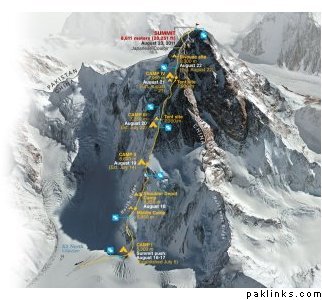
K2 THE HARDEST WAY
An image created using satellite measurements shows the expedition’s key camps along K2’s North Ridge route, which follows the steep fin of rock and snow to the so-called Japanese Couloir, a gorge just below the summit. The route was first scaled in 1982, by a Japanese expedition. K2 takes its name from the 1856 survey notes of British explorer T. G. Montgomerie: “K” for Karakoram, a subrange of the Himalaya, and “2” for the second peak he noted on the horizon.