We have been hearing about this organization which was allegedly formed by Murtaza Bhutto. Whats the reality behind it? Is it for real of a myth?
Re: Al Zulfiqar - Reality or myth?
For those who support Bhuttos its myth and others tend to prove it reality :halo:
Re: Al Zulfiqar - Reality or myth?
^ well I want to dig into the matter without any bias to find out if it was it a ploy of the establishment or did this organization really exist.
Re: Al Zulfiqar - Reality or myth?
But how will you reach to an unbiased and neutral conclusion? I mean what sources will you rely? PPP says that media was in full control under government during Zia regime and they kept on producing propaganda against PPP.
Re: Al Zulfiqar - Reality or myth?
^ thats the problem, there’s not enough information about the topic on the internet too.
Re: Al Zulfiqar - Reality or myth?
I think you can rely on Fatima Bhutto’s latest book.. she had covered the topic with mature approach 
Re: Al Zulfiqar - Reality or myth?
Here is the link for reading selected pages of the book 
Re: Al Zulfiqar - Reality or myth?
And I thought this might be a thread about a legendary sword… 
Re: Al Zulfiqar - Reality or myth?
» Al-Zulfikar: The unsaid history | The Dawn Blog | Pakistan, Cricket, Politics, Terrorism, Satire, Food, Culture and Entertainment](http://blog.dawn.com/2010/04/09/al-zulfikar-the-unsaid-history/)
Pakistan is infamous for having a history cramped with assorted Islamist and sectarian organisations that have been unleashing havoc on its people and the state for over a decade.
**But long before violent terror groups like Sipah-e-Shaba, Lashkar-e-Taiba, Lashkar-e-Jhangvi, and the Tehrik-e-Taliban-Pakistan started using unprecedented violence and coercion to turn their idea of a mythical Sunni Islamic utopia into reality, there was Al-Zulfikar, – a leftwing terror group formed by the sons of former Pakistani prime minister, Zulfikar Ali Bhutto, and the brothers of late Benazir Bhutto.
**
**The son rises
**
**Al-Zulfikar Organisation, or AZO, came into being some months after the execution of Z.A. Bhutto (April 4, 1979). The execution was sectioned by the Ziaul Haq dictatorship through a sham trial.
**
**Although AZO lasted for over a decade, its history has remained shrouded in mystery.
**
**The most complete document available on the subject is in the shape of an invigorating book by former Pakistan Peoples Party (PPP) member and (later) AZO operative, Raja Anwar.
**
**The book was first published in 1997. Called the ‘The Terrorist Prince’, it is an insightful look at the nature of the organisation as well as of its originator, Mir Murtaza Bhutto.
**
**Raja Anwar, one of AZO’s earliest members, after escaping Zia’s tyranny travelled to Soviet-held Afghanistan to join AZO operations in Kabul.
**
**Other sources I have used for this article are newspaper interviews of some of AZO’s leading operatives (many of whom are now dead), and private interviews with the family and cousins of AZO’s most notorious henchman, Salamullah Tipu (who died in 1984).
**
**Recently, Murtaza Bhutto’s daughter, Fatima Bhutto, too has discussed the AZO in her book, ‘Songs of Blood and Sword.’ Unfortunately, Fatima betrays her obvious talents as a writer by sounding cringingly naïve on the matter. In fact, she allows emotionalism and her extreme dislike of anyone even slightly critical of Murtaza to override any worthy hint of objectivity.
**
**Consequently, Fatima completely ignores the telling evidence and information available on the AZO in shape of books such as ‘The Terrorist Prince,’ and ‘The Politics of Terrorism’ (Michael Stohl), and interviews given by Murtaza to the BBC and the Indian media between 1981 and 1986.
**
**Also, Fatima (unlike Raja Anwar), did not find it important to talk to the families of the young, idealistic AZO operatives who were jailed, hanged, or killed between 1980 and 1989.
**
**AZO was formed by Murtaza Bhutto (who was 25 years old at the time) and his younger brother, Shahnawaz Bhutto, in late 1979 after their diplomatic efforts (in London) failed to stop Zia from executing their father who was also the country’s first-ever popularly elected prime minister.
**
**Frustrated and angry, Murtaza got in touch with sympathetic Muslim leaders such as Libya’s Colonel Qaddafi, Syria’s Hafizul Asad, and the PLO’s Yasser Arafat and told them about his plans to overthrow the Zia regime through an armed struggle. After bagging some funds (from Libya and Syria) and a huge arms cache (from the PLO), Murtaza arrived in Kabul, Afghanistan, which was under a pro-Soviet communist government at the time.
**
The AZO’s early recruits were a handful of fiery PPP members who had escaped Pakistan to avoid being arrested by Zia’s police. These men then helped Murtaza get a number of passionate activists from the PPP’s student-wing, the Peoples Students Federation (PSF), who crossed the Pak-Afghan border on foot to enter Kabul. However, almost all of them were either killed or arrested during AZO’s first few actions on Pakistani soil.
The AZO managed to survive the blow and began receiving its second batch of recruits in late 1980. This batch, though smaller in size, had some of the most militant elements from the PSF. One of them was the 25-year-old Salamullah Tipu, who already had blood on his hands, having previously shot dead a member of the Islami-Jamiat-Taleba (IJT), the violent student-wing of the pro-Zia Jamaat-i-Islami (JI), at the University of Karachi.
**Murtaza put Tipu in charge of a plane hijacking plan he’d been contemplating. In early 1981, Tipu, along with a cousin and another PSF militant (Nasser Jamal) in Karachi, pulled off a dramatic hijacking, taking a Peshawar-bound PIA plane at gunpoint to Kabul and then to Damascus in Syria.
**
**He shot dead a Pakistani official on board when Zia refused to accept Murtaza and Tipu’s demands for releasing over 50 activists from the PPP and PSF who had been languishing in Zia’s cramped jails. Zia finally relented, but only when Tipu threatened to kill the six American passengers who were also on the plane.
The successful hijacking not only saw many of the released men join AZO, but the organisation also welcomed a whole new batch of recruits who travelled across Pakistan’s tribal areas and entered Afghanistan, dodging bullets fired by the roaming bands of anti-Soviet jihad gangs that Zia had started to gather on the Pak-Afghan border.
**
**AZO described itself as a socialist guerrilla outfit, but its main purpose was avenging Bhutto’s death. The organisation was mostly made up of young PSF militants, and members of small left-wing groups such as the Communist Mazdoor Kissan Party. Almost all of these men belonged to the lower-middle-class and working-class strata of society and had faced stiff jail sentences, torture, and lashes of Zia’s Islamist tyranny.
**
**AZO was successful in making an “international impact” with the hijacking. Bolstered by fresh funds and support by the Afghan, Libyan, and Syrian governments, AZO soon made at least two serious assassination attempts against Zia. One was a missile attack at Zia’s special plane (Falcon) in Rawalpindi in 1982.
**
The Russian-made, heat-seeking missile whizzed pass the plane and just missed smashing into it, thanks to an astute last minute maneuver by the pilot who’d somehow seen the missile approaching. The attack was engineered and undertaken by two PSF brothers from Rawalpindi.
**The rot sets in
**
**Instead of further strengthening the urban guerrilla outfit, AZO’s sudden success and the fear that it sparked in the country’s brutal military regime, ironically left the organisation in the vicious grip of reckless infighting, mainly due to Murtaza Bhutto’s growing paranoia. He became convinced that the AZO had been infiltrated by Zia’s agents.
**
**Murtaza began to jail and eliminate his own men (with the help of the Afghan intelligence agency, KHAD), accusing them of being traitors, or worse, men ‘planted by the Zia regime.’ A number of murders were committed on Murtaza’s suspicious whims, as he now pitched one group of AZO men against the other.
**
Murtaza’s increasingly paranoid disposition saw him moving some of his men to Libya while he left some behind in Kabul as he himself moved to Damascus.
In 1983, at the height of infighting within the AZO, Murtaza once again decided to use his main weapon, Tipu, this time to assassinate Zia during the dictator’s trip to India. The plan came to a naught, and Murtaza ordered Tipu to go back to Kabul and assassinate some ‘traitors’ that he blamed for the botched assassination attempt. But after Tipu eliminated the ‘traitor’, Murtaza now decided to get rid of Tipu as well. He asked KHAD to arrest him.
Conscious of Tipu’s worth and daring, KHAD hesitated, leaving enough room for Tipu to take over AZO’s Kabul operations. Murtaza, by now firmly in the clutches of mistrust and irrational suspicions, faced the first major challenge to his leadership in the AZO.
From Damascus he again asked KHAD to put Tipu on trial for a murder Murtaza himself had ordered. It was Tipu’s bad luck that though he was able to charm both KHAD and the Soviet KGB with his declaration of being a communist revolutionary who was ready to undertake another hijacking, Tipu’s hot-headed and violent nature soon got him into trouble with the Afghan government as well.
By late 1983, Tipu began to be seen as a security threat by the Afghan government, and this time KHAD obliged Murtaza by arresting Tipu. He was then executed by a firing squad in early 1984.
**By 1985, AZO had crumbled. Most of its operatives had lost their lives. Many surviving AZO men escaped to Libya and Syria (never allowed back into Pakistan); some got asylum in European countries, while a huge number either rotted away in war-torn Kabul, or came back to Pakistan only to be arrested and given long jail sentences.
**
**Benazir Bhutto, who had languished in Zia’s jails, was sent into exile in 1984, and she (while talking to BBC) at once denounced AZO and Murtaza’s tactics.
**
**Murtaza and Shahanawaz (along with their Afghan wives) moved to Cannes in France, where Shahnawaz was allegedly poisoned to death by Zia’s agents.
**
**The second coming and demise
**
The gulf between Murtaza and Benazir continued to grow. Benazir plunged back into the mainstream politics of the country when she returned](http://www.youtube.com/watch?v=i8nk5fmPB9s&feature=related) to the country in 1986.
The same year, Murtaza began changing the ideological nature of AZO. He began turning it into an exclusively Sindhi nationalist organization.
The first version of the AZO (1979-84), had a number of ideologically-charged young Punjabi, Mohajir, Pushtun and Baloch men (along with Sindhis) in its fold.
**The second version of the organization (that shifted its base from Kabul to India), however, was exclusively made up of Sindhi nationalist youth who (between 1986 and 1992), took part in various cases of sabotage and murder in Karachi and the interior of Sindh.
**
Murtaza’s return to Pakistan (in 1993) was made possible only when the first government of Nawaz Sharif agreed to implement a plan hatched by former PPP big-wig, Jam Sadiq Ali (earlier chucked out by Benazir from the party) and some ISI sleuths. They were to make way for Murtaza’s return because they saw him capable of wresting the control of the PPP from Benazir and factionalize the party.
Murtaza arrived back to Pakistan in 1993 (after 17 years). After failing to get a prominent position in the PPP, he formed his own faction, PPP (Shaheed Bhutto).
Nonetheless, his party faced heavy defeats in the 1993 elections (which Benazir’s PPP won).
Till the day he was tragically killed, Murtaza spent all his efforts in trying to undermine Banazir’s second government, but the truth was, his short stint as the agency’s trump card came to an end as soon as it was realized that the majority of the PPP voters had rejected his claim of being the party’s ‘true heir.’
He was finally killed in 1996 during a police ambush on his convoy near his house in Karachi. The ambush was unconvincingly described as an ‘encounter’ by the police.
**Murtaza’s widow, Ghinwa Bhutto (his second wife) accused the Benazir government and Asif Ali Zardari for the murder, whereas Benazir blamed the agencies which she claimed used the episode to topple her elected government.
**
**Along with Murtaza also died whatever was left of Al-Zulfikar, whose last known operative was killed (by unknown assailants) in 2000.
**
Of the two hundred or so young, hot-headed and passionate (albeit naïve) operatives of the organization (between 1979 and 1993), only a few have survived to tell the tale. Most of them died young (aged between 17 and 27), and were buried either in Kabul or Libya, mostly in unmarked graves.
http://blog.dawn.com/wp-content/uploads/2010/04/nadeem_80x801.jpg Nadeem F. Paracha is a cultural critic and senior columnist for Dawn Newspaper and Dawn.com.

Re: Al Zulfiqar - Reality or myth?
This is the book Nadeem paracha is talking about, by Raja Anwer who was a part of the so called “Al Zulfiqar” but later fell out.
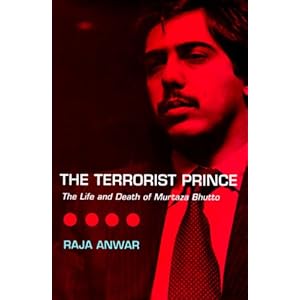
The Terrorist Prince is a gripping insider’s account of the Pakistani resistance organization Al-Zulfikar (in Urdu, “The Sword”), set up in 1979 after the coup by General Ziaul-Haq and the execution of Prime Minister Zulfikar Ali Bhutto. Raja Anwar, the author, was an advisor to Prime Minister Bhutto and one of the organizers of the campaign to save his life after his conviction on a trumped-up murder charge. Named as a traitor by Zia, and liable to execution if arrested, Anwar sought asylum in Germany. But when Bhutto’s sons Murtaza and Shahnawaz asked him to join them, he agreed and participated in the founding of Al-Zulfikar. Raja Anwar recounts the transformation of Al-Zulfikar into a terrorist group, run by Murtaza Bhutto as his own exclusive fiefdom. In 1981, the organization hijacked a Pakistani airline en route to Kabul. Twice it came close to assassinating Zia. For his opposition to Murtaza’s leadership, Anwar was imprisoned in Kabul for four years. Murtaza himself was killed by the police in Karachi in 1996. Raja Anwar draws unmistakably convincing portraits of the obsessively ruthless Murtaza, his lieutenant, chief executioner and eventual victim, Salamullah Tipu, and the young workers who sacrificed their lives for a corrupted cause. Rich in detail available only to a participant in the turbulent events it portrays, The Terrorist Prince brilliantly fuses the tension and pace of a political thriller with the veracity of first-rate reportage. It is a compelling narrative of ruptures which continue to divide a deeply troubled Pakistan.
Re: Al Zulfiqar - Reality or myth?
The mystique of ‘cursed dynasties’ - Features - Al Jazeera English
**Halfway across the world, the Bhutto family - sometimes known as the Kennedys of Pakistan - are also one of the most well-known political dynasties whose image has been branded by their unfortunate fate. Their curse began with the death of Zulfiqar Ali Bhutto, the prime minister who was imprisoned and hanged in 1977 at the orders of General Zia-ul-Haq following a military coup.****Zulfiqar’s sons Murtaza and Shahnawaz were both assassinated under mysterious circumstances.
**
[TABLE=“width: 33, align: right”]
**Murtaza, who formed the armed group al-Zulfiqar while self-exiled in Afghanistan to combat the military dictatorship under Zia, was supposedly shot dead in 1996 by police outside of his home - although a number of people question the police’s involvement. His brother Shahnawaz was found poisoned in his apartment in Nice, France, 11 years earlier. **More recently Benazir, who served two terms as prime minister and succeeded her father at the head of the democratic socialist Pakistan Peoples Party (PPP), died from a combination bomb and gun attack while leaving an election rally in 2007.
Duane Baughman, who directed a documentary on Benazir entitled Bhutto, told Al Jazeera that the Bhuttos captured the public imagination through “their good fortune, their wealth, their exceptional good looks” and the perception that they were martyred for democracy.
“Zulfiqar Ali Bhutto, Pakistan’s first democratically elected prime minister, won on the strength of the [PPP], which promised a poor country ‘food, shelter, and clothing’ as well as the creation of a middle class,” he explained. “When you try to change the course of your nation’s history and you are killed, you become a martyr; there will undoubtedly be a huge outpouring of sympathy.”
Zarrar Khuhro, the editor of the Express-Tribune daily’s magazine section, agreed, and said that their violent deaths turned both Zulfiqar and Benazir into saints.
In Zulfiqar’s case, Khuhro said, “the way in which he was killed… had the effect in many ways of putting his political legacy above reproach, much like [President] Kennedy”.
Re: Al Zulfiqar - Reality or myth?
Whats the history of the sword?
Re: Al Zulfiqar - Reality or myth?
The sword of so called democracy 
Re: Al Zulfiqar - Reality or myth?
The sword of Hazrat Ali, which had been made part of many fictitious tales
Re: Al Zulfiqar - Reality or myth?
Pakistanis are ahead of us, atleast they can hang their netas:D
Re: Al Zulfiqar - Reality or myth?
try that. boht maza aata hai