Re: Ah yes finally bush compares Eyraq to Vietnam
next on agenda…
→
safe israel from iraQ… :k:
—> Bomb iraQ vol 2 … ***coming soon to entertain mighty n superior americans ***… :k:
Re: Ah yes finally bush compares Eyraq to Vietnam
next on agenda…
→
safe israel from iraQ… :k:
—> Bomb iraQ vol 2 … ***coming soon to entertain mighty n superior americans ***… :k:
Re: Ah yes finally bush compares Eyraq to Vietnam
I realize that going into Iraq in the first place and almost every policy decision since has been a huge blunder. But the violent culture that has emerged has always been there, they just don't have a brutal dictator keeping them suppressed anymore. I predict a future military coup that will be backed by the US. They can't handle freedom and democracy and Bush's biggest mistake was thinking they could.
Of course Shia vs Sunni isn't the point of discussion and never will be with this crowd. It's so much nicer to keep your head in the sand, claim the perfect religion and try to find 'humiliation' for the US in every post instead of addressing the real problem that will be the reality on the ground whether the US stays or is wiped off the earth in humiliation. But I was (and am) responding to your post of a shia vs shia conflict that you wanted to somehow demonstrate that Iraq resembles Vietnam.
Re: Ah yes finally bush compares Eyraq to Vietnam
May be you can explain the logic of not allowing UN to take reigns of Iraq? Not once, but twice. Even when arm-chair critics saw the upcoming problems, journalists pointing out the obvious but there wasn't a budge from US policy stand point of view... all we could hear and see was "bring'em on".
Re: Ah yes finally bush compares Eyraq to Vietnam
My religion shiitia v Sunni is non of ya business, stick to the discusssion at hand in short put up or shut up… We all know how much love you have for camel jokeys and 4 footers in the far east that you killed in millions… How very civilized, isn’t it… Try hard you might hit a spin…
Re: Ah yes finally bush compares Eyraq to Vietnam
If you don't want to talk about shia vs shia violence then don't post articles about it. But shia vs sunni should be somebody's business since that is what is tearing Iraq apart.
And how smart of you to tell me who I care about and how many millions I've killed. And how very civilized to refer to others in such racist terms. You've never seen me type use those terms.
Go ahead and try to spin this into a humiliating defeat for US that is on par with Vietnam war. Meanwhile scores of Muslims are being killed and tortured every day. By Muslims.
Re: Ah yes finally bush compares Eyraq to Vietnam
Why, you don’t like to hear about Shias and Sunnis that are making love to your terrorist in uniform? Why hurts too much?.. Very nice of you to care so much about Shias and Sunnis and so little concern for 30,000 homicides at home… Keep your house in order and don’t stick your nose where it don’t belong… BTW any chance of liberating NoKos or is that region for table dance only?
Re: Ah yes finally bush compares Eyraq to Vietnam
.
That is what James Baker is recommending.
Re: Ah yes finally bush compares Eyraq to Vietnam
Firstly, I was totally against this war in iraq for exactly the predicament that USA, Iraq and the world finds it self in...
With that out of the way, please explain how do you expect the UN to maintain order in Iraq when they are so illequipped to deal with this kind of mess?
Dont you remember Somalia or Bosnia where the UN Peacekeepers were killed and couldn not stop the genocide from occuring in Sebrenecia...
Re: Ah yes finally bush compares Eyraq to Vietnam
well hopefully james baker does not hae to take his words back like this guy. I mean how do u say one thing and then say well I dinn really mean it. he claims that he seriously misspoke…He has not quote clarified what he had actually meant..
The US state department official who said that the US had shown “arrogance and stupidity” in Iraq has apologised for his comments
Re: Ah yes finally bush compares Eyraq to Vietnam
I am kinda on the same page as you. I had said way back that we seem to be rushing in too quickly and all, but that once the military is in, it can not be pulled back out because its like stirring a hornets nest, either let it be, or if u are going to mess with it, be preapred to go all the way or you and standerbys will all get stung.
Re: Ah yes finally bush compares Eyraq to Vietnam
Civil war is the latest phenomena, it didn't take place 1-2-3 years ago. When nations wanted UN to take reigns, it was possible, why? The terrorsts/victims main issue was presence of "allied army", any casualty involving allied-army was seen as insult to locals and resulted in more people joining the armed struggle... which later got hijacked to sectarianism and then civil war. US and alliances have failed to address the root-cause on many occasions, now even that seems to be impossible.
Re: Ah yes finally bush compares Eyraq to Vietnam
The date for military withdrawl should be approximate, and the process should be phased over a few months. But, yes, announcing a date can be very productive. Building of an Iraqi army, which is free from political, ethnic and religious affiliations, must be completed before withdrawl.
Re: Ah yes finally bush compares Eyraq to Vietnam
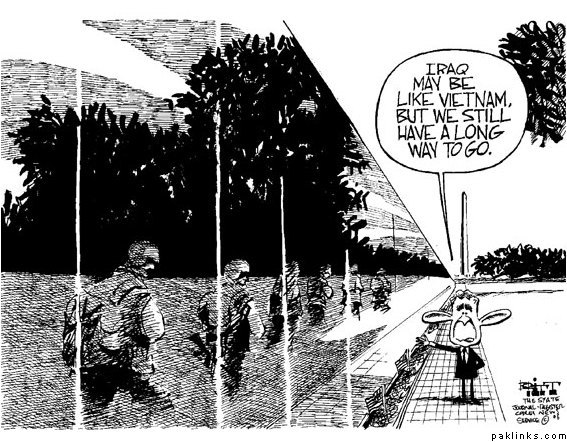
For those with comprehension problem.
Re: Ah yes finally bush compares Eyraq to Vietnam
When Shri Kim Sr. raped amreeka amreeka screamed Chini wala Chini wala when Shri Ho Chi Minh shafted amreeka amreeka screamed Russkie wala Russkie wala… What is amreeka gona scream now?
Rest assured Amreeka will never use the following BS EVER in that order or out of order..
OH BTW the retard at downing street made a similar confession in an interview to Al-Jazeeeeeera… I can post that too but it will be too much for some retard on this forum.
http://www.theherald.co.uk/news/74851.shtml
** Kissinger: military victory in Iraq ‘not possible’ ** 
MICHAEL SETTLE, Chief UK Political Correspondent November 20 2006
** Military victory in Iraq is “not possible”, Henry Kissinger, the former US Secretary of State, claimed yesterday as he delivered a downbeat assessment of the strategy being pursued by the American-led coalition.
The respected 83-year-old statesman claimed the US/UK’s original plan for a democratically-run Iraq in full control of its own security had failed ** and that Iraq was now embroiled in a “civil war”.
However, he warned pulling all the coalition troops out could lead to “disastrous consequences”, destabilising the region and causing a conflict that could last for many years.
Mr Kissinger, who served as Secretary of State in the Nixon and Ford administrations between 1973 and 1977, also called for an international conference on Iraq, bringing together the United Nations Security Council and regional powers to work out a way forward for the Middle East.
His gloomy comments came as Gordon Brown ended his first fleeting visit to Iraq; the Chancellor was due to return from Basra last night.
During his 24-hour trip, Mr Brown appeared to go further than Tony Blair on the withdrawal of Britain’s 7000 troops. The Prime Minister has given a timescale of 12 to 18 months but the Chancellor raised the prospect of some troops returning home “over the next few months”.
As he met Army chiefs and Iraqi ministers, Mr Brown announced Britain would pledge an extra £100m over the next three years to rebuild the country’s economy.
Addressing some 300 soldiers from the Princess of Wales Royal Regiment, known as “the Tigers”, he praised their “tremendous” work, adding: “You are the tigers. Proud and courageous tigers. Everyone in Britain is proud of you.”
Last week, Mr Blair appeared to agree with the contention that policy on Iraq had been “a disaster”, saying: “It has” but going on to explain that the reason for this was the continuing mayhem wrought by the insurgents. Downing Street at first said the remark had been misrepresented and then that it had been a “slip of the tongue”.
Yesterday, Mr Kissinger, when asked about whether the coalition could attain military victory, told the BBC: “If you mean by ‘military victory’ an Iraqi government that can be established, that gets the civil war under control and sectarian violence under control in a time period that the political processes of the democracies will support, I don’t believe that is possible.”
He added: “The art of leadership will be to find a course that will protect our values, our interests and the possibility of some progress in the area.”
The issue of Iraq will return to the Commons on Wednesday when MPs turn to foreign affairs. The prospect of the Conservatives changing tack has been raised after William Hague, Shadow Foreign Secretary, described the bipartisan approach to Iraq as having been “strained” by what he described as Mr Blair’s failure to be honest. “We feel free to be constructively critical.”
While the Tories will not demand an immediate withdrawal, they will insist British priorities must be taken into account into the White House’s new approach.
Last week, the Baker Commission investigating the way forward on Iraq ended its inquiry, and its report is due to published next month.
Hallelujah
Re: Ah yes finally bush compares Eyraq to Vietnam
Rat in Vietnam, learning how to cut and run…
http://www.guardian.co.uk/usa/story/0,,1950228,00.html
Bush to face the ghosts of America’s last failed war
Thirty-one years after the US army left Saigon, President Bush flies in for a visit dogged by the unlearned lessons of history
Suzanne Goldenberg
Friday November 17, 2006
The Guardian
Vietnamese soldiers form the honour guard to welcome state visitors. Photograph: Barbara Walton/EPA
On the morning of April 30 1975 a young corporal in the army of North Vietnam drove a tank through the streets of an unfamiliar city wreathed in smoke and resounding with gunfire, and stopped at a set of wrought-iron gates. Corpses lay on the pavement, and in the distance a lone helicopter rose above the US embassy and turned towards the river.
The soldier, Nguyen Van Tap, paused: could the gate be electrified? Then he gunned the engine and crashed into Saigon’s Independence Palace. Moments later, Mr Nguyen’s lieutenant, Vu Dang Toan, took the surrender of the South Vietnamese regime barricaded inside.
** The Vietnam war was over, and the two villagers from north of Hanoi had witnessed what would have once been unthinkable: the humbling of a superpower by a peasant army. In the paint factory on the outskirts of Hanoi where the two men work now, Mr Vu says the significance of the victory was apparent even then.
“When a small country like Vietnam is invaded by a big country like America and wins, then all the other countries can learn a lesson - that they can win a war against America,” he says.
“They ran like cowards,” says Mr Nguyen.
“They simply didn’t have the power to fight us,” adds Mr Vu. He smiles.
America has never really got over that morning in Saigon. Today, 31 years later, George Bush arrives in Hanoi for a visit steeped in the legacy of an old defeat - and haunted by the prospect of another.
Vietnam and Iraq - it is the comparison that the Bush administration has resisted since the US invasion of Iraq in March 2003. **
Weeks later, the defence secretary, Donald Rumsfeld, was snapping at reporters for even daring to suggest that America faced an organised resistance. But by last month, one of the bloodiest since the war began, even Mr Bush was forced to concede that there were points of comparison. He likened events in Iraq to the Tet offensive of 1968, which turned US public opinion against involvement in Vietnam.
In reality, the most compelling parallel has little to do with either Iraq or Vietnam. It is about the nature of power: America’s view of itself in the world, and its execution of foreign policy.
Once again, America is sending troops to a faraway country that it does not understand, an incomprehension that has led to fatally flawed war plans and policies. Once again, it has committed forces for reasons that seem unclear at best. In Vietnam, it was the August 1964 attack on US destroyer in the Gulf of Tonkin, which we now know never happened. In Iraq, it was the imminent danger that Saddam Hussein had weapons of mass destruction. And that is why this war has proven so painful - because the lessons of Vietnam were not absorbed.
This is Mr Bush’s first overseas trip since the midterm elections, when American anger at the war in Iraq cost the Republicans control of Congress. In the days since then, Mr Bush has worked hard to persuade Americans that he is willing and able to abandon his administration’s discredited policies. Mr Rumsfeld - our era’s version of Robert McNamara, the Pentagon chief in the 1960s - was sacked. Administration officials argue that Iraq can be fixed. But even if Mr Bush can effect a genuine change of course in the Iraq war, can all the damage of the last three years really be undone? Where will Iraq be 30 years from now, and how will this generation of Americans view this war?
In Vietnam, the visit of a serving US president was intended to show off the country’s rising prosperity - not remind the world of earlier suffering. But in a city where Ho Chi Minh’s marble mausoleum remains a place of pilgrimage, Mr Bush’s weekend in Hanoi may have less to do with the mundane details of trade agreements than awkward reminders of wars present and past.
Wartime scars
This is a city graced by small lakes, where Vietnamese stroll as the evenings cool. During the war, a young navy pilot named John McCain was shot down over one of them. Senator McCain, who this week declared his intention to contest the 2008 presidential elections, spent five years as a prisoner in Vietnam.
His flight suit hangs in a dusty display case in an ochre-coloured prison that was a hangover from the French colonial era, along with grainy photos of gaunt-faced prisoners. In some shots, they are playing ping pong - propaganda produced by the Vietnamese to show the prisoners were well treated. The Americans called it the Hanoi Hilton. The title seems an even greater irony now that part of the prison has been demolished to make way for the luxury Hanoi Towers, a hotel and shopping complex.
Ha Thuc Van, my translator, was born in July 1975, three months after the war. She has never been here before and is uncomfortable at the shackled prisoners and the colonial-era guillotine. “I’m really surprised here. I feel bad,” she says. “I was born when the war ended and I want nothing to do with the war.”
That attitude is not uncommon in Vietnam. Half of the population of 84 million were born after the war ended, and those old enough to remember the early post-war years of rice rationing and privation are just as eager to forget. The 80s were a time of economic disaster in Vietnam as the communist authorities pursued what they now acknowledge was “inappropriate socioeconomic management”. Thousands of people in the fallen city of Saigon, now Ho Chi Minh, were herded into re-education camps; a million more - from north and south - fled the country as boat people.
The Vietnamese are well aware they can never entirely rid themselves of that pain. Children are still born with the deformities attributed to Agent Orange, the toxic herbicide sprayed by US forces against Vietnam’s jungle canopies.
And yet time has erased some wartime scars. What once were free-fire zones have reverted to rubber plantations and rice paddies. Saigon was rebuilt as the bustling metropolis of Ho Chi Minh. And as the victors, the Vietnamese can take pride in their history - or at least make money from it.
War tourism
Forty-five miles north of Ho Chi Minh City, the Cu Chi tunnels, an intricate network of bunkers and supply routes protected by ingenious bamboo traps, are a monument to Vietnamese determination during the war. They are now also one of the country’s leading tourist destinations. Westerners can watch lithe Vietnamese in green uniforms shimmy into a hole that seems about the size of an A4 piece of paper. If they want an even deeper faux war experience, they can let off a few rounds from an AK-47 - 10 bullets for $12 (£6.30).
War was hell. Now it’s a theme park - although old hatreds are not entirely camouflaged. In a video the narrator intones: “The merciless American bombers have decided to kill this gentle piece of countryside,” extolling the valour of Vietnamese fighters. “Brave exterminators of American soldiers, brave destroyers of tanks, and brave down-shooters of American aircraft.”
But it is almost impossible to find anyone who still talks like that soundtrack in real life. The generations want to move on. Phan Thanh Hao, a writer and translator, spent her teenage years collecting corpses in the streets of Hanoi. Her son was born in 1972, too young to remember the bombing campaigns that Christmas. “When I talked to my son about the war, he said ‘now you want me to suffer too,’” she says.
That attitude may be changing. A long-suppressed novel on the brutality of those years by Bao Ninh, who was one of only 10 survivors in his unit of 500, was republished in Vietnam last year. And Ms Phan’s son now wants to make a film about the war.
For those Americans who came of age during the Vietnam war, the parallels with Iraq are painful and immediate. Veterans’ organisations say the Iraq war has reawakened long-suppressed traumas. “The longer the war goes on we have increased incidence of Vietnam vets or even world war two or Korean vets whose symptoms are popping up,” says Tom Berger, chairman of the post-traumatic stress disorder committee of the Vietnam Veterans of America.
But for the government of Vietnam, which is desperate to avoid any friction with its main trading partner, there is little to be gained from memories of that war - and certainly not in openly opposing the US on Iraq. Last week Tran Duc Loi, a senior member of the ideological wing of the Communist party, issued a scathing critique of the Iraqi resistance. “They behave more like random rebelling groups,” he told IPS news service. “When we fought, we only fought against the ones who fought us. Civilians were never our targets.” He said he doubted the Iraqis would succeed in driving out the Americans.
Other Vietnamese are not so sure, and in private are highly critical of this war. Nguyen Viet Noi was 18 in 1965 when the US poured thousands of new troops into Vietnam, and one of three members of his family to join the North Vietnamese army. He spent his war building a section of the Ho Chi Minh trail.
He bridles at the idea that Vietnam’s struggle was anything like the war in Iraq. The Vietnamese were organised, he says, and united around a single leader and objective: an independent country. But he also believes that no good can come of this war. “America sooner or later is going to have to withdraw troops from Iraq, and Iraq is going to have a civil war. America cannot stay there because it is going to cost a lot of money and lot of people. It’s just like with the former Soviet Union and Afghanistan.”
Tet offensive
A superpower came undone. The death toll in Iraq has painfully illuminated for many Americans the fact that their country was unprepared - as it was in 1968 when the North Vietnamese army launched the Tet offensive.
That January, Chuck Searcy was an analyst in military intelligence and based just outside Saigon. When he left his station that evening, the threat level was yellow - normal for that stage of the war - and he went into town to watch a movie. The alarm sounded hours later. Tan San Nhut airbase was overrun and Saigon was under attack. In their billet, the soldiers scrambled to unlock their weapons. “I will never forget. We were frozen with unexpected adrenaline awareness: ‘Oh my God, how can it be that the war had come to Saigon? Saigon was supposed to be secure.’ But by then we could see the smoke rising, so we knew it was a serious business.”
The attack had a devastating effect on domestic support for the war. “It made the American people aware for the first time that we were not winning the war, and that it was no longer true that if we kept our resolve and did not buckle under our disappointments we would prevail,” says Mr Searcy, who now heads a mine clearance programme for the Vietnam Veterans Memorial Fund. “The credibility of the American and military leadership was severely undermined and never recovered.”
Mr Bush faced that same moment of mass disillusion this month in the punishment US voters inflicted on the Republicans in the mid-term elections. Across the Pacific, the Vietnamese took note. US politics are followed avidly in Vietnam - even if the motivation now is to track developments that could help accelerate economic growth. There is nothing to be gained in dwelling on the pain of the past - still less on identifying too strongly with the suffering of those trapped in another war.
“The younger generation in Vietnam, they follow the Vietnamese government policy at the moment: don’t talk about the past. Move on. Look to the new,” says Mr Nguyen. “All nations are our friends.”
At this moment in time that should suit Mr Bush just fine. Maybe, 30 years from now, that credo will guide Iraq too.
Two wars : How they compare
Vietnam
Justification for war US destroyer attacked by north Vietnamese in the Gulf of Tonkin. Some historians now dispute that this happened.
Invasion A few thousand US troops arrive in 1965 in South Vietnam to prop up southern Vietnamese government.
Expanding the war US attacks Laos and Cambodia for providing a supply line to North Vietnamese troops.
Body count More than 58,000 US troops killed and 304,000 wounded. Estimated 3 million Vietnamese killed and a million in Laos and Cambodia.
Financial cost More than $150bn for the US alone.
Outcome US troops left in 1973 and in 1975 Vietnam was reunified under communist control.
Iraq
Justification for war Iraq suspected of having weapons of mass destruction and some ties to the terrorists behind the September 11 attacks.
Invasion March 2003: Approximately 100,000-strong allied coalition spearheaded by US forces.
Expanding the war Contained within Iraq, but strong allied intelligence suspects that Iraqi insurgents are being armed by Iranian sympathisers.
Body count Nearly 3,000 US troops killed and almost 22,000 wounded in action. Estimates that at least 50,000 Iraqis, mainly civilians, have died since the invasion.
Financial cost At least $400bn (£212bn) and rising.
Outcome Still uncertain.
Re: Ah yes finally bush compares Eyraq to Vietnam
American officials from the President downwards are just wanting to escape a sinking ship these days.
Re: Ah yes finally bush compares Eyraq to Vietnam
This was to be expected, when their army of terrorists are being picked off one by one.
Re: Ah yes finally bush compares Eyraq to Vietnam
The SOBs are now comming out gradually and confesing that the end cost of going to war with Eyraq will be in trillions of dollars with no objectives meet.
P.S: Converting the whitehouse into mental asylum would be a very productive thing for amreekans.