Re: Pak US relationship - Afghan War End Game
and its not rocket science, not something which is impossible to do 
Re: Pak US relationship - Afghan War End Game
and its not rocket science, not something which is impossible to do
Re: Pak US relationship - Afghan War End Game
It’s a propaganda failure of titanic proportions. We are a bad seller, bad advocate and a bad international player.
Re: Pak US relationship - Afghan War End Game
thanks to our fabulous leadership! 
Re: Pak US relationship - Afghan War End Game
Haqqani with president Reagon.
https://p.twimg.com/As25NT6CEAA10m3.jpg
Woh jo hum main tum main jo qarar tha
tumhain yaad ho kay na yaad ho
Re: Pak US relationship - Afghan War End Game
 Mullah Omer is missing
Re: Pak US relationship - Afghan War End Game
FM said we want to move beyond Salala incident. what was the point of making such tall claims we will not reopen nato routes without formal apology and US needs to stop drone strikes.
atleast they should impose taxes on nato routes 
Re: Pak US relationship - Afghan War End Game
and here 
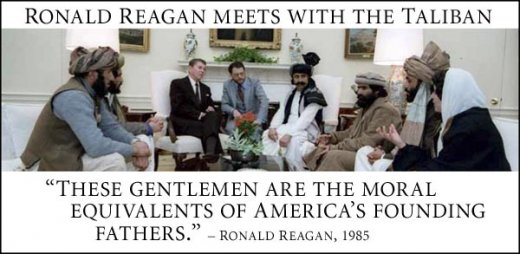
Re: Pak US relationship - Afghan War End Game
HAHAHA at that statement by US president 
Re: Pak US relationship - Afghan War End Game
http://www.nytimes.com/2012/05/20/us/obamas-journey-to-reshape-afghanistan-war.html?_r=1&hp
It was just one brief exchange about Afghanistan with an aide late in 2009, but it suggests how President Obama’s thinking about what he once called “a war of necessity” began to radically change less than a year after he took up residency in the White House.
Not long before, after a highly contentious debate within a war cabinet that was riddled with leaks, Mr. Obama had reluctantly decided toorder a surge of more than 30,000 troops. The aide told Mr. Obama that he believed military leaders had agreed to the tight schedule to begin withdrawing those troops just 18 months later only because they thought they could persuade an inexperienced president to grant more time if they demanded it.
“Well,” Mr. Obama responded that day, “I’m not going to give them more time.”
A year later, when the president and a half-dozen White House aides began to plan for the withdrawal, the generals were cut out entirely. There was no debate, and there were no leaks. And when Mr. Obama joins the leaders of other NATO nations in Chicago on Sunday and Monday, the full extent of how his thinking on Afghanistan has changed will be apparent. He will announce what he has already told the leaders in private: All combat operations led by American forces will cease in summer 2013, when the United States and other NATO forces move to a “support role” whether the Afghan military can secure the country or not.
Mr. Obama concluded in his first year that the Bush-era dream of remaking Afghanistan was a fantasy, and that the far greater threat to the United States was an unstable, nuclear-armed Pakistan. So he narrowed the goals in Afghanistan, and narrowed them again, until he could make the case that America had achieved limited objectives in a war that was, in any traditional sense, unwinnable.
“Just think how big a reversal of approach this was in just two years,” one official involved in the administration debates on Afghanistan said. “We started with what everyone thought was a pragmatic vision but, at its core, was a plan for changing the way Afghanistan is wired. We ended up thinking about how to do as little wiring as possible.”
The lessons Mr. Obama has learned in Afghanistan have been crucial to shaping his presidency. Fatigue and frustration with the war have defined the strategies his administration has adopted to guide how America intervenes in the world’s messiest conflicts. Out of the experience emerged Mr. Obama’s “light footprint” strategy, in which the United States strikes from a distance but does not engage in years-long, enervating occupations. That doctrine shaped the president’s thinking about how to deal with the challenges that followed — Libya, Syria and a nuclear Iran.
In interviews over the past 18 months, Mr. Obama’s top national security aides described the evolution of the president’s views on Afghanistan as a result of three rude discoveries.
Mr. Obama began to question why Americans were dying to prop up a leader, President Hamid Karzai of Afghanistan, who was volatile, unreliable and willing to manipulate the ballot box. Faced with an economic crisis at home and a fiscal crisis that Mr. Obama knew would eventually require deep limits on Pentagon spending, he was also shocked, they said, by what the war’s cost would be if the generals’ counterinsurgency plan were left on autopilot — $1 trillion over 10 years. And the more he delved into what it would take to truly change Afghan society, the more he concluded that the task was so overwhelming that it would make little difference whether a large American and NATO force remained for 2 more years, 5 more years or 10 more years.
The remaking of American strategy in Afghanistan began, though no one knew it at the time, in a cramped conference room in Mr. Obama’s transition headquarters in late 2008. Gen. Douglas E. Lute, who had spent the last two years of the Bush administration trying to manage the many trade-offs necessary as the Iraq war consumed troop and intelligence resources needed in Afghanistan, arrived with a PowerPoint presentation.
The first slide that General Lute threw onto the screen caught the eye of Thomas E. Donilon, later President Obama’s national security adviser. “It said we do not have a strategy in Afghanistan that you can articulate or achieve,” Mr. Donilon recalled three years later. “We had been at war for eight years, and no one could explain the strategy.”
So in the first days of his presidency, Mr. Obama asked Bruce O. Riedel, a former C.I.A. officer with deep knowledge of the region, to lead a rapid review. At the time, the president was still speaking in campaign mode. He talked about remaking “an economy that isn’t dominated by illicit drugs” in Afghanistan and a “civilian surge” to match the military effort. But he said little about the Riedel team’s central insight: that Pakistan posed a far greater threat.
“If we were honest with ourselves, we would call this problem ‘Pak/Af,’ not ‘Af/Pak,’ ” Mr. Riedel said shortly after turning in his report. But the White House would not dare admit that publicly — even that rhetorical reversal would further alienate the Pakistanis.
Mr. Obama agreed with Mr. Riedel, but thought the review did not point clearly enough toward a new strategy. To get it right, the president ordered up a far more thorough process that would involve everyone — military commanders and experts on civilian reconstruction, diplomats who could explore a negotiation with the Taliban, and intelligence officials who could assess which side of the war the Pakistanis were fighting on.
But he also began to reassess whether emerging victorious in Afghanistan was as necessary as he had once proclaimed. Ultimately, Mr. Obama agreed to double the size of the American force while training the Afghan armed forces, but famously insisted that, whether America was winning or losing, the drawdown would begin in just 18 months.
“I think he hated the idea from the beginning,” one of his advisers said of the surge. “He understood why we needed to try, to knock back the Taliban. But the military was ‘all in,’ as they say, and Obama wasn’t.”
The president’s doubts were cemented as the early efforts to take towns like Marja in Helmand Province took months longer than expected. To Mr. Obama and his aides, Marja proved that progress was possible — but not on the kind of timeline that Mr. Obama thought economically or politically affordable.
“Marja looks a lot better than two years ago,” one senior official said at the end of last year. “But how many Marjas do we need to do, and over what time frame?”
The tight group of presidential aides charged with answering questions like that — of redefining the mission — began meeting on weekends at the end of 2010. The group’s informal name said it all: “Afghan Good Enough.”
“We spent the time asking questions like: How much corruption can we live with?” one participant recalled. “Is there another way — a way the Pentagon might not be telling us about — to speed the withdrawal? What’s the least we can spend on training Afghan troops and still get a credible result?”
By early 2011, Mr. Obama had seen enough. He told his staff to arrange a speedy, orderly exit from Afghanistan. This time there would be no announced national security meetings, no debates with the generals. Even Defense Secretary Robert M. Gates and Secretary of State Hillary Rodham Clinton were left out until the final six weeks.
The key decisions had essentially been made already when Gen. David H. Petraeus, in his last months as commander in Afghanistan, arrived in Washington with a set of options for the president that called for a slow withdrawal of surge troops. He wanted to keep as many troops as possible in Afghanistan through the next fighting season, with a steep drop to follow. Mr. Obama concluded that the Pentagon had not internalized that the goal was not to defeat the Taliban. He said he “believed that we had a more limited set of objectives that could be accomplished by bringing the military out at a faster clip,” an aide reported.
After a short internal debate, Mr. Gates and Mrs. Clinton came up with a different option: end the surge by September 2012 — after the summer fighting season, but before the election. Mr. Obama concurred. But he was placing an enormous bet: his goals now focus largely on finishing off Al Qaeda and keeping Pakistan’s nuclear weapons from going astray. Left unclear is how America will respond if a Taliban resurgence takes over wide swathes of the country America invaded in 2001 and plans to largely depart 13 years later.
Re: Pak US relationship - Afghan War End Game
By Sherry Rahman, ambassador of Pakistan to the US.A better relationship for U.S., Pakistan - chicagotribune.com
The NATO summit in Chicago will focus on the endgame in Afghanistan on the heels of U.S. House debate on bills that will shape the nature of the U.S.-Pakistan relationship. The tone of this debate and the diplomacy of the Obama administration will send a clear signal to the 180 million people of Pakistan as to whether the world’s oldest democracy will stand with one of the world’s newest democracies to defeat terrorism and extremism for a politically stable and economically viable South Asia. Many are pessimistic.
However, a series of confidence-building measures could recast our bilateral relationship. If the war against extremism is to succeed, the war of words between democratic allies must end.
**The U.S. and Pakistan have had a rocky year. The unilateral raid on Abbottabad, the Raymond Davis CIA provocation, the U.S.-led NATO air assault in Salalah that tragically killed 24 Pakistani soldiers and the continuing unauthorized drone attacks on Pakistani soil have frayed our 60-year special relationship.
**
We can dwell on the things that have separated us or work toward rebuilding the relationship.
Pakistan has taken the first step to restoring normalcy to U.S.-Pakistan relations by working to reopen the NATO supply routes that were closed after the Salalah tragedy.
Significant progress could be made toward resetting the relationship between our countries if the U.S. were to:
•Finally apologize for the battlefield deaths at Salalah.
•Reimburse the Coalition Support Funds — U.S. repayments to Pakistan for the cost of battling terrorism — owed to Pakistan, a very small part of the $78 billion that Pakistan has lost on account of the war against extremism since 2001.
•Increase the sharing of counterterrorism intelligence to assist our military in combating extremism.
•Cease the controversial drone operations that violate our sovereignty and the norms of international law.
•Shift to a policy of trade not aid by providing enhanced access to U.S. markets for Pakistan’s exports.
These game-changing steps would serve as a deathblow to extremist expansion in the region.
**As the U.S. prepares to exit from South and Central Asia — again — in 2014, those of us who live and will remain in the region have a legitimate interest in a stable and responsible security transition in Afghanistan.
**
Pakistan has paid an enormous price in our battle against al-Qaida, with more than 37,000 civilians and nearly 6,300 security forces killed. Former Prime Minister Benazir Bhutto gave her life fighting this scourge. Given this level of clear commitment, coupled with sacrifice, it is unseemly for our resolve against terrorism to be questioned by the West.
**The 46 nations fighting in Afghanistan represent countries with an aggregate gross domestic product of more than $365 trillion, and an aggregate military force of nearly 22 million troops. When this unprecedented coalition cannot contain the terrorists on the Afghan side of the border, it is naive to assume that Pakistan alone can completely eliminate terrorist activity on our side of the border. We have 140,000 troops in daily combat against the militants in FATA, Pakistan’s Federally Administered Tribal Areas, and Waziristan. We are hardly passive allies in our existential battle against militancy.
**
**America may not be aware that our successful (and costly) effort to clear thousands of terrorists from Swat, Bajaur and Mohmand has been undermined by militants who now find sanctuary in eastern Afghanistan from which they continuously attack our civilians and our soldiers.
**
**Despite the enormous efforts taken and huge casualties suffered, Pakistan’s efforts are in vain if NATO cannot provide the anvil to Pakistan’s hammer.
**
The threat to Pakistan is real and constant. The daily attacks shatter lives on a level we could never have imagined before 2001. Each military offensive launched in our tribal areas results in immediate attacks on our schools, hospitals, markets and religious shrines across our nation. Yet we are resilient. We continue the fight.
My embassy updates the U.S. Congress on a weekly basis of the toll this fight has taken on the men, women and children of our country — a staggering 43,726 confirmed dead. Just last week an additional 34 Pakistani civilians and 18 security personnel were killed in my country as we fight this war. This is our reality.
**While some may question our commitment and ask whether we are doing enough, the truth is that Pakistan — our government, civilians and our soldiers — want a swift victory over terror more than anyone. Our existence depends on it. In order to succeed, America and Pakistan must forge a new beginning together, starting today.
**
Sherry Rehman is Pakistan’s ambassador to the United States.
Re: Pak US relationship - Afghan War End Game
The only way that the drones are stopping is if Pakistan shoots them down. No more and no less. No one should be in any other illusions in this current situation.
Re: Pak US relationship - Afghan War End Game
100 percent on the mark
Re: Pak US relationship - Afghan War End Game
Thinking Afghan unthinkables - PostPartisan - The Washington Post
**A veteran U.S. diplomat who has helped plan many NATO summits over the years was offering a wager the other day, and the bet was this: How many years after NATO forces withdraw from Afghanistan in 2014 will it take before the government falls and Kabul is once again in the hands of the Taliban?
**
This is the shadow that hangs over the NATO summit in Chicago today. The leaders are planning their exit strategy from Afghanistan and trying to sell it as a mix of leaving and staying: The main combat forces will turn over the lead role to the Afghans in mid-2013, and leave in 2014; a smaller counter terrorism force will stay for another 10 years to train the Afghans and chase the bad guys.
President Obama expressed the best-case version of the future in a statement Sunday after he met with Afghan President Hamid Karzai. He talked about a “shared vision that we have in which Afghanistan is able to transition from decades of war to a transformational decade of peace and stability and development.” But what about the Taliban? Unfortunately, they have a vote, too. If the past is any guide, they’ll go right to the points of greatest U.S. vulnerability — infiltrating their assassins into the Afghan security forces so that the United States stops trusting its allies, and mounting spectacular large-casualty attacks at U.S. bases and international gathering points, to sow fear and demoralization.
**
CIA analysts, who have been skeptical for years about the prospects for success in Afghanistan, apparently see the Taliban regaining strength — contrary to the U.S. military’s assessment that the insurgents’ momentum has been checked. That’s what I took from the comments of Sen. Dianne Feinstein and Rep. Mike Rogers, chairs of the Senate and House intelligence committees, respectively, after their visit to Afghanistan this month. “I think we’d both say that what we’ve found is that the Taliban is stronger,” said Feinstein — and she didn’t hear that from Gen. John Allen, the overall U.S. military commander, who is trying to be a good soldier and make the president’s plan work. More likely, the skepticism is a CIA view.
**
And to ask another meddlesome question, as the Chicago summiteers prepare the upbeat talking points: **What about the other ethnic groups and warlords in Afghanistan that have the jitters about NATO’s departure, even as the Taliban is licking its chops? What will the United States do if the Tajiks draw closer to the Northern Alliance militia in northeastern Afghanistan or the Hazaras deepen their alliance with Iran, which is proving a potent force in western Afghanistan?
**
These other ethnic groups (along with non-Taliban Pashtuns) are as important to the future of Afghanistan as the Taliban leadership hiding out in its Pakistani sanctuaries. So I hope the United States will spend a little more time working on the political transition in Afghanistan, even as it plans for the military transition. The goal should be to form a political alliance for a sane, non-terrorist Afghanistan that can extend beyond the shelf life of the Karzai government, which expires in 2014 (or maybe even earlier, with speeded-up elections).
**If there’s one thing that Afghanistan proves, it’s that warlike people abhor a vacuum: If power is up for grabs as NATO forces begin leaving, another shootout will begin. What will the U.S. answer be?
**
Well, officially (and in fact), we are betting that the Afghan security forces will be strong and cohesive enough to hold Kabul, maybe Kandahar and the ring road that links the country — providing a ragged version of “Afghan Good Enough” for the future. Tajiks and Hazaras will probably be free to have their militias under this scenario, so long as they keep the roads open and feed timely intelligence about al-Qaeda or Taliban terrorism to U.S. counterterrorism operatives.
**
But what if the center doesn’t hold? What if the Afghan forces collapse under fire and key Afghan government facilities are overrun? I frankly doubt the United States would send major forces back to prop up the government. Which means, I guess, that Plan B is civil war and an eventual partition.****Oh yes, about that bet: My friend the veteran diplomat predicted that two years after the 2014 withdrawal of most NATO forces, the Taliban will be back in control in Kabul.
**
Updated: 10:55 a.m., May 21, 2012
Re: Pak US relationship - Afghan War End Game
The Americans will be keeping a small anti terrorist force in Afghanistan after the departure of most of them in 2014 that means those forces will not be enough to secure all of Afghanistan.
In that case they try to secure Northern Afghanistan with the help of warlords there, where as in taleban badlands they might go ahead with their surgical strikes coupled with drone strikes in FATA, which could in the long run push Pakistan into a civil war situation.
Re: Pak US relationship - Afghan War End Game
If Americans adopt plan B in Afghanistan, which is division of Afghanistan that could be disastrous for Pakistan as well.
Plan B in Afghanistan
Why a De Facto Partition Is the Least Bad Option
Plan B in Afghanistan | Foreign Affairs
**Current U.S. policy toward Afghanistan involves spending scores of billions of dollars and suffering several hundred allied deaths annually to prevent the Afghan Taliban from controlling the Afghan Pashtun homeland – with little end in sight. Those who ask for more time for the existing strategy to succeed often fail to spell out what they think the odds are that it will work in the next few years, what amount of casualties and resources they think the attempt is worth, and why. That calculus suggests that it is time to shift to Plan B.
**
**The United States and its allies are not on course to defeating the Taliban militarily. There are now about 150,000 U.S.-led International Security Assistance Force (ISAF) troops in Afghanistan. This is 30,000 more troops than the Soviet Union deployed in the 1980s, but less than half the number required to have some chance of pacifying the country, according to standard counterinsurgency doctrine.
**
**Nor, with an occupying army largely ignorant of local history, tribal structures, languages, customs, politics, and values, will the alliance win over large numbers of the Afghan Pashtuns, as counterinsurgency doctrine demands. **In Sebastian Junger’s phrase, the United States will not capture the “human terrain” of southern and eastern Afghanistan. In November, Afghan President Hamid Karzai told The Washington Post that he wanted U.S. troops off the roads and out of Afghan homes and that the long-term presence of so many foreign soldiers would only worsen the war. “The time has come to reduce military operations,” Karzai said. “The time has come to reduce the presence of, you know, boots in Afghanistan . . . to reduce the intrusiveness into the daily Afghan life.” Such attitudes are common – and profoundly inconsistent with the counterinsurgency strategy of deploying soldiers in local communities.
The quality of governance emanating from Karzai’s deeply corrupt government will not significantly improve, and without a comprehensive reform of the Afghan government, U.S. success is virtually impossible. As the counterinsurgency expert David Kilcullen stresses, “You are only as good as the government you are supporting.” In that context, Dexter Filkins noted in The New York Times that “Afghanistan is now widely recognized as one of the world’s premier gangster-states. Out of 180 countries, Transparency International ranks it, in terms of corruption, 179th, better only than Somalia.”
Re: Pak US relationship - Afghan War End Game
lol this is funny and true…
Dr Shahid Masood @Shahidmasooddr](https://twitter.com/#!/Shahidmasooddr)
US ambassadors to Afghanistan left since 2001?( 7 )U.S. military commanders changed (8) ISAF commanders removed (14)Taliban leaders?(same)
Re: Pak US relationship - Afghan War End Game
Pakistan and U.S.: allies without trust
Pakistan and U.S.: allies without trust
By Michael Georgy
**ISLAMABAD (Reuters) - As Washington fumed over the jailing of a Pakistani doctor who helped the CIA hunt down Osama bin Laden, an educated Islamabad businesswoman voiced her own outrage - at the United States.
**
**“All we ever got from the Americans is instability and violence,” she said, echoing what many Pakistanis believe is Washington’s contribution to their country and region over three decades.
**
**“Didn’t you know Osama bin Laden was a CIA agent?”, she asked at a dinner attended by Western diplomats, referring to his role in U.S.-backed resistance to the Soviet occupation in Afghanistan in the 1980s.
**
**“Then he was on the same side as Washington.”
**
In Pakistan, public opinion increasingly views the United States as a fickle, selfish ally despite the billions of dollars in aid that flow to the cash-strapped South Asian nation.
It is a view that has only deepened since U.S. troops killed bin Laden on Pakistani soil in May 2011. The raid, kept secret from Pakistani authorities, was a humiliation for the powerful military and raised searching questions about whether it was harboring militants.
Relations have soured further after a court last week imprisoned for 33 years the Pakistani doctor who helped the CIA find the al Qaeda chief and mastermind of the 9/11 attacks.
“Most people in Washington are upset with Pakistan. Dr (Shakil) Afridi goes to jail, this guy should be a hero, instead you (Pakistan) are treating him like a crook,” said one U.S. official.
Pakistani officials told the media Afridi was jailed for treason for his ties to the CIA, but a court document released later said he was guilty of aiding a banned militant group.
Rising antipathy towards Washington makes it tougher for the government - already unpopular because of its failure to tackle poverty, power cuts and corruption - to do anything that might be seen as caving in to U.S. demands, especially ahead of general elections expected early next year.
Those constraints are evident in deadlocked talks on re-opening supply routes to Western forces in Afghanistan, which Islamabad shut six months ago to protest against a U.S. cross-border air attack that killed 24 Pakistani soldiers.
“As the relationship has deteriorated, public opinion in both countries has become a mirror image of the other, seeing each other almost as adversaries,” Maleeha Lodhi, a former Pakistani ambassador to Washington, told Reuters.
“A great deal of the anti-American sentiment in Pakistan has to do with the destabilizing fallout on the country of a decade of the American-led intervention in Afghanistan. American policies are seen as bringing grief to the region, especially Pakistan,” she said.
CIA AGENTS SEEN AS “RAMBOS”
When CIA contractor Raymond Davis killed two Pakistanis in the eastern city of Lahore last year, it opened another wound.
Washington says he acted in self defense.
For many Pakistanis, it was a Rambo-style act by CIA agents who seem to roam their country freely. Davis was acquitted of murder and allowed to leave Pakistan after a $2.3 million payment was made to the men’s families.
“In our homes, the eldest always has the last word. The younger ones can say whatever they like but one slap from the elder brother and they have to shut up,” said Mohammad Imran, owner of a sportswear shop in Pakistan’s commercial hub Karachi.
“America is like the elder brother or father in the house. Didn’t you see the Raymond Davis case, nobody could touch him, and had to send him off with dignity and respect.”
The main point of friction between Washington and Islamabad is the U.S. “war on terror”, a campaign Pakistan joined after the September 11, 2001, attacks on the United States and despite objections from some of its own generals.
But Islamabad has been accused of being less than sincere and of shielding Afghan militant groups to ensure it has a proxy stake in any political settlement once U.S. forces withdraw, an allegation it denies.
Some U.S. senators have pushed for aid cuts to force greater Pakistani cooperation, and the frustrations have spread far beyond the corridors of power in Washington.
Pakistan’s leaders “need to be helping us, not fighting against us”, said Lynne McClintock, an office manager in a physical therapy practice in a Seattle suburb.
“They need to be giving us any undercover information they have to destroy the Taliban.”
Pakistan sees such comments as a sign of U.S. ingratitude, pointing out that it has sacrificed more than any other country that joined the U.S. war on militancy, losing tens of thousands of security forces and civilians.
All Pakistan gets in return, many officials complain, is criticism and a lack of trust.
Shaking his head in anger, one Pakistani official recalled a visit he made to NATO headquarters in Brussels. When he went to the bathroom, he was escorted by a security guard, making him feel as if he were a threat.
FEARS OF HISTORY REPEATING ITSELF
Hardening the resentment of Pakistanis is a firm belief that it was Washington that fuelled militancy by funding Islamist guerrillas to fight the Soviet occupation of Afghanistan, and then by helping topple the Taliban regime in Kabul in 2001.
The latter move forced Taliban and al Qaeda fighters and leaders over the border into Pakistan, creating chaos in what President Barack Obama would later call the world’s most dangerous place.
“America has put a lot of international pressure on Pakistan, especially because of this Taliban business,” said Zubair Khan, who sells jeans and t-shirts.
“We had nothing to do with this war. But ever since 9/11 more people have died here than there (Afghanistan). We paid the price and we suffered.”
Pakistani officials say Americans, and especially their leaders, need to grasp the sensitivities of trying to pacify the region before judging Islamabad’s performance and accuse Washington of being naive by relying so much on military offensives to defeat the Taliban.
Many Pakistanis worry, too, the United States will abandon the region again after the 2014 pullout from Afghanistan.
Pakistan, they fear, will be left with a new mess.
Mistrust is so widespread that, even when the United States tries to do good, its efforts are often interpreted as devious.
Sitting near a shelf with books on counter-terrorism, a senior Pakistani security official enthusiastically discussed a book that argued U.S. aircraft deployed in Pakistan in 2010 to help victims of epic floods were actually used for reconnaissance missions ahead of the bin Laden raid.
The suspicion is returned.
On Saturday, an anti-terrorism court in the garrison city of Rawalpindi acquitted four Pakistanis charged with involvement in the botched 2010 Times Square bombing plot.
Reacting to the verdict, New York City Police Commissioner Raymond Kelly said: “It wouldn’t be Pakistan if it ceased to disappoint.”
(Additional reporting by Andrew Stern and James Kelleher in CHICAGO, Laura Myers in MIAMI, Laura Zuckerman in SALMON, Mark Hosenball and Missy Ryan in WASHINGTON, Mahawish Rezvi and Imtiaz Shah in KARACHI, and Rebecca Conway and Qasim Nauman in ISLAMABAD; Editing by Jonathan Thatcher and Paul Tait)
Re: Pak US relationship - Afghan War End Game
American ‘diplomats’ again detained as they were going from Malakand towards Peshawar and arms have been recovered from them.
Dunya News: Pakistan:-Peshawar:Arms recovered from US diplomatic vehicle…
Police stopped a car of foreigners at Peshawar Motorway Toll Plaza and recovered arms from it.
According to reports the police stopped a car at toll plaza Peshawar Motorway. American diplomats were travelling in the car. Police stopped the car at Peshawar Motorway and at search recovered arms and ammunition form the car. The Pakistani driver and security in-charge were also detained. The foreigners were travelling from Malakand Agency to Peshawar. Police sources said the foreigners did not have the NOC required to enter Peshawar city. Later, the American Council General also reached the site. Further details are awaited.
Re: Pak US relationship - Afghan War End Game
Are diplomats allowed to carry weapons? (I don’t know, just asking for info from anyone who may know for sure)
Re: Pak US relationship - Afghan War End Game
^ no they are not allowed to carry weapons, but Americans diplomats consider themselves above the law thats it…
