Peace
I have the task of teaching Mathematics to my children. I have gradually assessed the requirements to achieve this and produced a methodology that I have not yet implemented. I would like to share it with people here. Please feel free to use it, if you think it may have benefit, and if so please discuss improvements or comments etc.
It is based on the following diagram, it comes as concepts to be taught shown as rectangles, preparation activities shown by the irregular hexagons and the lines show the order of teaching going down the page. There are 6 levels which should be implemented in the span of between 2 weeks to 1 month.
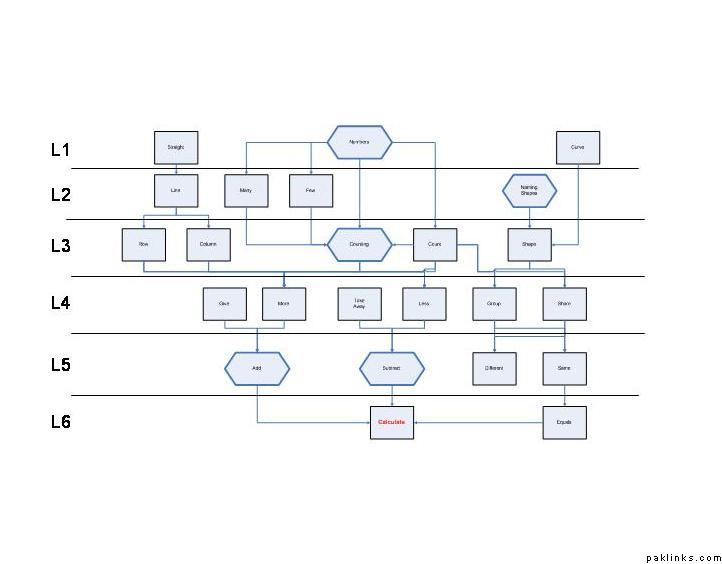
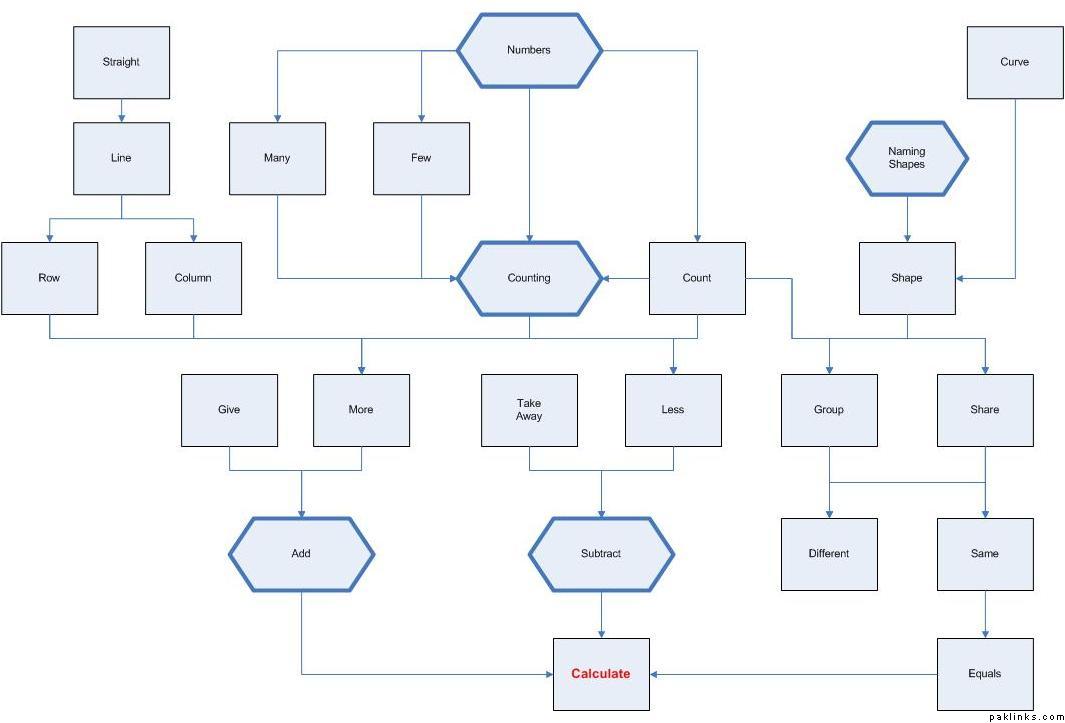
The first image shows the levels the second is clearer on the text
L1 – Straight, Curve and Numbers
Teach your child about the concept of straight and curved as words and also teach by rote the natural numbers up to 10.
L2 – Amount and Naming Shapes, Lines
Convert the concepts of straight and curve to use of lines straight and curved. Show how lines make shapes by drawing them in front of the child, but say nothing at this stage, except when you finish drawing the shape name it. Produce a list of 7 regular basic shapes and name them.
L3 – Using lines make rows and columns and name them get your child to understand the difference between rows and columns. Prepare your child for counting using the natural numbers they have learnt and get a number of items they can count out in front of you. Use the word ‘count’ when you want them to count and get them to understand that ‘count’ is something which is done with numbers on items of a group, without introducing the concept of groups at this stage. ‘Shapes’ as a term for the genre of all shapes should be taught to the child at this stage. The child will need to recognise that shape is something which has form and basically needs to be enclosed 2-dimensionally. A line is therefore not really a shape.
L4 – Define the terms ‘Give’ and ‘Take Away’ by using objects without paper and without any bearing to mathematics at this stage, the concept of these needs to be understood. First comparative work will include snapshot decisions. So the children will be expected to say what is either less or more in two sets of things being compared. Teach them the word ‘group’ and ‘share’ use stories and picture to show how these work in real life and then how they are translated into mathematical symbolism.
L5 – Prepare the child to understand that to give it will then have more and to take away it will have less, these forms the premises of addition and subtractions. Teach them the word concept ‘add’ and ‘subtract’ when they do exercises of that nature. Teach them the concept of sameness and difference. Teach the words ‘same’ and ‘different’ providing different examples of two or more things being compared.
L6 – Based on the previous concepts the term ‘same’ should be gradually replaced for ‘equals’ and given a mathematical context using the numbers they should now recognise on sight. Teach the term ‘calculate’ to mean either ‘add’ or ‘subtract’ and provide the meaning of the symbols ‘-‘ and ‘+’ prior to doing this. The child should now be equipped for simple arithmetic calculations.


