World War 2

Re: World War 2

Great! Have you uploaded them anyplace. Would love to watch them. We have hours and hours of footage on the Discovery Channel archives. Really very very interesting. I myself somehow am very much fascinated with WW2. After pretty girls and poetry, WW2 was the next best point of fascination for me. Grew up reading a lot of 'Commando' magazines, myself have a huge collection. Though fiction, but very thrilling. Then of course books like Hitlers 'Mein Kampf' and William Shirers 'The Rise and Fall of the Third Reich' have really left their mark. Somehow as far as footages go, I have mostly seen the pro British and American ones. I'd really like to watch something with the German angle and POV on them.

Yes WW2 is an interesting topic of discussion. I would also really love to discuss the role of Spies and Intelligence during this War. A lot of important and successful strategies and assaults were planned and executed to that effect. Many resulted in disasters. I bet Faris has some dirt on this. Would really love to read it.

Re: World War 2

Oh no India had the potential to make serious changes both in the events of World War 2 and afterwards too, technically what happened in Indian subcontinent in both World Wars is very significant.

I expexted no less from you Arlie bhai after we are both fans of General Dougals Mc Arthur.

Re: World War 2

Please elaborate.

Re: World War 2

Well in WW1 India was perhaps the main source of the British empires forces that stood against the Ottomans the British and thier Indian allies were comprehensivley beaten on many battles including Amara and Basra which are to date the most humiliating British defeats ever, the smaller Ottomans totally destroyed any British influence in the Eastern Middle East region. The Ottoman calls for Jihad however were ignored or not supported by Indian Muslims however one of the great "what if's" in History is the possiblity that the Ottomans and thier allies marched eastwards they may well have led to an Islamic uprising in India.

Again in WW2 Indian soldiers took part not only in campaigns in North Africa where the vital oil was prevented from feuling the Nazi war machine and thus helped turn the tide of the War. Again in the Pacific the British Empire was again saved by the Indians who helped first to defend against the Japanese and then begin the slow reconquest of South East Asia.

The price however for Indian support was freedom, and that in itslef led to more influential changes on the world map.

But many downplay the significance of the Indians in both Wars, the Ottomans would have never lost thier territories, even after the Arab revolt they could have held out had it not been for the massive man power they had to hold off from the British and Indian forces... earlier on in WW1 the Ottomans would have won it easy but by the end they were ground down.

The Japanese even reached the very frontier of India and two decisive battles at Kohima and Infal helped stop the Imperial Japanese war machine, most of the slow reconquest of Burma was largely helped by Indians too.

So Indian subcontinent certainly played it's very serious part in both World Wars. Indian soldiers saw action from the Western fronts trenches of the Somme in WW1 to the spearhead of operations against Italy and Japanese forces in WW2, without the help of millions of Indians both World Wars could easily have ended very differently.

Re: World War 2

Likeminds think alike :lifey:

Faris Bhai :hug:

Re: World War 2

Before discussing anything,I would like to pay tribute to my grand father who was a part of the British Indian Army.He was deputed to the Andaman and Nicobar Islands ,along with another colleague as spies,after the Japs occupied the islands.Both were instructed to study and spy on a Japanese ship ,which at one stage ,the British thought,was impossible to sink.Both roamed around the port posing as groundnut sellers,learned abt the ship and transferred the details to the British.Eventually British planes bombed and successfully destroyed it. :salute" to him and his colleague.

I object to the very idea of containing the discussion to Europe.Instead much of the sacrifice and actions took place in Asia ,especially in Pacific theatre.Who an forget the sufferings and pain endured by the allied troops in South East Asia? What abt the heroic efforts of the U.S troops in Manila during it's retaking? Who can forget the images of Japanese army men who refused to surrender,not fheeding to the words of their commander Mr.Yamashiita and fought on till their last breath?Who can forget the images of the Kamikazi fighetr pilots who laid down their lives happily for protecting their mother land? Who can forget the scenes at IwoJima?Who can erase the scene of a mother throwing down her two babes in to see from a cliff in IwoJima and also ending her own life by jumping off the cliff?(She along with her numerous friends and relatives were brainwashed by the retreated Japs that U.S forces are there to rape them). Who can forget the surrender action of a Jap soldier,and when the U.S soldiers approached him he exploded the grenaded he had between his teeth?The great naval battles in Pacific,great loss of life and materials,unexpected landingsby Jap forces,and avove all the famous words

I SHALL RETURN by Mc.Arthur...........

Re: World War 2

Far from the truth. The 2.5 million Indian soldiers who volunteered for the war could be found almost everywhere where Britain fought. When you consider that Britain itself raised only 3 million soldiers by the war's end, you realise the contribution that India made - for every British soldier committed to the war, there was an Indian soldier fighting too. Britain's ability to fight a world war relied on having massive numbers of Indian soldiers.

Re: World War 2

My grandad fought the Japanese in Burma, he always felt it was terribly unsporting when you had to gun them down after they ran out of ammunition, because they would come charging out of cover at you with swords and bayonet and knives rather than surrender.

The US pacific campaign was actually a terrible example of how to prosecute a war due to politics rivalries between services and most of all due to MacArthur's incredible ego. So many american lives were thrown away by MacArthur to capture symbolic places of no tactical value. The man was just lucky... not gifted. His luck ran out in Korea when his incompetence could no longer be covered up by his good fortune.

Re: World War 2

Both my grandfathers took part in the war too, one was captured by the Japanese in Burma.

My great uncle and mentor did not take part in the war as a soldier at least not to begin with but he left his home and went out to fight the Japanese rambo style... as part of a huge irregular force, the war in burma was terrible and it spread to North India too.

Re: World War 2

Well WW2 was full of many varied stragies most outstanding of all are a small selection I will give you of little known success and failures some of which are brilliant others are just utterly hair brained and downright disastrous.

First on my list is Jasper Maskelyn and the Original A team.
In 1941 a well known Magician from London was hired by no less than General Archibald Wavell to help the war effort in North Africa by creating an A force.
It was a cunning piece of trickery in which the master magician covered Wavell’s armies real action by staging several acts of trickery among his famous exploits were the use of fake tanks, dummy aircraft and best of all making the river nile dissapear and re-appear some miles away! :eek: really it was all trickery like most magic but it was definately succesfull and certainly had the Germans baffled for some time.

One of the other strange developements thanks to WW2 was the sub-machine gun. Allready many nations were working on simmilar designs the Americans had tommy guns for ages as seen in probition era gangster flicks. But really we should thank or rather laugh and blame Hitler for the invention… he was totally against reducing the standard rifle cartridge to a smaller more high velocity round for use in light machine guns and sub machine guns… but after seein it in trials he approved it as the SturmGewher. It is the father of most modern SMG’s and is direct ancestor to the worlds most popular rifle the AK47.

And finally a daft weapon used by the Japanese is now a common toy, yes trust the Japanese to make high incendiary explosives and fly them to america on balloons, and guess what they carried the explosives in… yep cute furry toys :omg: No seriously the Japanese were not the first and last to use this nefarious tactic but the buzz bombs came in mayn whacky forms few of them ever really reached let alone had any affect in the USA.

Re: World War 2

Everyone is in full form!

Re: World War 2

Well there is no denying the fact that India contributed its manpower to the British Raj for the cause. Gallantry was in no less numbers. At the outbreak of World War II, the Indian army numbered 205,000 men. Later during World War II the Indian Army became the largest all-volunteer force in history, rising to over 2.5 million men in size. These forces included tank, artillery and airborne forces. Indian soldiers earned 30 Victoria Crosses during the Second World War.

When I talk about the insignificance of India with the War, we have to understand India played its role only with its own personal aim of ‘Swaraj’ from the British Raj. The war itself had no actual meaning to India but only for its own silent war with the British for its freedom. No doubt there were concerns of the War and voices raised from all quarters in India. Andaman and Nicobar islands were invaded and occupied and there was the battle of Kohima and Imphal.

‘The Indian National Congress, led by Gandhi, Sardar Vallabhbhai Patel and Maulana Azad, took a strong stance against Fascism and Nazism. Gandhi, in an open letter to Adolf Hitler, touted tolerance and viewed Nazism as a source of violence. Several other Indian leaders and politicians expressed concerns over the rise of Fascism and Nazism and supported the British cause.

However, Jawaharlal Nehru pointed out the inherent contradiction in the British argument of going to war with Nazi Germany for the sake of freedom, since India was denied that same freedom. He pointed out that Nazism and the British Raj represented the two core ideologies the Congress was fighting against — imperialism and racism. It was because of this perceived hypocrisy of the British Government, that the Congress refused to align with Britain’s fight against the Axis Powers until India was granted independence.

Supporters of the British Raj argued that Great Britain could not afford to have to go through the trouble of decolonisation at such a difficult time. It was believed that losing India, the most prized crown colony, would put tremendous pressure on Britain especially when it was facing war on all fronts. So, in 1939, the British Viceroy, Lord Linlithgow declared India’s entry into the War without consulting prominent Indian congress leaders who were just elected in previous elections.

Another school of thought led by Subhash Chandra Bose of the Indian National Army (INA) allied itself with the Axis based on the principle that “An enemy’s enemy is a friend”. Bose led the Indian National Army and the Provisional Government of Free India, a government-in-exile based in Singapore, that was recognized by the Axis powers.’

Re: World War 2

One on the spies.. Montgomery's Double

In 1944 a washed-up, boozy Australian actor named Meyrick Clifton James experienced one of the oddest career revivals in history. James was not a great actor. He could neither sing nor dance, and he had lost a finger in the trenches. When war broke out again he volunteered to entertain the troops overseas, but instead wound up in Leicester, in the Army Pay Corps Variety Troupe. However, with his thin face and grey moustache, he could do a remarkable impersonation of the top British soldier, General Bernard Montgomery.

On the eve of D-Day the failed actor found himself plucked from obscurity to play the starring role in the war’s most melodramatic deception — as the spitting image of Monty. The operation, codenamed “Copperhead”, became the basis for the 1958 film I Was Monty’s Double, but the full details and the identity of the Nazi spy who fell for it have now been revealed for the first time in newly declassified documents released by MI5.

In the run-up to D-Day the British hit on the idea of using an actor to impersonate Monty in order to give a false impression of his whereabouts. In February 1944 it was announced that the victor of El Alamein had arrived in Britain to take command of the land forces for the coming invasion of Europe. Britain’s spy chiefs knew that “from then onwards it was certain that German agents would do their best to watch his movements”.

“Supposing he were to be seen somewhere in the Mediterranean a day or two before the Normandy invasion, the Germans would take it as a certain indication that they had at least a week or more to wait before the landings.” The apparent presence of Monty in the Mediterranean would also divert German attention from the impending assault on Normandy. Gibraltar was the ideal spot to put the plan into action, in part because it was the stamping ground of a particularly unscrupulous Spanish spy in German employ, Major Ignacio Molina Pérez. He was head of information on the staff of the Spanish military governor of Algeciras, and liaison officer between the Spanish government and the British authorities in Gibraltar. In theory, Spanish officials were neutral. In reality, as the declassified material reveals, MI5 knew Molina was a Nazi spy codenamed “Cosmos”.

The Spanish officer, while pretending to be pro-British, was “bad from head to foot”, in the words of one MI5 report. “Molina has been decorated by the German government on various occasions, and it has been proved that Molina is the prime mover in an extensive Nazi secret service organisation in Spain and Morocco.” Early in 1944 he was appointed head of the Gestapo for the Algeciras region. The British had contemplated flying him back to Britain for interrogation, but that plan was scotched by one Kim Philby, then head of MI6’s Iberian desk, who pointed out “the FO would not stand for this”. The Defence Security Officer in Gibraltar observed: “Although we know him to be a German agent, he continues to enjoy every facility to enter and leave the fortress. We have not been able to catch him in flagrante delicto. Something more must be done since at any moment he may get hold of some really valuable information.”

As a Nazi spy, Molina was the ideal target for the hoax: if he spotted a man he believed to be Montgomery in Gibraltar, the news would reach German ears swiftly. The files describe Molina as “a pretty big fish”, and if the plan worked he would be well and truly hooked.

Finding a Monty lookalike proved difficult. The first actor selected was Miles Mander, who had played Monty in the film Five Graves to Cairo. But Mander was several inches taller than the general. “This,” MI5 noted drily, “was a physical handicap it was impossible to disguise”. A substitute was found, who then “fell victim to a road accident and broke his leg”. The planners settled on Clifton James, the Australian-born lieutenant. Clifton was contacted by the actor David Niven, then a colonel in the Army Film Unit, and asked to come to London, where he was assigned to Monty’s staff, under cover as a journalist, in order to perfect the general’s speech and mannerisms. Monty was teetotal and loathed smoking. James was a heavy drinker and smoker, and missing a middle figure from serving in the First World War. He temporarily gave up drink and cigarettes, and a prosthetic finger was made out of plastic. The fake Monty trimmed his moustache, dyed his sideburns and was issued with khaki handkerchiefs with a “B.LM.” monogram. The British spread false information that Montgomery was coming to North Africa, via Gibraltar, to discuss plans for the invasion of southern France before the main invasion in the north.

On May 26, the bogus Monty landed on the Rock, where the Governor, Lieutenant-General Sir Ralph “Rusty” Eastwood, was waiting with a reception committee. A classified report described the scene: “The Governor himself was waiting for the visitor, and played his difficult part with expert skill. ‘Hello, Monty, glad to see you,” he called out as the distinctive black beret emerged.

‘Hello, Rusty, how are you?’ came the answer from James.

Molina had been invited to Government House for a meeting with the Colonial Secretary, and was left in a room with a view, where he could not fail to spot the figure in the beret being received by an honour guard. After a breakfast in which the Governor congratulated James on his performance (“You are Monty. I’ve known him for years”), the counterfeit took his leave. “This was the climax of the act,” the intelligence report records. “At exactly the right moment the pair [Molina and the Colonial Secretary] walked across the yard as His Excellency was handing ‘General Montgomery’ into his car.”

Molina was a better spy than actor and “his interest in happening on this significant scene was too great to hide”. The Spaniard quizzed the Colonial Secretary who, “with well-feigned embarrassment, was forced to confess that the commander-in-chief was on his way to Algiers”.

The Spaniard sped away in his car and was observed making “an urgent trunk call” in the Spanish town of La Línea. One British intelligence report estimated that “the material reached Berlin in 20 minutes” and was confirmed by other German spies. Molina embellished his own role, telling one of his confidants (a spy working for the British) that he had shaken hands with the British general. “The Governor introduced me to him. He seems muy simpático (very nice).” The double agent (who rejoiced in the codename “Pants”) reported that Molina “seemed to be very satisfied with himself”. Bletchley Park, the wartime decoding centre, duly intercepted a message from Madrid to Berlin which read: “General Montgomery arrived Gibraltar. Discussions held with Governor and French general.”

It was only one element in the deceptions surrounding D-Day on June 6, and the British never knew quite what impact it had. But it certainly had a dramatic effect on the players. James, who found the entire act stressful, was taken to Cairo, where he remained, with a copious supply of whisky, until the Normandy landings were under way. He drew a full general’s pay for the five-week period he played Monty, but no formal recognition.

In 1954 he wrote a book, I Was Monty’s Double, later made into a film starring John Mills, in which James played himself and Monty. When James died, in 1963, Field Marshal Montgomery said of his doppelgänger: “He fooled the Germans at a critical time of the war.”

Molina’s career as a Nazi spy came to an abrupt end. Now armed with hard evidence, the British declared him persona non grata, and excluded him from Gibraltar.

Re: World War 2

^ a very inspiring story :cheer:

Re: World War 2

Another story revolves around the Allies having attempted to assasinate Hitler with his favourite rifle... the Mauser 1898 model was chosen as the perfect snipers rifle to pick him off at the Wolfs Lair assasination attempt which was given up... it makes you wonder though what might have happend had it succeeded... oh the Irony that Hitler would have died due to his favourite rifle.

Re: World War 2

Really it makes you wonder!:woho:

There is one more take in the WW2 database on the assassination plot for Hitler on July 20,1944.

Hitler never trusted the professional army officers. His disdain came about because of the poor generalship in World War I that killed millions of German soldiers. He was always worried that the Army would attempt a coup de état and try to take over the government.

In 1934, as a result of the Night of Long Knives, he removed the SA, essentially a gang of thugs that had brought him to power, and killed their leader, Ernst Röhm. In exchange for removing the SA, the Army signed an oath of allegiance to Hitler.

As the losses mounted in late 1943 and early 1944, Hitler replaced or forced many generals into retirement and the Army high Command, except for those officers in Hitler’s personal orbit, grew openly critical of his constant meddling.

Oberst Claus Schenk, Count von Stauffenberg lost his left hand and fingers from his right fighting in Tunisia. As a member of the aristocracy, he had double contempt for Hitler, and joined the plot to kill him. General Ludwig Beck, Chief of Staff back in 1938, was the nominal leader.

The Normandy Landings inspired the plotters to attempt an assassination in the face of the Allied breakout. Von Stauffenberg placed a briefcase with a bomb inside Hitler’s “Wolf’s Lair” — his command post for the Eastern Front in Rastenburg, Prussia. The bomb was one of many British bombs confiscated by the Abwehr, the German intelligence organization. Stauffenberg had to activate the bomb with tongs. He placed the bomb under the conference table and left. He and the other plotters believed Hitler was dead and prepared to seize Berlin with Home Army troops.

Hitler was not dead. Believing God had spared him to avenge Germany on the world, he met with Mussolini later in the day despite wounds to his right arm and a loss of hearing.

Meanwhile, Stauffenberg was shot at midnight by a firing squad, loyal Army officers rounded up conspirators, many of whom tried to spare their lives by informing. Implicated was Erwin Rommel, who had been approached by the plotters but did not join. Rommel was recovering from wounds at home. For his failure to inform Hitler, he was given a choice: take poison and get a state funeral, or refuse and see your family executed as well. Rommel took poison. The man who had the best ability to change Germany’s fortunes of war was gone.

Also forced to commit suicide or sent to concentration camps were thousands of family members of the plotters. Eight of the conspirators were hung on meathooks and their death agony was filmed and shown to Hitler. Some Army officers committed suicide by walking into the Russian no-man’s-land.

Hitler used the July 20 Plot as an excuse to destroy anyone in the Army he feared would oppose him. The traditional salute was replaced with the Nazi Sieg Heil. Eventually 20,000 were killed or sent to concentration camps in the purge.

Hitler, a manic hypochondriac, became obsessed with his health after the assassination attempt. His doctor prescribed drugs of his own design that contained hemlock. Hitler gulped so many pills he was slowly poisoning himself. The tremors in his right hand became acute, and he rarely allowed photographs or film after July 20.

The failure of the July 20 plot precluded any possibility of Germany negotiating a peace with the Allies. Hitler intended to fight to the death in a struggle that would see the end of National Socialism or the end of Germany’s enemies.

Re: World War 2

Mc. can not be discredited with just one go incident. Mc. was either misinformed or even taken by surprise when Japs bombed Philippines and occupied the islands. But there was heavy pressure on him to retake the islands.At first he never wanted to use heavy bombardment in Manila but in the end it turned out to be a street to street fight and a massive destruction to the city took place,which was unavoidable.Remember many Jap commanders chose to defend the garrison till their last breath and thus led to a heavy bloodshed.

As far as Korya is concerned,Had Mc not landed troops in at Inchon the course of history would have been different.Thanks to one of the spectacular amphibious landings the world has ever seen and it was led by Mac. I believe Trueman was concerned abot the popularity Mc was garnering.Indeed Mc's stand on N-Bombs was well justified ,when the history and the loss of lives in that war are reckoned.

Re: World War 2

I have been searching on net and other sources for several years,for the final photographs of Mr.Stauffenberg and his accomplices.I had watched a programme on Discovery/Nat.Geo a few years ago,and it had shown the execution photographs of these brave men.I had posted a thread here ,seeking for the photographs.Also I have been searching on net for the same,to no avail...

Re: World War 2

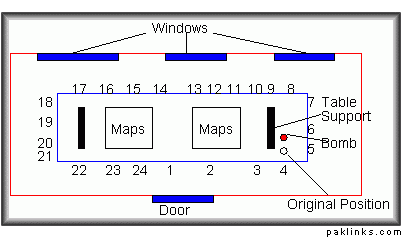
THE BOMB PLOT AT HITLER’S HQ.
The situation as at 12.30pm on July 20, 1944.

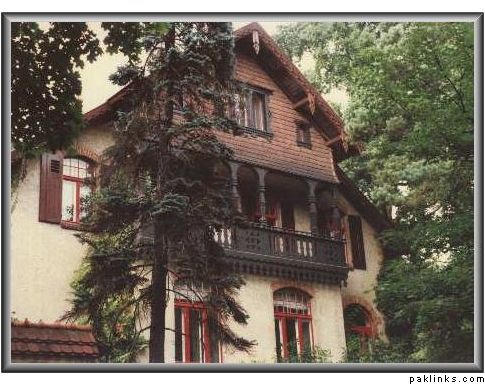
Claus Von Stauffenbergs Villa at Wannsee, Berlin.

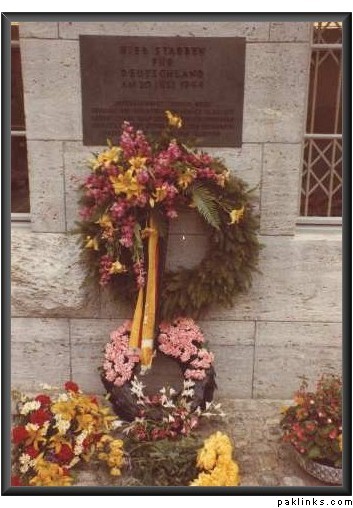
His execution site.

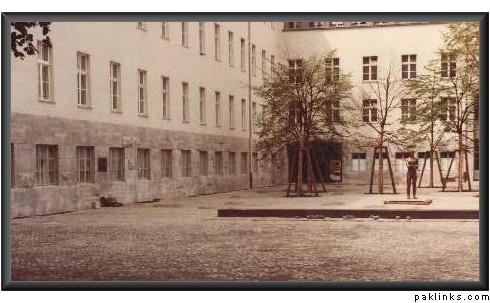
Place where the other executions took place.

I’ll get you some real rare stuff on this from the archives in a few days.

Re: World War 2

^Yaar, but I was referring to the actual execution photographs.A few photos were taken ranging from an injured Strauffenberg and his accomplices being taken out to the courtyard,They were line up ,photo of each conspirator being shot etc....