Re: Where is Kaaba?
God can protect his own city... He doesnt need the security of Man. And im sure if he didnt want this all to be happening, it wouldnt have... there must be a bigger plan...
Re: Where is Kaaba?
God can protect his own city... He doesnt need the security of Man. And im sure if he didnt want this all to be happening, it wouldnt have... there must be a bigger plan...
Re: Where is Kaaba?
I dont like the idea of them building something too extravagantly grand with suites like kings palaces, kinda like the building in the image in the first post. Thats just waste of space.
You have to admit though that space is tight and the number of pilgrims doesn’t decrease every year. Keeping that in mind, i like the idea of a large multi-storey compound designed only to house pilgrims. Instead of apartments, you have cramped suites (like in a dorm) designed to house two, max three people. If you have a floor like something in the illustration below, you can easily have about 76 suites on each floor.
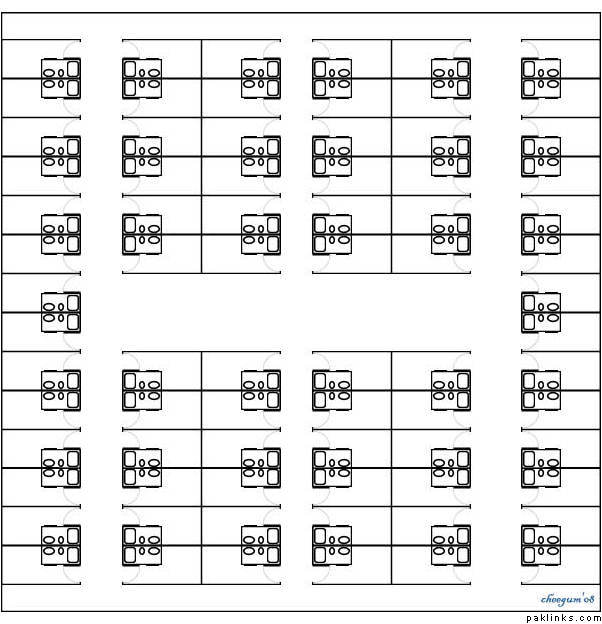
(I’ve left space for stairs, elevators, windows, electrical wiring, plumbing etc too)
SO, with a min of 2 people per suite, we have 152 people per floor. A 50 storey building like this can then house a minimum of 7600 pilgrims. Compare that to the same space being used to house pilgrims in tents i.e. ~ 100 pilgrims.
And that ends todays class on haji space management.
Re: Where is Kaaba?
Is that building already there, or is that a drawing?
Re: Where is Kaaba?
Some folks still want to see makkah and area around it as it was back in 8th century, well times are changing and as more and more people make their way to kaba, more and more space is required to accommodate them.
We should be focused on LEARNING from history rather than preserving it... how many people die of stampedes on hajj? Less space + More people = dead people
Well if you have been to Mecca you would know that there IS space in the city other than just along the boundaries of Kaaba. I wish they could make buildings as high as they wish to but just a few kms away. It will definitely make the space less congested and less stampede and more alive people.
And about the history thingie, well if you do not PRESERVE it then how can you LEARN from it?
Re: Where is Kaaba?
Some muslims have become idol worshippers over the years. Tell the "righteous" that even the prophet is not holy and they'll call you corrupted.
Lest we not forget that Muslims worship one thing and one thing only - God. True muslims could care less if a gas station was built over a grave or if a lavatory was built near a special tree. We just dont care... even if that grave/stone/building belongs to a prophet's mother, sister, best friend, personal chef or hair dresser.
So where does it say that to believe in the unity of Allah you have to think that the Prophet (SAW) is unholy or you must disrespect holy places. Respect of a holy place or monument doesn't mean you are worshiping it. Don't confuse things and don't judge people, let this task to be with Allah.
Re: Where is Kaaba?
Well if you have been to Mecca you would know that there IS space in the city other than just along the boundaries of Kaaba. I wish they could make buildings as high as they wish to but just a few kms away. It will definitely make the space less congested and less stampede and more alive people.
And about the history thingie, well if you do not PRESERVE it then how can you LEARN from it?
Then you have to deal with logistics of getting people (transportation) from KMs away to the place of worship. That is also a problem when you have 2.5 mil people converging on same spot.
What do you expect to learn from mud houses? Prophet's mosque is preserved, khana kaba is preserved and other important places that deal with worship are preserved... what would we learn from say mud house of some noble sahabi? Engineering? Psst!
Re: Where is Kaaba?
Then you have to deal with logistics of getting people (transportation) from KMs away to the place of worship. That is also a problem when you have 2.5 mil people converging on same spot.
What do you expect to learn from mud houses? Prophet's mosque is preserved, khana kaba is preserved and other important places that deal with worship are preserved... what would we learn from say mud house of some noble sahabi? Engineering? Psst!
aisi naak naak baatein karo bhai mere...
sab impress hoon ge ...
okay:)
Re: Where is Kaaba?
Then you have to deal with logistics of getting people (transportation) from KMs away to the place of worship. That is also a problem when you have 2.5 mil people converging on same spot.
What do you expect to learn from mud houses? Prophet's mosque is preserved, khana kaba is preserved and other important places that deal with worship are preserved... what would we learn from say mud house of some noble sahabi? Engineering? Psst!
Well millions of people use London Underground everyday. Considering that there isn't any funds problem for the govt., an efficient transportation shouldn't be a problem.
Mud houses, well firstly that's not the only thing that has been destroyed there are several others. And secondly, ever heard of emotional attachment? We hold on to an itssy bittsy thing for emotional purposes then why not some noble mud houses, what harm are they bringing you?
Nations need to preserve these things as part of their heritage and culture. Visit some museums, you'll find loads of crap there(including mud shmud), things that don't make sense to be preserved, but they are there as they are indicative of the past, which must not be forgotten.
Re: Where is Kaaba?
Well millions of people use London Underground everyday. Considering that there isn't any funds problem for the govt., an efficient transportation shouldn't be a problem.
Mud houses, well firstly that's not the only thing that has been destroyed there are several others. And secondly, ever heard of emotional attachment? We hold on to an itssy bittsy thing for emotional purposes then why not some noble mud houses, what harm are they bringing you?
Nations need to preserve these things as part of their heritage and culture. Visit some museums, you'll find loads of crap there(including mud shmud), things that don't make sense to be preserved, but they are there as they are indicative of the past, which must not be forgotten.
Comparison of London underground with Hajj/Umra logistics... kuch samajh nahi ayee?
If one thing works in London, we can't be too sure that it will work in Makkah as well. London underground is spread at least 30 40 mile radius if not more... what are the saudis to do in order to transport 2 3 million people from ONE spot to another? You have a completely different problem when there are 2 3 million people going from one spot to another than merely transporting 20 30 40 people from one station to another and then picking few from there to the next station.
I don't think its important to preserve mud houses but* If you must preserve mud houses and other artifacts then dig them up (whole thing intact, refill the space with mud from other places), transport them to some museum as a display item. However, they may hold little or no "*educational" value.
Re: Where is Kaaba?
Hmm so you are saying there is a problem with SO many people being TRANSPORTED to just ONE spot and there isn't any problem in AS many people LIVING at that spot?
Do you really think that these palaces and other buidings or whatever built in place of the mud houses have any EDUCATIONAL value?
Re: Where is Kaaba?
Hmm so you are saying there is a problem with SO many people being TRANSPORTED to just ONE spot and there isn't any problem in AS many people LIVING at that spot?
Do you really think that these palaces and other buidings or whatever built in place of the mud houses have any EDUCATIONAL value?
Hajjis and worshipers don't go there to live, they go there to worship.... perform the rituals in due time and come back home. That is why it is quick, there is a process involved and order in which things happen and it must remain organized...
The palaces? Are there palaces around Kaba?
Khair, Hotels and other buildings around Masjid Al-haram provide services for the people who visit for hajj or umra and also are easily accessible in vicinity of the holy places - that is all people need.
Mud house would not be effective in this situation... knowing that majority of those who go there are South Asians, that mud house might just become the next place you throw your trash... aka Roori.
Re: Where is Kaaba?
This makes it a planning quagmire. There's got to be a better middle ground. These decisions should be taken on a case-by-case basis and ramifications should be considered carefully.
There was another proposal before these monsters were built: build hotels far away and have a dedicated tunnel to ferry guests in busses. It happened to a degree, but it was only a matter of time before someone decided a hotel right next door could make more money.
Re: Where is Kaaba?
do you put your feet on the table when your parents or any elder one is around you?
i am not scared of my parents. i respect them!
but ALLAH SWT, who is my creator, i am obliged to fear him and his sovereignty.
 and they did call themselves.
…but what they ended up with?
…an admonitory symbol! 
ps. i recently have seen a Mummy. 
Re: Where is Kaaba?
The palaces? Are there palaces around Kaba?
Yes.
Re: Where is Kaaba?
Even if the grandest buildings around kaba, people only worship the kaba and not those buildings... no matter how grand they maybe built.
muslims don't worship the kaaba.
There is a growing shadow being cast over Islam's holiest site. Only a few metres from the walls of the Grand Mosque in Mecca skyscrapers are reaching further into the sky, slowly blocking out the light. These enormous and garish newcomers now dwarf the elegant black granite of the Kaaba, the focal point of the four million Muslims' annual Haj pilgrimage.
The tower blocks are the latest and largest evidence of the destruction of Islamic heritage that has wiped almost all of the historic city from the physical landscape. As revealed in The Independent last August, the historic cities of Mecca and Medina are under an unprecedented assault from religious zealots and their commercial backers.
Writing in response to the article, Prince Turki al-Faisal said that Saudi Arabia was spending more than $19bn (pounds 11bn) preserving and maintaining these two holy sites. "[We are aware] how important the preservation of this heritage is, not just to us but to the millions of Muslims from around the world who visit the two holy mosques every year. It is hardly something we are going to allow to be destroyed."
This rebuttal sits at odds with a series of previously unseen photographs, published today, that document the demolition of key archaeological sites and their replacement with skyscrapers.
Saudi religious authorities have overseen a decades-long demolition campaign that has cleared the way for developers to embark on a building spree of multi-storey hotels, restaurants, shopping centres and luxury apartment blocks on a scale unseen outside Dubai. The driving force behind this historical demolition is Wahhabism - the austere state faith that the House of Saud brought with it when Ibn Saud conquered the Arabian peninsula in the 1920s.
The Wahhabis live in fanatical fear that places of historical or religious interest could give rise to alternative forms of pilgrimage or worship. Their obsession with combating idolatry has seen them flatten all evidence of a past that does not agree with their interpretation of Islam.
Irfan Ahmed al-Alawi, the chairman of the Islamic Heritage Foundation, set up to help protect the holy sites, says the case of the grave of Amina bint Wahb, the mother of the Prophet, found in 1998, is typical of what has happened. "It was bulldozed in Abwa and gasoline was poured on it. Even though thousands of petitions throughout the Muslim world were sent, nothing could stop this action."
Today there are fewer than 20 structures remaining in Mecca that date back to the time of the Prophet 1,400 years ago. The litany of this lost history includes the house of Khadijah, the wife of the Prophet, demolished to make way for public lavatories' the house of Abu Bakr, the Prophet's companion, now the site of the local Hilton hotel' the house of Ali-Oraid, the grandson of the Prophet, and the Mosque of abu-Qubais, now the location of the King's palace in Mecca.
Yet the same oil-rich dynasty that pumped money into the Taliban regime as they blew up the Bamiyan Buddhas in Afghanistan six years ago has so far avoided international criticism for similar acts of vandalism at home. Mai Yamani, author of The Cradle of Islam, said it was time for other Muslim governments to ignore the al-Sauds' oil wealth and clout and speak out. "What is alarming about this is that the world doesn't question the al-Sauds' custodianship of Islam's two holy places. These are the sites that are of such importance to over one billion Muslims and yet their destruction is being ignored," she said. "When the Prophet was insulted by Danish cartoonists thousands of people went into the streets to protest. The sites related to the Prophet are part of their heritage and religion but we see no concern from Muslims."
Lay people, and in some cases even US senators could be forgiven for thinking that the House of Saud has been the guardian of the two holy places for time immemorial. In fact, it is only 80 years since the tribal chieftain Ibn Saud occupied Mecca and Medina. The House of Saud has been bound to Wahhabism since the 18th century religious reformer Mohamed Ibn Abdul-Wahab signed a pact with Mohammed bin Saud in 1744. Wahab's warrior zealots helped to conquer a kingdom for the tribal chieftains. The House of Saud got its wealth and power, and the clerics got the vehicle of state they needed to spread their fundamentalist ideology around the world. The ruler of this fledgling kingdom needed the legitimacy afforded by declaring himself "custodian of the two holy places".
But that legitimacy has come at an enormous price for the diversity of Muslims who look to Mecca for guidance. Once in charge, the Wahhabists wasted little time in censoring the Haj. As early as 1929, Egyptian pilgrims were refused permission to celebrate the colourful Mahmal rites and more than 30 were killed. At the time Egypt severed diplomatic relations with Saudi Arabia. Few governments have stood up to them since.
Instead, the homogenisation of Islam'sholiest sites was allowed to accelerate into a demolition campaign that now threatens the birthplace of the Prophet itself. The site survived the early reign of Ibn Saud 50 years ago when the architect for the planned library persuaded the absolute ruler to allow him to preserve the remains under the new structure. Saudi authorities now plan to "update" the site with a car park that would mean concreting over the remains. "The al-Sauds need to rein in the Wahhabists now," warns Dr Yamani. "Mecca used to be a symbol of Muslim diversity and it needs to be again." But with oil prices and profits, at record highs, there is little sign the House of Saud is listening.
Sami Angawi, a Hijazi architect who has devoted his life to a largely doomed effort to preserve what remains of the history of the world's greatest pilgrimage sites, said that the final farewell to Mecca was imminent. "What we are witnessing are the last days of Mecca and Medina.
what garbage. the saudi govt destroyed the grave of the prophet's (pbuh) mother and other historic sites so that they dont become a place of worship, something which us stupid pakistanis like to do, just look at the mazaars we have in our country. its not going to giv any1 sawaab to visit the house of the prophet's (pbuh) relative. It just going to lead to shirk if they rnt destroyed.
the buildings that u say r higher than the kaabah and putting a shadow over it, well that shadow provides shade for the thousands of ppl who r performing tawaf in the sweltering heat. these hotels and businesses provide food and shelter to the milllions of ppl that come to makkah. its not like someone has opend a gaming arcade or casino in front of the kaabah.
Re: Where is Kaaba?
Regardless if the place is holy or not, it has historical significance which allows muslims to connect with their past.
We all love to act like hardcore muslims, but we all know this ummah is dead inside. These small details in our lives, and especially this sacred place is what we have left of our past.
Its easier to say we have islam in our hearts, but its harder to attain it and keep it there. I know this because its taking a lot of struggle, and its still not attainable, its hard, requires effort, we all should work towards that, myself first inShallah.
The building in the picture has recently been completed, it houses a shopping mall complex which is larger than your malls in NA. I really dont see the issue of pilgrims having toruble finding a place to stay....there...that argument is very weak.
Most pilgrims aren't as rich...they stay in 4 star hotels (which are being DEMOLISHED constantly to make rooms for stores and 5-6 star hotels, just ask your travel agent next time u go for umrah!) and the hotels majority of the people can afford are located 10-15 mins walk from the Kabah!
So dont make up crap about how pilgrims need more space...its a futile argument. If it were done to cater everyon's need, we would have more affordable hotels all around makkah.
The shopping centers have NO significance there, NONE AT ALL!
Build them outside the Harram, somewhere a lil further down, its not rocket science. People can walk from the Kabah to Mina and to Muzdalifah , you think they cant taxi or walk down to a mall a bit further away?
These places hold islamic significance, even if the kabah is destroyed, even if we have nothing left there, that place is still in line with the arsh of Allah swt, (thus we pray in that direction).
But to replace islamic heritage with monstrous buildings in order to generate profit, and to cut off everything of our past from muslims...this is not correct.
**Think of what the Kabah meant to you when you were a child, and think of what it'll mean to the kids you'll have, and their kids, and the generation after them.
**They will see Colonel Sanders everytime they go for umrah or hajj instead of waht their focus should be.
When I was a kid, Makkah was the epitomy of our religion still is, the sacred place where islam was rectified. And now our history is being taken away from us.
The poster of this thread is 100% valid in his view to stop these useless projects.
The Jahils of Makkah, before Islam, used to adorn the sacred area with idols, and colours and markets, to attract business from pilgrims who came from all over Arabia.
It seems we're heading in the same direction now.
***Most pilgrims aren't as rich...they stay in 4 star hotels (which are being DEMOLISHED constantly to make rooms for stores and 5-6 star hotels, just ask your travel agent next time u go for umrah!) and the hotels majority of the people can afford are located 10-15 mins walk from the Kabah!
Ask any of ur agent in month of hajj or after mid of ramdan kareem that if he can manage any room in those expensive room at any cost :) u'll find no room is available even they are expensive, brother just dun under estimate muslims that they are not that rich :)