Re: ~ POSITIVE PAKISTANIS ~
He got only 500 bucks and a certificate…that’s it…I was supposed to meet him today…but couldn’t make it… maybe on Wednesday…
Re: ~ POSITIVE PAKISTANIS ~
He got only 500 bucks and a certificate…that’s it…I was supposed to meet him today…but couldn’t make it… maybe on Wednesday…
Re: ~ POSITIVE PAKISTANIS ~
oh okay, my bad 
Re: ~ POSITIVE PAKISTANIS ~
**Two Pakistani women feature on ‘foreign policy leaders’ list
KARACHI: Two Pakistani women have been featured on “Top 99 under 33 Foreign Policy Leaders,” list compiled by the The Diplomatic Courier (TDC).
**The Washington DC-based global news and international affairs analysis magazine curates an annual list as part of an international project that captures the impact of 99 leaders under the age of 33. Profiles are included from across the globe.
The Pakistanis who have been featured in this year’s list include Hina Mushtaq - an Atlas Corps Fellow from Pakistan serving at Public Health Institute in California and Kalsoom Lakhani – founder and CEO of Invest2Innovate (i2i) were two of the 99 young leaders selected by their peers in recognition of their impact on their respective communities.
According to her profile for TDC, Mushtaq has worked as a consultant at the ITU-UN Headquarters in Geneva and for USAID-funded projects. “She believes that innovative use of technology will reshape foreign policy by bringing about differences in people’s lives beyond their economic and social barriers,” the profile stated. She was listed under the subcategory of “innovator”, which the magazine described as a person who designs new solutions to a critical global challenge.
Lakhani is heading an organisation that supports early-stage social enterprises and strengthens access to capital in Pakistan. She is the founder of a blog named Chup and has also written for Next Billion, Foreign Policy, the Washington Post and the Huffington Post.
She was listed under the subcategory of “shaper”, which the magazine described as a person who changes the public discourse on an aspect of foreign policy or raises awareness on a critical issue.
Re: ~ POSITIVE PAKISTANIS ~
**Encouraged by Pakistan’s potential, SAP sees 30% growth
**](http://tribune.com.pk/story/439602/encouraged-by-pakistans-potential-sap-sees-30-growth/)
**KARACHI:
****Seeing immense potential for growth in Pakistan like other emerging markets of Asia, SAP – a leading business solutions provider worldwide –
is targeting 30% growth in its operations here as a new generation of qualified Pakistanis
is more interested in increasing efficiency and productivity of their businesses.
**
The penetration of enterprise business software is going to increase in Pakistan as the new generation,
which is taking over family businesses, is more tech savvy and inclined towards adopting innovative technological solutions,
says Darren Rushworth, Managing Director of SAP Pakistan and Emerging Markets, in an interview with The Express Tribune.
“We are adding around 15 customers every quarter and are targeting 30% growth this year, which is big,”
he said when asked if he was satisfied with the growth in Pakistan.
“We are selling enterprise software, not toothpastes.”
Competitors of SAP in Pakistan are big names like Microsoft and Oracle, among others. SAP has 200 customers in Pakistan and
its worldwide list of customers stretches to over 190,000.
Unlike most multinationals which include Pakistan in the Middle Eastern region, SAP counts Pakistan in its Asia-Pacific operations and
views the country as an important emerging market in its growth plans in this region.
To a question about revenues in Pakistan, Rushworth said he could not give the figure because the company did not breakdown country-wise revenues.
Last year, its global revenues were 15.4 billion euros.
**Like most other countries, out of the 200 customers in Pakistan, 80% of them came from small and medium enterprises (SMEs), **he said.
Responding to another question, he said, “the challenge we have in Pakistan is to have more trained partners.
We are very much dependent on our partners here and this is why we will invest much in our partners to grow our business.”
SAP partners include IBM, Siemens, Abacus, ExD, NetSol Technologies, VMS, BI Solutions and Sidat Hyder Morshed Associates.
“Other than the big partners, we are also looking for small partners,” he said. “But since we need specialised partners, our search is for a niche market.”
Agreeing with the fact that Pakistan’s economy is mostly based on SMEs, Rushworth believes that SAP will continue to focus on such enterprises.
When asked about the impact of Pakistan’s slow economic growth on SAP business in recent years,
he said, “I cannot draw a parallel between slow economic growth and our business.”
“I am not an economist, but what we saw in different markets is that we got business even in times of recession in different countries,” he added.
Re: ~ POSITIVE PAKISTANIS ~
**Pakistani Shahzad Iqbal **abandoned the jet-set lifestyle of a corporate executive because he wanted to do something worthwhile for his country. So he invested his life savings in world-class bull semen.
He imports the sperm from potent bulls in the West, with names like Socrates, Air Raid and Liberator, and sells it at affordable prices to farmers so they can breed cows that produce higher volumes of quality milk.
Iqbal is one of a band of trailblazers - from small-town entrepreneurs to managers in multi-national companies - who want to transform Pakistan’s ramshackle dairy industry into a multi-billion dollar enterprise.
“It’s going to take a revolution to turn it around,” said Iqbal, as his farm workers moved metal cylinders filled with liquefied nitrogen gas that store the semen at -196 Celsius (-321 Fahrenheit).
If Iqbal and his comrades can succeed in their mission to overturn centuries-old practices and introduce modern techniques, they could open the door to a revolution in the livelihoods of millions of impoverished farmers.
The dismal state of the dairy industry is a striking example of Pakistan’s habit of missing opportunities
throughout a 65-year history tainted by military coups, political infighting and a form of crony capitalism that has stifled entrepreneurship.
****With 63 million cows and buffaloes, Pakistan has one of the world’s biggest herds, but it cannot export milk because the animals’ yields are so low.
Preoccupied by power struggles and tension with the army, successive governments have failed to realize the potential of the sector, which engages about 35 million people, or 20 percent of the population, in direct or related work.
While other countries worked on ways to improve livestock gene pools, fodder and veterinary medicine, Pakistan largely left its farmers to fend for themselves over the decades.
The result is a haphazard supply chain riddled with inefficiencies stretching from the cow’s udder all the way to the tea cup.
“CHASING MY ANIMALS”
******The challenge for Iqbal and his fellow pioneers starts with men like 65-year-old Abdul Rashid, a farmer limping along with a cane made from a branch, trying to keep up with his cows and buffaloes wandering through flooded fields in Punjab, Pakistan’s agricultural heartland.
**
Unlike in the West, where livestock is neatly organized in high-tech farms for maximum efficiency, Pakistan’s dairy industry is fragmented.
The majority of suppliers are individual farmers who own three or four cows and buffalos and are scattered in remote villages along crumbling roads or cart tracks.
There is no modern marketing system, so it is up to the farmers to find a buyer for their meager yields.
“I have no one to turn to for help,” said Rashid as he struggled to stop his animals wandering across a road.
“I spend my time chasing my animals and they don’t give me enough milk to improve my family’s life.”
Rashid and millions of farmers like him rely on middlemen, or dodhis in Urdu, to sell their milk to households, transporting it in rusty cans tied to old Yamaha motorcycles.
In the potholed town of Sahiwal, dodhis dropped dirty ice cubes into the churns. Dead flies floated on the surface, a reminder of the bacteria that often contaminates Pakistan’s milk supplies.
“Nothing has changed in 40 years,” said one of the middlemen, Mohammed Akram, 55, wearing worn-out plastic sandals and standing near a pile of fetid garbage.
“We get up at four in the morning to buy the milk, two kilograms from here, four kilograms from there. We get it from far and wide. It’s a lot of hard work.”
Only about three percent of Pakistan’s milk is processed, unlike in many countries where supermarket shelves are stacked with various domestically produced brands.
“I spend my time chasing my animals and they don’t give me enough milk to improve my family’s life.”
Only about three percent of Pakistan’s milk is processed, unlike in many countries where supermarket shelves are stacked with various domestically produced brands.
DREAMS
After 15 years of making good money as an executive for Western beverage and tobacco companies overseas, Iqbal decided he wanted to do something for Pakistan.
To Iqbal, there was no more glaring example of the gap between Pakistan’s potential and its performance than the dairy industry.
Rather than despair, he saw an opportunity, pouring his savings of $1 million into creating a breed improvement project called Jassar Farms.
He dreams of the day when the average Pakistani cow, which yields about 1,600 liters (420 U.S. gallons) of milk after it calves, can compete with the top of the line Israeli Holstein that churns out 12,500 liters (3,300 gallons).
Iqbal acknowledges the odds are stacked against entrepreneurs in Pakistan because of red tape, corruption, poor governance, chronic power cuts and a Taliban insurgency that keeps many investors away.
"I’m not saying I’m mad, but certainly I’m not absolutely normal either, because it takes a lot of persistence
to undertake this kind of challenge," said Iqbal, wearing a pink polo shirt and jeans.
BIG MONEY
Iqbal can take comfort from the fact that he is not alone in his quest for reform. Some international companies are also working for change.
Nestle has installed 3,200 industrial-size milk refrigerators at collection points across the country to lay the foundations for the kind of cold storage chain essential for a modern dairy industry, and give farmers a steady market for their milk.
At a training centre with manicured lawns and spotless dormitories for farmers in Punjab, Nestle holds workshops to drive home a simple message - properly managed cows produce more milk.
Instructors show farmers how to treat their animals - the Nestle cattle lounge around on soft sand under powerful fans, chewing nutritious fodder. They have constant access to water - essential practices of which most farmers are ignorant.
So far, Nestle has put 9,000 farmers through the program. Some have doubled their milk output, says the company, which estimates it could make about $450 million in milk exports from Pakistan
**
The potential is very large but it will only succeed if we can develop milk of export quality because we need to be able to trade in the commodity export market," **said New Zealander Bill Stevenson, head of milk collection and dairy development at Nestle Pakistan Ltd.
Like Iqbal, he has found that deep in rural Punjab, attitudes are hard to change.
Many farmers still view their animals as status symbols, not assets that can help turn around the economy, where some believe a lack of opportunities for a frustrated, youthful population may pose as big a threat to stability as militancy.
Cows are often sold to pay for weddings or dowries and are seen as four-legged insurance policies for hard times, usually living beside farmers’ mud and brick homes.
“It’s a full-time job,” said farmer Mukhtar Ahmed as he lay on a rope bed outside his home, a cow defecating nearby.
“And farmers can’t always sell their milk because it’s not easy to transport and find buyers. Many are left with unsold milk.”
Pakistan pioneers lead epic struggle for more milk | Reuters
Re: ~ POSITIVE PAKISTANIS ~
**Pak student wins gold in world computer contest **
ISLAMABAD: A Pakistani student from Balochistan has bagged gold medal in an international contest held in Turkmenistan leaving all the countries like Germany, Canada, Russia, England, India, Bangladesh, Sri Lanka behind.
M. Ubaidullah son of Haji Talib Din, a rice trader, is a class ninth student of Pak-Turk International Schools and Colleges, has brought home a gold medal from the International Computer Project Olympiad (ICPO) held in Ashgabat, Turkmenistan.
The competition was held on Sept.14 and 15 among students from 45 countries who presented 150 projects in the Olympiad.
Ubaidullah’s project that caught attention of participants, organisers and judges was regarding plant automation system; subsequently he was awarded 1st position in the hardware category.
His project P-Bot aims at saving plants in cold-flame or greenhouse setting, especially when someone wants to protect the plants at home in all the seasons. P-Bot automates the round-the-year tasks of plant care by means of its full-automatic cold flame and greenhouse routines.
The bot helps people save time in caring about plants and is power-thrift by powering itself by its solar cells. The microprocessors board optimises the maximum energy possible to power the bot to fulfil its duties.
Upon arrival, Ubaidullah and project supervisor Halil Baris (Turkish teacher) both were received warmly because for their outstanding achievement that has brought pride and distinction to Pakistan.
It may be mentioned that ICPO is an international competition which brings the world’s best IT students together. It also serves to promote intercultural dialogue and cooperation, through the involvement of students and teachers from many different countries.
Another great news from our students. Hats off to Ubaidullah 
Re: ~ POSITIVE PAKISTANIS ~
**
Pakistan origin woman named Norway’s culture minister**
**A 29-year-old woman of Pakistani origin has earned a position in Norway’s cabinet, *Express News *reported Monday.
**
Hadia Tajik, the first Muslim member of the Norwegian cabinet, has been named as the culture minister.
Tajik is also the youngest in the cabinet.
The newly elected minister said that in future, multicultural values will become a part of Norway’s everyday life. Tajik, of Pakistani origin, was elected as a member of the Norwegian parliament in 2009.
Re: ~ POSITIVE PAKISTANIS ~
She better watch out for Anders Breivik (I know the nutcase is in jail right now)
Re: ~ POSITIVE PAKISTANIS ~
Pakistani doctors in Chicago offer free community healthcare for those cannot afford it.
Shahida Farooq – in her traditional shalwar kameez and chadar – bares her right arm for the physician to examine her swollen joints, which are diagnosed to carry a form of arthritis. She jokes that in her hometown of Karachi she has help around the house but here, she is the ‘maasi,’ maid herself. I ask her why, then, did she leave that life behind to be here in Chicago, wishing soon after that I had not.
A few months ago, her son was shot while working at a convenience store and the right side of his body was left paralysed. With glistening eyes, this strong breast cancer survivor breaks down as she recounts that she moved to the US to be with her son. His young wife, also here with her mother-in-law, stands beside her patiently. They drove almost an hour to the only clinic that provides free-of-cost premier healthcare to members of the community who have no health insurance.
The Pakistani Descent Physician Society of Illinois (PPS), under the umbrella of the Association of Physicians of Pakistani Descent of North America (APPNA), opened this free health clinic in 2009. APPNA, which has been in operation for 35 years, is headquartered in the Chicago suburb of Westmont, Illinois and has brought together motivated doctors sprinkled throughout the United States to volunteer at free clinics, perform charitable acts, and has also provided assistance in times of dire emergencies when natural disasters hit both the US and Pakistan.
As you drive away from the shimmering city of Chicago with gleaming towers of glass and concrete, the bluest waters of Lake Michigan and the America you see in the movies, some of the bitter truths of living in this country hit you like the wind on a cold, blustery day.
The scenic views of the third largest city in the country left behind, you reach the suburban town of Westmont, a few miles south of Chicago. Here you will find a diverse population of various ethnic backgrounds living side by side, taking advantage of this APPNA centre.
Open on Saturdays due to its nature of being run by volunteer physicians, medical students and community members who have other responsibilities during the week, the clinic caters to about 25 patients on a given day in the four hours it is open. With an increasing demand from the patients, PPS hopes to gain more support to start a mobile clinic and also begin providing services on Wednesdays in the future.
This APPNA initiative, led by Dr Imtiaz Arain has transcended to other cities within the country has proven to be a step in the right direction. The clinic runs mainly on support from doctors in the US who have helped Pakistan earn the title of being a generous nation in the country, with their continued dedication and philanthropic efforts. It is time that more people devoted their attention to this issue and reached out to support this cause.
In his opinion, Dr Khan believes there should be such clinics available every few miles.
As I walked in, I was pleasantly surprised by the set up and warmth that emanated from the people and surroundings. Uzma and Afia, young student volunteers greet you at the reception with an eagerness to be helpful. Most of the volunteers are from Pakistan but there are some friendly faces from India and the US – all genuinely happy to contribute to this cause.
Clinics are no fun place to be, but as a smiling patient Tasneem Abbasi commends, he is highly satisfied with the treatment but also especially comfortable because he can speak to the doctors in Urdu. An environment of culturally infused respect and mannerisms, it was like walking into a family gathering. I happened to catch Dr Rizwan Farooqi, their coordinator and physician, crouching on the floor, holding the feet of an elderly patient.
There are other free clinics but very few notable organisations serving South Asians in the Chicago area, who are the second largest in population after New York within the US.
Pakistani doctors in Chicago offer free community healthcare | DAWN.COM
Re: ~ POSITIVE PAKISTANIS ~
**
Suparco set to get global navigation satellite system
******KARACHI, Sept 25: Pakistan Space and Upper Atmosphere Research Commission (Suparco) is in the process of acquiring the global navigation satellite system (GNSS) in collaboration with China, which will give a boost to its satellite communication technology.
**
**This was announced at the first symposium and exhibition on Global navigation satellite system and its applications held at a hotel on Tuesday. The two-day event has been jointly organised by Suparco and China Satellite Navigation Office.
Discussing the importance of the navigation system, Suparco chairman retired major general Ahmed Bilal said that the symposium and exhibition was the first milestone for a regularised development of this technology in Pakistan.
He said that the technology, which was emerging in Pakistan with great success and at a very fast pace, had tremendous applications in the field of surveying and mapping, construction and deformation monitoring, transport and aviation management, mining and agriculture among others.
Pakistan is rich in mineral resources and an efficient system of surveying is the demand of our industry, he said, adding that computerisation of land parcel had also been undertaken by the government, while the Civil Aviation Authority was planning to deploy space-based and ground-based infrastructure in line with International Civil Aviation Organisation (ICAO) recom-mendations and assuring the transition to GNSS.
Mr Bilal thanked China for its continuous assistance to Pakistan that he described as timely, reliable and selfless and based on equality and respect for Pakistan`s national sovereignty. He expressed gratitude to the Chinese for choosing Pakistan for the first-ever BeiDou (technology) application and demonstration outside China.
`For Pakistan, China is not just the best of ourfiends;it is also an inspiration for economic development based upon scientific principles, he said.
Mr Bilal congratulated China also on achieving the longest-ever manned space mission and reaching the deepest-ever ocean depth by any manned research vehicle in the world.
Reciprocating the sentiments, consul general of China, Karachi, Zhang Jiaxin and China Satellite Navigation Office Director Ram Chengqi congratulated Suparco on its latest endeavour, and said that the symposium was the first step towards a joint collaboration between Pakistan and China in the field of GNSS.
`This would undoubtedly add a new chapter to our bilateral scientific and technological cooperation and will surely diversify the meaning of Pak-China relationship and cooperation, said Mr Zhang. The consul general assured Pakistan of his support in the field and vowed to propel the strategic partnership into a new phase.
Zahid Jamal of Suparco gave an audio visual presentation on the GNSS technology and its application across the world, particularly in Pakistan.
Highlighting economic importance of the technology, he said that currently the GNSS market was worth over $150 billion, and was expected to increase to $35 billion by 2015. He then explained in detail the applications of the GNSS in regions like digital map production for road vehicle navigation, public safety and disaster management, mapping and resource positioning, mining and quarrying among others.
Explaining how Pakistan can benefit from the GNSS, Faisal Ahmed Khan of Suparco said that given that the country had no existing infrastructure in this field, this was the time to capitalise on the technology. He added that this had provided Pakistan with both economic and strategic opportunities.
Mr Khan then declared that Suparco was now calling for technology companies, academic and research institutions and investors and venture capitalists to help boost this venture.
The symposium also included technical reports on GNSS` role in monitoring and management of vehicles and ships, precision positioning and GIS, presented by both Chinese and Pakistani speakers.
The audience was shown a visual introduction to BeiDou and its application in various fields.
The exhibition will be open to public on Wednesday as well.
Suparco set to get global navigation satellite system | DAWN.COM
Re: ~ POSITIVE PAKISTANIS ~
**A Bangladeshi perspective on Karachi
I had been in Karachi](Blogs & Commentary | The Express Tribune) for six days a couple of months ago. Looking at Pakistan from the outside, we usually perceive this country through what the media portrays it to be – a gory place full of violence.
**Thus, I already had a picture in my mind about Pakistan – but the image I had and the image I discovered there, were remarkably different.
I am a 29-years-old Bangladeshi banker, working in one of the leading Pakistani banks in Dhaka, Bangladesh. When my department head told me that I would have to go to Karachi for training purposes, I was glad because it offered the benefit of foreign training.
However, at the back of my mind remained the grim picture of Pakistan that I had been accustomed to hearing about; this perplexed me and I wasn’t sure about whether I should take this opportunity or not. I was worried about taking the risk, for Karachi is a dangerous city. My family was enormously unhappy to hear about my affirmative decision and my 16-year-old niece went a step further to suggest I arrange a bullet proof jacket first, and then visit Karachi!
I reached Karachi with a heavy heart, but, boy, was I in for a surprise!
Was this the same country we commonly associate to terrorism?
The same country we blamed for the killing of Sarfaraz Shah, for Bin Laden’s notorious operation in Abbottabad; for suicide bombing attacks on innocent people; or match fixing in cricket?
Now my answer is no, absolutely not.
From morning to night, I do not think I can point to a particular moment I had not enjoyed in this city. I have had the opportunity to visit many cities and according to my experience, if a tourist can recognise a city for its own identity, for example culture, traditions, values, he/she starts enjoying a different perspective with the experience imbedding its own uniqueness.
In comparison to other cities, customarily and culturally, Karachi is different. It has a wealth of resources and has the advantage of being Pakistan’s economic hub. The men and women dress proudly, donning shalwar kameez and a Sindhi* topis***, **showing off their heritage.
What struck me as truly beautiful were the fancy buses decorated with truck art. This feature in itself should be enough to attract tourists - given that the law and order situation permits such promotion.
The variety offood here is tremendous and it definitely has to be the best food in the world; at least from this food lover’s point of view. The people of Karachiand Lahore should apply to the United Nations to nominate themselves as the “World Capital of Delicious Food”.
The night life in Pakistan also has its own distinctive allure. It’s not about bars or dancing, it’s about traditional food, late night chats and just a bunch of people enjoying each other’s company in a hospitable environment.
In 2009, I was in America as a member of a group study exchange team organised by the Rotary Foundation. The idea behind this exchange programme was for people from different countries to interact and swap stories about their culture, traditions and lifestyle in their respective countries. It is at that point that I learnt the importance of the preservation of heritage and how positive marketing values, help with endorsing a better view of a own country.
So why should Karachi not be known for its own customs and folklore? Why should it not be allowed to boast its most admirable aspects?
A Bangladeshi perspective on Karachi – The Express Tribune Blog
Re: ~ POSITIVE PAKISTANIS ~
**Six Pakistani universities among top Asian universities: QS Ranking-2012
**ISLAMABAD - Investment in higher education in Pakistan continues to reap dividends.
According to QS World Universities Rankings 2012, 6 Universities of Pakistan have won its place in the list of top 300 Universities, says a press release.
Quacquarelli Symonds (QS) UK is the world’s most renowned and prestigious ranking agency.
National University of Science and Technology (NUST-108) Karachi University (191-200) AKU (201-250) Lahore University of Management Sciences (LUMS) (251-300) and Lahore University (251-300) are now in top 300 Asian Universities of the World.
It speaks volumes of the hard work put in by the management and faculty of these universities and consistent support of the Higher Education Commission (HEC) in terms of improving infrastructure, access to Digital Library, providing quality education, providing opportunities for conducting innovative research, establishing international linkages, engaging in collaborative research with leading international institutions/organizations, participating in international exchange programs and producing graduates who are welcomed by national/international industry, academia and corporate sector. It is essential that this growth should continue and further focus on adding quality in research and education to our other universities as well.
HEC is focusing on development of critical technologies including Biotechnology and Genetics, Immunology, Robotics and Automation, Nanotechnologies, Superconductivity, Computer Vision, Photo-optics and Lasers, Electromagnetics and Microwaves and Nuclear Fusion for Energy, etc. which are important for the strategic growth of Pakistan.
The next 5 year strategy of HEC calls for universities building Pakistan. It is important that this vision become a reality. Pakistani universities have produced more PhDs in the last 9 years (3280) since the establishment of HEC than in the first 55 years (3000). Research output has grown eight-folds since 2002 (from 815 in 2002 to 6,200 in 2011) which is a remarkable achievement by any world standards. 80% of these research publications are coming from HEIs. Output has more than doubled just in the last 3 years and is expected to double again in the next 3 years. Nearly 5,000 scholars from Pakistan have been facilitated to present their research work in leading conferences of the world. Researchers from Pakistan have established academic linkages with their counterparts in every leading university of the world in the US, UK, China, Germany, France, Australia, Korea, etc.
Pakistan’s scientists, engineers and technologists are its single biggest strategic asset. Till five years ago, these were concentrated in a few strategic organizations; however, the revolution in higher education brought about by HEC has ensured that every engineering and science and technology university has started to blossom into a center of research and innovation.
HEC has integrated Pakistan and broken the elitist myth of availability of talent only in big cities by providing scholarships to talented student belonging to the middle class and poor segments of the society through a transparent process of merit.
HEC has proved itself a role model federal organization which empowers equal and full participation of all universities and provinces to facilitate higher education for the socio-economic development of Pakistan.
Re: ~ POSITIVE PAKISTANIS ~
Shabash Pakistan’ kicks off with common pledge to bring change****ISLAMABAD: As many as 250 National University of Science and Technology students gathered in NUST School of Civil and Environmental Engineering auditorium and pledged to save their motherland by becoming ‘ambassadors of peace’ as they kicked off their nationwide campaign, entitled ‘Shabash Pakistan’.
‘Shabash Pakistan’ is a nation-b*****ng movement started by the School of Leadership. This movement ***aims at re-awakening patriotism and ‘Pakistaniyat’ in the youth of Pakistan. The programme will help put them on the path of creating a positive image of Pakistan in the international arena. ***
‘Shabash Pakistan’ is a series of three one-day sessions in four universities, which will be divided over three months. The target audience is the undergraduate and graduate students.
School of Leadership did it in a different way. The methods were unlike the conventional educational and personality building methods. The young blood was taught in an interactive and participative manner, which is actually role-playing in itself. Everyone was made to prove his or her presence. They were mainly led by questions. The role-playing, as stated earlier, was also being practiced and taught.
Games and exercises were being carried out. Group discussion-a very productive way of learning and making the youth realize their hidden passions is being carried out. All in all, it was a “learning with fun” journey, which turned out to be very fruitful. Talking of the fruit, here is what School of Learning looks forward to reap: **The first objective: making the Pakistani young blood more loyal to the brand that is called ‘Pakistan’ and to make them feel proud as Pakistanis.
**
**The second fruit: *****reap i*s to make the youth realise their responsibility towards the country and that the youth is encouraged to launch social action projects.*********The third fruit: ******encouraging the youth to reflect Pakistan as positive and upbeat on social media. Fourthly, harvest more awareness in them of the global challenges that our motherland is currently facing. The last fruit: provide a platform to the students to develop and polish their leadership skills.
School of Leadership is known for being pioneers of the training industry in Pakistan. They claim to provide a platform for individuals to discover and utilise their unquestionable ability to elevate their lives through conscious endeavour. School of Learning helps bring about positive changes in peoples’ personal, professional and social lives, which favourably impacts their families, organisations, communities and society at large. School of Learning aspires to empowering people through greater awareness of self, others and their environment so that they are better able to steer their communities and organisations to higher levels of sustainable growth, impact and profitability. School of Learning believes that youth can be trusted to shape their own destiny, inspire their communities and craft a brighter future.
The trainer, Umair Jaliawala, conducted the session in quite an interesting manner. The event kicked off with the national anthem, keeping with the topic of ‘Shabash Pakistan’. The theme of the session was main (me). It was basically about what an individual can do to bring a change in society by taking personal responsibility. A number of interactive exercises and activities made the concept not only transparent but also rational.
Talking to Daily Times, Umair said, “It is high time the youth started taking action about the things they do not like happening, because if one is being affected negatively by a particular situation, it should be he to be the first to take action to change it for himself instead of waiting for others to come and save the day.” The session ended with an action plan, which was in fact an individual answer from each participant to the question: “What will I personally do to bring positive change?”
It is really heartening to see that in these depressing and gloomy times, there is still some hope. It should be a proud moment for anyone who Pakistan’s well-wisher, that the youth of Pakistan is stepping forth to play their part in such time when we seem to be losing everything, and that the youth is moving forward with the responsibility of salvaging Pakistan.
Re: ~ POSITIVE PAKISTANIS ~
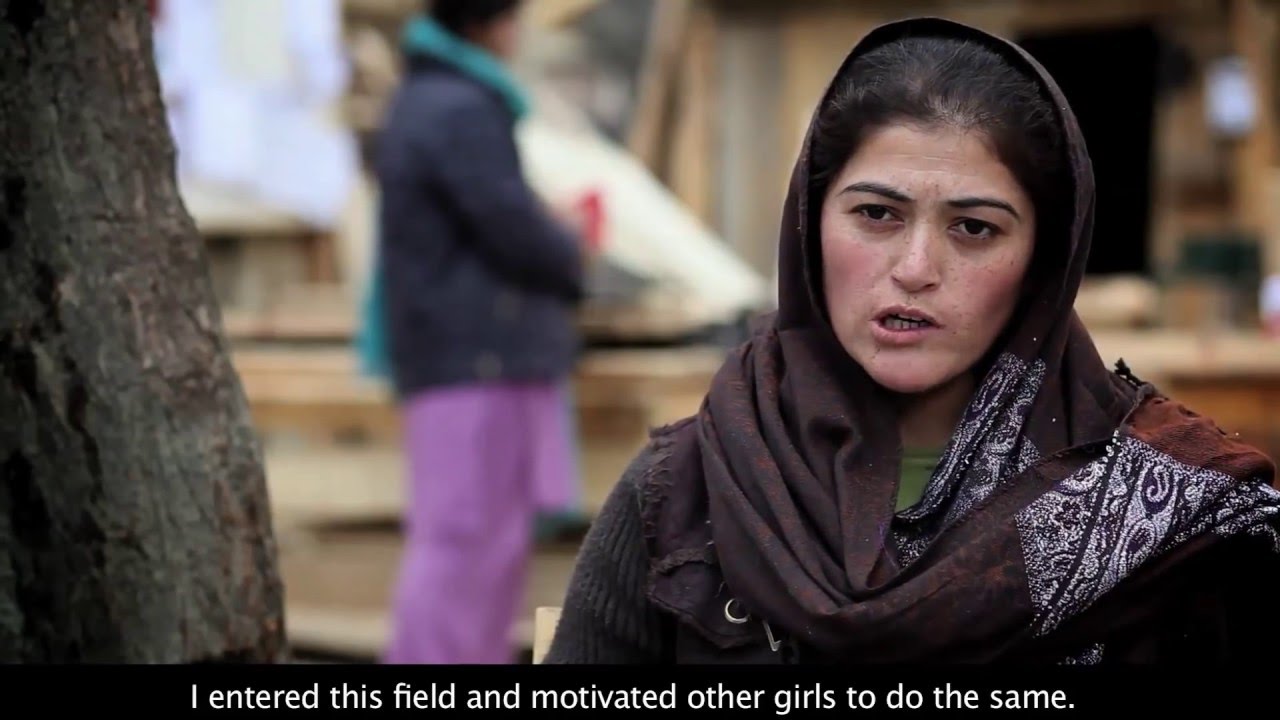
**Female carpenters! Now THAT’S a first!
“*Move aside boys, here come brave young women carpenters from Hunza, Pakistan, proving that there really is nothing a woman can’t do! We salute the courage and determination of Bibi Amna and her fellow carpenter ladies in Hunza.”
*
**
Re: ~ POSITIVE PAKISTANIS ~
**Total number of PhDs reaches 8,142 in Pakistan
Islamabad
The Pakistani universities are now able to produce more PhDs in the next 3 years as compared to last 10 years. The total number of PhDs in Pakistan has reached the figure of 8,142.
According to the data available with ‘The News’, the number of PhDs has increased from 348 (1947 to 2002) to 679 in 2012 in agriculture and veterinary sciences, from 586 to 1,096 in biological sciences, from 14 to 123 in business education, from merely 21 to 262 in engineering and technology and from 709 to 1,071 in physical sciences. In social sciences, the number increased to 887 from 108 during last ten years.
The figures also indicate that during the last decade, special emphasis has been paid to the disciplines of agriculture and veterinary sciences, biological sciences, business education, engineering and technology, physical sciences and social sciences.
Expressing his view over this development, HEC Executive Director Professor Dr. Sohail H. Naqvi said that the production of these PhDs is the harbinger of a great future. “These researchers, who have worked on problems of crucial importance to Pakistan, will play a leading role in the production of knowledge workers with a potential to take Pakistan in the ranks of developed nations,” he added.
He further said that HEC since its inception has introduced various indigenous scholarship schemes to create a critical mass of highly qualified human resources in all fields of studies who conduct research on issues of importance to Pakistan. “These locally qualified academics and researchers are playing an important role to improve the research and development potential of public as well as private universities and it will also strengthen the local industrial sector. With the launching of the schemes, research culture in public or private sector universities has been developed in accordance with international standards.”
The education experts view this development as an achievement in the higher education sector of Pakistan.
Dr. Farida Faisal, a fresh PhD holder from Fatima Jinnah Women University, Rawalpindi in Economics, views this development as result of provision of incentives and various indigenous scholarship schemes introduced during last few years in Pakistan. She said that good aspect of this development is that along with quantity, there has been strong emphasis over quality of these PhDs, which will improve with the passage of time, she hoped.
She suggested that keeping in view the future needs of Pakistan; there is a need to produce more number of PhDs in the next ten years.
Dr. Ashfaq Ahmed, associate professor at the Institute of Business and Management, UET, Lahore, who has recently completed his PhD degree in Management Science with distinction from Foundation University, Islamabad, termed this achievement an outcome of reforms and education-friendly policies introduced by the HEC, which were aimed at promotion and research and academic activities nationwide and across the globe during the last decade.
In the first 55 years since Pakistan’s independence, a total of 3,281 PhDs were awarded at Pakistani universities. However, since the establishment of the HEC in 2002, over 4,850 PhDs have been awarded to-date, which is more than what was awarded in the previous 55 years.
Total number of PhDs reaches 8,142 in Pakistan - thenews.com.pk
**
Re: ~ POSITIVE PAKISTANIS ~
One quoted here
14-year-old girl wins Pakistan’s first peace prize.received two bullets today .This is sure an act of Taliban , The dirty killers.
She is in hospital ,Prey for her
Re: ~ POSITIVE PAKISTANIS ~
**The first Japanese business delegation to visit Pakistan in over a decade made positive and encouraging remarks about the country, after spending two days in Karachi on the first leg of their visit to Pakistan.
**The 23-member delegation comprises corporate-level executives and top management of Japanese companies from several different sectors, many of whom are first time visitors to Pakistan.
“I have been surprised to know that the business promotion policy is quite welcoming for the investors in Pakistan.”
“**There is this perception among Japanese people that Pakistan is a dangerous and high-risk country and yet I think that this situation can be purposeful for business operations. I have good expectation from the business sector of the country,” **said Japan External Trade Organization (Jetro) Executive Vice President Daisuke Hiratsuka.
“People here are very friendly and smart. Their working style is comprehensive and systematic. I think that Pakistan is very capable of business investments and it is a potential business hub for foreign investors,” he added.
The delegation’s visit was arranged by Jetro, which is a non-profit official trade and investment promotion agency working under the aegis of the Government of Japan. Jetro has been operating in Pakistan for more than five decades.
During its stay in Karachi, the delegation first visited Expo Pakistan 2012 on Sunday, where they had a large Japanese pavilion. At the event, they also met with senior executives of the Trade Development Authority of Pakistan (TDAP) and other government officials.
Later, the delegation held networking sessions with local business leaders and office-bearers and members of different business associations.
Deriving valuable insights from their interactions, the delegation members were of the view that the potential for expansion of trade between Pakistan and Japan was substantial.
On the second day of their stay in Karachi, the Japanese delegation visited the Indus Motor Company’s Toyota plant and the Port Qasim Authority to get an insight into the port operations, before driving through the Bin Qasim Industrial Park, a project of the National Industrial Parks, and going to the Jinnah Terminal to catch a flight for Islamabad.
In Islamabad, the delegation will be meeting with the president of Pakistan and senior government officials.
They will also meet businessmen in Lahore and Sialkot, the Punjab Board of Investment and Trade before departing for Japan.
Re: ~ POSITIVE PAKISTANIS ~
Pakistan’s first artificial heart a success
KARACHI: Time must have stood still when doctors took 40-day-old Mohammad Ahmed Baloch’s heart off a make-shift, customized system – one that was set up because the actual machine that would have saved the infant’s life is not available anywhere in Pakistan.
But his heart began to beat.
“All the team members, doctors and nurses will never forget the amazing moment when the artificial support was taken off and the baby’s heart started beating on its own,” recalls his paediatric cardiac surgeon, Dr Muneer Amanullah.
To save Ahmed’s life, the paediatric cardiac and critical care team of the Aga Khan University Hospital (AKUH), Karachi, assisted by Dr Asif Hasan from the UK, set-up a customised heart-lung bypass system that acted like an ECMO (Extra-Corporeal Membrane Oxygenation) machine, which is not available anywhere in Pakistan.
Hence, 40-day-old Ahmed from Dera Allah Yar, Balochistan, became the first patient in Pakistan to survive on an artificial heart-lung machine for three days.
Great job 
Re: ~ POSITIVE PAKISTANIS ~
**Pakistani researcher grabs excellence award in Australia
****Muhammad Aamir Cheema has received the 2012 Malcolm Chaikin Prize for Research Excellence in Engineering. This prestigious prize carries with it a medal and $10,000 and is given each year to the doctoral student in the Faculty of Engineering at University of New South Wales, Australia, for producing the best PhD thesis, in the broadest sense, within the calendar year.
**His PhD thesis proposes state-of-the-art techniques for several important location-based queries that have many interesting applications such as finding the nearest facilities (ATMs, restaurants), navigation and location-based SMS advertisement.
During his PhD, Aamir published 17 research papers 12 of which had appeared in top-tier conferences and journals. His PhD thesis titled “Efficiently Processing Proximity Based Spatial Queries” is a collection of eight of his best publications including four top-tier conference papers and four top-tier journal papers.
His publications won him several awards including two best paper nominations in ICDE 2010 and ICDE 2012, the best poster award in ICDE 2011, the best paper award in ADC 2010, and two CiSRA best research paper awards in 2009 and 2010, consecutively.
Aamir’s PhD thesis was highly appreciated by the examiners. One of the examiners stated “This is the best thesis I have ever reviewed, in terms of research quality”.
Pakistani researcher grabs excellence award in Australia | Technology Times
Re: ~ POSITIVE PAKISTANIS ~
Two unsung golfing heroes of Pakistan await their countrymen here 