Re: Learn Arabic Grammar !
JazakAllah khair
You are talking about second one right? What is the meaning of na’at man’oot?
BarakAllahu feek & may Allah reward you beyond your imagination Ameen
The first one is jumlatul ismia?
Re: Learn Arabic Grammar !
JazakAllah khair
You are talking about second one right? What is the meaning of na’at man’oot?
BarakAllahu feek & may Allah reward you beyond your imagination Ameen
The first one is jumlatul ismia?
Re: Learn Arabic Grammar !
Na’at = sifa
man’out = mausoof
sifa can be understood from its jam’a … Sifaat … Like the Sifaat of Allah (SWT) … It means Adjectives … which means “description” …
What is really amazing here is that Arabic is completely presenting modern logic theory in its grammatical structure.
In the first sentence … The word clean is Nakira … Which implies there are other clean things around and the handkerchief is one of them. In the second case the ma’rifa designation is on the word clean says to us that “there is a clean thing” and that it is a handkerchief. Hence it is called equivalence in the case of the adjective and predicatation in the case of the First sentence.
The word al-Mindeel in the first one is the Mubtada and the nazdeef is the Khabar.
In in the second case the word Al-Mindeel is not a mubtada as there is no jumla, however, it called the man’oot or mausoof
it means the term that corresponds with the adjective, but not the adjective itself. The adjective itself is called na’at or sifa
Re: Learn Arabic Grammar !
So the rule between the na’at and man’oot is …
If any of these is not the same then they are not na’at man’oot.
Re: Learn Arabic Grammar !
samjh agayi…but little bit confusing…so the na’at or sifa is an nazeef right?
i will post examples…app bateyga kay theek hay kay nahi..
jazakALLAH khair
it is cleared now alhamdulilah
Re: Learn Arabic Grammar !
Alhumdulillah …
So there are other shibhu jumlas in Arabic … I.e. Word phrases that are not quite sentences.
For example:
mudaaf, mudaaf ilay… e.g. >>> ibn-ul-mudarrisi …
Meaning … Son of the teacher
In this case the mudaaf is the ism … Ibn
and the mudaaf ilay is the ism … Al-muddarisu
Perhaps you’ve noticed that by putting the ibn before the Al-mudarrisu it has altered the u into an i … It has changed the marfu state of the word into a jarr state.
Re: Learn Arabic Grammar !
Now … Here is a task for anyone …
You can write this down like sister Tahurra has done and sent in the photo of it, it is important that you get all of the 'iraab correct so typing will not be enough, I.e. Show the full Tashkeel.
using the below words create two examples of jumla ismiyya, two examples of na’at man’oot and two examples of mudaaf, mudaaf ilay.
baab, kursi, Zahid, kitaab, siyarah, jadeed, jadeedah, nazdeef, bait, kabeer, kabeera, naafidza, Saleema.
You can get a token star if you can form a valid combination of two or more of these learnt forms into one sentence correctly.
Re: Learn Arabic Grammar !
Can you please tell me what these words are and their meaning..i took nazdeef as nazeef
And i haven’t done mudaaf and mydaaf aliy
It might be ibn ul zahidi (i am not sure) its just a guess
Here it is brother my effort
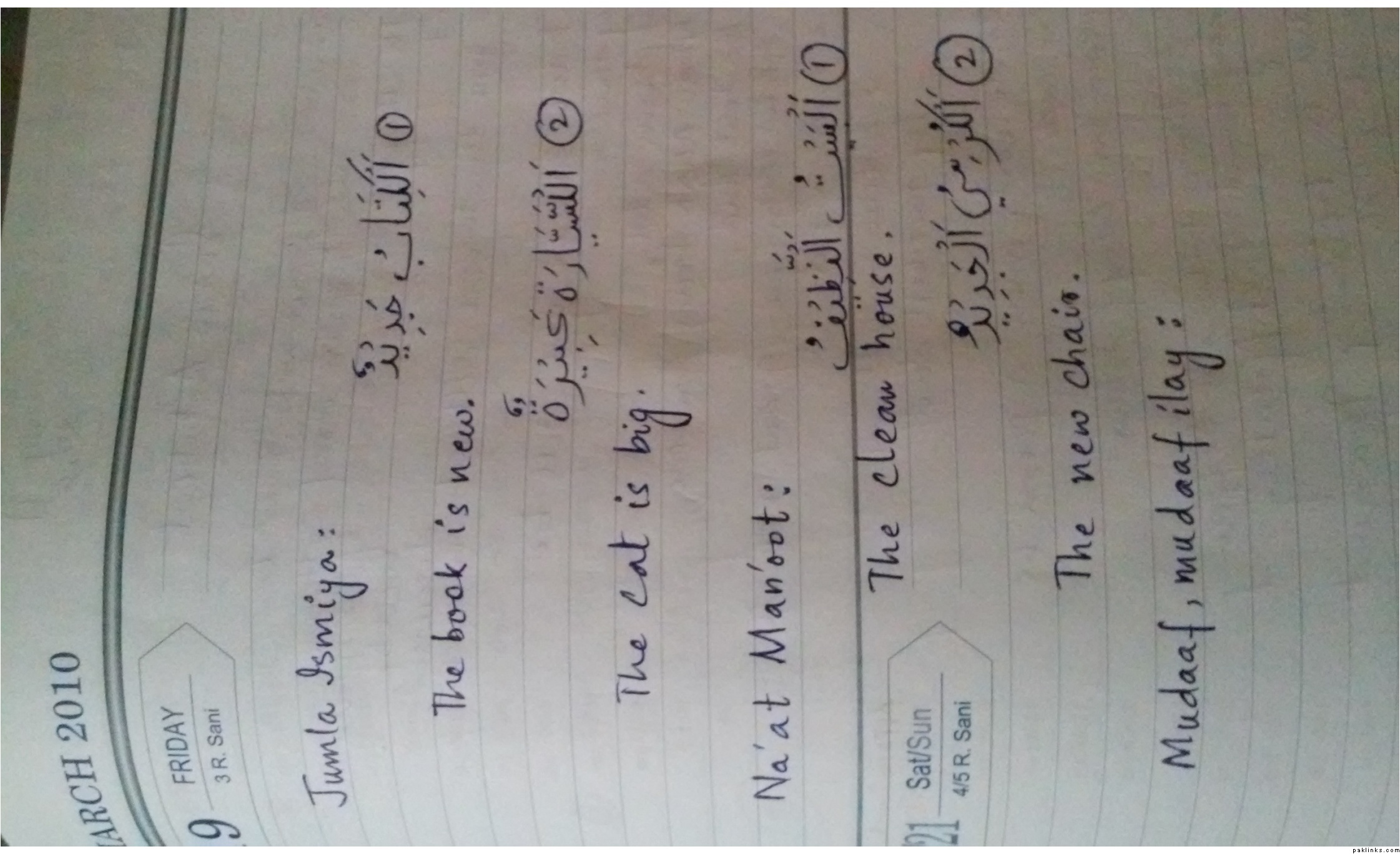
Correct me!!
JazakAllah khairan kaseera
Re: Learn Arabic Grammar !
nazdeef = clean
naafidzah = window
Sister Tahurra
MashaAllah … good effort …
Al-kitaabu-jadeedun - is correct and translation is correct
For the second one you missed the dhamma on the ta marbuta of the word siyaarah - but you remembered to match the gender of the car with the gender of the word big - well done. I think your wrote car … but it looks like cat … LOL … and you remembered the haroof shamsiyya on the name siyaarah - also that is excellent.
Al-baytu-Nnazdeefu is correct and the translation too … again you remembered the haroof shamsiyya of noon - good …
Al-kursiy-ul-jadeedu is nearly correct … But you wouldn’t know because there is another rule that you may not have learnt yet … it is to do with long and short vowel combinations. Basically the sound ee and oo after the ya is tricky so the Arabic language facilitates this sound by adding a tashdeed on the ya …
Look at ayat-ul-kursi for the word kursi and you will see a shaddah on the ya.
Regarding the mudaaf, mudaaf ilay - your example of mudaaf, mudaaf ilay is correct … this combination means or translates to possessed, possessor.
x of y …
x is possessed by y
likewise ibn is possessed by Zahid
But you cannot use **ibn **here because it is not a member of the words I have given. Any two nouns can be placed together so long as it makes sense. You can’t say the Zahid of Saleema for example. A rule for the mudaaf, mudaaf ilay is that the mudaaf (possessed) MUST be nakirah and hence it cannot take the AL before it.
Re: Learn Arabic Grammar !
Assalamualaikum brother,
Well in kursi i was thinking of mushadad but JazakumAllah khair for explaining well..may Allah increase you in knowledge and amal..and may You have reward in both world Ameen
Well brother i wrote cat..strange if t seems like r  and funny is this i wrote stars first instead of cat…from sayyarah i translated stars then googled…
See if this is correct?
Ibn ul tabeebi
The son of doctor
I am again not sure..
Re: Learn Arabic Grammar !
Sister … 
cat = hirr(a) or qitta(h) in Arabic
car = siyaarah
star = najm in Arabic
Translation you wrote is son of the doctor … It is correct, remember Tashdeed on tau.
Re: Learn Arabic Grammar !
yes then i forgot stars is najam…
yes silly mistakes since childhood:smack:
jazakAllah khair..
Re: Learn Arabic Grammar !
Arabic by Aamir Sohail
[Yt]MA2XkCzPlmg[/Yt]
Playlist
Re: Learn Arabic Grammar !
Audio quality is too slow??? not proper
Re: Learn Arabic Grammar !
^
Can you fix it? 
Re: Learn Arabic Grammar !
Yahan kia hota hai jo bilkul nae ho rha 