This Day in History, May 24
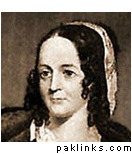
**On May 24th, 1830, **
**Sarah Hale published the poem **
***“Mary Had a Little Lamb.”
Re: INTERESTING LIVES and INTERESTING FACTS
The hotel is really BEAUTIFUL,uncle....WOW
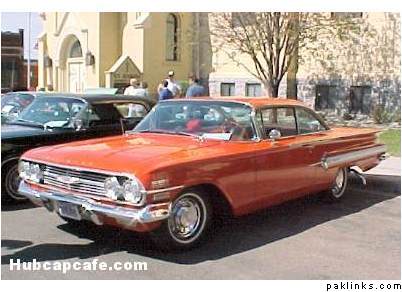
Chevrolet Pictures and Information including the 57 Chevy!
**
Antique, Classic and Special Interest Collector Car Pictures.
You can find Chevy cars and trucks from 1927 to 1986 in the classic Chevrolet pictures listed in the link below.
*** And more pictures/details.*
A beauty of a car…IMPALA…!!
There are but a few like 4 or 5 seen on Karachi Roads
now..perhaps with some diesel engine…
MAGICAL TAP
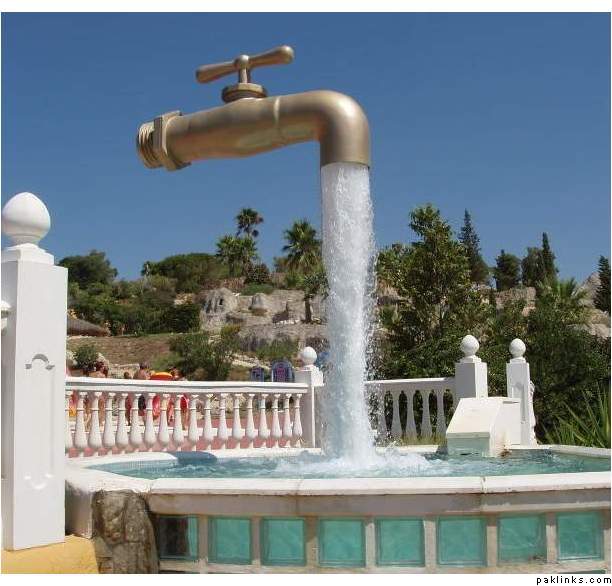
**HOW?? **
***The magic tap, which appears to float ***
***in the sky with an endless supply of water. ***
***In actuality, there is a pipe hidden in the stream of water. ***
***The construction is fascinating and is easy to make, ***
***if the pipe is made of transparent Perspex ***
***than you would never see it inside the water stream.
BOY SCOUTS
The Boy Scout movement was founded on this day in 1907 by Robert Baden-Powell. It has since grown to become the largest youth movement in the world, as certified by GWR at last year’s World Jamboree, and Scouts have a long tradition of record breaking feats, as the following list shows:
**Knot-tying - fastest six knots
**The fastest recorded time for tying the six Boy Scout Handbook Knots (square knot, sheet bend, sheep shank, clove hitch, round turn and two half hitches, and bowline) on individual ropes is 8.1seconds by Clinton R. Bailey (US) on 13 Apr 1977 at Sunset West Lounge in Pacific City, Oregon, USA.
Largest ping pong ball release
Boy Scout Troop 442 of Union, Missouri sucessfully retrieved 3,055 ping pong balls on 11 Sept 1999, which had been released from a tractor scoop and rolled half a block downhill into a wooden funnel on North Church Street, Union.
Most model rocket kits launched simultaneously
The record for most model rockets launched simultaneously is 965 by Boy Scout Troop #990 and Cub Scout Pack #990 (all USA) in Austin, Texas, USA, on 12 May 2007.
Longest line of sweets
In 24 hours between 5 to 6 Dec 1998, a total of 60 Scouts from Maryborough, Victoria, Australia, produced a continuous line of 306,250 Mintie sweets, covering a distance of 15.143km 9miles 720yds at Goldfields Leisure Nestle Centre.
***Longest knotted rope chain in 5 minutes
The longest knotted rope chain made in five minutes measured 1,675 m (5,496 ft 1 in) and was completed by 325 Scouts along with their parents and leaders for an event organised by 3rd Bowmanville Scouts (Canada) at JOTA, Mosport International Race Track, Ontario, Canada on 20 October 2007.
**This Day in History, May 29 **
***On May 29th, 1953, ***
Sir Edmund Hillary
***became the first person to reach the top of Mt. Everest. ***
Re: INTERESTING LIVES and INTERESTING FACTS
**HeartMath - A Change of Heart Changes Everything**
**
***"HeartMath’s research shows that emotions work much faster, and are more powerful, than thoughts. And that—when it comes to the human body—the heart is much more important than the brain to overall health and well-being—even cognitive function—than anyone but poets believed.* Briefly re-experiencing a cherished memory creates synchronization in your heart rhythm in mere seconds. Through its research, the Institute of HeartMath proves that health starts with love. "
** -- Ode Magazine, June 2005 Issue
Recently, I was diagnosed with
*~ A.A.A.D.D. ~ *
*Age Activated Attention Deficit Disorder *
This is how it manifests ...
**I decide to water my garden. As I turn on the hose in the driveway. I look over at my car and decide it needs washing. As I start toward the garage, I notice mail on the porch table that I brought up from the mail box earlier. **
**I decide to go through the mail before I wash the car. I lay my car keys on the table, put the junk mail in the garbage can, under the table, and notice that the can is full. So, I decide to put the bills back on the table and take out the garbage first. **
**But then I think, since I'm going to be near the mailbox when I take out the garbage anyway, I may as well pay the bills first. I take my cheque book off the table, and see that there is only 1 cheque left. My extra cheques are in my desk in the study, so I go inside the house to my desk where I find the can of Coke I'd been drinking. **
**I'm going to look for my cheques, but first I need to push the Coke aside so that I don't accidentally knock it over. The Coke is getting warm, and I decide to put it in the refrigerator to keep it cold. As I head toward the kitchen with the Coke, a vase of flowers in the hall catches my eye ~ they need water. I put the Coke on the table and discover my reading glasses that I've been searching for all morning. I decide I better put them back on my desk, but first I'm going to water the flowers. **
**I set the glasses back down on the table, fill a container with water and suddenly spot the TV remote. Someone left it on the kitchen counter. I realize that tonight, when I go to watch TV, I'll be looking for the remote, but I won't remember that it's in the kitchen, so I decide to put it back in the study where it belongs, but first I'll water the flowers. I pour some water in the flowers, but quite a bit spills on the floor. **
**So, I set the remote back on the table, get some towels and wiped up the spill. Then, I head down the passage trying to remember what I was planning to do. **
*** At the end of the day ~***
*** - the car isn't washed***
*** - the bills aren't paid***
*** - there is a warm can of Coke sitting on the table***
*** - the flowers don't have enough water***
*** - there is still only 1 cheque in my cheque book***
*** - I can't find the remote***
*** - I can't find my glasses***
*** - and I don't remember what I did with the car keys.***
**Then, when I try to figure out why nothing got done today, I'm really baffled because I know I was busy all day, and I'm really tired. I realize this is a serious problem, and I'll try to get some help for it, but first I'll check my e-mail. **
**Do me a favor. Forward this message to everyone you know, because I don't remember who the hell I've sent it to. **
Don't laugh ~ if this isn't you yet, your day is coming!!
GROWING OLDER IS MANDATORY.
GROWING UP IS OPTIONAL.
LAUGHING AT YOURSELF IS THERAPEUTIC.
RAJU
***Ladies & Gentlemen----Boys & Girls, ***
***what you are to see now… ***
***is something I called THE ART OF PERFORMING!
Yep…there was this guy JERRY LEWIS (praise be upon ALLAH he is still around) who started his career doing weekly B&W shows on TV before a live audience with Dean Martin in mid-50’s. Jerry rose to fame for his typical style (the smile & comical facial expressions par excellence) and did many movies…including his 30 seconds role in MAD MAD MAD MAD WORLD where he is seen driving ***
his convertible over Police Chief Pepper’s hat!
This video comes from his movie “WHO’S MINDING THE STORE” and the manner in which he has synchronized his TYPING.. is something amazing!
JERRY LEWIS does the imaginary typing…on a MANUAL TYPEWRITER of the late 60’s which use to have a lever on the right hand side to push the base back to the next para to continue typing…when a tinkle was heard that its the end of the line being typed manually…
Enjoy…
(Raju)
JERRY LEWIS; “TYPES”
(Who’s Minding The Store)
(Tribute to Jerry & his typewriter bit)
The Fringe Benefits of Failure, and the Importance of Imagination
Harvard University Commencement Address
by J.K. Rowling
Copyright June 2008
As prepared for delivery
**President Faust, members of the Harvard Corporation and the Board of
Overseers, members of the faculty, proud parents, and, above all, GRADUATES, **
**The first thing I would like to say is 'thank you.' Not only has Harvard
given me an extraordinary honour, but the weeks of fear and nausea I've
experienced at the thought of giving this commencement address have made
me lose weight. A win-win situation! Now all I have to do is take deep
breaths, squint at the red banners and fool myself into believing I am
at the world's best-educated Harry Potter convention. **
**Delivering a commencement address is a great responsibility; or so I
thought until I cast my mind back to my own graduation. The commencement
speaker that day was the distinguished British philosopher Baroness Mary
Warnock. Reflecting on her speech has helped me enormously in writing
this one, because it turns out that I can't remember a single word she
said. This liberating discovery enables me to proceed without any fear
that I might inadvertently influence you to abandon promising careers in
business, law or politics for the giddy delights of becoming a gay
wizard. **
**You see? If all you remember in years to come is the 'gay wizard' joke,
I've still come out ahead of Baroness Mary Warnock. Achievable goals:
the first step towards personal improvement. **
**Actually, I have wracked my mind and heart for what I ought to say to
you today. I have asked myself what I wish I had known at my own
graduation, and what important lessons I have learned in the 21 years
that has expired between that day and this.
I have come up with two answers. On this wonderful day when we are
gathered together to celebrate your academic success, I have decided to
talk to you about the benefits of failure. And as you stand on the
threshold of what is sometimes called 'real life', I want to extol the
crucial importance of imagination.
These might seem quixotic or paradoxical choices, but please bear with
me. **
**Looking back at the 21-year-old that I was at graduation, is a slightly
uncomfortable experience for the 42-year-old that she has become. Half
my lifetime ago, I was striking an uneasy balance between the ambition I
had for myself, and what those closest to me expected of me.
I was convinced that the only thing I wanted to do, ever, was to write
novels. However, my parents, both of whom came from impoverished
backgrounds and neither of whom had been to college, took the view that
my overactive imagination was an amusing personal quirk that could never
pay a mortgage, or secure a pension. **
**They had hoped that I would take a vocational degree; I wanted to study
English Literature. A compromise was reached that in retrospect
satisfied nobody, and I went up to study Modern Languages. Hardly had my
parents' car rounded the corner at the end of the road than I ditched
German and scuttled off down the Classics corridor. **
**I cannot remember telling my parents that I was studying Classics; they
might well have found out for the first time on graduation day. Of all
subjects on this planet, I think they would have been hard put to name
one less useful than Greek mythology when it came to securing the keys
to an executive bathroom. **
**I would like to make it clear, in parenthesis, that I do not blame my
parents for their point of view. There is an expiry date on blaming your
parents for steering you in the wrong direction; the moment you are old
enough to take the wheel, responsibility lies with you. What is more, I
cannot criticise my parents for hoping that I would never experience
poverty. They had been poor themselves, and I have since been poor, and
I quite agree with them that it is not an ennobling experience. Poverty
entails fear, and stress, and sometimes depression; it means a thousand
petty humiliations and hardships. Climbing out of poverty by your own
efforts, that is indeed something on which to pride yourself, but
poverty itself is romanticised only by fools. **
**What I feared most for myself at your age was not poverty, but failure.
At your age, in spite of a distinct lack of motivation at university,
where I had spent far too long in the coffee bar writing stories, and
far too little time at lectures, I had a knack for passing examinations,
and that, for years, had been the measure of success in my life and that
of my peers. **
**I am not dull enough to suppose that because you are young, gifted and
well-educated, you have never known hardship or heartbreak. Talent and
intelligence never yet inoculated anyone against the caprice of the
Fates, and I do not for a moment suppose that everyone here has enjoyed
an existence of unruffled privilege and contentment. **
**However, the fact that you are graduating from Harvard suggests that you
are not very well-acquainted with failure. You might be driven by a fear
of failure quite as much as a desire for success. Indeed, your
conception of failure might not be too far from the average person's
idea of success, so high have you already flown academically.
Ultimately, we all have to decide for ourselves what constitutes
failure, but the world is quite eager to give you a set of criteria if
you let it. So I think it fair to say that by any conventional measure,
a mere seven years after my graduation day, I had failed on an epic
scale. An exceptionally short-lived marriage had imploded, and I was
jobless, a lone parent, and as poor as it is possible to be in modern
Britain, without being homeless. The fears my parents had had for me,
and that I had had for myself, had both come to pass, and by every usual
standard, I was the biggest failure I knew. **
**Now, I am not going to stand here and tell you that failure is fun. That
period of my life was a dark one, and I had no idea that there was going
to be what the press has since represented as a kind of fairy tale
resolution. I had no idea how far the tunnel extended, and for a long
time, any light at the end of it was a hope rather than a reality.
So why do I talk about the benefits of failure? Simply because failure
meant a stripping away of the inessential. I stopped pretending to
myself that I was anything other than what I was, and began to direct
all my energy into finishing the only work that mattered to me. Had I
really succeeded at anything else, I might never have found the
determination to succeed in the one arena I believed I truly belonged. I
was set free, because my greatest fear had already been realised, and I
was still alive, and I still had a daughter whom I adored, and I had an
old typewriter and a big idea. And so rock bottom became the solid
foundation on which I rebuilt my life. **
**You might never fail on the scale I did, but some failure in life is
inevitable. It is impossible to live without failing at something,
unless you live so cautiously that you might as well not have lived at
all - in which case, you fail by default. **
**Failure gave me an inner security that I had never attained by passing
examinations. Failure taught me things about myself that I could have
learned no other way. I discovered that I had a strong will, and more
discipline than I had suspected; I also found out that I had friends
whose value was truly above rubies. **
**The knowledge that you have emerged wiser and stronger from setbacks
means that you are, ever after, secure in your ability to survive. You
will never truly know yourself, or the strength of your relationships,
until both have been tested by adversity. Such knowledge is a true gift,
for all that it is painfully won, and it has been worth more to me than
any qualification I ever earned. **
**Given a time machine or a Time Turner, I would tell my 21-year-old self
that personal happiness lies in knowing that life is not a check-list of
acquisition or achievement. Your qualifications, your CV, are not your
life, though you will meet many people of my age and older who confuse
the two. Life is difficult, and complicated, and beyond anyone's total
control, and the humility to know that will enable you to survive its
vicissitudes. **
**You might think that I chose my second theme, the importance of
imagination, because of the part it played in rebuilding my life, but
that is not wholly so. Though I will defend the value of bedtime stories
to my last gasp, I have learned to value imagination in a much broader
sense. Imagination is not only the uniquely human capacity to envision
that which is not, and therefore the fount of all invention and
innovation. In its arguably most transformative and revelatory capacity,
it is the power that enables us to empathise with humans whose
experiences we have never shared. **
**One of the greatest formative experiences of my life preceded Harry
Potter, though it informed much of what I subsequently wrote in those
books. This revelation came in the form of one of my earliest day jobs.
Though I was sloping off to write stories during my lunch hours, I paid
the rent in my early 20s by working in the research department at
Amnesty International' s headquarters in London. **
**There in my little office I read hastily scribbled letters smuggled out
of totalitarian regimes by men and women who were risking imprisonment
to inform the outside world of what was happening to them. I saw
photographs of those who had disappeared without trace, sent to Amnesty
by their desperate families and friends. I read the testimony of torture
victims and saw pictures of their injuries. I opened handwritten,
eye-witness accounts of summary trials and executions, of kidnappings
and rapes.
Many of my co-workers were ex-political prisoners, people who had been
displaced from their homes, or fled into exile, because they had the
temerity to think independently of their government. Visitors to our
office included those who had come to give information, or to try and
find out what had happened to those they had been forced to leave
behind. **
**I shall never forget the African torture victim, a young man no older
than I was at the time, who had become mentally ill after all he had
endured in his homeland. He trembled uncontrollably as he spoke into a
video camera about the brutality inflicted upon him. He was a foot
taller than I was, and seemed as fragile as a child. I was given the job
of escorting him to the Underground Station afterwards, and this man
whose life had been shattered by cruelty took my hand with exquisite
courtesy, and wished me future happiness. **
**And as long as I live I shall remember walking along an empty corridor
and suddenly hearing, from behind a closed door, a scream of pain and
horror such as I have never heard since. The door opened, and the
researcher poked out her head and told me to run and make a hot drink
for the young man sitting with her. She had just given him the news that
in retaliation for his own outspokenness against his country's regime,
his mother had been seized and executed. **
**Every day of my working week in my early 20s I was reminded how
incredibly fortunate I was, to live in a country with a democratically
elected government, where legal representation and a public trial were
the rights of everyone. **
**Every day, I saw more evidence about the evils humankind will inflict on
their fellow humans, to gain or maintain power. I began to have
nightmares, literal nightmares, about some of the things I saw, heard
and read. **
**And yet I also learned more about human goodness at Amnesty
International than I had ever known before. **
**Amnesty mobilises thousands of people who have never been tortured or
imprisoned for their beliefs to act on behalf of those who have. The
power of human empathy, leading to collective action, saves lives, and
frees prisoners. Ordinary people, whose personal well-being and security
are assured, join together in huge numbers to save people they do not
know, and will never meet. My small participation in that process was
one of the most humbling and inspiring experiences of my life. **
**Unlike any other creature on this planet, humans can learn and
understand, without having experienced. They can think themselves into
other people's minds, imagine themselves into other people's places.
Of course, this is a power, like my brand of fictional magic, that is
morally neutral. One might use such an ability to manipulate, or
control, just as much as to understand or sympathise.
And many prefer not to exercise their imaginations at all. They choose
to remain comfortably within the bounds of their own experience, never
troubling to wonder how it would feel to have been born other than they
are. They can refuse to hear screams or to peer inside cages; they can
close their minds and hearts to any suffering that does not touch them
personally; they can refuse to know. **
**I might be tempted to envy people who can live that way, except that I
do not think they have any fewer nightmares than I do. Choosing to live
in narrow spaces can lead to a form of mental agoraphobia, and that
brings its own terrors. I think the wilfully unimaginative see more
monsters. They are often more afraid. **
**What is more, those who choose not to empathise may enable real
monsters. For without ever committing an act of outright evil ourselves,
we collude with it, through our own apathy.
One of the many things I learned at the end of that Classics corridor
down which I ventured at the age of 18, in search of something I could
not then define, was this, written by the Greek author Plutarch: What we
achieve inwardly will change outer reality. **
**That is an astonishing statement and yet proven a thousand times every
day of our lives. It expresses, in part, our inescapable connection with
the outside world, the fact that we touch other people's lives simply by
existing. **
**But how much more are you, Harvard graduates of 2008, likely to touch
other people's lives? Your intelligence, your capacity for hard work,
the education you have earned and received, give you unique status, and
unique responsibilities. Even your nationality sets you apart. The great
majority of you belong to the world's only remaining superpower. The way
you vote, the way you live, the way you protest, the pressure you bring
to bear on your government, has an impact way beyond your borders. That
is your privilege, and your burden. **
**If you choose to use your status and influence to raise your voice on
behalf of those who have no voice; if you choose to identify not only
with the powerful, but with the powerless; if you retain the ability to
imagine yourself into the lives of those who do not have your
advantages, then it will not only be your proud families who celebrate
your existence, but thousands and millions of people whose reality you
have helped transform for the better. We do not need magic to change the
world, we carry all the power we need inside ourselves already: we have
the power to imagine better. **
**I am nearly finished. I have one last hope for you, which is something
that I already which is something that I already had at 21. The friends
with whom I sat on graduation day have been my friends for life. They
are my children's godparents, the people to whom I've been able to turn
in times of trouble, friends who have been kind enough not to sue me
when I've used their names for Death Eaters. At our graduation we were
bound by enormous affection, by our shared experience of a time that
could never come again, and, of course, by the knowledge that we held
certain photographic evidence that would be exceptionally valuable if
any of us ran for Prime Minister. **
**So today, I can wish you nothing better than similar friendships. And
tomorrow, I hope that even if you remember not a single word of mine,
you remember those of Seneca, another of those old Romans I met when I
fled down the Classics corridor, in retreat from career ladders, in
search of ancient wisdom:
As is a tale, so is life: not how long it is, but how good it is, is
what matters. **
I wish you all very good lives.
Thank you very much.
**THE
“R”
WORD
**Respect PSA
HISTORY OF THE
OLYMPIC MEDALS
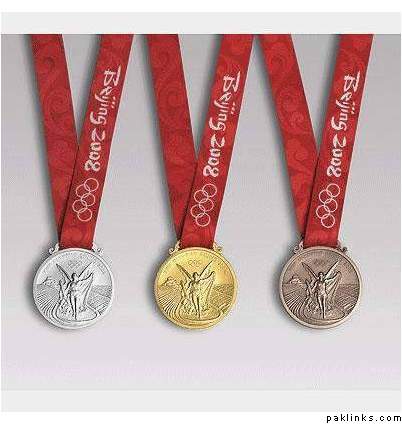
In the ancient Olympics, no medals were awarded. The first-place winner was given an olive branch to wear on his head. The second and third place winners did not receive anything.
At the first Games in 1896, silver medals were awarded to the winners and bronze to the second place getters. Eight years later, at the 1904 Games in St. Louis, gold replaced silver as the medal awarded for first place.
The last Olympic gold medals that were made entirely out of gold were awarded in 1912. Today’s ‘gold’ medals are actually made of sterling silver and covered with a thin coat of pure gold (6 grams or .21 ounces) . The current specifications is that each medal must be at least three millimeters thick and 60 millimeters in diameter.
All Olympic medals since 1928 have featured the same design on the front: a Greek goddess, the Olympic Rings, the coliseum of ancient Athens, a Greek vase known as an amphora, a horse-drawn chariot, and the year, number of the Olympiad, and host city. Each host city is allowed to add special details to this design.
For the reverse of the medal, each organizing committee is allowed their own design.
FOR BETTER
or
FOR WORSE!!
The Animal School: A Parable
Once upon a time the animals decided they must do something decisive to meet the increasing complexity of their society. They held a meeting and finally decided to organize a school.
The curriculum consisted of running, climbing, swimming and flying. Since these were the basic behaviors of most animals, they decided that all the students should take all the subjects.
**The duck proved to be excellent at swimming, better in fact, than his previous bosses. He also did well in flying. But he proved to be very poor in running. **
Since he was poor in this subject, he was made to stay after school to practice it and even had to drop swimming in order to get more time in which to practice running. He was kept at this poorest subject until his webbed feet were so badly damaged that he became only average at swimming. But average was acceptable in the school, so no body worried about that – except the duck.
The rabbit started at the top of her class in running, but finally had a nervous breakdown because of so much make-up time in swimming – a subject she hated.
The squirrel was excellent at climbing until he developed a psychological block in flying class, when the teacher insisted he start from the ground instead of from the tops of trees. He was kept at attempting to fly until he became muscle-bound – and received a C in climbing and a D in running.
The eagle was the school’s worst discipline problem; in climbing class, she beat all of the others to the top of the tree used for examination purposes in this subject, but she insisted on using her own method of getting there.
The gophers, of course, stayed out of school and fought the tax levied for education because digging was not included in the curriculum. They apprenticed their children to the badger and later joined the groundhogs and eventually started a private school offering alternative education.
Alas the author is unknown (a student at the University of Toronto)
 I read it many times before but always get pleasure reading it, I thought many times to upload it at GS, but for *some *reasons I killed my desire
Re: INTERESTING LIVES and INTERESTING FACTS
Very interesting stuff you shared Mr. Raju Jamil. bundle of thanks 
Jerry Lewis is an amazing actor. The clip was marvelous :lajawa: I saw his movies in adolesent days, mostly when they were shown by PTV & NTM. They were extremely funny and kept us rolling on the floor.
The music if someone noticed was and is still used for intro of Radio Pakistan News bulletin  Now i know they took if from this movie :k:
The picture and stories are worth sharing
Thank you…I am honored with your kind comments and thoughts.
-Raju
*(This remarkable 443-word composition was written and published by an
unknown Scottish author sometime in the 19th century ) *
Winnie and Walter
**“Warm weather, Walter! Welcome warm weather! We were wishing winter would wane, weren’t we?” “We were well wearied with waiting,” whispered Waiter wearily. Wan, white, woe-begone was Walter; wayward, wilful, worn with weakness, wasted, waxing weaker whenever winter’s wild, withering winds were wailing. Wholly without waywardness was Winifred, Walter’s wise, womanly watcher, who, with winsome, wooing way, was well-beloved. **
**“We won’t wait, Walter; while weather’s warm we’ll wander where woodlands wave, won’t we?” **
**Walter’s wanton wretchedness wholly waned. “Why, Winnie, we’ll walk where we went when we were with Willie; we’ll weave wildflower wreaths, watch woodmen working; woodlice, worms wriggling; windmills whirling; watermills wheeling; we will win wild whortleberries, witness wheat winnowed.” **
**Wisbeach woods were wild with wildflowers; warm, westerly winds whispered where willows were waving; wood-pigeons, wrens, woodpeckers were warbling wild woodnotes. Where Wisbeach water-mill’s waters, which were wholly waveless, widened, were waterlilies, waxen white. Winifred wove wreaths with woodbine, whitehorn, wallflowers; whilst Walter whittled wooden wedges with willow wands. **
**Wholly without warning, wild wet winds woke within Wisbeach woods, whistling where Winifred wandered with Walter; weeping willows were wailing weirdly; waging war with wind-tossed waters. Winifred’s wary watchfulness waked. **
**“Walter, we won’t wait.”
“Which way, Winnie?” **
**Winifred wavered. “Why, where were we wandering? Wisbeach woods widen whichever way we walk. Where’s Wisbeach white wicket, where’s Winston’s water-mill?” **
**WistfuIly, Walter witnessed Winifred’s wonder. “Winnie, Winnie, we were wrong, wholly wrong; wandering within wild ways. Wayfaring weather-beaten waifs, well-nigh worn-out.” **
**Winifred waited where, within wattled woodwork walls, waggons, wheelbarrows, wains were waiting, weighty with withered wood. Walter, warmly wrapped with Winifred’s well-worn wadded waterproof, was wailing woefully, wholly wearied. Winnie, who, worn with watching, well-nigh weeping, was wistfully, wakefully waiting Willie’s well-known whistle, wholly wished Walter’s well-being warranted. **
**With well-timed wisdom, Walter was wound with wide, worsted wrappers, which wonderfully well withstood winter’s withering, whistling winds. Wholly without warm wrappers was Winifred, who, with womanly wisdom, was watching Walter’s welfare, warding Walter’s weakness. **
**“When will Willie wend where we wait?” wearily wondered Walter. “Whist, Walter,” whispered Winnie, “who was whooping?” **
**“Whereabouts?” **
**Welcome whistling was waking Wisbeach woods when winter’s windy warfare waxed weaker. **
**“Winnie! Walter!” **
**Winifred’s wakefulness was well-grounded. “We’re well, Willie; we’re where Winston’s waggons wait.” **
**Without waiting, Willie was within Winston’s woodwork walls. **
**“Welcome, welcome, Willie.” Winnie was weeping with weariness with watching Walter, weak with wayfaring. **
**“Why Winnie! Wise, watchful, warm-hearted Winnie,” Willie whispered wheedlingly. “We won’t weep; Walter’s well. What were Walter without Winnie?” **
Wholly wonderful was Winifred’s well-timed womanly wisdom, which well warranted weakly Walter’s welfare. Whenever wandering within Wisbeach woods with Winnie, Walter would whisper, “What were Walter without Winnie? Wise, watchful, warm-hearted Winnie!”
Raju’s Roses Club
Live Well, Love Much, Laugh Often
*** Smile is an inexpensive way to improve your looks***