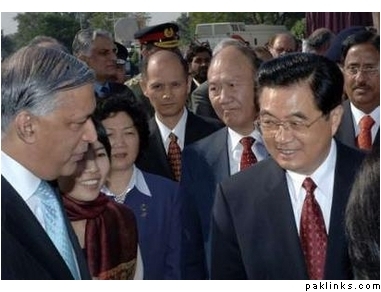
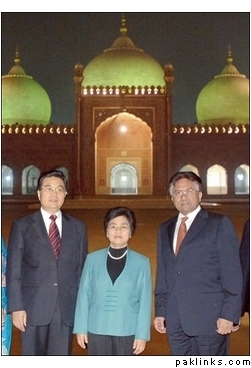
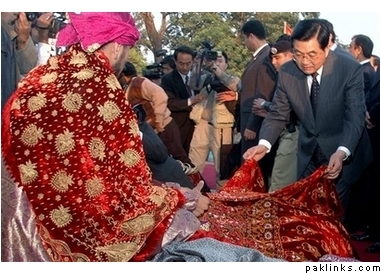
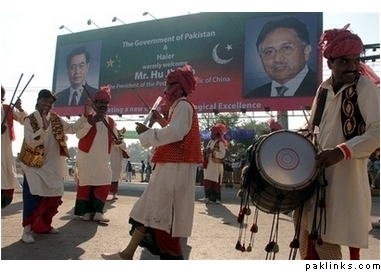
Hu Jin Tao in Pak

Re: Hu Jin Tao in Pak

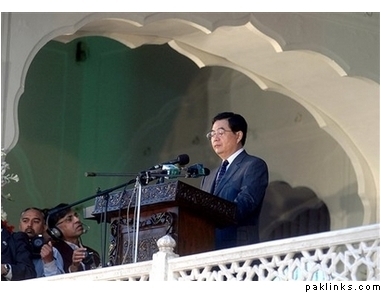
Text of Chinese President’s address to Pakistani nation

Following is the English rendering of Chinese President Hu Jintao’s address to the Pakistani nation delivered here at the Convention Centre and broadcast live by radio and television networks. Text begins:

"Distinguished,
Ladies and Gentlemen,

Dear Friends,

It gives me great pleasure to speak to you here at the Islamabad Convention Center. First of all, I would like to convey the cordial greetings and best wishes of the 1.3 billion Chinese people to you and, through you, to our Pakistani brothers and sisters. This is my second visit to Pakistan. I first visited your beautiful country in 1984. In the 22 years since, the world has gone through tremendous changes, so have China and Pakistan. But the profound friendship between our peoples has remained unchanged. Since we arrived yesterday, my delegation and I have been accorded gracious hospitality by the government and people of Pakistan, and we are deeply touched by the outpouring of brotherly affection of the Pakistani people.** In the words of one Pakistani friend, such friendship is “higher than the Himalayas, deeper than the Indian Ocean and sweeter than honey”**. Pakistan has a long history. Here, the ancient Indus Valley civilization and Buddhism blossomed, and the Islamic civilization is thriving today, leaving rich cultural heritage, Pakistan is also a young country. Born after World War II, Pakistan, overcoming obstacles and difficulties on the road of advance, has made remarkable achievements in its 59 years of independence. In the new century, under the leadership of President Pervez Musharraf, the people of Pakistan have faced up to many complex and difficult challenges, both internally and externally, and made continued progress in national development. Pakistan’s economy has grown at an average rate of 7.5% in the past three years, ranking Pakistan as one of the countries with the fastest economic growth in the world. After the massive earthquake last year, Pakistan has made good progress in rebuilding the homeland. Internationally, Pakistan is actively involved in regional and international affairs and is committed to upholding peace and stability in Asia. Its international standing is rising steadily, both in Asia and beyond. We in China are heartened by the achievement made by the brotherly Pakistani people. We wish you even greater progress in the noble cause of national development and rejuvenation!

**Ladies and Gentlemen, **
Dear Friends,

The friendship and contacts between our peoples have a time-honored history. In the old days, they were linked by the Silk Road. In China’s Tang dynasty, Hsuan-tsang, an eminent Chinese monk, studied Buddhism in Taxila on his pilgrimage to the west His Sojourn in Pakistan, recounted in a book entitled The Great Tang Dynasty Record of the Western Regions, is a popular anecdote in the history of exchanges between the Chinese and Pakistani peoples. Pakistan was one of the first countries to recognize New China. Ever since our diplomatic relations began in 1951, we have enjoyed mutual understanding, respect, trust and support, and our friendship and cooperation have flourished. We are truly good neighbours, close friends, trusted partners and dear brothers. When China was in difficulty caused by Western blockade in the 1950s and '60s. it was Pakistan which opened an air corridor linking China to the outside world. In the early 1970s, it was Pakistan which served as a bridge for the normalization of China-US relations. On issues affecting China’s core interests - Taiwan, Tibet, human rights, and the fight against “East Turkestan” terrorist forces - it is Pakistan that has over the years extended valuable support to China. These are something we in China will never forget. On our part, the Chinese Government and people have always sided with Pakistan in its struggle to uphold sovereignty and independence and promote economic and social development. History has witnessed the dynamic growth of China-Pakistan friendship. The Karakoram Highway, the Chashma Nuclear Power Plant and the Gwadar Part, jointly built by China and Pakistan, stand testimony to the great friendship our peoples have forged. We take great pride in the unshakable friendship between China and Pakistan.

**Ladies and Gentlemen, **
Dear Friends,

Working in partnership for a bright future; this is a mission entrusted upon us by history. It is the calling of the times. The Chinese Government and people treasure their relationship with Pakistan and are committed to promoting cooperation with Pakistan in various fields and strengthening China-Pakistan strategic partnership. To this end, I propose that we take the following steps:

First, deepen strategic cooperation and consolidate traditional friendship. China and Pakistan enjoy a time-tested all-weather friendship. This is our shared asset and it should be cherished and continuously enhanced. In 2003, we signed the Joint Declaration on Directions of Bilateral Cooperation which was followed by the signing of the Treaty of Friendship, Cooperation and Good-neighbourly Relations last year. This has brought our strategic partnership to a new stage. We should build on this momentum and enhance our cooperation in all areas to further strengthen our strategic partnership, China views its relations with Pakistan in strategic terms and from a long-term perspective. We will maintain close contacts between our leaders, expand exchanges and cooperation between the governments, legislatures, political parties and civic organizations of our countries, and maintain regular consultation and coordination on major issues of mutual concern through bilateral mechanisms in strategic, economic, technological, security and defense fields.

Second, expand win-win business ties. With a market of combined population of close to 1.5 billion andeconomic complementarity, China and Pakistan enjoy huge potential for cooperation. In recent years, China-Pakistan business ties have seen strong growth, becoming an important driving force of our relations. The Free Trade Agreement between the Government of the People’s Republic of China and the Government of the Islamic Republic of Pakistan signed this morning marks the success in the negotiations on establishing a free trade area. It will go a long way in upgrading China-Pakistan business ties. The two countries also signed the Five Year Development Program on Trade and Economic Cooperation between the Peoples Republic of China and the Islamic Republic of Pakistan, a blueprint for accelerating their economic cooperation and trade in the future. The Chinese Government encourages leading Chinese companies to take Pakistan as a priority destination of investment and support them in undertaking construction projects, opening factories and conducting research and development in Pakistan. China will strengthen win-win cooperation with Pakistan in key areas such as energy and resources development, information technology, infrastructure and agriculture to give full play to our comparative strength.

Third, expand cultural and social exchanges and strengthen the basis of friendship. We are glad that the Confucius Institute has been set up in Pakistan and the two countries have officially exchanged notes on setting up the China-Pakistan Friendship Center. We hope that these two projects will serve as a new platform for cultural exchanges between our countries. To ensure that our friendly relations will be earned on by the next generation, the Chinese Government invites 500 young people from Pakistan to visit China in the next five years and will provide more scholarships to Pakistani students. The Chinese Government supports increased exchanges and cooperation with Pakistan inthe areas of culture, health, education, tourism, sports and press and between academic institutions. We also support expanding air and land links and enhancing sister-city ties to strengthen the popular basis of friendly relations and cooperation between the two countries.

Fourth, strengthen cooperation in international affairs and uphold common interests. Both being developing countries, China and Pakistan share extensive common interests in international and regional affairs and have a good tradition of cooperation. To China, Pakistan is an important partnerof cooperation in the international arena- China will continue to work with Pakistan to uphold the purposes and principles of the UN Charter and the collective interests of the developing countries and promote democracy in international relations. As a true friend of Pakistan, China hopes that Pakistan will play a greater role in regional and international affairs and will strengthen coordination and cooperation with Pakistan in the ASEAN Regional Forum, Shanghai Cooperation Organization, South Asian Association for Regional Cooperation, Asia Cooperation Dialogue, Asia-Europe Meeting and other regional organizations.

Fifth, promote exchanges among civilizations to enhance world harmony. A harmonious world of enduring peace and common prosperity serves the interests of the world people. Different social systems and cultural background have never stood in the way of friendly relations between China and Pakistan, As a matter of fact, China-Pakistan relations have become an example of harmonious coexistence between countries of different civilizations. China highly appreciates the “enlightened moderation” championed by President Musharraf, viewing it as an important proposition for promoting harmony among countries of different civilizations. In our view, the world is a colourful and diversified one. Differences in culture, tradition, social system, value and mode of development should be recognized. These differences reflect the vitality of the world and serve to promote its dynamic growth. One should not make irresponsible remarks about the internal affairs of other countries simply because of differences among countries. And it is equally wrong to blame a particular civilization, nation or religion for some problems and conflicts in the world. China will work with Pakistan to promote harmony and progress among civilizations and uphold diversity in the world and in development models in an unremitting effort to build a harmonious world of enduring peace and common prosperity.

**Ladies and Gentlemen, **
Dear Friends,

China has an ancient civilization of more than 5,000 years. In the long course of history, the Chinese people, who are hard-working, innovative and courageous, have advanced China’s social development and progress and created the splendid Chinese culture, This is an important contribution to human civilization. Since the adoption of the policy of reform and opening up in 1978, the Chinese people, guided by the Deng Xiaoping Theory and the important thought of “Three Represents”, have succeeded in embarking upon a path of development suited to China’s conditions. They have worked hard to build socialism with Chinese features and ushered in a new era of development for China. In the past 28 years, China has steadily increased productivity and national strength and improved people’s life. From 1978 to 2005, China’s GDP grew from US $ 147.3 billion to US $ 2.235 trillion, and its total volume of export and import grew from US $ 20.6 billion to US $ 1.4219 trillion. Its poor rural population dropped from 250 million to just over 23 million. The Chinese people have generally achieved moderate prosperity. On the other hand, we are keenly aware that even with its remarkable achievements, China remains a country with a big population, weak economic foundation and uneven regional development. Its development is not yet cost-effective and its per capita GDP still ranks lower than 100 countries. China is still the largest developing country facing many acute problems and challenges in its development endeavour. We need to make protracted and strenuous efforts before we can reach the level of medium developed countries. China has set for itself the goal of development for the first 20 years of this century, that is, to build in an all-round way a moderately prosperous society at a higher level to the benefit of its more than one billion population, to quadruple its 2000 GDP by 2020, bringing it to US$4 trillion, or US$3,000 in per capita terms, and to achieve greater progress in economic development, democracy, science and education, culture and social harmony and make life better for its people. We will, guided by the scientific outlook on development that is people-oriented and focuses on comprehensive, well-coordinated and sustainable development, work unswervingly to speed up economic development, deepen reform and open wider to the outside world. We will work with perseverance to increase China’s overall national strength, raise people’s living standard and improve social harmony to meet China’s goal of development.

**Ladies and Gentlemen, **
Dear Friends,

“Loving people and treating neighbours kindly is critical to a country’s survival.” This philosophical tenet is deep-rooted in the Chinese culture. Having suffered from foreign aggressions, internal turmoil and wars that ravaged China for a century in the modern history, the Chinese people love peace and cherish the value of peace. What they have gone through and the experience and lessons in development of other countries make them clearly aware of one thing: Every nation should realize its development goal through peaceful means. Only development thus achieved will sustain and promote the progress of both its own people and people of other countries. China will remain a champion of peace, development and cooperation and continue to pursue an independent foreign policy of peace. It is committed to peaceful development and an opening-up strategy for win-win progress. It endeavours to develop itself by carrying out wide-ranging and mutually beneficial cooperation with other countries and will contribute more to world peace and common development through its own development. China’s development is peaceful, open and cooperative, in nature. It, will not pose threat to anyone. Quite on the contrary, China’s development will create more opportunities for world development. China will always be a staunch force for enhancing world peace and common development and building a harmonious world.

**Ladies and Gentlemen, **
Dear Friends,

China and Pakistan are great nations and close neighbours bound together by common destiny and goals. In the new century, let us seize the opportunity, take up challenges and carry on traditional friendship and deepen all-round cooperation. Let us work unremittingly to strengthen China-Pakistan strategic partnership and build a harmonious world of enduring peace and common prosperity.

May China and Pakistan enjoy eternal friendship!
Re: Hu Jin Tao in Pak

How would you’ll compare Hu Jintao’s India visit with Pakistan visit?

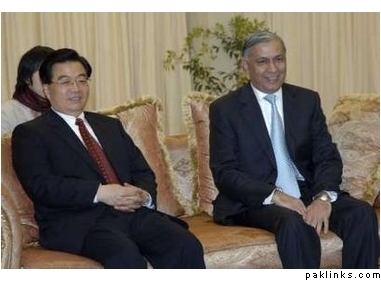
The word ‘pragmatic’ comes to mind when we view the outcome of Chinese President Hu Jintao’s visit to Islamabad. The visit, the first in 10 years, was warmly awaited by Islamabad, China’s ‘evergreen’ friend. But it was more about rhetoric than substance. The larger statement of the visit, manifested in the agreements signed and the statements made, was that China wanted better relations with all of South Asia, especially its largest country, India. What was announced in Islamabad about nuclear cooperation was not very different from what was said in New Delhi. There was no nuclear deal to rival the one India has signed with the United States. No doubt, the canny Chinese will wait to see the fate of the India-US nuclear agreement in the American Congress and within the Nuclear Suppliers Group before making a move

**
Mr Hu reiterated his country’s pointedly neutral stance on Kashmir. Asked what role China could play in resolving the dispute, Mr Hu’s anodyne answer was that as a close neighbour of both countries, China hoped to see peace and stability in the subcontinent. He reiterated Beijing’s support to the efforts of India and Pakistan to resolve their problems through dialogue. As for taking strategic partnership to a ‘new level’, the formulation is no different from the one that was made in New Delhi. If Mr Hu has invited 500 Pakistanis to visit China in the next five years, the number he invited in India is 5,000; if Sino-Pak trade is to triple in five years to $15 billion in five years, Sino-Indian trade is to double to $40 billion.
**

http://www.hindustantimes.com/news/181_1853470,0012.htm

The one major difference was the signing of the free trade agreement between Islamabad and Beijing, which basically reflects the relative weakness of the Pakistani economy. Even in the area of conventional defence relations, the movement is not particularly significant. The Chinese cooperation with Pakistan in the aviation sector is actually a convenient way for Beijing to access Western technology currently denied to it. The airborne early warning project will undoubtedly feed off from the deal Pakistan has signed with Sweden for its very capable Eyrie system earlier in May. All in all, the Pakistan visit was more by way of reassuring an old and still useful ally, rather than breaking any new ground.

Re: Hu Jin Tao in Pak

^ an analysis from hindutimes, how convenient lol... jal gaye barnool lagaye!

Re: Hu Jin Tao in Pak

Chinese president concludes landmark Pakistan

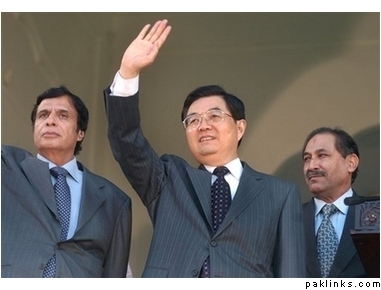
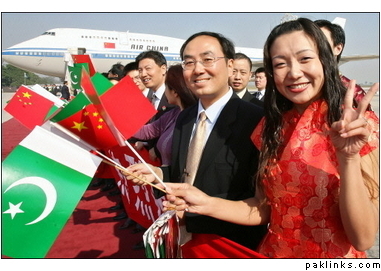
Chinese President Hu Jintao concluded his landmark visit to Pakistan, during which the close allies signed a free trade deal and agreed to boost their strategic partnership and ties in the defence and energy sectors. Prime Minister Shaukat Aziz and senior civil and military officials saw off the Chinese leader at Lahore’s airport, which was bedecked with Chinese and Pakistani flags and large portraits of Hu. Before leaving for Beijing, Hu visited a Chinese factory in Lahore that manufactures air conditioners, refrigerators and other electronics items. He also inaugurated an economic zone set up outside Lahore to promote industrial development. Officials said the economic zone, where Chinese companies will be given land free of cost, will help promote private sector investment. Hu said he would ask Chinese companies to invest in Pakistan, they added. Prime Minister Aziz, who accompanied Hu, said cooperation between Pakistan and China would further increase in different sectors, especially defence, technology and energy, after the Chinese president’s “successful” visit.

The Chinese president arrived in the historic city of Lahore on Saturday for a civic reception in the scenic Mughal-built Shalimar gardens. Hu, the first Chinese leader in a decade to visit Pakistan, declared at the reception that the Sino-Pakistan strategic partnership would remain intact under all circumstances. “The changing global scenario with critical challenges or the situationin the region will not affect our evergreen friendship,” he said. The Chinese leader, who flew into Islamabad on Friday after a trip to Pakistan’s bitter rival India, said the friendship between Pakistan and China was “vital for the stability in the region.” Pakistan and China signed 18 agreements in the economic, trade, social and defense fields. China also pledged to play a constructive role in resolving disputes between Pakistan and India. A wide-ranging joint statement issued on Saturday hailed continued close ties in the fields of defence, energy, trade, agriculture, information technology, combatting terrorism, culture and tourism. “China will continue to view its relations with Pakistan from a strategic and long-term perspective and work together with Pakistan to elevate the China-Pakistan strategic partnership to a new high,” the statement said. It added that China thanked Pakistan for its “valuable support on such issues as Taiwan, Tibet and human rights”.

It said the free trade agreement signed after Hu’s arrival for his three day visit would serve as an “engine for balanced growth of volume of trade” between the two countries. The two sides agreed to increase bilateral trade to more than 15 billion dollars in the next five years. Pakistan will also receive Chinese help in the energy and mining sectors. “The two sides also agreed to strengthen cooperation in the energy sector, including fossil fuels, coal, hydro-power, nuclear power, renewable sources of energy as well as in the mining and resources sector,” it said. The two countries also vowed to jointly combat terrorism, separatism and extremism, saying those “three forces” posed great threats to regional peace, stability and security. After talks with President Pervez Musharraf on Saturday Hu confirmed he would continue cooperating with Pakistan in nuclear power production. China has built one reactor and is helping to construct another. Pakistan is developing the JF-17 Thunder fighter aircraft with Chinese help and China is also building a multi-million-dollar Gwadar deep sea port in southwest Pakistan to access the Arabian Sea.

http://news.yahoo.com/s/afp/20061126/wl_sthasia_afp/pakistanchinadiplomacy_061126130057

Re: Hu Jin Tao in Pak

good posts Silly Billy :k:

Re: Hu Jin Tao in Pak

declaring a holiday for his visit?

wow.

lol.

Re: Hu Jin Tao in Pak

I am skeptic of all this hype about Hu jIn Tau visit. Chinese are not stupid nor they have fallen in "Ishq" with Pakistan.

Re: Hu Jin Tao in Pak

Economic zone is very good thing for Pakistanis. Bringing in jobs and investments. Hopefully, the world will see how much good China is doing. Wait, only Americans can do good.

Re: Hu Jin Tao in Pak

Growing Sino-India ties —Rasul Bakhsh Rais

http://www.dailytimes.com.pk/default.asp?page=2006\11\28\story_28-11-2006_pg3_2

India and China need access to each other’s huge markets, though in a competitive global trade and investment environment. India is a bit apprehensive about a free trade regime with China fearing that cheap Chinese products will harm its own industry

Recent visit of the Chinese President Hu Jintao to India symbolises a new relationship that the two countries have been quietly building up over the past ten years. The hallmark of this relationship is economic pragmatism, which invisible forces of globalisation and rapid growth of economies of the two countries have shaped.

Moving away from traditional rivalry and confrontation has created fairly large diplomatic and political space to rethink and restructure their bilateral relations. As the two neighbouring giants set their eyes on becoming global economic and technological centres, they cannot allow old feuds to stand in the way of their economic integration. The growth in their bilateral trade, still smaller compared to their major partners in global economy, has, nonetheless, soared during the past decade from US$1.4 billion in 1996 to US$18.7 billion last year. They have pledged to double bilateral trade by 2010.

China and India started out as partners with the common vision of a role for the developing countries during the early years of the cold war. But that phase didn’t last very long. Following a brief but bitter border clash in 1962, relations between China and India remained frosty for more than three decades. There was a strong sense of hurt on both sides — India felt humiliated as a result of the defeat and China angered by India’s aggressive posture in the disputed areas. The clash put an end to the growing partnership between the two largest countries on issues that concerned the post-colonial societies and states. The logic of security, competing strategic interests and traditional policies of balancing and counter-balancing rapidly replaced the initial warmth of post-independence years.

India raised the spectre of Chinese expansionism and portrayed itself as the victim of that policy. New Delhi’s cries for international help found sympathy both in Washington and Moscow. Both capitals were eager to win over India for reasons of its size and importance among the developing countries of the world. Over the years, India moved much closer to Moscow than to the US, as the former became its largest supplier of weapons and defence technology.

In a changing regional and international climate, Pakistan reviewed its traditional policy of dependence on the United States and decided to open up to China, which was equally eager to settle the border demarcation issue and broaden the scope of bilateral relations. In subsequent years, two parallel rivalries produced two parallel informal alliances between Moscow and New Delhi on the one hand, and Beijing and Pakistan on the other. The security issues and geopolitical considerations largely shaped the international politics of the region from two wars between India and Pakistan to the Soviet intervention in Afghanistan and its retreat from there in 1989.

Much of that is history now. The transformation of the world system during the past decade has changed the priorities of China, India and many other important world powers, giving new direction to their foreign and security policies.

During the past decade, China and India have worked persistently to evolve a new framework to reshape their bilateral relations. There are three important elements of this framework that continue to move both the countries on the path of new partnership: First relates to the understanding that the border dispute will not hold the two countries back from improving bilateral relations. Both have realised that border demarcation is a complex issue that will take more time and negotiations on its technical aspects and that development on other tracks should not be made contingent upon resolution of the border problems.

In other words, they have decided to freeze the border issue, though not left it totally out of the negotiation process. They have formed a Joint Working Group to resolve technical problems of border demarcation and evolve a set of principles according to which the difference would be resolved. Meantime, they have taken steps under the 1993 and 1996 agreements to build confidence and stabilise the situation along the disputed border, without prejudice to the position of either side. Practically, they have accepted the Line of Actual Control as the common border for the interim period. The important thing is that they do not wish to make the border dispute a point of discord or confrontation.

The second important element of the new framework is that their relations with a third country will not interfere with the expansion of their bilateral ties. It is an accepted principle of international relations, but remains a vague and tricky issue because strategic cooperation — military ties, sale of weapons etc — affects the security consideration of other countries, particularly in the immediate neighbourhood. India, for instance, is concerned about China’s friendship with Pakistan. Similarly, China may be apprehensive about New Delhi’s growing partnership with Washington, which seems to be assuming strategic overtones.

It is too early to tell how and to what extent China and India will succeed in isolating the third-party factor from bilateral relations. India is very keen to neutralise China from its confrontation with Pakistan. It believes that technologies and materials from China have greatly assisted Pakistan in developing its nuclear and missile capability. What pressure and influence can India bring on China to downgrade its traditionally close relationship with Pakistan? At the moment, India has no levers to change the basic structure of partnership between China and Pakistan, which is now multi-dimensional and does not rest on common hostility toward India. The dynamics of this partnership today are quite different and would continue to flourish with new focus on cooperation in economic, scientific and technological fields.

Finally, trade and commercial interests have assumed greater salience than the political issues. This is not a specific trait of China’s relations with India but a worldwide phenomenon. Material well-being and concerns of development dominate national outlooks more than the emotive issues of nationalism that defined policies of many countries immediately after the Second World War. With economic liberalisation and lessening of state control over the economies, India and China need access to each other’s huge markets, though in a competitive global trade and investment environment. India is a bit apprehensive about a free trade regime with China fearing that cheap Chinese products will harm its own industry.

The emerging partnership between China and India cannot and should not be interpreted according to the old formulations of geopolitics and dominance of security issues. They remain important, and some of these like the border problem need to be resolved. But they are not likely to push the two towards a confrontation.

The author is a professor of Political Science at the Lahore University of Management Sciences. He can be reached at [email protected]

Re: Hu Jin Tao in Pak

Quite unusually the American’s have commented on the increasingly close relations between China and Pakistan.

**U.S. says it welcomes strong ties between China and Pakistan
**
The United States said Monday it welcomes strong ties between China and Pakistan and urged China to play a “constructive role” in world affairs as Beijing flexes rising economic, military and diplomatic power. Last week, Chinese President Hu Jintao received a lavish welcome in Pakistan, where the two countries deepened military ties and settled a five-year free trade pact expected to more than triple bilateral trade to $15 billion (€11.4 billion) over the next five years. “We encourage development of bilateral relations between Pakistan and its neighbors,” State Department spokesman Sean McCormack said. “China and Pakistan have a long history of relations.” “China is going to be an important power on the international scene for some time to come. And we would hope that as it develops and as it defines its future role on the international stage that it plays a constructive role,” he said.

http://www.iht.com/articles/ap/2006/11/27/america/NA_GEN_US_China_Pakistan.php

Re: Hu Jin Tao in Pak

Hu in beautiful Lahore, enjoying more time with our leaders and the people.

Re: Hu Jin Tao in Pak

Pakistan to open consulate general in SW China

Pakistan has been given the green-light from the Chinese government to open the consulate office in Chengdu, capital of Southwest China’s Sichuan province, an official said in Chengdu on Monday. Pakistani President Pervez Musharraf visited Sichuan in February and expressed his hope to further develop economic exchanges with the province, said Cui Zhiwei, director of the foreign affairs office of the province. Pakistan and the Sichuan have cooperated on thermal and hydro power, environmental protection, locomotives and others ventures, according to the official.

Pakistan will be the seventh country to open a consulate in Chengdu after the United States, Germany, the Republic of Korea, Thailand, France and Singapore. China and Pakistan signed a wide-ranging joint statement on Saturday in Islamabad on bilateral relations during Chinese President Hu Jintao’s state visit to the country. Pakistan was the last leg of Hu’s four-nation Asia tour, which took him to Vietnam, Laos and India. Hu Jintao left Lahore, Pakistan on Sunday for home. The visit also coincides with the 55th anniversary of the establishment of diplomatic ties between China and Pakistan.

http://english.people.com.cn/200611/27/eng20061127_325702.html

Re: Hu Jin Tao in Pak

Its in americas interest to spoil relations between china and pakistan. May ALLAH swt protect us, Ameen...