Re: Countries on verge of default or close encounters
How times change!
Re: Countries on verge of default or close encounters
How times change!
Re: Countries on verge of default or close encounters
That is the key :k:
I don’t think recent run will go farther as it doesn’t have ‘solid footing’, lots of things are going wrong but speculators pumping money into market, hope for the best though.
Re: Countries on verge of default or close encounters
Nice call - on the money!
I had some regret that only 75% of cash set aside for equities was deployed during the recent downturns. The market appears to give one more chance. Deployed a small fraction of remaining excess cash today - just to get feet wet. Will take what Mr. Market offers.
Re: Countries on verge of default or close encounters
^ And the market reverses violently again - about 4% gain in 2 days after a 5 pct drop in 2 days which was after a 18% gain in a couple of weeks which was after a ~ 15% drop which was after a …
No, not kidding, above sequence did happen within last 3 months. The only certainty is uncertainty.
Re: Countries on verge of default or close encounters
The violent turns continue, Dow dropped around 390 points today!
Re: Countries on verge of default or close encounters
^ You called it earlier - the volatility. Nice.
Today gave another chance to deply some of the 25% of original cash allocated for stocks. Depployed 5% of this 25%. Market down ~3.3%. Will take (or ignore) what Mr. Market offers depening on price.
Re: Countries on verge of default or close encounters
Market has now gone down about 8.5% fromrecent local peak. Only 11% of original cash set aside remaining. As said earlier, will bring in another 25% of original cash if market continues to go lower - planning to put fixed amt in for every percent drop all the way to S&P 500 level of say 670 (Marcj 09 low). If it goes lower still, will bring in same amt - then I am done. The experiment continues.
As always, Mr. Market knows best.
Re: Countries on verge of default or close encounters
Massive credit cuts expected in next few months which could trigger the recession to new dimensions:
Europe’s worsening sovereign debt crisis has spread beyond its banks and the spillover now threatens businesses on the Continent and around the world.
From global airlines and shipping giants to small manufacturers, all kinds of companies are feeling the strain as European banks pull back on lending in an effort to hoard capital and shore up their balance sheets.
The result is a credit squeeze for companies from Berlin to Beijing, edging the world economy toward another slump.
The deteriorating situation in the euro zone prompted the Organization for Economic Cooperation and Development on Monday to project that the United States economy would grow at a 2 percent rate next year, down from a forecast of 3.1 percent growth in May. It also lowered its economic outlook for Europe and the rest of the world, and a credit contraction could exacerbate the slowdown.
In addition, Moody’s Investors Service, the credit-rating agency, on Monday raised the possibility of mass downgrades of European government debt if a forceful resolution to the escalating crisis was not found.
Investors have begun to treat Europe’s big banks as the weak link in the global financial chain because of their huge holdings of bonds issued by debt-laden governments like Italy and Spain.
American money market funds have been closing the spigot of money they lend to European banks, forcing them to tighten lending standards and, in some cases, even withdraw financing from longtime customers. To make matters worse, European institutions are simultaneously under pressure from their regulators to hold more capital for each dollar they lend, prompting many banks to reduce their portfolio of loans. Analysts say Europe’s banks could shed up to 3 trillion euros of loans over the next few years, equal to about 10 percent of their total assets.
“If your largest banks aren’t able to provide credit, it hinders economic development and contributes to a recession,” said Alex Roever, a fixed-income research analyst at JPMorgan Chase.
Air France, for example, typically relied on French banks like BNP Paribas and Société Générale to help it finance about 15 percent of what it spends to purchase airplanes. Now those banks are retreating from making airline loans to save capital.
As an alternative, Air France officials say that they started developing closer ties with Chinese and Japanese banks, which have not faced the same pressure as their euro zone counterparts, to help pick up the slack.
**Executives of Emirates Airlines, based in Dubai, are turning to the Islamic financing system, as well as to lenders in emerging markets, to help pay for its new fleet as some of the European banks shut off lending. Emirates has ordered 243 aircraft, worth more than $84 billion, from Airbus, Boeing and other aerospace companies.
“We were kind of planning for finance from the European banks,” Tim Clark, president of Emirates, told Reuters. “It’s just a bit difficult now.”**
A failure to secure financing could quickly add up to lost jobs in the United States, Latin America and elsewhere.
The airplane maker Boeing recently warned that a European pullback could affect its business next year. With some European banks out of the picture, “this leaves a difference that must be made up by other sources if airplane deliveries across the industry, already set to increase in 2012, are to occur as planned,” said John Kvasnosky, a spokesman for the company.
Embraer, a Brazilian aerospace company, tempered its growth expectations despite having a pickup in commercial and business jet sales in the third quarter.
“This whole situation in Europe again has stalled this recovery process,” said Frederico Curado, chief executive of Embraer, in a conference call with investors in early November. “The way we see the world going forward is of a moderate growth.”
It remains to be seen, though, whether even moderate growth can be achieved. Moody’s cautioned that there was an increased chance that more than one country in the euro zone could default. In spite of that warning, investors put their fears aside and sent stocks up Monday by nearly 3 percent in New York.
Investors remain hesitant about government bond offerings, though. A tepid auction in Germany last week was particularly unnerving since its economy has long been seen as Europe’s financial bulwark. In Italy, weak demand for bonds pushed yields back above the critical 7 percent threshold, a level that has prompted other government borrowers to seek bailouts.
Higher interest rates on government debt quickly translate into higher borrowing costs for European banks, and in turn, for local companies and consumers in need of loans. Meanwhile, those banks’ own costs are also rising because the dollars they need to lend are in short supply.
“The strains and stress are increasing,” said Dirk Schumacher, a senior European economist at Goldman Sachs.** “Funding conditions for corporations will get tougher going forward.”**
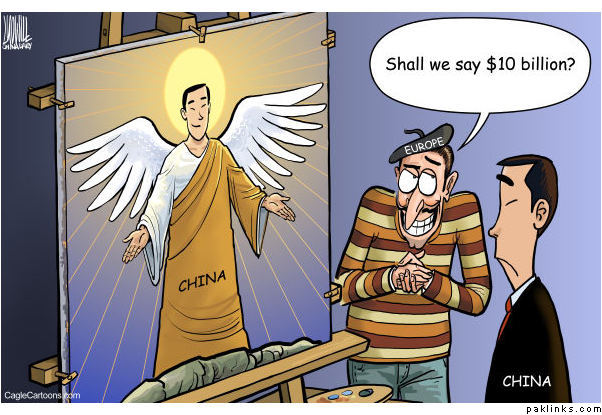
One sign of this strain is that European lenders are quietly withdrawing from big infrastructure projects, like power plants and water developments, especially in the Middle East. Just this month, the $10 billion Barzan gas project in Qatar secured financing from 31 lenders, but three of the biggest French banks — BNP Paribas, Société Générale and Natixis — were notably absent.
“These guys are usually very active and this is a material sign that European lenders are holding back,” said Khalid Howladar, an analyst at Moody’s.
Large shipping companies are finding fewer lenders, too. Only a few years ago, Europe’s biggest banks were clamoring to supply credit at very attractive terms. Now, as freight rates collapse amid a global slowdown, those banks are tightening their purse strings. Frontline Ltd., an oil tanker giant in financial straits, said last week that it had lined up financing for only two of the seven vessels it planned to build.
The economic fallout from a global decline in shipbuilding affects not only the workers at the dry docks but also hundreds of businesses that supply parts and raw material to the industry. In Germany, for example, more than 5,000 people have lost their jobs in major ports like Hamburg, Kiel and Rostock, according to a local trade group.
Smaller companies are also struggling to secure credit. In Ireland, a survey by the local Small and Medium Enterprises Association found that 58 percent of companies that had approached banks for loans were turned down.
“We have many, many businesses that are viable, but the banks are not lending to them in the short term,” said Mark Fielding, its chief executive.
In Eastern Europe, where Western European banks have retrenched, leaders are sounding alarms. Traian Basescu, president of Romania, accused Austrian regulators of “choking the Romanian economy” after they ordered banks to limit lending outside its borders.
In Hungary, new construction for shopping centers and other commercial developments has come to a halt. Nora Demeter, an architect in Budapest, said her 20-member firm had already laid off a handful of employees and was likely to make further cuts. “The chance of getting a major project off the ground in this country is virtually over,” Ms. Demeter said. She added that “2012 is looking even bleaker.”
Even companies as far away as China are being hurt by Europe’s economic slowdown. Jacky Xu, the sales manager of the Yongkang Wanyu Industry and Trade Company in eastern China, said European orders for its scooters, skateboards and other children’s toys were down 20 to 30 percent this fall from a year ago. Several months ago, his company stopped accepting letters of credit from Greek banks, forcing Greek retailers to put down cash deposits of around 30 percent for new orders — a move that will worsen the decline.
“There are fewer people coming by from Europe,” he said.
Reporting was contributed by Jack Ewing, Keith Bradsher, Stephen Castle and Sara Hamdan.
Re: Countries on verge of default or close encounters
^ As the cliche goes, time will tell. Market is up 3% last 2 days. I think Italian bonds (3 or 10 year not sure) have reached 8.5% yield - at least I remember reading today.
Re: Countries on verge of default or close encounters
Market up 7.3% last 3 days.
Re: Countries on verge of default or close encounters
Most of the cash has now been deployed. Got some European exposure abour 3 weeks ago - fotuitous timing - felt it had gone down enough.
There was another thread (which I cant find) about 2 months ago when someone wanted to know abt US real estate. Since then, home builders stocks have been up nicely.
European situation - most sovereign debt yields are lower than they were 1-2 monts ago. The Euro stoxx index is also up about 8% (I think) from its bottom.
Lesson learnt (for me at least) - when everyone is worried about some asset class, get interested.
As always, Mr. Market knows best.
Re: Countries on verge of default or close encounters
Market is up about 3-4% up from Nov time frame, you must’ve made some dough, good for you… I am trying to put some cash into my new home.
Re: Countries on verge of default or close encounters
Market has touched its peak yet again, was I wrong or was I wrong? 
Re: Countries on verge of default or close encounters
I dont believe you were wrong Captain. You called the European crisis when this thread started. Your Oct 28 post mentioned market had become frothy. Since then it actually dropped about 15%. So that call was not bad. Since then market has gone up. So I think you got 2 out of 2 calls correct and have not made a call since.
Re: Countries on verge of default or close encounters
It is that time again when value investers get interested. Buying European index little at a time as the pundits become pessimistic. Time will tell as the clinched goes