Re: Apologies, Mr Dinshaw!
You do not have anything concrete!
Re: Apologies, Mr Dinshaw!
You do not have anything concrete!
Re: Apologies, Mr Dinshaw!
yes, because that part may be ‘connected’ to overall negligence of historical sites but the thread you mentioned has no correlation with defacing of Karachi.
Re: Apologies, Mr Dinshaw!
I think you need to revisit the history of Pakistan. 1971? In December 1971 when Pakistan broke in to two, Yahya Khas was the president. Yahya handed over power when Pakistan army was defeated by Indian army. Bhutto took over the half country when it was also about to collapse. However he started as PM from 1973 to 1977 when mardood Zia-ul-Haq kicked legally elected PM and the government. In the earlier years Bhutto spent his time only to boost the morale and rebuilding of nation which was at the lowest after break up of Pakistan. Later years what he did to establish the country on sound footings none ever matched his achievements. No PPP government ever allowed to complete its tenure. But this is besides the point. Open another thread on PPP’s achievements and I will be gladly to participate. Please don’t try to derail this thread and keep it for defacing Karachi and people responsible for it, mqm shares the maximum damage.
Re: Apologies, Mr Dinshaw!
I don’t know why you support that ghatya super duper world class # 2 mayor. The reference is very much correlated. Read as follows:
The details of the case filed by Naimatullah Khan :
SC issues notice to federal, Sindh govts in alleged land-grabbing case
Staff Report
ISLAMABAD: A three-member Supreme Court bench on Thursday issued notices to the federal and the Sindh governments in a case of an alleged “joint venture” between land mafia and the MQMized City District Government Karachi in which land grabbers have illegally occupied more then 170 public parks, playgrounds and public spots.
The bench comprising Chief Justice Iftikhar Muhammad Chaudhry, Justice Ghulam Rabbani and Justice Khalilur Rehman Ramday directed the CDGK to submit a report on the matter within two weeks. The petition said conversion of parks and public land into residential and commercial plots and establishing political parties’(MQM’s unit terror cells) offices on public property were illegal and unconstitutional.
Shaukat Aziz Siddiqui, the lawyer for former Karachi nazim Naimatullah Khan, said the use of parks and public land for any other purpose was illegal and unlawful, based on malafide intentions, a violation of the fundamental rights of citizens and without jurisdiction.
He said it was the duty of the state to provide playgrounds, parks and other recreational services to citizens instead of depriving them of the ones already existing. The court, after hearing preliminary arguments, issued notices to the respondents with a direction to submit replies.
Reversal: The petition stated that the occupation, possession or control of any individual(s) over the public land and amenity plots mentioned and any construction, structure or installation over the same is illegal, unlawful and an infringement of the fundamental rights of the citizens. Therefore, illegal occupation of such places must be reversed, he added.
Siddiqui stated that one of the biggest causes behind the deteriorating law and order situation in Karachi was illegal possession of public property by land grabbers.
The petition raised several questions regarding the alleged occupation of public land, places and points such as parks and playgrounds, stating, “Is the local government vested with any power, authority or jurisdiction to convert public land and amenity plots into residential or commercial estate, to allot the same to any person(s) and to give sanctions, approval or authorisation of the construction over the same.”
It stated that Karachi, besides being one of the largest cities of the world with a population of more than 15 million, is a commercial hub and a revenue-generating unit of the country. The increase in population has also resulted in the expansion of the city, it maintained.
This yield of economic activity and expansion of the city has raised the value of the city’s land to unprecedented heights. Besides immense commercial, economic and business significance, the city’s public places also have great social, cultural and political importance, which led to grabbing, encroachment and occupation of land by land mafia, the petition said.
Grabbed land: The petition stated that there are more than 128 public places being allegedly grabbed, including Shah Faisal Town, Gulshan-e-Iqbal Town, Gadap Town, Jamshed Town, Malir Town, Site Town and Orangi Town.
The list also includes land and places located in Kimari. According to the list, around 35 such places, parks and amenity plots were occupied to convert them into residential/commercial plots in the last four years, including North Nazimabad Town, Baldia Town, Site Town, Orangi Town, New Karachi Town, Gulberg Town and Gadap Town, the petition added.
NON-FICTION: Understanding Karachi | Magazines | DAWN.COM
Tea isn’t the only thing brewing in Karachi. It is a city mired in intrigue, conspiracies and violence, with problems looming on nearly every front. Ghastly images of the not so distant past continue to haunt the city, and major political and religious parties deny responsibility for helping to create this deadly situation.
In this scenario, Steve Inskeep (the host of National Public Radio’s “Morning Edition”) chronicles the growth of Karachi and its myriad problems in his first book, Instant City: Life and Death in Karachi. He discusses the push and pull factors of the city which, in the 1940’s, was a modestly populated urban township of 350,000, but is now inundated with millions of vehicles and concrete structures, as well as 18 million inhabitants (the book puts the population of Karachi at 13 million).
“Instant city” is an apt title for a city that has grown at such a pace. For the migrants coming to Karachi, economic opportunities out-weigh its negative attributes. For those leaving this commercial hub, they are not only leaving Karachi but going beyond the borders of the country looking for a life with better prospects and without Karachi’s trials and tribulations.
Inskeep introduces us to the city in an interesting, almost fictional manner, ostensibly through a day in its life. That day is December 28, 2009. It is a date that most people in Karachi would remember. It was the tenth of Moharram and the Ashura
procession comprising thousands of mourners was attacked by (typically) “unknown perpetrators”. Two bomb explosions resulted in over thirty deaths and hundreds wounded followed by complete mayhem and widespread arson in a wholesale district in the heart of the city.
**Arriving some days later, Inskeep writes of this neighbourhood: “I saw gaps in the otherwise crowded landscape. Daylight showed through the archways on the facades of a row of stone buildings. Through the doorways I saw a field of rubble. The buildings behind the facades were gone. Next to the rubble was a piece of real estate that I knew had held a market not long ago. Now it was a parking area covered with motorcycles.”
Hundreds of shops were gutted in the fire. According to popular conjecture, the real motive behind this disastrous event seems to have been not merely an act of sectarian terrorism but, under its guise, a foul plan to destroy old stone buildings in order to make way for new real estate in a choice area of the city.
Inskeep goes about the city looking for clues like a seasoned detective solving a murder or theft mystery. He interviews many individuals, from those living in dilapidated homes to some of the most influential and affluent citizens of Karachi, dwelling in gated, guarded, high-walled villas. He draws on these interviews to paint a portrait of the “instant city”.
Social disparity in Karachi can sting sensitive nerves and looking at the congested lanes and the overcrowded buses, one begins to wonder what happened to this city. Why and how did it reach its present condition?
Step by step Inskeep unravels the mystery behind some of these questions. He probes land use abuse in Karachi in detail, not only through the 2009 Ashura tragedy but by also looking for other inter-connecting stories. He investigates the murder of social and environmental activist Nisar Baloch. Despite its lofty new name, the Garden of Martyr Benazir Bhutto, or Gutter Baghicha as it was originally called, is that large piece of land meant for a park for which Baloch raised his voice against encroachers, and for which he paid with his life. Gutter Baghicha’s borders have been drawn and re-drawn over the years and the land-grabbers’ settlements are a result of manipulated ambiguity. Although the park continues to present neglect, squalor, violence and crime, it is a coveted piece of real estate eyed by at least two ethnic groups and their respective political supporters. Baloch was killed a day after he named the political parties at a press conference. Inskeep also makes a reference, though only in passing, to the Pakistan military establishment as “the single most important property owner in the city”.
Inskeep’s observations are peppered with in-depth interviews with the Edhis, Dr Seemin Jamali of the Jinnah Hospital, Perween Rahman of the Orangi Pilot Project, former city mayor Mustafa Kamal, businessmen and builders such as Adnan Asdar and Nadeem Riaz, and others. He has also studied several publications related to Karachi. Perhaps these prompted him to say that “in many ways, it’s a city that lives beyond the law, but it’s a city that lives and a city that has a vibrancy to it that’s hard to find elsewhere.”
As a citizen of this city by birth, and having grown up and lived and worked here, to me Karachi’s notoriety fades in comparison to its resilience, its thriving civil society, entrepreneurship, innovative projects, and the richness of its ethnic diversity. Inskeep does not miss these signs either. Despite switching between a plethora of topics, the book is a veritable page-turner. The insights he provides are significant as well as remarkable.**
The reviewer is the author of Karachiwala: A Subcontinent Within a City
http://www.skyscrapercity.com/showthread.php?t=258712
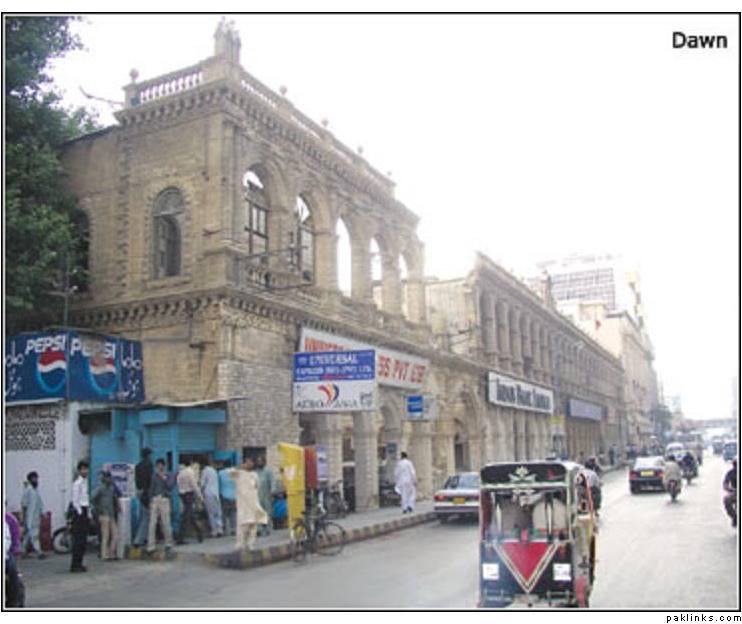
KARACHI: Historical sandstone building being razed: Heritage sacrificed for high-rise
By Bhagwandas
**KARACHI, Sept 18: A building that is protected under the Sindh Cultural Heritage Protection Act is being demolished gradually although it has been sealed off more than once by the Karachi Building Control Authority, it is learnt reliably. According to sources, there is some confusion about the actual name of the building. While the list of protected buildings identifies it as ‘Beaufort Building’, the building itself carries a plaque, inscribed with the name ‘Bandookwala Building’, at its main entrance. The impressive sandstone building has been partially demolished.
According to sources, owner of the building, located opposite the Habib Bank Plaza on I. I. Chundrigar Road, intends to sell it to a public sector financial institution but the potential buyers are not ready to demolish the protected building on their own as this might land them in trouble.
The sources claimed that the new party intended to construct a high-rise on the 2,000-square-yard piece of land and for the purpose, it had asked the present owner to get the old structure demolished. The land, according to a conservative estimate, is valued at over Rs1 billion.
Nobody, including the owner, can demolish or destroy a building that is protected under the Act which prescribes long prison terms and heavy fines for violators. A prior permission from the Advisory Committee, headed by chief secretary, is required for carrying out any construction work in such a building.
The Karachi Building Control Authority, which is supposed to monitor and check violation of building laws and the Sindh Cultural Heritage Protection Act, has not been able as yet to prevent the demolition process, although it has issued notices to the concerned party and also sealed off the building more than once.
S. A. Samad Khan, an advocate who has been keeping his office in the building for 50 years now on a rent basis, told Dawn on Thursday said that for the past five/six years the owner, Mr Habibullah, had been forcing the tenants to vacate the premises. He confirmed that the demolition work was going on at the site.
The sources claimed that the demolition work was usually carried out on holidays apparently to make sure that the activity was going on unnoticed. Till some time back, there were about 10 tenants occupying different portions of the building but eight of them have already gone.
The two tenants still there are the advocate and a travel agent, according to the sources, who added that the structures on the vacated portions had already been demolished.
“There is an interesting story to tell about how the building had been purchased in mid-1960s… the details may be of interest to the National Accountability Bureau,” the sources said.
The attractive gate and a portion of the arcade of the building’s façade have been demolished in the past few days, they said, pointing out that some conservationists, along with a group of children and concerned citizens, had cleaned up this beautiful piece of architecture a few months back with a view to save the heritage building from dilapidation or let dust, garbage, rubbish and other such things render the structure unattractive.
The owner, however, seems to be unmindful of its preservation as he has opted for demolishing this architectural gem, according to the sources.
Responding to the Dawn’s queries, KBCA’s Building Controller Munir A. Bhambhro said that when it transpired that the building was still being demolished despite being sealed off first, the KBCA again sealed it off on Thursday.
He said that the first letter against the demolition of the heritage building, standing on plot number 4/2-RY-5, Railway Quarters, had been issued to the owner on the first day of this month.
It read: “It has been observed that you have started demolition of existing structures of the heritage building without obtaining a permission from the authority/culture heritage department. You are hereby directed to stop demolition of the old structure and the heritage building forthwith failing which the same shall be sealed off by the authority at your expanse.”
Mr Bhambhro said that when the directive had not been complied with, the building had been sealed off on Sept 5. The letter to this effect told the owner: “If the seal is found broken by any person/persons he/they shall be punished under Sindh Building Control Ordinance or any other panel action permissible under the law.”
The Karachi Building Control Authority official said that on Sept 15, another re-sealing order had been issued.**
Re: Apologies, Mr Dinshaw!
Sorry sachaydino you do have genuine complains against Mustafa Kamal and I can support you but you are using wrong actions to justify your other complains. I only supported Mustafa Kamal for building bridges and parks in the areas designated for parks. Some areas designated for parks get taken over by encroachers involving city government and that sure is condemnable but the article does not mention when parks land was sold for commercial estate.
Re: Apologies, Mr Dinshaw!
From 1971 to 1973 Bhutto performed as the president of the country.
Re: Apologies, Mr Dinshaw!
I agree with you on this point that grabbing government land and defacing important and historical buildings should not be tolerated at any cost as that’s our historical heritage. The present federal and provincial governments are in power for the past 4 years, what steps have they taken to revive these buildings to their former glory and protect other buildings which might have been spared by mqm?
Re: Apologies, Mr Dinshaw!
Again wrong. Better read the history.