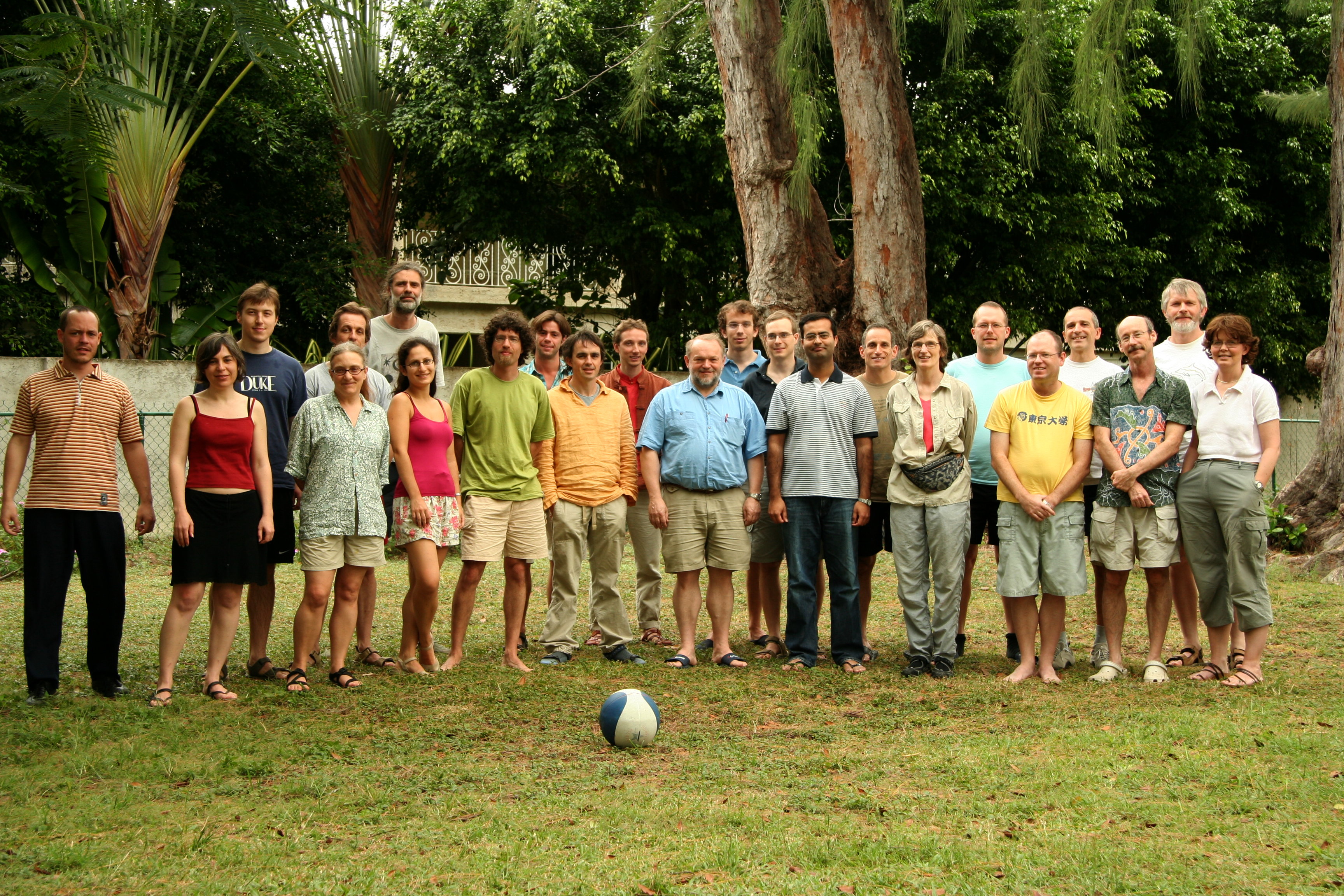
Re: A man beyond limits
LOOKING quite hardworking person
I dont know whats the meaning of ‘quite hardworking’ !:halo: . Unfortunately he is so humble that he never made his CV so that we actually know about his all achievements. He is winner of Aizaz-e-Sabqat from President of Pakistan for 4 years , winner of Nishan-e-Haider Schoalrship , the highest award for any Pakistani student , winner of Rhodes Scholarship , the most prestigious scholarship of the world. Parallel to him i dont think anyone will be in the muslim world at this young age.Its not appropriate to say ’ quite hardworking’ 
http://www.khwarzimic.org/activities/index.asp?View=1
http://www.khwarzimic.org/archives/index.asp
http://forum.kalpoint.com/student-center/69421-most-genius-man-islamic-world-sabieh-anwar.html
Re: A man beyond limits
Impressive, MashaAllah.
Invited Lecture at the Pakistan Physical Society and Government College University (GCU) , Lahore, Pakistan, 2003
First Year at Oxford
http://ravi.lums.edu.pk/sabieh/report-f1.pdf](http://ravi.lums.edu.pk/sabieh/report-f1.pdf)
Re: A man beyond limits
ok desert bird is the reincarnation of this guppy who kept goin on and on about pakistan and how great it is... don't remember the nick at the moment but i think he's the same guy
multi alert :p
p.s. are all the penguins hybernating? i thought this section was for personal pics
Re: A man beyond limits
Tête-à-Tête with Sabieh Anwar
Aqsa Shabbir
Yasmin Ansari
Humble, modest and amicable… he is an epitome of what every UET student dreams to become one day. One of the youngest PhD from Oxford, a Rhodes Scholar of Pakistan, recipient of Aizaz-e-Sabqat and Nishan-e-Haider (Government of Pakistan), founder and joint secretary of Khawarizmic Science Society, a World Class Orator and yet he is just an ordinary mortal. He is a strong critic of the semester system and believes that there shouldn’t be immense academic pressure on students. Even though he is an advocate of academic strictness in UET, he feels that there should be more social and intellectual freedom. His father has always been his major inspiration. He highly appreciates the egalitarianism and justice which is prevalent in the western society but, irrespective of that, he chose to return to his native country because he feels that he can make a difference here. Dr. Sabieh was kind enough to give some of his precious time to “Electrical ICON” and share with us the memories of his golden days at UET and his valuable experiences on his journey to success.
ICON: Tell us something about your family background?
I come from an educational background. My father is a professor at the Centre of Solid State Physics, Punjab University and my mother is a homeopath. From the very beginning, I was deeply interested in sciences.
ICON: Was physics a god-gifted talent or did you work for it?
Well, you can only acquire things naturally to a certain extent. Physics is not like poetry or music or art which you have an innate talent for; physics has to be learnt.
ICON: As a student, how did you manage your time? Did you participate in extra-curriculars?
I was always very keen on extra-curricular activities. I used to read a lot and debate as well. At UET, we were a part of the Khawarizmic Science Society which was very active and it was unsurpassed in all of its activities till about 2002. I was very actively involved in KSS.
**ICON: What do you think is your biggest strength? **
*Well one thing is very important if *
*you really want to make a mark and that is not being materialistic. If you try to be materialistic, that will be a big chain on your foot. That will actually impede your performance and hold you back from achieving things. Secondly, you should never be an over ambitious achiever. There are students whose first and last goals are to achieve something. At any cost, they want to be at the top. At UET, I was never at the top of my class because I realized that there are other things to life. *
ICON: All these years, what was your driving force?
My driving force is the passion I have for my work. I have strong faith in what I am doing and I thoroughly enjoy my work.
ICON: What is your biggest achievement, in your opinion, so far?
Well, everything is relative. At one stage of my life I considered one success as my biggest achievement and at another stage I considered another success as my true success but when you look at things back in retrospect your successes seem very meager.
ICON: Were your achievements a result of careful and calculated planning?
*I do not plan. I am not a great planer. After my engineering, I never knew where I would end up. I never took the GRE. I never applied for universities. I just struck upon one opportunity for a Phd; **I applied for it and I got it. ***
ICON: After your FSc, why did you choose UET as an engineering institution?
At that time, I did not think that I was doing the right thing. I was not very fond of electrical engineering but when I think of it now, I give credit to my father who told me to pursue electrical engineering in UET. Today I think that coming to UET was a very good decision. My four years in UET have been amazing and engineering has really opened my mental vistas.
ICON: What has UET added to you as a person?
When we were in UET, semester system had not been introduced, and as a consequence we had an ample amount of free time. The two years spent in FSc were very compressed. However, in comparison to that there was no academic pressure in UET, so I could do whatever I liked to. Also, UET has a very rich culture. There are people from all kinds of backgrounds and one gets a chance to communicate with them, interact with them, and learn about them. This enables one to grow as a person
ICON: Which were your favorite subjects in UET?
I was always captivated by subjects that revolved around physics. My favorite was electromagnetic theory, taught by Dr Imran Mufti and Control theory which was taught by Mr. Masood. Ahmed (May Allah Bless his soul).
ICON: What did you particularly like about them?
Well, I liked their interactivity. When you look at a teacher you can tell whether he is passionate about his subject or not. You can tell if a teacher is teaching from his mind or his heart. If he is teaching from his heart, his tongue and his gestures will be in consensus with his heart. You can tell whether a teacher actually wants to impart the wisdom of that subject to you or just throw information at you.
**ICON: Tell us about your final year project? **
My final year project was a project related to bio-medical engineering. There is a method of measuring blood pressure known as the oscillo-metric method. In this method, you apply pressure on the artery and you look at its oscillations in order to measure the pressure. We looked at the oscillations and we did some dynamical system analysis on those oscillations.
ICON: How did you choose this final year project?
I was interested in the Cardio-Vascular-System and I was fortunate enough to received help from PIC (Punjab Institute Of Cardiology). This project really inspired me. Moreover, it was something different from what other people were doing.
ICON: Did you have a mentor?
My mentor was in Crescent Model School.. He was our urdu teacher Tahir Shadani (late). He has had the max influence on me. He taught us for five years. He was very old and one of the few remnants of the great classic era of teaching of languages. He taught us urdu, arabic , persion and poetry.
ICON: If you can go back to UET and do your engineering again, is their anything you would like to change in your four years of UET?
I would do everything the same.
**ICON: In your opinion, what do UET students lack? **
UET gets the best students. It’s unlike LUMS, it gets raw talent. It
gets the finest potential from across the country all belonging to different financial backgrounds. The lament of the day is that much of that talent goes to waste due to a lack of inspirational teaching. Students have been trained in a particular way, they have come from typical mindsets, and when they come to UET, they haven’t received any training in their previous 15 to 16 years. The stay in their colleges is very short-lived. Therefore, it’s very difficult to put any blame on those students or hold them answerable. They have never been shown how good they can actually be. They have never been given a role model.
ICON: What to you think about the curriculum of EE?
The curriculum has now modernized as compared to when I was a student. Even then, full advantage of these courses can be realized if teaching is improved. What a student needs is not text or notes, it’s the inspiration. The role of university education is not to relegate info to students rather to build their character and character building comes from inspiration and that inspiration comes from teaching. ICON: What should the students of UET do in order to grow as people?
The blessing of UET is that it gives you freedom so students should indulge in some activity. For instance, some literary activity or some sport. They should go beyond the text books. They should think about national issues, political issues. They should think about the world around them. They should go into their surroundings and have some impact on them.
ICON: What did you do once UET finished?
I always wanted to do a PhD and then the Rhodes scholarship came along. At that time, there were 2 scholarships for Pakistani’s but now they only have one. They accept applications then shortlist a few applicants and interview them. When I applied for a PhD in physics and I had an engineering background so they were skeptical whether I would be able to do a PhD in physics and whether Oxford would grant me an admission in physics with my EE background. But then in the end, it all worked out fine.
ICON: Whats the purpose of Education
*“The role of a university education is not to relegate info to students rather to *
*build their character and character building comes from inspiration and that *
*inspiration comes from teaching” *
Also, I think that UET students should consider themselves lucky. Even if one wants to go abroad for higher studies, it’s very good to have an undergrad degree in Pakistan, because that tells you what Pakistan really is. That tells you that you belong to this country; otherwise you become a very confused personality. If you stay in UET for four years, interact with the crowd that makes UET, you are very lucky because then you know what kinds of problems prevail, what opportunities are accessible and you can pin your heart here in this country
**ICON: Of all the educational institutions you have studied in, which has been closest to your heart? **
My school has played its essential part. My mentor played his part. My college was great as well. Even though I was there for my FSc, but I wasn’t a typical FSc student. I enjoyed every part of my college. When I went there, I felt that I was a part of a long tradition. Then UET was just amazing. Oxford was a marvelous place as well. Again, it had very good extra curricular opportunities.
So, its very difficult to decide.
ICON: Did you do extra-curricular in Oxford as well?
I did a lot of extra curricular in Oxford. I did not, however, pursue my science society over there. In two years, I organized and worked very hard to host two national symposiums; one on Iqbal and the other on Indo-Persian poetry. These were very successful symposiums.
**ICON: Tell us something about Quantum Computing? **
Quantum computing is using quantum mechanics to do information processing. Classical computing would deal with a large no. of electrons moving from one place to another or an ensemble of electrons residing on a gate, but when we look at a single electron or a few electrons then we can’t use classical physics to explain the devices and we need quantum mechanics.
ICON: What would you say to those UET students who want to take up this field?
I would recommend that it’s a very rich field. It’s at the interface of EE, computer science, physics, complexity theory, thermodynamics and mathematics. It’s a very cross disciplinary field.
Re: A man beyond limits
With EE background, completion of Doctrate in the Most Difficult field of Today’s Science Quantum Computation from the University like Oxford and that in just 2 years and demonstrated the World’s First Liquid State Quantum Computer

Re: A man beyond limits
http://waugh.cchem.berkeley.edu/people/site-images/Pinenuts_Feb_2007.jpg
Sabieh Anwar (in front row) as **Collaborator **of Dr. Alexander Pines in Pines Lab , the first muslim ever to be a Collaborator of Dr. Pines.
Alex Pines
*To call “Alex” Pines one of the world’s leading authorities on MRI technology is an understatement. Pines, who holds joint appointments with Berkeley Lab’s Materials Sciences Division and with UC Berkeley, where he is the Glenn T. Seaborg Professor of Chemistry, has worked with an ever-changing but consistently creative and dedicated group of graduate students and post-doctoral researchers (affectionately referred to as “Pinenuts”, plus a long-standing core of collaborators, to essentially re-define what NMR/MRI technology is. Like the ultimate therapist, he has extracted from atomic nuclei an on-going series of increasingly sensitive self-revelations under ever-broadening situational settings. Over the past two decades, Pines has been using NMR/MRI technology to carry out a veritable communications gabfest with atomic nuclei.**This issue of SABL debuts the first in a series of three articles on the latest of the lengthy but still growing list of accomplishments by *Alex Pines and his Pinenuts.
Atoms and the molecules that they form are more than ready and able to communicate their nature to those who have mastered any one of several different languages they use. Of these languages, perhaps none is potentially more revealing than “nuclear magnetic resonance” or NMR, and its sibling,* “magnetic resonance imaging” or MRI.** And of those who have mastered the language of NMR/MRI, there is none who has mastered it better than Berkeley Lab Chemist Alexander Pines.*
Sabieh Anwar with Alex Pines
Research News: Berkeley Scientists Bring MRI/NMR to Microreactors
http://www.lbl.gov/Science-Articles/Archive/sabl/2007/Jul/Pines.html
Pines Lab
http://waugh.cchem.berkeley.edu/
Lawrence Berkeley Lab, California
Re: A man beyond limits
emm what am i meant to be lookin at exactly?
Re: A man beyond limits
Lawrence Berkeley Lab at a Glance
11 — Nobel Laureates
13 — National Medal of Science members
61 — National Academy of Science members
$700 Million — Contributed to the local economy
800 — University students trained each year
4,000 — Employees
200 — Site acreage
Lawrece Berkeley Laboratory , California
In the world of science, Lawrence Berkeley National Laboratory (Berkeley Lab) is synonymous with “excellence.” Eleven scientists associated with Berkeley Lab have won the Nobel Prize and 55 Nobel Laureates either trained here or had significant collaborations with our Laboratory. Thirteen of our scientists have won the National Medal of Science, our nation's highest award for lifetime achievement in fields of scientific research. As of 2008, there have been 61 Berkeley Lab scientists elected into the National Academy of Sciences (NAS), considered one of the highest honors for a scientist in the United States. This translates to approximately three-percent of the total NAS membership, an unparalleled record of achievement. Eighteen of our engineers have been elected to the National Academy of Engineering, and two of our scientists have been elected into the Institute of Medicine. In addition, Berkeley Lab has trained thousands of university science and engineering students who are advancing technological innovations across the nation and around the world.
Berkeley Lab is a member of the national laboratory system supported by the U.S. Department of Energy through its Office of Science. It is managed by the University of California (UC) and is charged with conducting unclassified research across a wide range of scientific disciplines. Located on a 200 acre site in the hills above the UC Berkeley campus that offers spectacular views of the San Francisco Bay, Berkeley Lab employs approximately 4,000 scientists, engineers, support staff and students. Its budget for 2008 was approximately $600 million. Studies estimate the Laboratory’s overall economic impact through direct, indirect and induced spending on the nine counties that make up the San Francisco Bay Area to be nearly $700 million annually. The overall economic impact on the global economy is an estimated $1.4 billion a year. Technologies developed at Berkeley Lab have generated billions of dollars in revenues, and thousands of jobs. Savings as a results of Berkeley Lab developments in lighting and windows, and other energy-efficient technologies, have also been in the billions of dollars.
Berkeley Lab was founded in 1931 by Ernest Orlando Lawrence, a UC Berkeley physicist who won the 1939 Nobel Prize in physics for his invention of the cyclotron, a circular particle accelerator that opened the door to high-energy physics. It was Lawrence’s belief that scientific research is best done through teams of individuals with different fields of expertise, working together. His teamwork concept is a Berkeley Lab legacy that continues today.
Steve Chu, Sixth Director of Lawrence Berkeley National Laboratory is a Nobel Prize winner of 1997 in Physics
Re: A man beyond limits
Ah! Not again...
Zhai Qismat , Zhai Qismat , Wo Aai Thread mai hamari Khuda ki Qudrat hai 
Yai Aap ki *Location *kyu har waqt badalti rahti hai, kabi Hingland, kabi Berkshire , kabi Lahore kabi Saudia 
bass hubby likes changing jobs…and i like living in different places. aap sunao aap ki parahi kaisi hai.
Re: A man beyond limits
Pysah pai jaan is a wonderful man so always needs something new in life. How about your 2 teeto bateeto, hope they are enjoying good health :)
Picture of Muhammad Abubakr
http://www.loria.fr/~everett/McGill-ISA/Bellairs-2008/photo.jpg
Muhammad Abubakr (in front row in the middle, right to the old professor in bright blue shirt) is the Collaborator of Sabieh Anwar of his Research Group at SSE,LUMS and his friend of Crescent , Government College , UET, Lahore.
Resume of Muhammad Abubakr
http://www.cs.mcgill.ca/~abubakar/docs/Muhammad_CV.pdf](http://www.cs.mcgill.ca/~abubakar/docs/Muhammad_CV.pdf)
Note
News! I am moving to LUMS School of Science & Engineering (SSE) in Pakistan in** Dec 2008** as assistant professor of electrical engineering. The website below will no longer be maintained.
Re: A man beyond limits
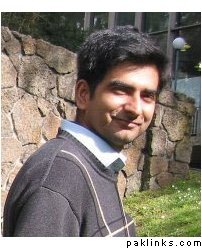
http://www.khwarzimic.org/islam/sabieh1.jpg
Sabieh opening lecture on Prof. George Saliba of Columbia University,NY visiting Lahore(2007)
http://www.khwarzimic.org/news/uploaded_images/sabieh-mri-may07-765552.jpg
Giving Lecture on MRI (Punjab University, 2007)
http://www.gcu.edu.pk/Images/Lhr/DebSoc/6112AR.JPG
Sabieh Anwar (bottom left) in Government College Lahore Debating Society (1995)
Government College, Lahore, 1880s.
Oriental and India Office Collection,
British Library,London.
Oval Ground
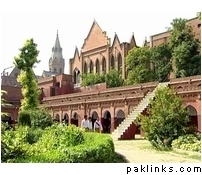
Clock Tower
Iqbal Hostel (Allama Iqbal lived here in 1896)
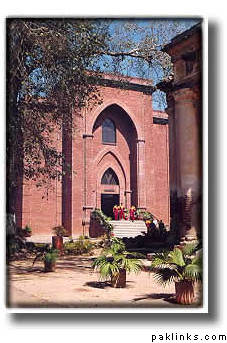
Post Graduate Block
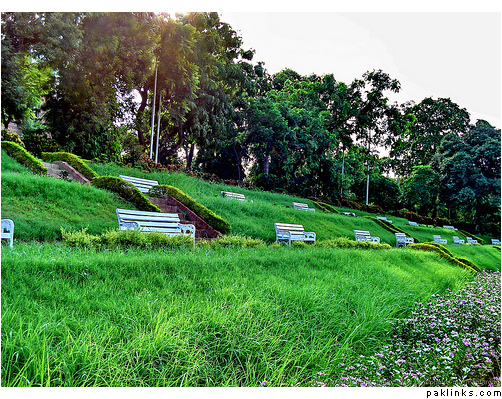
Oval
Notable Alumni of Government College Lahore (1864-2008)
http://en.wikipedia.org/wiki/Government_College_University#Notable_alumni
Associated with College
http://en.wikipedia.org/wiki/Government_College_University#Others_Associated_with_the_College